
NAICS Code for General Contractors: What It Is and How to Get Licensed
Learn what is the best NAICS code for general contractors, how licensing works in FL, NC & TX, and steps to get certified. ✅

If you are searching for what is the best NAICS code for general contractors, the answer depends on the scope of work your company performs. The North American Industry Classification System (NAICS) categorizes businesses so that federal agencies, lenders, and licensing boards can identify what industry a company operates in. For most general contractors who build single-family homes, the primary code is 236115. For commercial and institutional building construction, NAICS 236220 applies. Selecting the correct code affects your eligibility for government contracts, small business loans, and bonding requirements, so accuracy matters enormously.
Obtaining a general contractor license florida or in any other state requires you to understand how your business is classified. When you apply for a contractor license, state licensing boards and the SBA frequently ask for your NAICS code to verify that your company is engaged in construction, not some tangentially related trade. Misclassifying your business can delay license approvals, disqualify you from public bids, and complicate your insurance and bonding applications, so it is worth spending time to get this classification right from the start of your business journey.
General contractors are classified under NAICS Sector 23, which encompasses all construction activity. Within that sector, Subsector 236 covers building construction, and Subsector 237 covers heavy and civil engineering. The distinction between residential and commercial general contracting is codified within these subsectors, and contractors who work across both residential and commercial projects typically select the code that represents the majority of their revenue. Understanding these classifications helps you accurately represent your business in government databases and licensing applications across all fifty states.
Beyond the NAICS code itself, you must also understand the licensing requirements in your specific state. States like Florida, North Carolina, and Texas all have their own licensing boards, examination requirements, and financial thresholds that determine who qualifies for a general contractor license. The NAICS code is a federal classification tool, but it interacts with state-level licensing requirements in meaningful ways, particularly when you pursue government-funded construction projects that require both a valid state license and proper business classification under federal procurement rules.
Many contractors are surprised to learn that there is no single universal NAICS code for all general contracting work. Instead, the system offers several codes depending on the type of construction performed. Single-family residential new construction falls under 236115, while multi-family residential construction falls under 236116. Commercial and institutional building construction is coded as 236220, and industrial building construction, such as factories and warehouses, carries the code 236210. Knowing these distinctions allows you to choose the code that most accurately reflects your business and maximizes your eligibility for industry-specific programs and contracts.
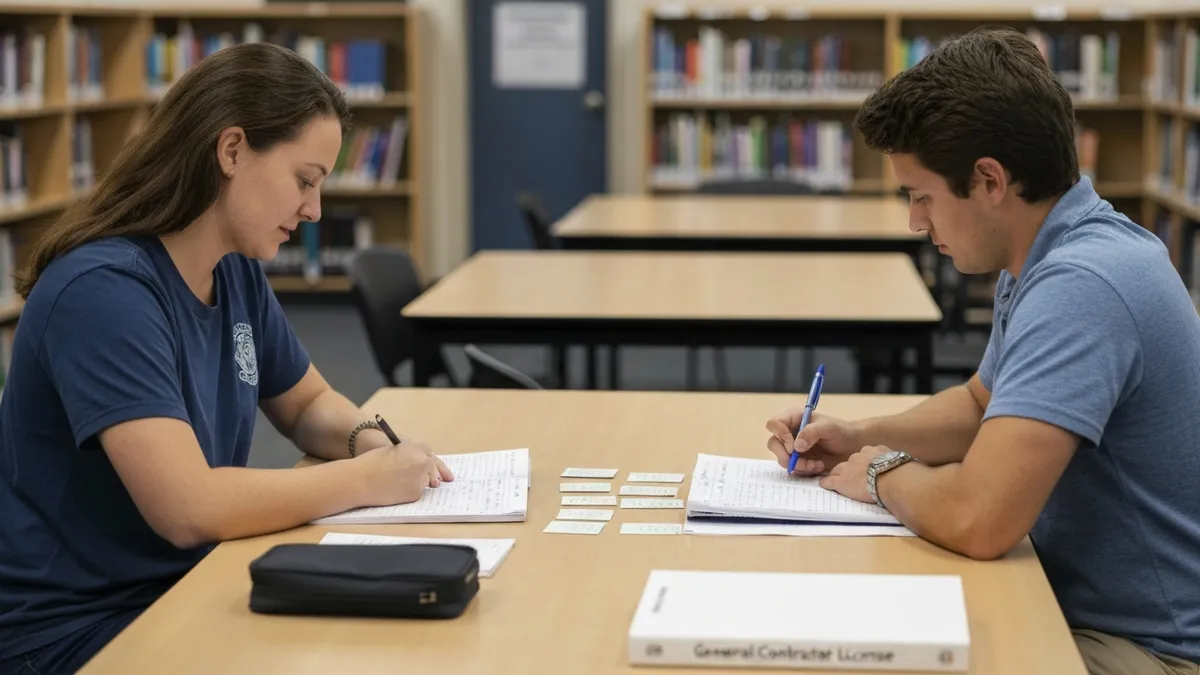
Preparing for the general contractor licensing examination is a parallel process that runs alongside your business registration and NAICS code selection. Most states require candidates to pass a written examination covering building codes, project management, business law, and construction safety before they can receive a license.
These exams are rigorous, and pass rates in states like Florida and North Carolina hover around 50 to 60 percent for first-time takers. Investing in quality study materials and practice exams is one of the most effective strategies for improving your chances of passing on the first attempt and moving forward with your contracting career.
This article provides a comprehensive overview of NAICS codes relevant to general contractors, how those codes interact with state licensing requirements in Florida, North Carolina, and Texas, and what steps you need to take to get properly licensed and classified so that your contracting business can pursue the projects, contracts, and growth opportunities it deserves in today's competitive construction market.
General Contractor Licensing by the Numbers

Key NAICS Codes Every General Contractor Should Know
Covers new construction of single-family homes. This is the most common NAICS code for residential general contractors who build custom homes, spec homes, or tract housing developments for individual buyers or developers.
Applies to contractors building apartment complexes, condominiums, and townhomes with multiple dwelling units. Contractors earning more than half their revenue from multi-family work should register under this classification.
Used by contractors who primarily build office buildings, retail centers, schools, hospitals, and government facilities. This code is critical for pursuing federally funded commercial construction contracts and public bids.
Covers factories, warehouses, distribution centers, and heavy industrial facilities. Contractors in this sector often require specialized bonding, environmental permits, and industrial safety certifications beyond standard licensing.
Subsector 237 includes highway, bridge, utility, and infrastructure contractors. If your work involves roads, pipelines, or site grading for large developments, one of the 237 codes may better represent your primary business activity.
Understanding how to obtain a general contractor license begins with recognizing that each state sets its own requirements, and there is no single national license that grants you permission to build in every jurisdiction. The process typically involves meeting minimum experience requirements, passing a written examination, submitting a financial statement demonstrating your fiscal solvency, securing a surety bond, and obtaining liability insurance. States also require background checks for criminal history, and certain felony convictions can disqualify an applicant depending on the nature of the offense and how recently it occurred.
If you want to get general contractor license nc or in any other state, your first step is to contact the relevant state licensing board. In Florida, that is the Florida Department of Business and Professional Regulation (DBPR). In North Carolina, it is the North Carolina Licensing Board for General Contractors (NCLBGC). In Texas, contractor licensing is handled at the city and county level rather than the state level, which creates a more fragmented but in some ways more accessible licensing environment depending on where you intend to work.
The experience requirements are particularly important to understand before you apply. Most states require that you have at least three to four years of supervised construction experience before you can sit for the general contractor examination. This experience must typically be in a supervisory or management capacity, not just as a laborer or subcontract worker. Some states accept a combination of formal education in construction management or civil engineering alongside fewer years of practical experience, which can accelerate the pathway to licensure for candidates who have pursued relevant academic credentials.
Financial responsibility is another cornerstone of the licensing process. Many states require applicants to submit a personal financial statement reviewed by a certified public accountant. Florida, for example, requires that applicants demonstrate a minimum net worth appropriate to the license class they are seeking. Class A licenses, which allow contractors to work on projects of unlimited dollar value, require higher financial thresholds than Class B or Class C licenses, which cap the value of projects the licensed contractor can legally accept. Understanding which license class fits your current financial situation helps you set realistic goals for your application timeline.
The surety bond requirement protects consumers and project owners in the event that a licensed contractor fails to complete work or causes financial harm. Bond amounts vary by state and by license class, but they typically range from $5,000 to $25,000 for standard general contractor licenses. Obtaining a bond requires a credit check and may be more difficult or expensive for contractors with poor credit histories. Some states also require contractors to maintain a separate contractor's recovery fund contribution, which is a pool of money used to compensate consumers harmed by licensed contractors who cannot otherwise satisfy judgments against them.
Insurance requirements for general contractors are separate from bonding requirements but equally important. At a minimum, most states require general contractors to carry general liability insurance covering bodily injury and property damage. The minimum coverage amounts vary but typically start at $300,000 per occurrence and scale upward based on the types of projects you pursue.
Workers' compensation insurance is also required if you have employees on your payroll. Many clients and project owners require contractors to carry umbrella policies that extend coverage beyond the standard minimums, so building higher coverage limits into your business plan from the outset is a sound strategy.
Once you have satisfied all prerequisites, you will schedule and sit for the licensing examination. Most states offer their contractor licensing exams through approved testing centers, and many have transitioned to computer-based testing that allows for faster score reporting. Examination topics typically cover building codes and standards, project planning and estimating, business law, construction safety and OSHA regulations, and project management. Allocating eight to twelve weeks of focused study time before your exam date is the standard recommendation among contractors who pass on their first attempt, and using practice exams is one of the most effective preparation strategies available.
General Contractor License by State: Florida, NC, and Texas
The florida general contractor license is issued by the Florida Department of Business and Professional Regulation (DBPR) and comes in two tiers: Certified and Registered. A Certified license allows you to work anywhere in Florida without local board approval, while a Registered license limits you to specific counties or municipalities. To qualify for the Certified license, you must pass the Florida Construction Industry Licensing Board exam, demonstrate at least four years of experience, and prove financial solvency through a reviewed financial statement prepared by a licensed CPA.
Florida's exam covers four main subject areas: project management, contracts and business law, building codes, and finance. The exam is administered by Prometric at approved testing centers statewide. Florida's licensing fees include a $249 application fee for the Certified Contractor license, and you must also submit proof of general liability insurance with minimum limits of $300,000 per occurrence and $50,000 property damage. License renewal occurs every two years and requires 14 hours of continuing education, including one hour on workplace safety and one hour on workers' compensation.

Pros and Cons of Getting Your General Contractor License
- +Access to a wider range of projects, including public bids and government contracts that require a state license
- +Higher earning potential: licensed contractors charge premium rates compared to unlicensed competitors
- +Greater consumer trust and credibility, which leads to more referrals and repeat business from satisfied clients
- +Ability to pull your own permits, which speeds up project timelines and eliminates permit-related markup from subcontractors
- +Legal protection: operating without a required license exposes you to fines, stop-work orders, and civil liability
- +Access to specialized insurance and bonding products available only to licensed contractors with documented track records
- −Significant upfront time investment required to meet experience prerequisites and prepare for the licensing exam
- −Examination costs, application fees, and ongoing renewal expenses add up to several hundred dollars annually
- −Financial documentation requirements can be burdensome for sole proprietors who lack formal accounting systems
- −Insurance and bonding minimums represent a recurring overhead cost that reduces profit margins, especially early in a career
- −Continuing education requirements demand time away from billable work every renewal cycle
- −License reciprocity between states is limited, meaning you may need to repeat the licensing process in each new state where you want to work
Pros and Cons at a Glance
| Pros | Cons |
|---|---|
| Access to a wider range of projects, including public bids and government contracts that require a state license | Significant upfront time investment required to meet experience prerequisites and prepare for the licensing exam |
| Higher earning potential: licensed contractors charge premium rates compared to unlicensed competitors | Examination costs, application fees, and ongoing renewal expenses add up to several hundred dollars annually |
| Greater consumer trust and credibility, which leads to more referrals and repeat business from satisfied clients | Financial documentation requirements can be burdensome for sole proprietors who lack formal accounting systems |
| Ability to pull your own permits, which speeds up project timelines and eliminates permit-related markup from subcontractors | Insurance and bonding minimums represent a recurring overhead cost that reduces profit margins, especially early in a career |
| Legal protection: operating without a required license exposes you to fines, stop-work orders, and civil liability | Continuing education requirements demand time away from billable work every renewal cycle |
| Access to specialized insurance and bonding products available only to licensed contractors with documented track records | License reciprocity between states is limited, meaning you may need to repeat the licensing process in each new state where you want to work |
How to Get a General Contractor License: Step-by-Step Checklist
- ✓Determine your primary NAICS code (236115, 236116, 236220, or 236210) based on the majority of your construction revenue
- ✓Research the specific licensing requirements in your state or, for Texas, in each city where you plan to work
- ✓Verify you meet the minimum experience requirement (typically 3–4 years in a supervisory construction role)
- ✓Gather documentation of your work history: reference letters, pay stubs, project records, or employer verifications
- ✓Prepare or commission a reviewed financial statement from a licensed CPA to demonstrate required net worth
- ✓Obtain a surety bond in the amount required by your state's licensing board before submitting your application
- ✓Purchase general liability insurance meeting state minimums and request a certificate of insurance for the application
- ✓Submit your completed application with all required documents and pay the applicable application and exam fees
- ✓Schedule your licensing examination and allow 8–12 weeks for focused study using practice tests and study guides
- ✓Upon passing, register your NAICS code in SAM.gov if you plan to pursue federal or state government construction contracts
Choose Your NAICS Code Before Your First Government Bid
Many contractors register their NAICS code as an afterthought, but your classification determines which set-aside contracts you qualify for, whether you qualify as a small business under SBA size standards, and how your bonding capacity is evaluated. For NAICS 236115 (single-family residential), the SBA size standard is $45 million in annual receipts. For 236220 (commercial construction), it is $45 million as well — but getting this right before your first bid avoids costly re-registrations and bid disqualifications.
The cost of obtaining and maintaining a general contractor license varies significantly by state, but understanding the full financial picture before you begin the application process helps you plan your budget and avoid surprises. In Florida, the total first-year cost of a Certified General Contractor license, including the application fee, exam fees, insurance premiums, and bonding, can easily exceed $3,000.
In North Carolina, the costs are generally lower because the bond requirement is smaller and the exam fees are modest, but you still need to account for insurance premiums that can run $1,200 to $2,500 per year depending on your revenue and coverage limits.
Insurance is consistently one of the largest ongoing costs for licensed general contractors. General liability premiums are calculated based on your annual revenue, the types of projects you perform, your claims history, and the geographic area where you work.
A new contractor with no claims history and under $500,000 in annual revenue might pay $1,500 to $3,000 per year for a $1 million per occurrence general liability policy. As your revenue grows, your premiums will scale accordingly, but so will your ability to absorb those costs through project pricing. Most experienced contractors include insurance costs in their overhead calculation and factor them into every bid.
Surety bond premiums are separate from insurance premiums and are calculated as a percentage of the bond amount, typically between one and three percent annually depending on your personal credit score and business financials. A contractor with excellent credit seeking a $25,000 bond will pay approximately $250 to $375 per year for that bond. Contractors with lower credit scores may pay significantly more, which is another reason to maintain strong personal credit throughout your career as a licensed contractor. Some states also require separate license bonds and performance bonds for individual projects, adding to your annual bonding expense.
Examination fees represent a one-time cost for most contractors, but if you need to retake the exam after a failed attempt, those fees accumulate. Florida's exam through Prometric costs approximately $150 to $200 per attempt. North Carolina charges $55 per exam section, and since the exam has two sections, a full attempt costs $110.
Most states allow an unlimited number of retake attempts but impose a waiting period of 30 to 90 days between attempts. Thorough preparation before your first attempt is clearly the most cost-effective strategy, and the savings from passing on the first try often more than cover the cost of high-quality study materials and practice exams.
Continuing education costs are another recurring expense that licensed contractors often underestimate. Florida requires 14 hours of continuing education every two years, and many of those courses cost $25 to $75 per credit hour when taken through approved providers.
Some contractors choose to attend industry conferences or trade association events that qualify for continuing education credit, which provides the added benefit of networking and staying current on industry trends alongside the CE requirement. Budgeting $200 to $500 per renewal cycle for continuing education is a reasonable estimate for most Florida contractors, and similar costs apply in other states with ongoing education requirements.
The return on investment for a general contractor license is substantial when viewed over a full career. Licensed contractors command higher hourly rates, can pursue larger and more profitable projects, and build more valuable businesses that can eventually be sold or transferred.
A licensed general contractor business with a documented project history, established client relationships, and a transferable license is worth significantly more as an asset than an unlicensed construction operation of identical size. Viewing your licensing costs as a long-term business investment rather than a short-term expense helps frame the financial commitment in its proper context and reinforces the importance of getting licensed as early in your career as possible.
Many contractors find that joining a trade association such as the Associated General Contractors of America (AGC) or the National Association of Home Builders (NAHB) provides access to discounted continuing education, legal resources, contract templates, and networking opportunities that more than justify the annual membership dues. These associations also advocate for favorable regulatory changes at the state and federal level, which can affect licensing requirements, insurance mandates, and the overall business environment for general contractors. Membership is a professional investment that compounds over time as your network grows and your access to industry resources deepens.
In Florida and North Carolina, performing general contracting work without a required license is a criminal offense that can result in fines of up to $10,000 per violation, stop-work orders, and in repeat cases, misdemeanor or felony charges. Unlicensed contractors also cannot legally collect payment for work performed, and homeowners can sue to recover money already paid. Always verify your licensure status is active and current before starting any new project.
Preparing for the general contractor licensing exam requires a structured study approach that covers all major topic areas while emphasizing the subjects most heavily weighted on your specific state's examination. The Florida exam, for instance, devotes a significant portion of its questions to the Florida Building Code, project management principles, and business and finance topics. The North Carolina exam emphasizes trade knowledge and state-specific business law. Regardless of which state you are testing in, building codes and safety regulations consistently appear as high-frequency topics that reward candidates who invest study time in mastering the relevant code books and OSHA standards.
One of the most effective study strategies is to use the nc general contractor license study resources alongside state-specific code books. Many candidates make the mistake of studying only general construction principles without drilling into the specific code sections and legal statutes that appear most frequently on their state's exam. Reviewing past exam outlines published by the licensing board, which typically list the percentage of questions devoted to each topic area, allows you to allocate your study time proportionally and avoid over-preparing for low-weight topics while under-preparing for high-weight ones.
Practice exams are the most reliable predictor of actual exam performance. Research consistently shows that candidates who complete at least five full-length practice exams before their test date score significantly higher than those who rely solely on reading and note-taking.
Practice exams help you identify knowledge gaps, build familiarity with the question format and phrasing, manage your time during the actual exam, and reduce test anxiety by making the exam environment feel familiar rather than intimidating. The best practice exams include detailed answer explanations that teach you the reasoning behind each correct answer rather than simply telling you which option was right.
Time management during the actual exam is a skill that deserves specific attention during your preparation. Most state contractor exams allow approximately one to two minutes per question, and many candidates find that certain topic areas take longer to reason through than others. Developing a consistent pacing strategy, such as answering every question you know immediately, flagging uncertain questions for review, and never spending more than three minutes on any single question before moving on, helps ensure that you do not run out of time before reaching questions you could easily answer if given the opportunity.
The days immediately before your exam should be dedicated to light review rather than intensive new learning. Attempting to absorb large volumes of new information in the final 48 hours before an exam typically backfires because mental fatigue impairs retention and recall under pressure.
Instead, spend those final days reviewing your notes on the highest-priority topic areas, working through a shortened practice exam to maintain momentum, ensuring you know the testing center location and logistics, and getting adequate sleep. Arriving at the testing center well-rested and confident is worth more than any last-minute cramming session, and the preparation you have invested over the prior weeks will carry you through the exam.
After passing your exam, you will receive your license and can begin operating as a licensed general contractor. However, the professional development process does not end with licensure. The construction industry is constantly evolving with new building technologies, updated code editions, revised safety regulations, and changing market conditions. Staying current through continuing education, trade publications, and industry associations ensures that your knowledge and skills remain sharp and relevant throughout your career, which is the foundation of a sustainable and successful contracting business.
For contractors interested in the florida general contractor license career path, the long-term earnings potential is significant. Experienced licensed general contractors who build their own firms can earn well above the median salary figure, particularly those who specialize in high-value niches such as luxury residential construction, healthcare facility renovation, or commercial tenant improvement work. Building a specialty reputation within a niche market allows you to command premium pricing and attract clients who prioritize quality and expertise over the lowest bid price, which is the most direct path to building a profitable and resilient contracting business.
Understanding how NAICS codes interact with your day-to-day business operations goes beyond the initial registration step. When you apply for a Small Business Administration loan, the SBA uses your NAICS code to determine whether your business qualifies as a small business under the applicable size standard. For most construction NAICS codes, the size standard is based on average annual receipts over three years.
For NAICS 236115 and 236220, the current SBA small business size standard is $45 million in average annual receipts, meaning that most general contracting firms will qualify as small businesses for the vast majority of their operating years, which opens access to set-aside contracts, lower-interest SBA loans, and other small business support programs.
When bidding on federal government contracts, your NAICS code determines which solicitations you can respond to, since each solicitation is assigned a specific NAICS code that defines the type of work being procured. A contractor registered under NAICS 236220 can respond to solicitations for the construction of federal office buildings, military facilities, and government-owned commercial structures, while a contractor registered under 236115 would be better positioned for federal housing programs or privatized military housing contracts.
Registering with the correct NAICS codes for all types of work you perform, rather than just your primary classification, maximizes the range of government solicitations you can legally bid on and pursue.
State licensing reciprocity is an important consideration for contractors who want to expand their geographic footprint without repeating the full licensing process in every new state. Some states have formal reciprocity agreements that allow licensed contractors from one state to obtain a license in another state without re-taking the full examination, provided they meet certain conditions such as having held their home-state license for a minimum number of years, passing a state-specific law and code exam, and demonstrating financial responsibility meeting the new state's standards.
Researching reciprocity agreements before you decide which state to obtain your initial license in can save you significant time and money if interstate expansion is part of your long-term business plan.
The florida general contractor license search tool maintained by the Florida DBPR is an important resource for both contractors and consumers. Contractors use it to verify that subcontractors they intend to hire are properly licensed and that their licenses are current and free of disciplinary action. Consumers use it to verify the credentials of contractors they are considering hiring for home improvement or construction projects.
Maintaining a clean license record with no complaints or disciplinary actions is critical for contractors who want to build a strong professional reputation, since a single disciplinary action visible in the florida general contractor license search database can deter potential clients from hiring you even years after the incident was resolved.
The process of building a licensed general contracting business also requires attention to contract management and documentation. Every project should be governed by a written contract that clearly defines the scope of work, payment schedule, project timeline, change order procedures, dispute resolution process, and the contractor's license number as required by state law.
Many states require contractors to include their license number on every contract and proposal, and failure to do so can result in fines or create grounds for the client to void the contract and seek return of money paid. Developing professional contract templates reviewed by a construction attorney is one of the most valuable early investments a new licensed contractor can make.
Risk management is another critical competency for licensed general contractors that extends well beyond maintaining the required insurance and bonding coverage. Effective risk management includes conducting thorough pre-construction site assessments to identify potential hazards, implementing written safety programs that comply with OSHA requirements, maintaining detailed project documentation that creates a defensible record of your work and decision-making, and conducting regular subcontractor qualification reviews to ensure that the companies you hire share your commitment to quality and safety.
Contractors who invest in proactive risk management spend less time and money managing claims, disputes, and rework, which directly improves profitability and enables faster business growth.
Technology adoption is increasingly important for licensed general contractors who want to compete effectively in today's market. Modern project management software platforms allow contractors to track project progress, manage subcontractor schedules, process change orders, generate invoices, and maintain compliance documentation from a single integrated system. Estimating software that integrates with material cost databases helps contractors produce more accurate bids in less time, which improves win rates and reduces the financial risk of underbidding. Investing in the right technology stack early in your business development gives you the operational infrastructure needed to scale your company without proportional increases in administrative overhead.
Sample General Contractor License Practice Questions
Try these questions from our free General Contractor License practice tests. The correct answer and an explanation follow each question.
A contractor is building a new single-story office space with a calculated occupant load of 65 people. According to the International Building Code (IBC), what is the minimum number of exits required from this space?
- A. One
- B. Two
- C. Three
- D. Four
Answer: B. Two
The International Building Code generally requires a minimum of two exits when the occupant load of a space exceeds 49. Since the occupant load is 65, at least two exits are mandatory to provide adequate means of egress in an emergency.
A contractor has just completed the construction of a new restaurant. Before the owner can legally open for business and allow public entry, which document must be issued by the local building department to certify that the structure complies with all applicable building codes and is safe to occupy?
- A. Building Permit
- B. Certificate of Substantial Completion
- C. Certificate of Occupancy (CO)
- D. Letter of Intent
Answer: C. Certificate of Occupancy (CO)
A Certificate of Occupancy (CO) is the final document issued by a local government agency or building department that certifies a building's compliance with applicable building codes and other laws, indicating it is in a condition suitable for occupancy. A building permit authorizes construction to begin, while a certificate of substantial completion is a contractual document between the owner and contractor.
What is the typical consequence for a licensed contractor who allows another person to 'use' their license number for a fee?
- A. A small administrative fine only
- B. License revocation and potential criminal charges
- C. A mandatory continuing education requirement
- D. Suspension of the license for 30 days
Answer: B. License revocation and potential criminal charges
License 'lending' or 'brokering' is a serious violation that typically results in revocation of the licensee's license and can carry criminal penalties.
A project's plans are governed by both a state-adopted building code and a more restrictive local municipal amendment. In a situation where the local code requires a higher fire-resistance rating for a specific wall assembly than the state code, which requirement must the contractor follow?
- A. The state code, as it has broader jurisdiction
- B. The contractor's choice, with owner approval
- C. The more restrictive local municipal amendment
- D. The least restrictive requirement to save costs
Answer: C. The more restrictive local municipal amendment
When building codes are adopted, the rule is to follow the most restrictive requirement. Local jurisdictions (cities, counties) can amend state or model codes, and if their amendment is stricter, it takes precedence for all construction within that jurisdiction.
General Contractor License Questions and Answers

General Contractor License Wisconsin: Requirements and How to Get Licensed
How to Get a General Contractor License in Florida: Step-by-Step Guide

General Contractor License: Complete Study Guide 2026
General Contractor License: Career Paths, Salary, and Requirements 2026

Does a General Contractor Need Insurance? Yes—Here's Why
About the Author

Educational Psychologist & Academic Test Preparation Expert
Columbia University Teachers CollegeDr. Lisa Patel holds a Doctorate in Education from Columbia University Teachers College and has spent 17 years researching standardized test design and academic assessment. She has developed preparation programs for SAT, ACT, GRE, LSAT, UCAT, and numerous professional licensing exams, helping students of all backgrounds achieve their target scores.
Join the Discussion
Connect with other students preparing for this exam. Share tips, ask questions, and get advice from people who have been there.
View discussion (7 replies)