
How to Take the Florida Civic Literacy Exam: Complete FCLE Guide 2026 September
Learn how to take the Florida Civic Literacy Exam step by step. FCLE practice test tips, format, scoring, and free prep resources. 📝
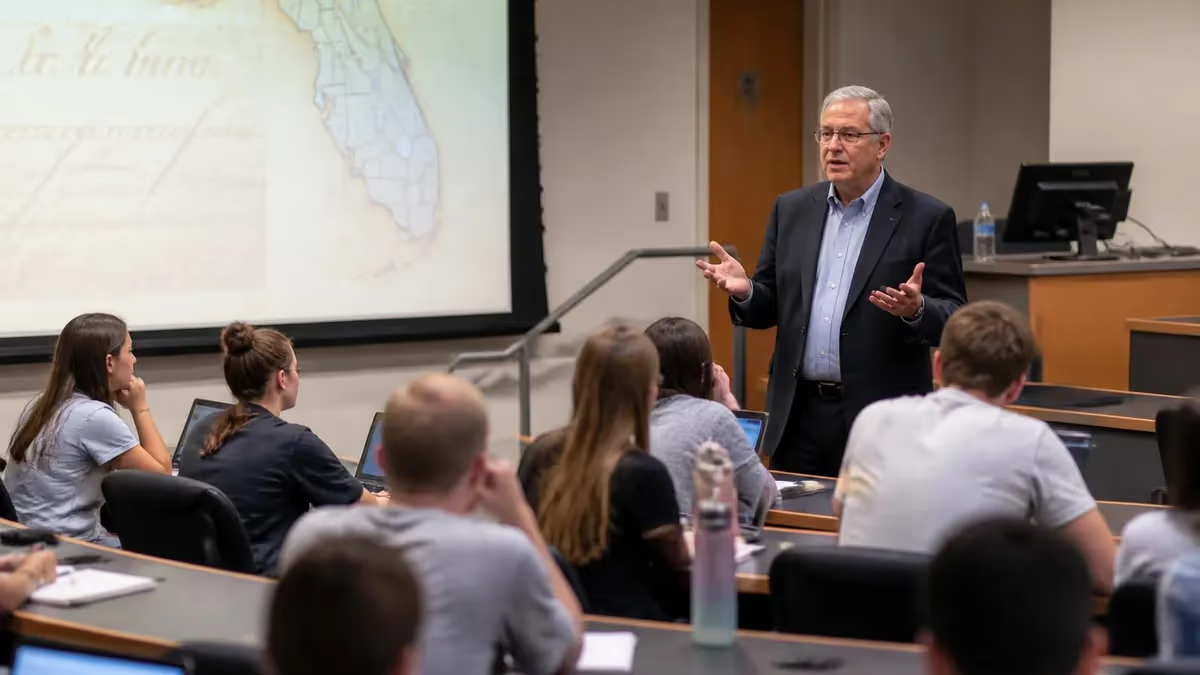
Understanding how to take the Florida Civic Literacy Exam is essential for every Florida college student who wants to fulfill the state's civic education requirement. The FCLE, mandated under Florida law, tests your knowledge of U.S. history, government institutions, constitutional principles, and the rights and responsibilities of citizenship. Whether you are preparing with an fcle exam simulation or studying your course materials, knowing the exam structure and registration process puts you ahead before test day even arrives.
The Florida Civic Literacy Exam was established by the Florida Legislature as part of House Bill 7 in 2021, requiring all Florida College System and State University System students admitted after July 1, 2021 to demonstrate civic literacy competency. Students can satisfy this requirement either by passing the FCLE itself or by completing an approved civic literacy course. Most students choose the exam route because it allows them to demonstrate existing knowledge without adding another class to their schedule, making efficient preparation with targeted resources a smart investment of time.
The exam draws from four major content domains: American government and political institutions, the philosophical foundations of American democracy, American history, and the rights and responsibilities of citizenship. Each domain carries its own weight within the overall test, so understanding which areas receive the most emphasis helps you allocate your study hours strategically. Students who walk in without knowing the domain breakdown often spend too much time on lighter topics and underperform in the heavily weighted sections.
Registration for the FCLE is handled through your institution's testing center or the Florida State College at Jacksonville's Testing Services Center, depending on your school's partnership arrangements. You will need a valid government-issued photo ID on test day, and you should arrive at least 15 minutes before your scheduled appointment to complete sign-in procedures. Missing your appointment without proper cancellation typically results in forfeiture of your testing fee, so calendar management matters.
Scoring on the FCLE uses a scaled score system, and the passing threshold is set by the Florida Department of Education. Students who do not pass on the first attempt are permitted to retake the exam, though specific waiting periods and retake policies vary by institution. Knowing the retake rules at your school before you sit for the first time removes a major source of anxiety and lets you approach the exam with a clear plan rather than a fear of a single failure defining your academic path.
Preparation resources range from official state materials to comprehensive practice platforms. The florida civic literacy exam quizlet style resources and downloadable PDF practice tests give you realistic question exposure before the real exam. PracticeTestGeeks offers free FCLE practice questions organized by content domain, so you can focus on your weakest areas first and then do full-length simulated exams as your test date approaches.
This guide walks you through every step of the FCLE process: what the exam covers, how to register, what to bring, how the scoring works, and how to build a study plan that maximizes your chances of passing on the first attempt. Read each section carefully, use the linked practice resources, and enter your test day fully prepared rather than guessing at procedures you could have researched in advance.
Florida Civic Literacy Exam by the Numbers
How to Take the FCLE: Step-by-Step Process
Confirm Your Eligibility & Requirement
Register at Your Testing Center
Study with Targeted Practice Tests
Gather Required Documents
Arrive Early and Check In
Review Results and Plan Next Steps
Registration for the Florida Civic Literacy Exam varies slightly depending on which institution you attend, but the general process follows a consistent pattern across the Florida College System and State University System. Most schools route students through an online testing services portal where you can browse available exam slots, select a date and time, and pay any applicable testing fee. Some institutions offer the FCLE through a third-party testing provider, so confirm your school's specific process with the registrar or academic advising office before assuming you know where to register.
The fee structure for the FCLE also varies by institution. Some schools absorb the cost as part of standard student fees, meaning there is no out-of-pocket charge at the time of registration. Others charge between $25 and $35 per attempt. If you are on financial aid or have a documented financial hardship, ask your testing center about fee waiver options before registering, since many institutions have provisions for students who cannot afford the exam fee. Not asking about waivers is one of the most common and easily avoidable mistakes students make during the registration process.
On test day, plan your commute carefully so you arrive at the testing center at least 15 minutes before your appointment. Testing centers follow strict protocols, and late arrivals are typically turned away without refund, regardless of circumstances. Bring your unexpired government-issued photo ID as your primary form of identification. A driver's license, state-issued ID card, or passport all qualify. Student-only IDs are generally insufficient as a standalone document, though some centers accept them alongside a secondary form of identification.
The testing room environment is controlled and quiet. You will not be permitted to bring personal items such as your phone, smartwatch, notes, or any study materials. Most testing centers provide lockers or designated storage areas for your belongings. You will typically be given a dry-erase board or scratch paper for working through questions, along with a marker or pencil. Use this scratch space actively during the exam to eliminate answer choices and track your reasoning on difficult questions.
The florida civics literacy exam is administered year-round at most testing centers, giving you flexibility in scheduling. However, peak periods — especially at the start and end of semesters — can lead to limited appointment availability. If your graduation timeline is approaching, do not wait until the last minute to schedule your exam. Many students have delayed graduation by a semester simply because they could not get an exam slot in time to submit their passing score before the degree conferral deadline.
Special accommodations for students with documented disabilities are available through your institution's office of disability services or accessibility resources. You must apply for accommodations separately from the FCLE registration itself, and the approval process can take several weeks. If you have an approved accommodation on file with your school, confirm that it has been properly communicated to the testing center before your exam date. Extended time, a separate testing room, and screen reader access are among the accommodations that may be available depending on your documented need.
After completing the exam, your raw score is converted to a scaled score, and the result is transmitted to your institution's records system. In most cases, you will see your pass or fail status within 24 to 72 hours through your student portal. A passing result satisfies the Florida civic literacy requirement permanently — you do not need to retake the exam even if you transfer to another Florida public institution. Keep a copy of your score report for your own records as confirmation in case administrative discrepancies arise during degree auditing.
FCLE Practice Test Study Strategies by Domain
The American government and political institutions domain covers the three branches of federal government, their constitutional powers, the system of checks and balances, the federal legislative process, and the structure of state and local governments. This domain consistently accounts for a significant portion of FCLE questions, so you should spend at least 35 to 40 percent of your total study time here. Use practice tests that isolate this domain to build fluency with the specific vocabulary and concepts before mixing them into full-length simulations.
Effective strategies for this domain include creating comparison charts that show what each branch can and cannot do, memorizing the names and roles of key constitutional amendments, and practicing with real FCLE-style multiple-choice questions that test application rather than simple recall. Many students understand the concepts abstractly but struggle with questions that present a scenario and ask which branch or which constitutional provision applies. Scenario-based practice questions are the most efficient way to close that gap before exam day.
Taking the FCLE vs. Completing a Civic Literacy Course
- +Saves a full semester course credit — satisfying the requirement with the exam frees up your schedule for major electives or lighter workloads
- +Faster path to requirement completion — the exam can be scheduled and completed in a single afternoon rather than over 16 weeks
- +Lower cost than a college course — exam fees range from $0 to $35, compared to per-credit tuition costs for an additional course
- +Immediate clarity on your civic knowledge gaps — detailed score reports by domain help you understand exactly where you stand
- +No GPA impact — the FCLE is a pass/fail requirement and does not factor into your grade point average either way
- +Flexible scheduling throughout the year — testing centers offer appointments across all semesters and summer sessions
- −No structured instruction — students who struggle with self-directed study may find the exam path harder without a professor guiding the content
- −Test anxiety is a real factor — a high-stakes single exam environment is more stressful than ongoing course assessments spread across a semester
- −Retake waiting periods apply — failing on the first attempt may delay requirement completion if your institution enforces a mandatory waiting period between attempts
- −Limited feedback depth — score reports show domain-level breakdowns but do not identify specific questions answered incorrectly
- −Registration logistics vary by school — navigating different testing portals and deadlines adds administrative burden
- −Accommodations require advance planning — students with disabilities who need extended time or other supports must apply weeks in advance, adding complexity to the timeline
FCLE Florida Civic Literacy Exam Preparation Checklist
- ✓Confirm with your registrar that the FCLE is required for your degree program and check your institution's specific deadline
- ✓Register for your exam appointment at least three weeks before your target test date to secure your preferred time slot
- ✓Complete at least one full-length timed FCLE practice test to establish your baseline score by domain
- ✓Review the four content domains and allocate study hours proportionally based on your baseline performance in each area
- ✓Study the U.S. Constitution, the Bill of Rights, and the Declaration of Independence using primary source documents
- ✓Memorize at least ten landmark Supreme Court cases and their constitutional significance for the rights and government domains
- ✓Use domain-specific practice quizzes three to five times per week during the two weeks leading up to your exam
- ✓Confirm your government-issued photo ID is valid and unexpired at least one week before your test appointment
- ✓Locate your testing center in advance and plan your route, parking, and arrival time to ensure you reach the center 15 minutes early
- ✓Review your institution's retake policy so you understand the waiting period and fee structure if a second attempt becomes necessary
Domain Weighting Determines Your Study Priority
The American Government and Political Institutions domain typically carries the heaviest weight on the FCLE, accounting for roughly 40 percent of total questions. Students who spend at least 40 percent of their prep time on this domain — using targeted practice tests and scenario-based questions — consistently report higher first-attempt pass rates than those who study all four domains equally.
Understanding how the FCLE is scored is just as important as understanding what it covers. The exam uses a scaled scoring system rather than a simple raw percentage, which means that not all questions carry identical weight in the final score calculation. The Florida Department of Education sets the passing standard, and while the specific cut score is subject to periodic review, students should target a comfortable performance margin rather than aiming to just barely pass. Scoring well above the minimum threshold also reduces the anxiety of borderline results that may require administrative review.
Your score report will show your overall result — pass or fail — along with a breakdown of your performance across the major content domains. This domain-level feedback is invaluable whether you passed or need to retake the exam. If you passed but scored low in one domain, that weakness does not affect your current result, but it signals a gap in your civic knowledge that an approved civic literacy course could address. If you did not pass, the domain breakdown tells you exactly where to concentrate your efforts before scheduling your next attempt.
Retake policies vary by institution, but most Florida schools permit unlimited attempts with a mandatory waiting period between each one. Common waiting periods range from 14 to 30 days, giving you time to review the material before sitting again. There is no state-wide limit on the total number of attempts, though some institutions impose their own maximums. Check your school's academic catalog or speak with your advisor to understand the exact retake rules that apply to your situation, including whether each retake carries a separate fee.
For students who have failed twice or more, many institutions offer a supplemental civic literacy course or tutoring program specifically designed to address FCLE knowledge gaps. These resources are sometimes free or low-cost for enrolled students and provide structured instruction that self-directed study cannot always replicate. If you have taken the exam multiple times without success, pursuing institutional support rather than simply retaking the exam again is usually the more efficient path to passing.
Transfer students from other states or from private institutions should be aware that the FCLE requirement applies to all students enrolled in Florida public colleges and universities who fall under the post-2021 admissions cutoff, regardless of prior civic coursework completed elsewhere. Credits from out-of-state courses do not automatically satisfy the Florida civic literacy requirement unless your institution's registrar has reviewed and accepted them as equivalent under an approved transfer articulation agreement. When in doubt, schedule an advising appointment before assuming your transfer credits cover the requirement.
Students who completed an approved civic literacy course at a Florida institution — whether before or after the FCLE was introduced — may already have the requirement satisfied without needing to take the exam. Check your degree audit in your institution's student information system to see whether the civic literacy requirement shows as met. If the audit shows it as incomplete despite a course you believe qualifies, bring your official transcript to the registrar's office for manual review rather than registering for the FCLE unnecessarily.
For students approaching their final semester, timing is critical. The FCLE result must be officially recorded on your academic record before your institution processes your degree application. Most registrars require civic literacy completion to be confirmed at least 30 days before the degree conferral date. If you are graduating in May, for example, aim to complete and pass the FCLE no later than early April. Waiting until the last possible moment has prevented otherwise fully-qualified students from graduating on schedule, a situation that is entirely avoidable with proper planning.

The FCLE must be passed and officially recorded on your transcript before your institution processes your degree application — typically 30 or more days before your graduation date. If you are graduating at the end of a semester, schedule your FCLE exam no later than six weeks before the conferral date to allow time for a retake if needed. Missing this window has caused students to have their graduation delayed by an entire semester.
Building an effective study plan for the Florida Civic Literacy Exam requires balancing content review with active practice rather than passive reading. Many students make the mistake of re-reading textbook chapters or reviewing class notes without testing their knowledge against actual exam-style questions. The FCLE is a standardized multiple-choice exam, and the most direct preparation strategy is practicing with multiple-choice questions that mirror the exam's format, difficulty level, and content distribution. Reading about civic topics helps build background knowledge, but answering questions under timed conditions builds the specific skills the exam tests.
A four-week study plan works well for most students who have a general foundation in U.S. history and government. In week one, take a full-length baseline practice test to identify your weakest domains, then spend the rest of the week reviewing foundational material in those areas using primary sources and concise review guides. In week two, shift to domain-specific practice quizzes and aim to answer 30 to 50 questions per day across your weakest content areas. Track your accuracy by domain using a simple spreadsheet or note-taking app so you can see your progress clearly.
Week three should focus on mixed-domain practice that simulates the actual exam experience. Rather than isolating topics, answer full-length practice tests of 50 to 100 questions covering all four domains in a single sitting. Time yourself strictly — approximately 72 seconds per question for a 100-question, two-hour exam.
This timed practice conditions your pacing so that you do not spend too long on any single question on exam day. If you find yourself consistently running out of time, practice the elimination strategy: immediately rule out obviously wrong answers and commit to the best remaining choice rather than searching for a perfect answer.
Week four is consolidation week. Take two or three full-length timed practice tests and review every incorrect answer carefully to understand why the correct answer is right, not just why your choice was wrong. This distinction is critical — understanding the reasoning behind correct answers reinforces the conceptual framework the exam tests, while only noting that you were wrong misses the instructional value. By the end of week four, most students who have followed this plan report feeling confident rather than anxious going into the actual exam.
The florida civic literacy examination prep resources on PracticeTestGeeks are organized to support exactly this kind of structured study cycle. You can filter practice questions by domain, set custom time limits for timed practice, and review detailed answer explanations that explain the correct choice in context. These explanations do more than confirm the right answer — they teach the underlying civic concept so you retain the knowledge beyond a single practice session and can apply it to differently worded questions on the real exam.
Students who supplement their practice test work with primary source review tend to outperform those who rely on secondary summaries alone. Spend time reading the actual text of the U.S. Constitution, including all amendments, the Declaration of Independence, the Federalist Papers (particularly No. 10 and No. 51), and key Supreme Court opinions in landmark civil rights and civil liberties cases. These documents are cited directly and indirectly throughout the FCLE, and familiarity with the original language helps you parse question stems that use constitutional phrasing rather than simplified paraphrases.
Group study can be an effective supplement to individual practice, particularly for the rights and responsibilities domain where discussion of real-world applications deepens understanding. Form a small study group with two to four classmates who are also preparing for the FCLE, and take turns explaining civic concepts to each other. Teaching a concept is one of the most effective memory consolidation strategies available, and the act of explaining why the First Amendment protects certain types of speech but not others, for example, forces a level of understanding that re-reading a bullet point never achieves.
On exam day itself, your preparation should already be complete — the morning of the test is not the time for intensive last-minute studying. Instead, do a brief 15-minute review of key facts you want fresh in your memory: the three branches of government and their powers, the first ten amendments, and a handful of landmark Supreme Court cases. Keep this review light and confidence-building rather than comprehensive. Overloading your working memory right before the exam can actually impair performance by increasing anxiety and reducing the clear thinking you will need to work through complex question stems.
Eat a solid meal before your exam and stay hydrated. Testing centers can be cool, so bring a light jacket or layer if you run cold. Get a full night of sleep the night before — research consistently shows that sleep deprivation impairs memory retrieval and decision-making in ways that no amount of last-minute cramming can compensate for. Students who are well-rested perform measurably better on standardized exams than those who sacrificed sleep for additional study hours the night before the test.
During the exam, read each question stem carefully and completely before looking at the answer choices. Many incorrect answers are designed to be plausible partial truths that trap students who skim the question. Pay special attention to negation words like "not," "except," and "least" — these reverse the logic of the question and are easy to miss when reading quickly under time pressure. If a question asks which action is NOT protected by the First Amendment, for example, identifying the three protected options before selecting the exception is a reliable strategy that eliminates guessing.
Manage your time actively throughout the exam. Aim to answer questions at a pace of roughly one per 70 to 75 seconds, leaving yourself five to ten minutes at the end to review flagged questions. Most testing platforms allow you to mark questions for review and return to them later — use this feature strategically rather than getting stuck on a single difficult question and losing time on questions you would have answered correctly with more attention.
Your first instinct on multiple-choice questions is often correct, so be cautious about changing answers unless you have a specific reason beyond a general feeling of uncertainty.
After finishing the exam, resist the urge to mentally replay every question you found difficult. Your score will reflect your overall performance across the full exam, not your worst moments, and anxiety about specific questions after the fact neither changes the result nor helps you prepare better for a potential retake. Instead, take note of the general topic areas that felt least comfortable so that if a retake is needed, you already know where to focus your renewed preparation effort without waiting for the official score report to tell you.
Students who pass the FCLE on the first attempt typically share several common characteristics: they used domain-specific practice tests rather than generic study guides, they practiced under timed conditions, they reviewed incorrect answers with explanations rather than just checking their score, and they did not cram the night before. Replicating these habits gives you the best possible foundation for first-attempt success regardless of your starting knowledge level or academic background in civic topics.
If you do need to retake the exam, approach the second attempt with a specific improvement plan rather than simply reviewing the same material you already studied. Use your score report to identify which domain showed the greatest deficiency, allocate at least 60 percent of your retake preparation to that domain, and use new practice questions rather than re-doing sets you have already seen. Familiarity with specific questions creates a false sense of mastery — new questions on the same content reveal whether you have actually internalized the concept or just memorized a particular answer.
FCLE Questions and Answers
FCLE Practice Test PDF (Free Printable 2026)

When Is the Florida Civic Literacy Exam? Complete FCLE Guide 2026

FCLE Practice Test TSC: Free Florida Civic Literacy Exam Questions
FCLE Practice Test: Florida Civic Literacy Exam Free Prep 2026

How Long Is the FCLE? Complete Florida Civic Literacy Exam Guide 2026
About the Author

Educational Psychologist & Academic Test Preparation Expert
Columbia University Teachers CollegeDr. Lisa Patel holds a Doctorate in Education from Columbia University Teachers College and has spent 17 years researching standardized test design and academic assessment. She has developed preparation programs for SAT, ACT, GRE, LSAT, UCAT, and numerous professional licensing exams, helping students of all backgrounds achieve their target scores.
Join the Discussion
Connect with other students preparing for this exam. Share tips, ask questions, and get advice from people who have been there.
View discussion (7 replies)