
FAA Academy: Complete Mike Monroney Aeronautical Center Guide 2026 September
🔎 FAA Academy at Mike Monroney Aeronautical Center trains ATCs, ATSS, inspectors, and CAMI staff in Oklahoma City. Paid training, housing, and
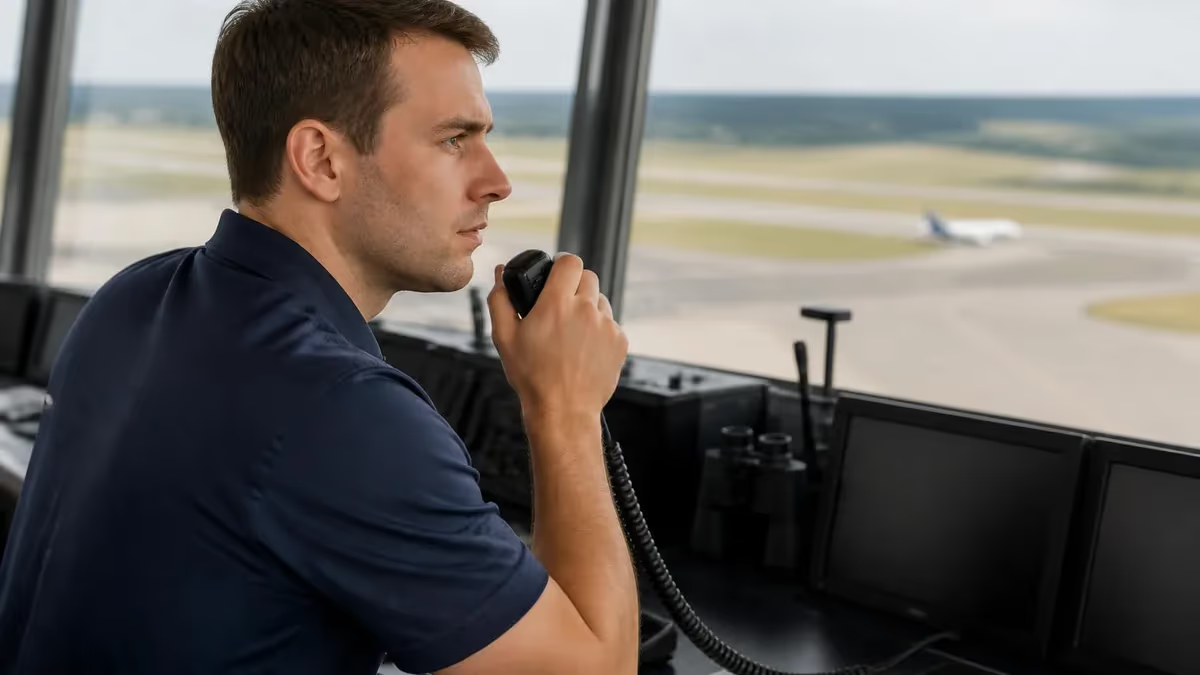
The FAA Academy sits inside the Mike Monroney Aeronautical Center in Oklahoma City and trains nearly every technical workforce the Federal Aviation Administration hires from outside. Air traffic controllers, airway transportation systems specialists, aircraft inspectors, medical certification staff, and dozens of other career fields all funnel through this 1,100-acre campus before they ever touch a live operations console or a real aircraft.
If you are pursuing a federal aviation career, this is the choke point. Hiring announcements on USAJOBS feed into Academy classes — and Academy classes feed into facility assignments across the country. Wash out, and you start over from the application.
This guide walks through what the FAA Academy actually is, every major training program it runs, what daily life looks like during residential training, and how trainees move from Oklahoma City to a permanent facility. The FAA itself is older than the Academy, but the campus has been the agency's main schoolhouse since 1946.

FAA Academy at a Glance
The numbers above show why the Academy matters. Roughly 1,100 acres, 90+ buildings, and a permanent staff of around 6,000 federal employees and contractors make it the largest single FAA installation outside Washington. Roughly 40,000 trainee-days run through the campus every year.
You will hear three names used almost interchangeably — Mike Monroney Aeronautical Center, MMAC, and the FAA Academy. Technically the Center is the larger installation (it also hosts the Civil Aerospace Medical Institute, the Aircraft Registry, the Logistics Center, and the Enterprise Services Center), and the Academy is the training organization inside it. In day-to-day speech, most current FAA staff just call the whole place "Oklahoma City" or "OKC."
The Academy reports up through the FAA's Office of Human Resource Management as the agency's central learning institution. It is not a degree-granting school and is not accredited like a university. Completion certificates feed directly into FAA's airman and personnel certification systems and into your federal personnel file — that is the value, not a diploma.
The Air Traffic Basics (ATB) course is the entry point for almost every newly hired air traffic controller who comes through the FAA's off-the-street or veteran hiring tracks. It is the shortest controller program at the Academy but also the highest-stakes — failing here ends the career path before it really begins.
ATB runs roughly five weeks and is a classroom-only, non-simulator course. The curriculum is heavy on aviation vocabulary, FAA Order 7110.65 phraseology, weather basics, airspace classes, and the geography of the National Airspace System. You will learn to read sectional charts, decode METARs and TAFs, and recite the seven separation criteria from memory long before you ever sit at a radar scope.
The pass mark is 70%, but Academy washout statistics for ATB hover around 6 to 10% depending on the cohort. Most trainees who fail do so on the cumulative final block test rather than individual quizzes. After ATB, students branch into one of two tracks — terminal (tower / TRACON) or en route (Air Route Traffic Control Center). Branching is partly assignment-driven and partly performance-driven.
Major FAA Academy Programs
5-week classroom-only intro for all new controllers.
- ▸FAA Order 7110.65 phraseology
- ▸Airspace classes A–G
- ▸Weather basics (METAR, TAF)
- ▸Sectional chart reading
- ▸Separation criteria
9–12 week tower/TRACON simulator course post-ATB.
- ▸Live-radar simulation
- ▸Voice grading by retired controllers
- ▸Pass-fail performance checks
- ▸25–40% washout rate
High-altitude ARTCC sector training post-ATB.
- ▸Center radar position
- ▸Sector flight strip management
- ▸Strategic separation planning
- ▸Performance grading rubric
8-week electronics fundamentals for technicians.
- ▸AC/DC electronics
- ▸FAA test equipment
- ▸Safety procedures
- ▸NAS facility overview
Aviation Safety Inspector specialty courses.
- ▸14 CFR regulatory framework
- ▸Operations / Airworthiness tracks
- ▸Surveillance procedures
- ▸Recurrent currency training
5-day medical examiner credentialing.
- ▸FAA medical standards
- ▸MedXPress online system
- ▸Color vision testing
- ▸Class 1/2/3 exam procedures

Air traffic controller training does not end at ATB. Trainees move into one of three specialty courses depending on their initial assignment, and each one is significantly tougher than basics. Real-time radar simulation, voice communication grading, and pass-fail performance checks define this phase of training — and it is here that most washouts happen.
ATC Training Track Comparison
Terminal trainees go through Air Traffic Basics, then the Terminal Basic and Initial Qualification Training (BIQT) course at the Academy. BIQT runs 9 to 12 weeks and uses a tower cab simulator and TRACON radar lab modeled on real airports. Students work fictitious airports (Newark Tower's training-version, for example) under increasingly heavy traffic loads, with retired controllers grading every transmission, scan pattern, and decision.
Performance is binary: students either meet the rubric or they don't. Three failed simulation runs in a block usually means a final review board. Pass rates run 60 to 75% depending on the cohort. Graduates head to towers or TRACONs nationwide, then begin 18 to 36 more months of facility OJT before earning CPC status. Free FAA airspace and weather practice questions are useful prep for the airspace blocks within BIQT.
The post-ATB controller courses sit at the heart of the Academy's reputation. They are the courses that determine whether you become a Certified Professional Controller (CPC) or end up reassigned to a non-controller federal role. Tower and TRACON trainees go through the Terminal Basic and Initial Qualification Training (BIQT) course — about 9 to 12 weeks of simulator runs at increasingly complex airports. En route trainees go through the En Route Basic Course — similarly intense but focused on high-altitude sector radar work.
Performance is graded by retired controllers (called "RCOs" or simply instructors). Every simulation run is recorded, debriefed, and scored against a rubric covering safety, separation, phraseology, scanning, and decision-making. The cumulative wash rate from BIQT or En Route Basic ranges from 25% to nearly 40% depending on the year — the FAA does not publicize a single official number. When you read about air traffic controller staffing shortages, this attrition pipeline is one of the root causes.
The good news: trainees who graduate from these courses are not yet CPCs. They go to their assigned facility and complete on-the-job training (OJT), which can take 2 to 4 more years. The Academy gets you to the front door — your local facility certifies you for the actual position.
Air traffic gets the press, but the Airway Transportation Systems Specialist (ATSS) workforce is what keeps every navigation aid, communication radio, radar, and computer system inside the National Airspace System running. ATSS technicians are the FAA's electronic technicians — the people who climb VOR antenna towers, repair ILS components, and maintain ARTCC computer rooms at 3 a.m. when something fails.
ATSS basic training at the Academy runs roughly 8 weeks and covers AC and DC electronics fundamentals, FAA-specific test equipment, safety procedures, and an introduction to the agency's facilities. After basics, trainees enter equipment-specific courses that can stretch the total Academy time to 16 to 32 weeks. Common specialty tracks include Communications, Navigation, Surveillance, Automation, and Environmental.
The ATSS job series is GS-2101 and the entry grade is usually GS-7 or GS-9 depending on prior experience. Unlike controllers, ATSS trainees keep their pay during Academy training and there is no pass-fail attrition gate as severe as controller school. Most ATSS attrition happens during facility OJT, not at the Academy itself.
The Aircraft Inspection Branch of the Academy trains FAA Aviation Safety Inspectors — the men and women who certify everything from a homebuilt experimental aircraft to a Boeing 787 production line. Inspectors are the agency's enforcement and oversight backbone, and the Academy's inspector training feeds into all five inspector specialties: Operations, Airworthiness, Avionics, Cabin Safety, and Manufacturing.
Inspector courses are shorter than controller school but assume far more prior experience. Most new Aviation Safety Inspectors come in with airline pilot, airframe and powerplant mechanic, or military maintenance backgrounds. Academy training focuses on the regulatory framework — Title 14 CFR — and on FAA inspection procedures, surveillance methods, and enforcement options.
The Academy also runs recurrent training for already-certified inspectors. Every few years, working inspectors come back to Oklahoma City for currency courses on new aircraft types, changes in 14 CFR, or specialty topics like Safety Management Systems (SMS) auditing. This keeps the inspector workforce aligned across all 80+ FAA Flight Standards District Offices nationwide.
The Civil Aerospace Medical Institute (CAMI) is the smallest of the Academy's major programs by trainee count but arguably the most specialized. CAMI is the FAA's medical research arm — and it also trains and credentials every Aviation Medical Examiner (AME) in the country.
If you have ever taken a Class 1, 2, or 3 medical exam for a pilot certificate, the doctor who signed your form was trained and credentialed at CAMI. New AMEs attend a five-day Basic AME Seminar in Oklahoma City covering FAA medical standards, the MedXPress online application system, color vision testing, ECG interpretation, and the FAA's medical certification policy framework. After the basic seminar, AMEs maintain currency through online courses and a recurrent live seminar every three years.
CAMI also conducts cabin safety research, accident toxicology, pilot fatigue studies, and the human factors work that informs FAA rulemaking. The campus is the only one in the agency with a full altitude chamber, an ejection-seat sled track, and a forensic toxicology lab — facilities that explain why the Center remains a technical center of gravity for the whole FAA.

How to Get into the FAA Academy
- ✓Create a profile on USAJOBS.gov and upload a federal-style resume
- ✓Watch FAA hiring announcements — bids open and close in days
- ✓Apply during an open bid for your target job series (ATC, ATSS, inspector, etc.)
- ✓For controllers: take and pass the FAA Air Traffic Skills Assessment (ATSA)
- ✓Receive a Tentative Offer Letter (TOL) from FAA HR
- ✓Complete medical clearance (Class 2 for controllers), security background, and drug screening
- ✓Receive Final Offer Letter (FOL) with Academy class date in Oklahoma City
- ✓Arrange housing — on-campus residence halls or off-campus apartments near MMAC
- ✓Report to the Academy with required documents and begin paid training
- ✓Pass all Academy courses and progress to assigned facility OJT
Getting into the FAA Academy is not like applying to college. There is no application, no transcript, and no admissions essay. The Academy admits trainees only through the FAA's official federal hiring process — you cannot pay to attend.
The path runs through USAJOBS.gov. The FAA opens hiring announcements ("bids") at irregular intervals for each major job series. Air traffic controllers are hired through annual or biannual Air Traffic Controller Specialist (ATCS) bids. ATSS, inspectors, and other technical positions post throughout the year as facility vacancies open. You must apply during an open bid window — the FAA does not maintain a perpetual applicant pool.
For controllers specifically, applicants take the FAA's Air Traffic Skills Assessment (ATSA) — a multi-hour computerized test administered by PSI Services. The ATSA replaced the older AT-SAT exam in 2018. Top scorers get a Tentative Offer Letter (TOL), undergo medical and security checks, and then receive a Final Offer Letter (FOL) with an Academy class date. The entire pipeline from application to Academy class typically runs 12 to 24 months.
You do not need a pilot certificate, an aviation degree, or military experience to apply for most Academy tracks. The FAA explicitly welcomes off-the-street candidates and runs separate veteran-preference pathways. Maximum entry age is 30 for controllers (set by law) and varies by series for other positions. faa news for upcoming hiring bids — windows often close within days.
Once you receive a class date, you have roughly 60 to 90 days to report to Oklahoma City. Housing is your responsibility, but the Academy makes it manageable. Two on-campus residence halls — Building 6 ("Quad") and Building 71 — offer dormitory-style rooms at federal per-diem rates. Off-campus apartments around Will Rogers World Airport and along Interstate 240 are popular alternatives.
The FAA pays trainees full federal salary from day one of Academy. Controllers receive locality-adjusted GS-7 to GS-9 pay (roughly $43,000 to $55,000 annualized in 2025), plus per-diem during residential training. ATSS and other technical series start at GS-7 to GS-11 depending on prior experience. Health insurance, retirement contributions (FERS), and TSP eligibility begin immediately.
Class hours vary by program — controller school typically runs 0700 to 1500 with mandatory simulator labs in the late afternoon. ATSS classes follow a more traditional 0800 to 1630 schedule with hands-on equipment labs replacing classroom blocks two to three days a week. Weekends are technically free, but most trainees use them for study, simulator review, and the famous "scenario tape" practice that controllers do off-shift.
The Academy has a small library, two fitness centers, a cafeteria, and a credit union branch. Most trainees describe the experience as "boot camp without the yelling" — long days, heavy reading, structured peer study groups, and high stakes on every test. FAA operational decisions like ground stops are case-study material for advanced controller trainees, so reading recent NTSB reports and FAA news is unofficially required.
Daily life follows a predictable rhythm. Reveille is informal — there is no military formation — but most trainees are eating breakfast at the cafeteria by 0630 to make a 0700 class. Lunch is a quick 30 minutes at the Center cafeteria or one of three on-campus food trucks. Afternoon labs typically wrap by 1700, and dinner with classmates at off-campus chain restaurants along the I-240 corridor is the norm. Many students log another 2 to 3 hours of self-study after dinner, particularly the night before block tests.
The social culture is intense and supportive. Cohorts that arrive together often eat, study, and live together for the entire training period. Senior controllers say the friendships formed at the Academy last entire careers — and the informal study-group culture is one of the strongest predictors of who graduates. Loners do not do well at Oklahoma City. Build your study group within the first week.
FAA Academy Career Path Pros and Cons
- +Paid federal training from day one — no tuition, no student loans
- +Direct pipeline to GS-12 to GS-14 careers with locality and night-differential pay
- +Controllers often reach $150,000–$200,000+ at busy facilities
- +Federal benefits: FERS pension, TSP match, health insurance, leave accrual
- +Early retirement eligibility (age 50 with 20 years for controllers)
- +Strong union representation through NATCA, PASS, or other federal unions
- −Maximum entry age of 30 for controllers — non-negotiable by law
- −Academy washout rates of 25–40% in controller simulator courses
- −Facility OJT adds 2–4 more years before full certification
- −No control over your initial facility assignment — high-cost cities are common
- −Mandatory rotating shifts and weekend work for controllers
- −Mandatory retirement at age 56 for controllers
The Academy is the front door of an FAA career, but it is only the first 5 to 32 weeks of a much longer training pipeline. Graduating from Oklahoma City does not make you a fully certified controller, inspector, or technician — it makes you eligible to begin facility-level on-the-job training.
For controllers, that next phase runs 2 to 4 years at the assigned tower, TRACON, or center. Trainees rotate through positions, work alongside Certified Professional Controllers, and pass facility-specific certification ratings one position at a time. Final CPC status arrives only when all positions are certified. Wash-out at the facility level is real — roughly 15 to 25% of Academy graduates never make CPC at their first assigned facility.
Several specific Academy realities can trip up incoming trainees. These are worth knowing before you sign the offer letter.
Despite the long training pipeline, FAA Academy graduates land in some of the most secure technical careers in the federal government. Controllers, ATSS, and inspectors all enjoy strong union representation, federal benefits, and competitive pay — controllers in particular often reach $150,000 to $200,000+ at busy facilities once fully certified.
The FAA also offers retirement-age advantages. Controllers can retire as early as age 50 with 20 years of service and must retire at age 56. The 25-year career window makes the Academy training investment one of the highest-ROI federal career paths available, particularly for younger candidates entering directly from a community college or military separation. faa notams and operational publications becomes second nature once you are in the system.
Before committing to the Academy pathway, weigh the realistic tradeoffs. The career is rewarding, but the pipeline is brutal and washouts are real.
Bottom line: the FAA Academy is the gateway to one of the strongest technical careers in federal service, but it is also the single biggest filter in the pipeline. Trainees who arrive prepared — physically rested, mentally focused, and already comfortable with aviation vocabulary and ATC phraseology — pass at much higher rates than those who treat Academy like a "we'll see what happens" experience.
The best preparation you can do before reporting is genuinely free: study FAA Order 7110.65 chapter 2, memorize the standard aviation phonetic alphabet, learn the 14 airspace classes cold, and run practice FAA federal aviation regulations and FAA airspace and weather tests until you score 90%+ consistently. If you can do that, your odds of graduating Oklahoma City are dramatically better. Good luck — and welcome to the FAA.
FAA Questions and Answers
About the Author
Commercial Pilot & FAA Certification Specialist
Embry-Riddle Aeronautical UniversityCaptain Jennifer Walsh graduated with honors in Aerospace Engineering from Embry-Riddle Aeronautical University and holds FAA Airframe & Powerplant and Airline Transport Pilot certificates. With 11 years of commercial aviation experience and 6 years as a ground school instructor, she guides aviation mechanics and student pilots through FAA written exams and practical tests.
Join the Discussion
Connect with other students preparing for this exam. Share tips, ask questions, and get advice from people who have been there.
View discussion (9 replies)