
FAA Academy: Complete Guide to Air Traffic Controller Training 2026 September
FAA Academy in Oklahoma City: ⏳ ATC training, 12-16 week course, 30-40% washout, pay, requirements, and what life is really like at Mike Monroney.
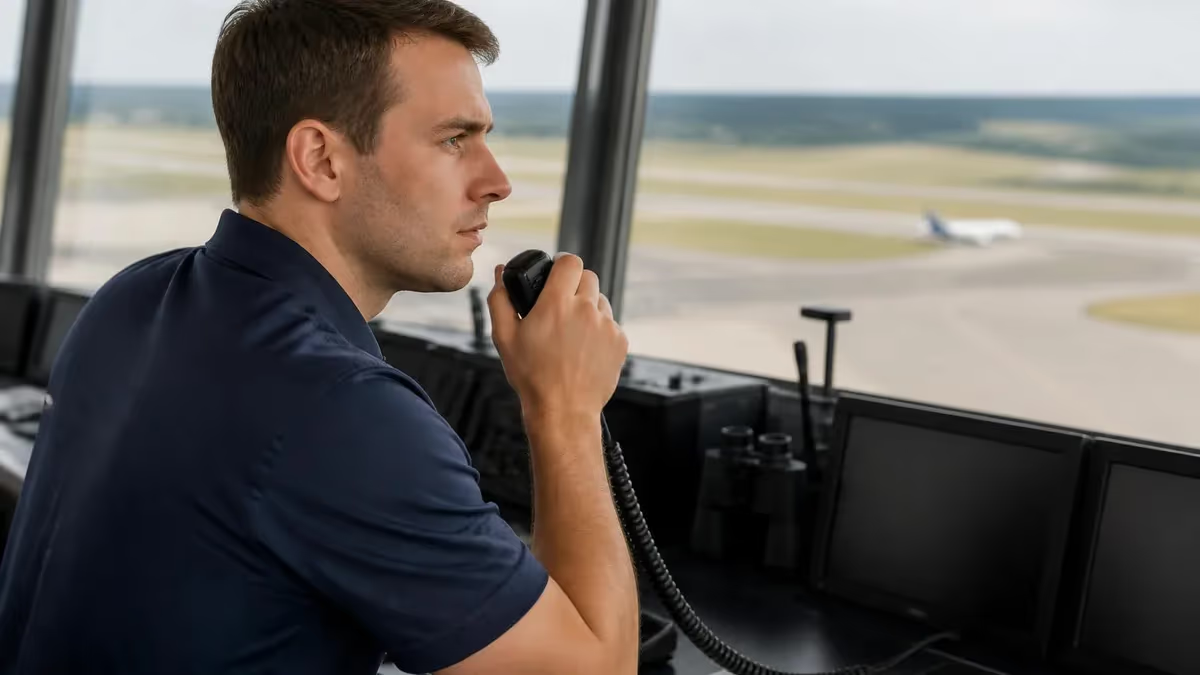
The FAA Academy sits on a 1,100-acre campus in Oklahoma City — the Mike Monroney Aeronautical Center (MMAC). It's where every new federal air traffic controller earns their wings, alongside aviation safety inspectors, flight inspectors, and airway transportation systems specialists. Founded 1946. Renamed for Senator Mike Monroney in 1971. Trains 1,500+ controllers a year. Washout rate hovers between 30% and 40%. If you want a career in the tower, in the TRACON, or at an en route center, this is the gate you have to walk through.
The FAA Academy is the single federal training facility for new air traffic controllers and a long list of other Federal Aviation Administration workers. You don't pick it. If you get hired by the FAA as a controller, you go here. Period. The campus shares an address with Will Rogers World Airport at 6500 S MacArthur Blvd, Oklahoma City, OK 73169. That means trainees can watch the very thing they're learning to manage from the cafeteria window.
It opened in 1946 as the CAA Training Center. The agency renamed it the Mike Monroney Aeronautical Center in 1971 after the Oklahoma senator who pushed for the facility's expansion. Today it employs more than 6,000 federal workers and houses three giants under one umbrella: FAA Logistics, the Civil Aerospace Medical Institute (CAMI), and the Academy itself. The campus has grown across nearly 80 years from a single classroom building to dozens of structures spread across 1,100 acres.
Beyond controllers, the campus trains aviation safety inspectors, flight inspectors who fly check missions on FAA-owned aircraft, and the airway transportation systems specialists who maintain radars, navaids, and tower equipment nationwide. Curious about the broader picture? Browse open FAA jobs before you commit. Controller is just one path among many — and not every aviation career goes through this gate.
The Academy also handles refresher training for existing controllers transitioning between facilities or specialties. A tower controller moving to TRACON, for example, returns to Oklahoma City for several weeks of conversion training. So you'll see seasoned 20-year veterans walking the halls alongside fresh trainees on day one. That mix shapes the culture. Veterans share war stories at lunch. Trainees absorb them — and learn faster.

FAA Academy by the Numbers
The Academy has rules. Hard ones. You must be a US citizen. You must be under 31 at the time of hire — yes, really, the cutoff is federal law because controllers retire mandatorily at 56 and the FAA wants a full 25-year career out of every trainee. You'll need a bachelor's degree, three years of progressive work experience, or military controller time. The educational requirements aren't subject-specific — any degree counts.
The AT-SAT (Air Traffic Skills Assessment) is non-negotiable. So is the Class II medical exam, the Secret-level background check, and the drug screen. One more wrinkle: examiners verbally test your English speech clarity. Mumble or slur, and you don't pass. Phraseology is life-or-death in this job — pilots in marginal weather can't ask you to repeat without burning seconds they don't have. Regional accents are fine; unclear articulation isn't.
Before you even apply, double-check you can hold a current FAA medical certificate. There's no point in starting the paperwork if you can't pass the physical. Color vision, hearing, cardiovascular health — all on the checklist. Disqualifying conditions don't always end your career, but the medical waiver process is slow and unpredictable.
The application timeline runs roughly 6-18 months from initial submission to your Academy class start. Bid window opens. You submit through FAA.gov. AT-SAT scheduling happens within 60-90 days. Medical and background investigation run in parallel and can each take 4-6 months. Tentative offer letters arrive. Then class dates get assigned, usually with 60-90 days of notice. Patience matters — many candidates drop out during the wait because life moves on.
The Four Controller Course Paths
The Basic Course — formally Initial Qualification Training (IQT) — runs 12 to 16 weeks. Every new controller takes it. This is the common foundation: airspace classifications A through G, FAA phraseology, separation rules (3-mile, 5-mile, vertical), weather impact, NOTAMs, and the absolute basics of conflict alert recognition. The course is heavily computer-based, with simulator labs in the afternoon and lecture in the morning. Expect 4-6 hours of nightly study on top of the 7:30 AM to 4:00 PM daily schedule. Cohort sizes run 25 to 50 trainees. Checkrides every 2-3 weeks. Fail two in a row and you're separated.
The day starts at 7:30 AM. Morning lectures fill most rooms — airspace theory, weather, regulations, phraseology drills. Lunch in the cafeteria, then simulators all afternoon until 4:00 PM. Sounds reasonable on paper. The reality? Most trainees study 4 to 6 hours every single night. Phraseology has to be reflex-fast. Separation math has to be automatic.
Stop studying for a weekend and you fall behind your cohort. Falling behind in this place is how 30 to 40 percent of trainees wash out. The Academy doesn't slow down for anyone. Miss a checkride benchmark and the instructors flag you. Two flags and you're meeting with leadership. Three and you're packing your bags and figuring out what to tell family back home.
You won't live on campus. The FAA reimburses hotel stays in nearby Oklahoma City through a $189-per-day per diem. Most trainees pool up and rent extended-stay suites near the airport. Weekends are yours. OKC has a respectable food scene, the Bricktown district, and easy weekend trips to Dallas if you need to escape. You'll need that escape. The pressure is real, and the social dynamics in a cohort that watches classmates wash out weekly can grind you down.
Study groups form fast. By week two, cohorts self-organize into 4-6 person study clusters that meet nightly at hotels or coffee shops. These groups become lifelines — sharing notes, drilling phraseology, quizzing each other on separation rules. The strongest trainees pull weaker ones up. The weakest trainees often pull the strongest down, time-wise. Choosing your study group well in the first week shapes whether you graduate.
Controller Specialties Compared
- What you control: Cruise altitude aircraft (high sectors)
- Training length: 12-16 weeks Basic + 4-8 weeks Phase 2
- Software used: ERAM radar system
- Top facilities: ZNY, ZLA, ZAU
- Difficulty: Highest — most washouts
- What you control: Departing and arriving aircraft within 40 miles
- Training length: 12-16 weeks Basic + 4-8 weeks Phase 2
- Software used: STARS radar system
- Typical location: Standalone approach control or co-located
- Difficulty: High — fast pace, tight separation
- What you control: Runways, taxiways, within 5 miles
- Training length: 12-16 weeks Basic + 4-8 weeks Phase 2
- Software used: Visual + ASDE-X surface radar
- Typical location: Airport control tower cab
- Difficulty: Moderate — visual-heavy, fewer aircraft
- What you control: Tower duties plus TRACON approach control
- Training length: 12-16 weeks Basic + extended Phase 2
- Software used: STARS plus visual
- Typical location: Mid-size airports with combined facilities
- Difficulty: High — dual certification required

Money matters. While at the Academy, trainees sit at GS-7 on the federal pay scale — that's $43,000 to $48,000 a year base. The $189 daily per diem covers hotel and meals on top of that. With Oklahoma City locality pay layered in, total compensation lands around $50,000 to $55,000 during training. Not glamorous, but the FAA covers your housing, meals, and tuition — so net cash flow is positive.
Federal benefits start day one. TSP retirement contributions kick in immediately. FEHB health insurance becomes available within weeks. Sick leave accrues from week one. After Academy graduation, the pay grade jumps to GS-9, then most line controllers reach GS-11 ($85,000+) once they're a Certified Professional Controller at their facility. The jumps come faster than most federal jobs because controller demand is so high.
Want the full picture on what you'll earn long-term? Check the detailed air traffic controller salary breakdown by facility, locality, and experience level. Top centers like Atlanta, Chicago O'Hare, and Los Angeles pay base controllers $200,000+ after 10 years. With overtime — and there's plenty of overtime given the staffing shortage — $250,000 is common at busy facilities. The retirement annuity caps it: 1.7% of high-three salary times years of service, paid for life starting at age 56.
Pass Rates and Graduation Stats
The Academy doesn't fail people for fun. It fails them because real lives depend on what controllers do. Some skills can be taught — phraseology, regulations, airspace classifications. Others can't. Spatial reasoning, working memory, multitasking under pressure — these are wired in or they aren't.
The most common failure modes aren't laziness. They're cognitive ceilings hitting cohort after cohort. A trainee who can't track six aircraft in their head will struggle no matter how many hours they study. A trainee who panics on the mic during a busy scenario can practice all night and still freeze the next morning. Personality matters too. The job demands controlled aggression, decisive timing, and zero ego when a supervisor corrects you mid-shift.
The Academy uses a points system tied to checkride performance. Each evaluation generates a score; fall below threshold twice and you're flagged. Three flags and the conversation turns serious. Most wash-outs happen between weeks 6 and 10 — long enough that you've moved your life to Oklahoma, short enough that the FAA can recover its training investment. Trainees describe this as the cruelest stretch. You can see the finish line, and instructors are watching every checkride.
Top Reasons Trainees Get Cut
- ✓Inability to multitask under pressure — can't track 8+ aircraft mentally
- ✓Slow voice communication — phraseology must be reflex-fast
- ✓Poor working memory — forget call signs, headings, altitudes
- ✓Weak spatial reasoning — can't picture 3D airspace from a 2D scope
- ✓Time management struggles — fall behind on academic load
- ✓Inability to think in three dimensions — vertical separation confuses
- ✓Personality conflicts with cohort or instructors
- ✓Stress-related withdrawal — voluntary self-elimination
- ✓Failed simulator evaluations — graded checkrides every 2-3 weeks
- ✓Phraseology slips — using non-standard wording on the radio
You cannot start ATC training after age 31. This is federal law, not policy. Controllers retire mandatorily at 56, and the FAA structures hiring to guarantee 25 years of service. There are no waivers. No exceptions for prior military controllers either — though VRA candidates get hiring preference, the age cap still applies. If you're 30 and considering this career, apply now or accept that the door is closing fast.
The curriculum is dense. Airspace classifications A through G — when does Class B start, when does it end, who needs clearance to enter. Phraseology — the standardized radio language that lets a pilot in Atlanta and a controller in Memphis communicate without confusion. Separation rules: 3-mile lateral inside 40 miles of radar, 5-mile beyond, 1,000 feet vertical below FL290, 2,000 feet above. These numbers must be memorized cold by week four.
Weather is its own beast. Convective activity reroutes traffic, visibility minima dictate approach procedures, and you'll learn to read weather radar overlays in real time. NOTAMs and advisories, conflict alert recognition, emergency procedures including hijack codes and lost-comm protocols. Every scenario gets practiced until it's reflex. Instructors throw curveballs — engine failures, medical emergencies, runway incursions — to see how trainees respond under pressure.
And the software. STARS is the modern radar system at most TRACONs. ERAM runs the en route centers. You'll log hundreds of simulator hours on both. Coordination with adjacent facilities — handoffs, point-outs, flow control — is drilled until it's automatic.
For pilots reading this, the same regulatory framework governs your IACRA application and certificate issuance, so the FAA's regulatory ecosystem is one continuous web. Controllers must understand pilot procedures, and pilots benefit from understanding controller perspective. Cross-training builds mutual respect on the frequency. The Academy quietly assumes you've already studied basic aviation before arrival — gaps in pilot knowledge hurt controllers more than instructors will admit out loud during after-action reviews.

From Graduation to Certified Professional Controller
Step 1: Graduation certificate
Step 2: Facility assignment
Step 3: Pay grade jump
Step 4: Relocate
Step 5: Facility training begins
Step 6: Achieve CPC status
Step 7: GS-11 pay grade
Step 8: Performance reviews
Step 9: Supervisor track (optional)
Step 10: Mandatory retirement at 56
The Academy isn't a single building. It's a campus. The tower simulator replicates real ATC cabs — 360-degree projected visuals, realistic aircraft movement, the works. En route training rooms run banked ERAM workstations identical to what you'll see at a real center. The TRACON simulator floor houses dozens of STARS scopes. Every simulator session is recorded — instructors review replays with trainees the next morning, highlighting separation errors, phraseology slips, and timing mistakes.
There's an aircraft trainer — literal sit-in mock-ups of cockpits so controllers understand pilot perspective. The Flight Service Station training area handles future flight service specialists. The technical library, a cafeteria, a gym, and recreation areas round out the campus. Trainees joke that the gym is where you go to forget how badly you did on yesterday's sim. CAMI runs medical research labs nearby — they study controller fatigue, sleep cycles, and stress responses using volunteer trainees as test subjects.
FAA leadership has invested heavily here. The 2025 ERAM-3 simulator software upgrade brought more realistic traffic flows. AI-assisted training tools entered trial in 2026 — flagging student errors in real time and suggesting corrective phraseology. The agency runs all this from the Mike Monroney Aeronautical Center, where the FAA administrator regularly visits to highlight new technology rollouts and announce hiring expansions tied to the national controller shortage. Visiting senators, foreign aviation authorities, and aerospace industry leaders also tour the campus regularly.
Salary Trajectory Year by Year
Want to beat the washout odds? Start prepping months — ideally a year — before your Academy class date. Practice AT-SAT-style multitasking exercises daily. There are free apps that mimic the test's split-attention drills. Memorize the airspace classifications cold. Learn FAA phraseology vocabulary so it's already in your mouth. The Pilot/Controller Glossary is free online and worth reading cover to cover.
Practice speaking slowly and clearly on a recording. Pilots can't ask you to repeat without burning time. Get physically fit. Stress eats people who don't sleep or exercise. Cut screen time in the weeks before exams. Sleep matters — eight hours a night is the minimum if you want your working memory firing at full capacity during simulator scenarios. Caffeine is fine but don't let it replace sleep.
Network with current controllers. Reddit's r/ATC subreddit, LinkedIn groups, and CTI school alumni networks are gold. Current controllers will tell you which instructors are tough, which simulator scenarios trip people up, and how to handle the social pressure when classmates start washing out. That intel saves careers. Some trainees pay for private AT-SAT prep courses — these can help but aren't necessary if you're disciplined about self-study.
Mental preparation matters as much as academic prep. Visualize busy scenarios in your head. Practice making decisions under time pressure in everyday life. Drive in heavy traffic and consciously track multiple vehicles. Play strategy games that require split-attention. The Academy isn't testing what you know — it's testing how fast you can apply what you know while your hands shake and your headset crackles with simultaneous transmissions.
FAA Academy Pros and Cons
- +High pay potential — $200K+ at top facilities after 10 years
- +Full federal benefits — TSP, FEHB, sick leave from day one
- +Strong job security — federal workforce, hard to fire
- +Mandatory retirement at 56 with full pension plus TSP
- +Technical, varied work — no two shifts are the same
- +Training fully paid by the FAA — no student loans
- +No four-year degree required if you have 3+ years experience
- +Per diem covers Academy housing — net positive financially
- −30-40% washout rate — high risk of cut
- −Hire-by-30 rule — career closed to anyone over 31
- −Stressful work — separation errors can end careers
- −Mandatory retirement at 56 even if you want to keep working
- −Rotating shifts including overnights and weekends
- −Holiday work expected — towers don't close on Christmas
- −FAA bureaucracy — slow promotions, rigid procedures
- −Limited facility transfers — moving facilities is competitive
- −Oklahoma City required for training — relocation mandatory
Pros and Cons at a Glance
| Pros | Cons |
|---|---|
| Full federal benefits — TSP, FEHB, sick leave from day one | Stressful work — separation errors can end careers |
| Strong job security — federal workforce, hard to fire | Rotating shifts including overnights and weekends |
| Technical, varied work — no two shifts are the same | Holiday work expected — towers don't close on Christmas |
| Training fully paid by the FAA — no student loans | FAA bureaucracy — slow promotions, rigid procedures |
| Per diem covers Academy housing — net positive financially | Limited facility transfers — moving facilities is competitive |
The Academy expects professional behavior. Business casual or uniform in the classroom. No earbuds during instruction. Tardiness is logged — three strikes and you're meeting with leadership. The campus is drug-free, and random screens happen. Phones stay out of simulator rooms because distraction is the enemy. Background check verification happens daily because you're walking around with Secret-level access in a federal facility.
Some quirks worth knowing. Training costs the taxpayer more than $1 million per controller — that's why the FAA is brutal about washing out anyone who won't make it. Failure represents about $700,000 of lost federal investment per cut trainee. The CTI program acts as a pressure valve, fast-tracking college grads who've already proven they can handle the foundational coursework before they ever set foot on campus.
The 2026 starting pay bump to roughly $50,000 reflects the agency's scramble to close a nationwide controller shortage that's been building since the 2013 sequester hiring freeze. Class sizes have expanded. The Academy now runs cohorts back-to-back with minimal downtime between classes. Instructors are stretched thin, and quality complaints have surfaced — but the agency's priority is volume right now.
One last quirk: the Academy uses a graded peer-feedback system. Your cohort rates your professionalism, communication, and reliability. Low peer scores don't directly wash you out, but they do trigger instructor reviews. The job is collaborative — you'll be handing off aircraft to controllers in adjacent sectors for thirty years, so the FAA wants to know you can work with people. Personality matters as much as test scores.
The FAA Academy in Oklahoma City is the gateway to air traffic controller careers. Twelve to sixteen weeks of intense training, 30-40% washout, leads to GS-7 pay during training and GS-11+ ($100,000+) after certification. You must be a US citizen, under 31, pass the AT-SAT, Class II medical, and Secret-level background check. Apply via FAA.gov or through a CTI partner school. The pay is high. The retirement is early. The benefits are federal-grade. But the training is genuinely the hardest job interview most people will ever face. Go in prepared, or don't go at all.
FAA Academy Questions and Answers
About the Author
Commercial Pilot & FAA Certification Specialist
Embry-Riddle Aeronautical UniversityCaptain Jennifer Walsh graduated with honors in Aerospace Engineering from Embry-Riddle Aeronautical University and holds FAA Airframe & Powerplant and Airline Transport Pilot certificates. With 11 years of commercial aviation experience and 6 years as a ground school instructor, she guides aviation mechanics and student pilots through FAA written exams and practical tests.
Join the Discussion
Connect with other students preparing for this exam. Share tips, ask questions, and get advice from people who have been there.
View discussion (9 replies)