
FAA Flight Delays: Causes, Tracking, & Passenger Rights Guide 2026 September
FAA flight delays explained: 📗 how fly.faa.gov tracks ground stops, NAS delays & DOT refunds. Causes, NextGen fixes & passenger rights.
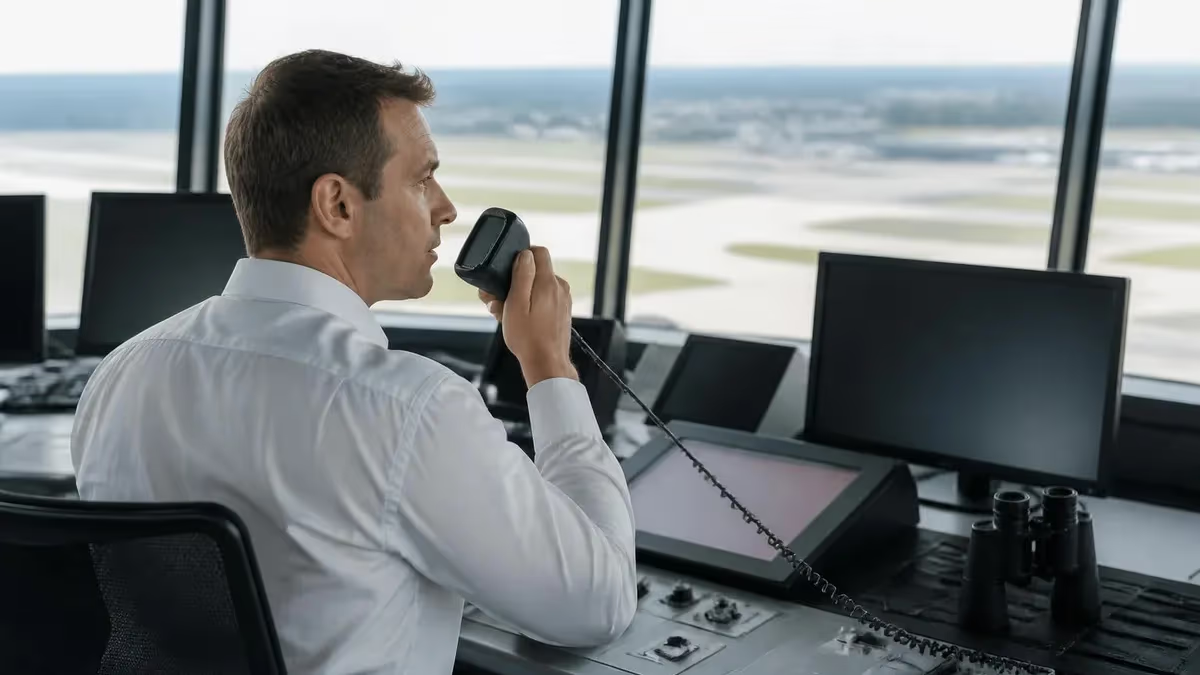
If you have ever stared at a departure board and wondered why the 4:15 to Chicago keeps slipping further down the screen, you are not alone — and the answer almost always begins with the Federal Aviation Administration. The FAA doesn't just run a few control towers; it operates the entire National Airspace System, juggling roughly 45,000 flights a day. That's the scale we're talking about. Weather, runway construction, controller shortages, a flock of birds near a busy approach corridor — any of these can push a single delay into a nationwide cascade within minutes.
Here is the part most travelers miss. The agency publishes a public, near real-time delay tracker at fly.faa.gov, and it updates roughly every five minutes. So when an airline blames "the FAA" for a hold, you can actually verify the story. Was there a ground stop at JFK? A traffic management program over Atlanta Center? A staffing trigger at Jacksonville?
It's all there, in plain English, if you know where to click. This guide breaks down how those delays happen, who calls the shots inside the FAA, what your rights are when a flight goes sideways, and how the system is — slowly — being modernized through NextGen. By the end you'll read a delay board the way a dispatcher does.

The nerve center of all of this is the Air Traffic Control System Command Center (ATCSCC) in Warrenton, Virginia. Pilots and dispatchers just call it "Command Center." Roughly 70 traffic management specialists work the floor in shifts, 24/7, and their job sounds simple until you watch them do it: balance the demand for airspace against the capacity the system can actually deliver.
Capacity is never static. A thunderstorm cell parked over Newark drops the airport's arrival rate from 38 to 24 an hour. A runway closure at O'Hare changes the math instantly. Command Center reacts in real time and pushes instructions out to every airline operations center and every en-route radar facility.
And those numbers — the 9,900-odd queries a month people type into Google about FAA flight delays — tell you that the public is hungry for transparency. The FAA, to its credit, has leaned into that. The agency publishes an Operations Network (OPSNET) dataset with cause-coded delays, and the Bureau of Transportation Statistics rolls airline-reported data into the monthly Air Travel Consumer Report. You can pull a CSV showing exactly how many minutes of delay were assigned to weather versus volume versus equipment last March if you want to. Few passengers know they can. Now you do.
Quick Tip: Check fly.faa.gov Before You Argue
The FAA's public delay map at fly.faa.gov updates every ~5 minutes and shows ground stops, ground delay programs, and airport-specific arrival/departure delays in real time. Before you blame the airline (or the FAA), check the map: if your destination shows a red GS or a GDP banner, the constraint is system-wide, not your carrier alone.
Let's untangle two terms that sound identical and aren't: ground stop versus ground delay program. A ground stop is the emergency brake. When something at a destination airport — a runway closure, a security event, a sudden line of thunderstorms — eliminates capacity for arrivals, Command Center tells every airport in the country to hold flights bound for that airport on the ground. No airborne holding, no fuel burn at FL350, no risk of diverting. Ground stops are usually short, often 30 to 90 minutes, and they end the moment the underlying problem clears.
A ground delay program is the more elegant cousin. Think of it as metering rather than stopping. When the FAA expects demand at, say, San Francisco to exceed capacity for the next four hours due to low ceilings, it issues a GDP. Each inbound flight gets a calculated Expected Departure Clearance Time (EDCT). Your 9:00 a.m. departure might be assigned a 10:47 a.m. wheels-up window. You'll still leave — just later, and on a precise schedule that prevents arrival queues. Pilots and dispatchers actually prefer a GDP to a ground stop, because at least it's predictable.
Five Traffic Management Initiatives (TMIs)
Emergency hold on all departures bound for one airport. Usually 30 to 90 minutes. Triggered by sudden capacity loss: runway closure, severe weather, security event.
Metering, not stopping. Each inbound flight gets an Expected Departure Clearance Time (EDCT). Used for predictable capacity reductions like low ceilings or winds.
Meters traffic through a constrained chunk of en-route airspace rather than a destination. Useful for thunderstorm reroutes affecting one corridor.
Spacing restriction between aircraft on the same route. A 30 MIT means 30 nautical miles between successive flights. Quiet but effective.
Command Center reassigns flights to alternate airways, adding miles and time but preserving safety margins around weather or military airspace activity.

Now to the part that has been screaming across headlines lately: controller staffing. The FAA is short roughly 3,000 fully certified professional controllers against its target, and that gap doesn't get fixed quickly. The academy in Oklahoma City graduates only so many a year, and developmentals then spend two to three years training to a specific facility.
When New York TRACON or Jacksonville Center is short-staffed for a shift, the FAA throttles traffic. It's a safety call, full stop. You'll see this on the FAA status page as "ARTCC staffing" or "traffic management initiative due to staffing." The 2023 contract delays at Newark were a textbook example — Command Center rerouted volume around the affected airspace for weeks.
Weather, though, is still the heavyweight. By the FAA's own cause coding, weather accounts for roughly 75% of all system delays in a typical year, and that number rises in summer when convective activity is everywhere. Modern radar and the Collaborative Convective Forecast Product (CCFP) help Command Center pre-position route reroutes, but a fast-moving squall line can still collapse capacity at three airports simultaneously. If you fly often, learn to read a convective SIGMET — it will explain more of your delays than any airline tweet.
Maintenance, crew issues, baggage loading, fueling, aircraft cleaning. The airline is responsible. This category triggers most DOT controllable-delay commitments (meals, hotels for overnight controllable cancellations).
The agency's long-running modernization effort is called NextGen, and it has been simmering since 2003. The headline pieces are satellite-based ADS-B surveillance (now mandated in most controlled airspace), Data Comm text messaging between controllers and pilots for clearance delivery, and Performance Based Navigation (PBN) procedures that allow tighter, more fuel-efficient arrival paths.
The GAO's own scorecard says NextGen has delivered real value — billions in fuel and time savings — but also that critical projects keep slipping. NextGen 2.0, announced in late 2024, shifts emphasis toward trajectory-based operations and an aging-facility replacement plan that taxpayers will fund well into the 2030s.
Traffic management initiatives, or TMIs, are the levers Command Center pulls when capacity tightens. The five biggest are ground stops, ground delay programs, airspace flow programs (AFPs, which meter traffic through a specific en-route constraint instead of a destination), miles-in-trail restrictions, and reroutes. Each one shifts pain around the system. A ground delay at Charlotte protects Charlotte; it also shoves connecting passengers into a different mess two hops away. Command Center coordinates this through a daily "strategic plan of operations" telcon — every major airline dispatch office and every en-route center is on the line, twice a day.
If you see your delay tagged as NAS, the FAA was the constraint — not the airline. But under the DOT's 2024 refund rule, you're still entitled to a cash refund if a domestic flight is delayed 3+ hours (6+ international) and you choose not to travel. The cause code affects voluntary meal/hotel commitments, not your refund right.
So who actually decides why your flight was delayed? Airlines do, using DOT-defined cause codes. When a flight lands 15 or more minutes late, the operator must report it to the Bureau of Transportation Statistics and assign one of five categories: Air Carrier (maintenance, crew, baggage loading), Extreme Weather (only weather so severe it prevents flight, like a hurricane), National Aviation System (the famous NAS delay), Late-Arriving Aircraft (the inbound was late, so you are too), and Security.
Most weather delays the public experiences actually fall under NAS, not Extreme Weather. That's where airline reporting gets controversial — the carrier benefits from coding ambiguity, because some categories carry rebooking obligations and others don't.
The phrase NAS delay deserves its own paragraph because passengers see it everywhere and rarely understand it. NAS captures everything within the FAA's operational envelope: non-extreme weather, heavy traffic volume, air traffic control actions, airport operations limitations, and equipment outages.
It is, in other words, the bucket for "the system was overloaded." If you scroll Flightradar24 and see a flight tagged with a NAS delay, that means the FAA — not the airline — was the constraint. It does not automatically mean compensation is off the table, but it does mean the airline can't put it all on the carrier itself.

- ✓Open fly.faa.gov and check your destination airport's status (GS, GDP, AFP).
- ✓If the FAA map shows a system-level event, the airline can't fix it faster than the FAA can.
- ✓Take a screenshot of the FAA status — useful evidence if you file a DOT complaint later.
- ✓Check the DOT cause code on your airline's app: Air Carrier delays trigger meal/hotel commitments.
- ✓If delayed 3+ hours domestic (6+ international), you can demand a cash refund and rebook elsewhere.
- ✓On tarmac longer than 2 hours? Politely ask the cabin crew about the 3-hour rule — they know it.
- ✓Save your boarding pass and confirmation; file DOT complaint form 1382 within 60 days if needed.
Speaking of money: U.S. passenger compensation rules are weaker than most travelers assume. There is no equivalent of EU261. The DOT's enforceable rule is the refund regulation that took effect in late 2024 — if your flight is canceled or "significantly changed" and you choose not to travel, the airline must issue a cash refund automatically, no fight required.
Significant change is defined: a domestic delay of 3+ hours, an international delay of 6+ hours, changes to departure or arrival airport, additional connections, downgrade of class, or a swap to a less accessible aircraft for passengers with disabilities. That last rule is genuinely new and genuinely useful.
For meal vouchers, hotel rooms, and ground transportation during controllable delays, the DOT in 2023 launched a public dashboard at transportation.gov/airconsumer that names which airlines voluntarily commit to what. Every major U.S. carrier now commits to meals and hotels for controllable cancellations — a controllable delay being anything not coded as weather or NAS.
Tarmac delays carry their own teeth: domestic flights cannot keep you on the airplane longer than three hours without offering deplaning, food, water, and working lavatories, with fines of up to $27,500 per passenger. Save your boarding pass. The DOT's complaint form (form 1382) is short, free, and read by actual investigators.
FAA NextGen Modernization: The Honest Scorecard
- +ADS-B surveillance now nationwide, replacing aging radar with satellite-based tracking.
- +Data Comm reduces voice congestion on clearance delivery frequencies at major airports.
- +Performance Based Navigation procedures cut fuel burn and noise around hub airports.
- +Collaborative Decision Making lets airlines optimize their own flights inside ground delay programs.
- +GAO confirmed billions in fuel and time savings already delivered.
- −Program timeline has slipped repeatedly since the 2003 launch — most milestones late.
- −ARTCC facility infrastructure is 50+ years old on average; replacement runs into the 2030s.
- −Trajectory-based operations remain partially implemented; full benefit still years away.
- −Controller staffing shortages undermine technology gains — capacity is people, not just radar.
- −NextGen 2.0 (2024) effectively re-scoped the program, an admission that 1.0 underdelivered.
Time for the practical bit. When you spot an inbound delay, the first thing to do is hit fly.faa.gov and type your destination airport's three-letter code. The map will show, in red or yellow, any active ground stops, GDPs, or airspace flow programs.
If you see a one-hour-plus arrival delay at your destination but no traffic management initiative listed, suspect an airline-side issue (crew, aircraft, gate). If you see a big red "GS" on your destination, you're in a ground stop and you can stop refreshing the airline app — nothing is moving until Command Center says so. Knowing the difference saves you a sprint to the gate and an angry tweet you'd regret.
For pilots and dispatchers, the same data feeds into the National Airspace System Status page and the FAA's Operational Information System (OIS). Airlines integrate the FAA's TFMS (Traffic Flow Management System) data directly into their dispatch software. So when your captain announces a ground stop, that information is genuinely fresh — your gate agent often knows less than the pilot, because the pilot is reading the same FAA feed in the cockpit via ACARS or EFB. Tip: politely ask the gate agent to call the ramp tower or check ACARS rather than reciting what the app told them.
One nuance worth flagging — airline apps and the FAA map sometimes disagree, and the FAA map is usually right. Carriers update their consumer-facing apps on a different cadence than dispatch, so you'll occasionally see a flight still showing "on time" in the app while Command Center has already issued an EDCT two hours out.
Trust the FAA data first, the airline data second. And if you ever fly often enough to subscribe to FlightAware Premium or similar, you'll see the raw TFMS messages — wheels-up estimates, route changes, EDCT assignments — exactly as dispatchers see them. It's overkill for most travelers but eye-opening once.
Let's zoom out. Why does the U.S. system, with all this technology, still produce more than two million minutes of delay in a peak summer month? Three structural reasons. First, U.S. airline scheduling is extremely tight. Carriers schedule peak banks at major hubs that exceed published airport capacity in clear-weather conditions, betting on margin to absorb the difference.
When weather hits, the math breaks. Second, the FAA's facility infrastructure is old. Average ARTCC age is north of 50 years, and the replacement program — Facility Replacement Program — is on a 20-year rollout. Third, runway capacity at the biggest airports hasn't grown meaningfully in two decades. JFK, LaGuardia, San Francisco, and Boston are essentially capped.
One bright spot: Collaborative Decision Making (CDM) has matured into a genuine partnership. Under CDM, airlines voluntarily share schedule data with the FAA in exchange for influence over how ground delay programs are allocated. When a GDP runs at SFO, airlines can swap their own flights inside their allocation — they decide which of their own flights eats the delay, based on connections, aircraft type, and load.
It's not a fix for capacity, but it makes the worst days less random. Whether you ever see this happen depends on whether your airline still cares about Operations Research as a discipline. (Spoiler: the good ones do.)
If you study for any FAA exam — Part 107, Private Pilot, Commercial, ATP, dispatcher — you'll see this exact machinery on the test. Traffic management initiatives, NOTAMs, airspace classifications, and the rules around ground stops and GDPs are fair game. Memorizing the categories isn't the same as understanding the system, though. The controllers, dispatchers, and traffic management specialists who run this thing every day think in terms of flows, not flights. Demand versus capacity. Acceptance rates. Trajectories. Once that vocabulary clicks, the delay board stops looking like chaos and starts looking like a weather map.
A few habits separate frequent travelers who navigate delays gracefully from those who don't. Travel early in the day if you can; afternoon banks pile up. Avoid tight connections through capacity-constrained hubs like LaGuardia, San Francisco, Newark, and Boston, especially in summer. Watch the convective outlook from the FAA Aviation Weather Center the night before — the day-2 thunderstorm forecast is uncannily good at predicting which hubs will struggle.
If you have status, use it: most premium-cabin and elite-status travelers get priority rebooking even when the airline app shows nothing. And keep a screenshot of your boarding pass, the FAA status map at the time of your delay, and the cause code from your airline. Those three things turn a DOT complaint from a vague gripe into an actionable case file.
One more thing worth knowing: airlines have started building resilience back into their schedules over the past two years. After the 2022 holiday meltdowns, every major U.S. carrier added buffer time into block schedules, increased crew reserves, and revised IT redundancy. On-time performance numbers reflect this — 2024 was the best year for on-time arrivals since 2018. So the picture isn't all doom. The FAA still has structural problems, especially controller staffing and facility age, but the airline side has measurably improved. If you're flying in 2026 expecting the chaos of 2022, you'll be pleasantly surprised more often than not.
That's the goal. Whether you're a frequent flyer, a student pilot, or someone who just wants to argue with United's chatbot from a position of strength, the FAA's data is yours. Use it. And the next time someone tells you the FAA "caused" your delay, check the cause code before you nod along. The truth is usually a little messier — and a lot more interesting.
FAA Questions and Answers
About the Author
Commercial Pilot & FAA Certification Specialist
Embry-Riddle Aeronautical UniversityCaptain Jennifer Walsh graduated with honors in Aerospace Engineering from Embry-Riddle Aeronautical University and holds FAA Airframe & Powerplant and Airline Transport Pilot certificates. With 11 years of commercial aviation experience and 6 years as a ground school instructor, she guides aviation mechanics and student pilots through FAA written exams and practical tests.
Join the Discussion
Connect with other students preparing for this exam. Share tips, ask questions, and get advice from people who have been there.
View discussion (9 replies)