
FAA Cracking Down on Carry-On Bags: New Rules Explained 2026 September
FAA and TSA tighten carry-on bag enforcement: size limits, gate-check fees, lithium battery rules, airline differences, and what flyers need to know. 🎯
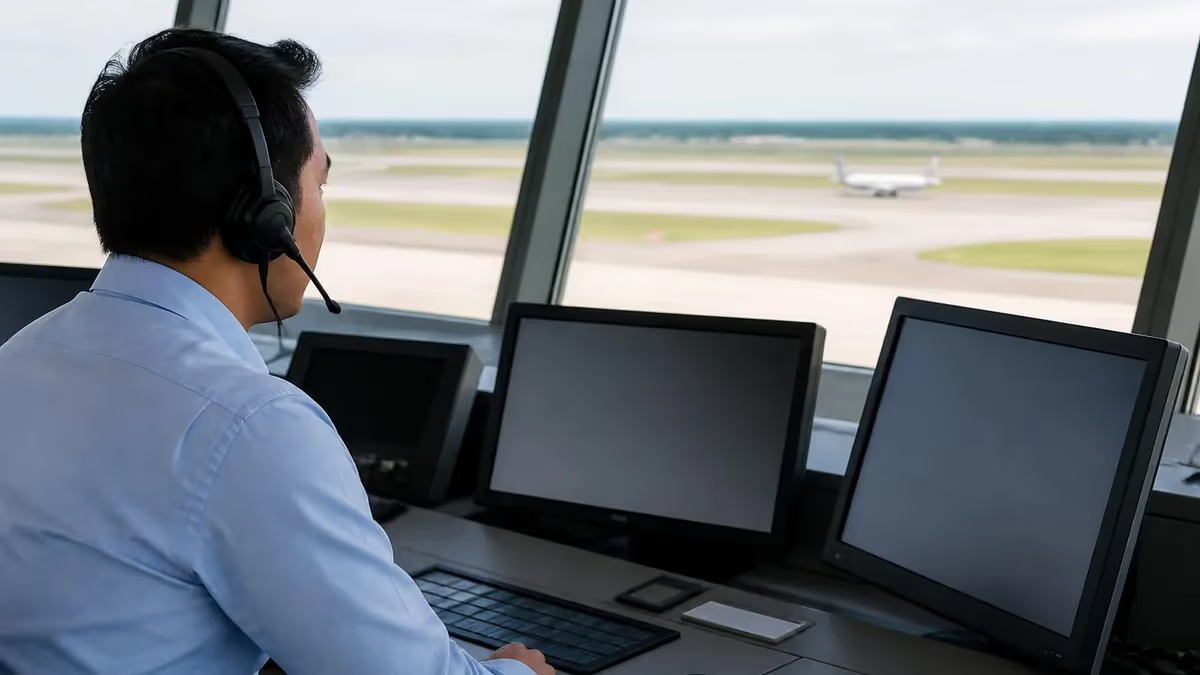
If you fly in the United States in 2026, your carry-on bag is under more scrutiny than it has been in a decade. The FAA cracking down on carry-on bags isn't a single rule change — it's a stack of pressures hitting passengers at the same time: tighter cabin-space enforcement at the gate, sharper TSA screening, evolving lithium-battery restrictions, and airline-by-airline sizer policies that vary in ways most flyers don't realize until they're standing at the jet bridge holding a bag that won't fit.
Here's what's actually happening. The FAA itself doesn't measure your roller bag at the gate. The agency sets the safety framework — evacuation timing, weight distribution, hazmat rules, and what airlines must enforce — and the carriers handle the bag-by-bag enforcement on the ground. That distinction matters because when you read headlines about the "FAA crackdown," the real story is twofold: the FAA tightened the rules airlines must enforce, and the airlines themselves got far more aggressive about following them. Both pressures land on you, the passenger, at the same gate-side moment.
The 2024 FAA Reauthorization Act, signed in May 2024, accelerated several of these changes. It expanded passenger-rights protections, required clearer carry-on size disclosure at booking, and pushed the FAA to update lithium-battery guidance for the explosion of power banks and e-cigarettes now coming through security. By 2026 the downstream effect is a noticeably stricter cabin environment — bag sizers being used at the gate by all four major U.S. carriers, $50-plus gate-check fees on previously-free routes, and TSA officers pulling more bags aside for battery and liquid violations than at any point since 2019.
This guide breaks it all down: what the FAA actually requires, why the crackdown is happening (cabin overcrowding plus evacuation safety), how United, American, Delta, and Southwest enforce differently, what the penalty looks like if your bag is oversized, current lithium-battery and power-bank rules, and the alternatives — personal-item-only fares, ship-ahead services, and how to pack for compliance without paying gate-check fees. If you want a deeper dive on what the FAA itself regulates day-to-day, our FAA hub covers the agency's full scope.

FAA Carry-On Crackdown by the Numbers
Cabin space is the root problem. Modern narrowbody aircraft — the Boeing 737 MAX, Airbus A321neo, and their variants — fly fuller than at any time in commercial aviation history. Load factors across U.S. carriers averaged 84.6% in 2025, and most flights between major hubs run at 92%-plus. When 180-plus passengers each bring a 22-inch roller and a personal item, overhead bin capacity runs out about row 15. The people in the back row either gate-check or get their bag jammed sideways into a bin two rows from their seat.
That overcrowding cascades into a safety problem the FAA does care about: evacuation time. The federal standard requires that any commercial aircraft be evacuable in 90 seconds with half the exits blocked. Passengers grabbing roller bags from overhead bins during an emergency evacuation have repeatedly delayed real-world evacuations — Aeroflot 1492 in 2019, American Airlines 383 in 2016, and at least eleven other incidents the NTSB has flagged since 2018. The FAA's current crackdown is partly a response to that pattern: smaller bags, fewer items overhead, faster evacuation.
There's also a financial angle nobody at the FAA will say out loud but the airlines absolutely will. Baggage fees generated $7.27 billion in revenue for U.S. carriers in 2024. Stricter enforcement at the gate — where a bag that fit fine in the bin sizer at home suddenly "doesn't fit" the airline's sizer — converts free carry-ons into paid checked bags. Critics call it revenue protection dressed up as safety. The reality is some of both: the safety rationale is real, and the revenue is real, and they reinforce each other.
For passengers, the practical impact is that you can no longer assume a bag that worked five years ago will work today. United, American, and Delta have all rolled out hard-sided plastic sizers at boarding gates between 2023 and 2026. If your bag doesn't drop cleanly into the slot — wheels and all — it gets gate-checked. The handle bulge, the front pocket stuffed with a jacket, the slightly-overstuffed top all count against you. You can study the rules cold and still get caught by an inch of fabric.
FAA controls: the safety framework — lithium-battery limits, hazmat rules (no propane cylinders, no fireworks), evacuation standards (90-second rule), weight-distribution physics, and what airlines must disclose to passengers at booking under the 2024 Reauthorization Act.
Airlines decide: the exact carry-on dimensions, gate-check fees, sizer enforcement strictness, personal-item dimensions, which fare classes get carry-ons (basic economy on UA and AA does not), and how aggressively gate agents enforce on a given day.
Translation: when your bag gets gate-checked, the airline made that call — but the FAA framework is what makes it possible. Both rules apply. You need to know which is which so you can argue the right ones.
The standard carry-on size limit across most U.S. airlines is 22 inches long by 14 inches wide by 9 inches deep, including wheels and handles. That sounds straightforward until you realize how much variance exists. Southwest allows up to 24x16x10 — generous by industry standards — while Spirit and Frontier sit at 22x18x10 for their paid carry-on tier but charge a fee that often exceeds a checked-bag fee on legacy carriers.
JetBlue matches the major-three at 22x14x9. Alaska and Hawaiian use 22x14x9 as well. The American Airlines limit of 22x14x9 includes wheels and handles, which is a critical detail because many "carry-on" suitcases sold online measure 22 inches without the wheels and end up 23-plus with them.
Personal items are even less standardized. United's limit is 17x10x9 (fits under a seat). Delta's is 18x14x12 if you have a basic economy fare. American allows 18x14x8. Southwest is famously generous with personal items and rarely enforces. The personal-item-only fare classes — United's Basic Economy and American's Basic Economy — restrict you to that smaller bag and charge $35–50 to bring a roller. Delta's Basic Economy still includes a full carry-on, a meaningful difference that flyers often miss when comparing fare prices.
Here's the practical implication: read the specific airline's policy for the specific fare class on the specific route, every time. A flight where you bought basic economy on a partner-operated leg might have a different carry-on rule than your main carrier — and the gate agent enforces the operating carrier's rules, not the one whose loyalty program you're using. If you've ever been told "your United bag doesn't fit our Air Canada policy," that's why. Codeshares add a layer of confusion that the FAA isn't responsible for and won't help you with.
Airline-by-Airline Carry-On Enforcement
Strictest sizer enforcement of the legacy three. Basic Economy = no carry-on.
- ▸22x14x9 including wheels and handles
- ▸Hard plastic sizer at every gate
- ▸Basic Economy bars carry-on — personal item only
- ▸$50 gate-check fee if oversized
- ▸Premier elites bypass enforcement on most domestic flights
Moderate enforcement but inconsistent gate-by-gate.
- ▸22x14x9 including all protrusions
- ▸Sizer used at hub airports (DFW, CLT, ORD, MIA)
- ▸Basic Economy bars carry-on on most domestic routes
- ▸$50 gate-check fee, $75 at boarding if oversized
- ▸AAdvantage status mitigates enforcement
Generally lighter enforcement but tightening fast in 2026.
- ▸22x14x9, slight tolerance on soft-sided bags
- ▸Sizer present but used selectively at gates
- ▸Basic Economy DOES include a carry-on (key difference)
- ▸$30 gate-check fee if oversized
- ▸Medallion elites rarely face enforcement
Most generous limits, least gate-side enforcement.
- ▸24x16x10 — largest standard limit in U.S. industry
- ▸No sizer at gate, visual check only
- ▸Two free checked bags included for most fares
- ▸Personal item rarely measured
- ▸Carry-on enforcement only when a flight is genuinely full

The financial penalty for an oversized bag varies more than most passengers expect. United and American both charge $50 if your bag is gate-checked at the door before boarding, but that number jumps to $75 — and sometimes higher — if you're caught after the boarding pass has been scanned and you're already in the jet bridge.
Delta sits lower at $30 in most cases, and Southwest typically doesn't charge unless the bag is obviously oversized and the gate agent intervenes (rare). Spirit and Frontier charge $69–99 for a carry-on at the gate, which is the highest tier in the U.S. industry and explicitly designed to incentivize prepaying.
Beyond the fee, there's a time cost. Gate-checked bags get tagged at the door and tossed onto the cart with checked luggage, then routed through baggage claim at your destination. You lose 20–40 minutes on the back end waiting for it. For connecting flights, gate-checked bags can be "plane-side delivered" if you ask the agent — meaning they're returned at the jet bridge of your connecting flight — but that depends on whether the agent flags it and whether the route has the staffing to handle it. Don't count on it.
There's also a TSA dimension to the crackdown that flyers often miss. TSA pulled 6.9 million prohibited items out of carry-on bags in 2024, a 17% jump over 2023. Most of those were liquids over 3.4oz, knives, multi-tools, and the increasingly common lithium-ion power bank that exceeds the 100 watt-hour limit. Every pulled item is a few minutes at screening, and during peak summer travel TSA staffing simply can't absorb that volume — which is why security lines doubled in length at major hubs through 2024 and 2025. The crackdown isn't just gate-side; it starts at the security checkpoint.
If you're studying the regulations that drive these enforcement decisions, the FAA Federal Aviation Regulations practice test covers the underlying framework — passenger conduct rules, hazmat regulations, and the parts of Title 14 that airlines and TSA reference when they pull a bag aside.
What Triggers a Gate-Check, Section by Section
The sizer is the law. If your bag doesn't drop cleanly into the slot — wheels, handle, and front-pocket bulges included — it's getting tagged. Hard-sided cases are the most ruthless test because they don't compress. Soft-sided bags with give to the fabric squeeze through with another inch of stuffing inside. The smart move is to pack with a hard-sided bag at home, test it in your own sizer-equivalent (a 22x14x9 cardboard cutout), and leave 10% empty space. Bags expand at altitude due to pressure changes, and most gate agents know it.
The handle bulge is the most common quiet violation. Many "international" carry-ons measure 21.5 inches in the body but 22.8 with the handle extension. United and American both count the handle. Delta sometimes doesn't. Test before you fly.
The 2024 FAA Reauthorization Act is the regulatory engine behind much of what passengers are now experiencing. Signed into law by President Biden in May 2024 after a multi-year extension cycle, it reauthorized the FAA through 2028 and added several passenger-facing provisions worth knowing about. Section 510 expanded refund rights — airlines must now issue automatic cash refunds (not vouchers) when flights are canceled or significantly delayed. Section 514 requires clearer disclosure of carry-on and baggage rules at the point of booking, not buried in fine print.
For carry-on bags specifically, the Act directed the FAA to update lithium-battery guidance, modernize hazmat rules for consumer electronics, and require airlines to publish carry-on dimensions in a standardized, machine-readable format. That last provision is what's driving the cleaner disclosure flyers now see at booking — though enforcement on whether airlines actually comply is still uneven. The Act also gave the Department of Transportation more authority to penalize airlines that misclassify fees, which is part of why ancillary-fee transparency has improved (slowly) over the past 18 months.
What the Reauthorization Act did not do is set a federal minimum carry-on size. Despite advocacy from consumer groups, the final bill left airline-by-airline dimension setting in place. So while the disclosure rules improved, the actual fragmentation between carriers remains. United can still set 22x14x9 and Southwest can still set 24x16x10, and you, the passenger, are still responsible for knowing the difference at the gate.
Passenger rights under the Act do include one underused protection: if a gate agent forces you to gate-check a bag that meets the airline's published dimensions, you can file a DOT complaint and the airline can be fined. You'll need photographic evidence of the bag at the sizer plus the published policy in writing. It's not a fast remedy — DOT complaints take months — but airlines do adjust gate-agent training when complaint volumes spike on specific routes. Document, file, and the system slowly self-corrects.
Packing a lithium-ion power bank in your checked bag. The FAA prohibits ALL lithium-ion batteries in checked baggage — this includes power banks, spare phone batteries, vape pens, e-cigarettes, and any device with a removable battery. The reason: thermal runaway. A lithium fire in the cargo hold cannot be reached by crew, and Halon fire suppression doesn't fully extinguish lithium fires. UPS Flight 6 (2010) and Asiana 991 (2011) both involved lithium-battery cargo fires; both aircraft were lost.
If TSA catches a power bank in your checked bag during X-ray screening, the bag won't fly — and you might miss your flight entirely while they pull it from the cargo loading process. Pack ALL batteries in carry-on, every time, no exceptions.
If you fly enough that gate-check anxiety is a recurring problem, there are concrete workarounds. The first is the personal-item-only strategy: book the basic-economy fare on United or American and just don't bring a roller. A 17x10x9 backpack (United's personal-item limit) holds three or four days of clothing, a laptop, toiletries, and shoes if you pack with compression cubes.
You'll save the carry-on fee, never face a gate-check, and board with everyone else. The catch is space — this only works for trips short enough to fit in a daypack, and it doesn't work if you need a suit, a long dress, or business-meeting attire that can't be folded.
The second option is ship-ahead services. Companies like Luggage Forward, Lugless, and Send My Bag will pick up your suitcase from your home or office, ship it to your destination hotel, and have it waiting when you arrive — usually for $40–80 each way for a standard suitcase.
For business travelers on full-fare itineraries, it's not even a cost question (the company expense covers it). For leisure flyers, it's worth comparing against the all-in cost of a checked bag plus the time you'd lose at baggage claim. On a domestic flight, ship-ahead often loses; on an international itinerary with multiple connections, it can be a clear win.
The third option is to fly carriers that don't enforce strictly. Southwest is the obvious case — generous size limit, two free checked bags, light enforcement at the gate. JetBlue's Mint and Even More Space fares include carry-on priority boarding. Alaska's Mileage Plan elites get carry-on guarantees even on full flights. If you fly the same route repeatedly, the carrier choice compounds: someone flying weekly between SFO and Seattle on Alaska as MVP Gold barely ever thinks about carry-on enforcement. Someone flying the same route on United Basic Economy fights with a gate agent every Tuesday.
Status helps disproportionately. United Premier Silver and above, AAdvantage Gold and above, Delta Silver Medallion and above — all get carry-on priority and de facto enforcement-skipping on most domestic flights. The bar to earn status has risen (United now requires $5,000 in spending or 12 flights for Silver), but the carry-on benefit alone is worth the chase for anyone flying 15-plus segments a year.
You can continue preparing with the faa practice test, which includes answer explanations for every question.
You can continue preparing with the faa written practice test, which includes answer explanations for every question.

FAA Carry-On Compliance Checklist Before Every Flight
- ✓Confirm the operating airline's carry-on size limit — not the airline you bought the ticket from
- ✓Measure your bag with the handle extended and wheels included
- ✓Leave 10% empty space — bags expand at altitude due to cabin pressure changes
- ✓Move all lithium-ion batteries, power banks, and vapes into carry-on (never checked)
- ✓Pack liquids in 3.4oz containers inside a single quart-sized clear bag
- ✓Take medications and infant formula out for separate TSA screening
- ✓Check the fare class — Basic Economy on UA and AA does not include a carry-on
- ✓Weigh international carry-ons against partner-carrier limits (often 17–22 lbs)
- ✓Bring a backup soft duffel in case you need to redistribute on the spot
- ✓Photograph your bag in the sizer if you suspect future gate-check disputes
- ✓Know your airline's gate-check fee in advance so you can decide quickly under pressure
For flyers who travel only occasionally, the practical advice condenses into three habits. First, buy a bag that's clearly under the limit — a 21x13x8 model rather than something marketed as "maximum size" — and you'll never have a borderline call at the gate. The four or five inches you give up in capacity is easily recovered by packing better (compression cubes, layered folding, wearing your heaviest items on the plane).
Second, treat your carry-on like a regulated container, not a closet. Pull batteries every time. Pull liquids every time. Know what's in every pocket before you reach security. The friction at TSA isn't from the screening itself — it's from the surprise of a forgotten pocket knife, a half-full water bottle, or an unlabeled medication. Familiarity beats hope every time.
Third, leave margin in your schedule. Airport timing assumptions baked in pre-pandemic are obsolete. Two hours before a domestic flight is no longer overcautious — it's standard at hub airports during peak travel windows. Three hours for international. If you arrive light on time and get pulled aside for a battery check or a sizer measurement, you're going to miss the flight. The crackdown adds friction; budget for it.
The FAA Carry-On Crackdown: Pros and Cons for Passengers
- +Faster evacuations and a measurable safety upside the FAA can defend with data
- +Cleaner cabin space when overhead bins are no longer crammed three rows past capacity
- +Better disclosure at booking thanks to the 2024 Reauthorization Act
- +Predictability — if you study the rules, you'll never be surprised at the gate
- +Lithium-battery enforcement reduces cargo-hold fire risk on every flight you take
- +Automatic refunds on cancellations are a meaningful new passenger protection
- −Gate-check fees can equal or exceed checked-bag fees, especially on budget carriers
- −Inconsistent enforcement gate-by-gate makes planning harder for occasional flyers
- −Basic Economy fares hide the true cost of travel until you reach the airport
- −Personal-item-only travel doesn't work for business attire or longer trips
- −Status benefits create a two-tier system — elites breeze through, everyone else negotiates
- −TSA confiscation increases mean longer security lines during peak travel periods
Pros and Cons at a Glance
| Pros | Cons |
|---|---|
| Faster evacuations and a measurable safety upside the FAA can defend with data | Gate-check fees can equal or exceed checked-bag fees, especially on budget carriers |
| Cleaner cabin space when overhead bins are no longer crammed three rows past capacity | Inconsistent enforcement gate-by-gate makes planning harder for occasional flyers |
| Predictability — if you study the rules, you'll never be surprised at the gate | Basic Economy fares hide the true cost of travel until you reach the airport |
| Lithium-battery enforcement reduces cargo-hold fire risk on every flight you take | Personal-item-only travel doesn't work for business attire or longer trips |
| Automatic refunds on cancellations are a meaningful new passenger protection | Status benefits create a two-tier system — elites breeze through, everyone else negotiates |
The honest summary: carry-on enforcement is permanently tighter and it's not going back. The combination of fuller flights, sharper FAA safety guidance, post-Reauthorization disclosure requirements, and airline revenue incentives all point the same direction. The smart adaptation isn't to fight the system at the gate — gate agents have no discretion and arguing wastes time you don't have. The smart adaptation is to pack within the rules, know the specific airline's policy for your specific fare, and pre-empt the failure points (batteries, liquids, sizer-bulge).
If you fly the same airline often, learn that carrier's quirks cold. Delta's Basic Economy includes a carry-on. United's doesn't. American's Basic Economy varies by route. Southwest barely enforces. Spirit charges you double if you miss the prepay window. Each of those facts is worth knowing before you book, not after you've arrived at the gate with a non-refundable ticket and a bag that's about to cost you $75.
And one final note for people who care about the bigger picture: the FAA crackdown isn't a one-time event. The pattern over the last decade is monotonic — every year, enforcement gets a little stricter, fees rise a little, and the gap between basic-economy and full-fare expectations widens. The 2024 Reauthorization Act didn't reverse any of that; it codified it. Plan for 2027 to be stricter than 2026. The flyers who minimize friction are the ones who pack like the rules will tighten further. Because they will.
Below are the questions flyers ask most often about the FAA carry-on crackdown — pulled from passenger forums, airline support inboxes, and recurring confusion at TSA checkpoints. Most cluster around three themes: the difference between FAA rules and airline rules, what to do when a bag is borderline, and lithium-battery rules that keep evolving as consumer electronics get more powerful.
The short version, in advance of the detail below: the FAA sets the safety framework, the airlines set the specific dimensions and fees, and TSA enforces the security screening. Three different agencies, three different rule sets, all hitting you at the same airport visit. Knowing which agency owns which rule is the difference between arguing the right point and wasting your time.
FAA Questions and Answers
About the Author
Commercial Pilot & FAA Certification Specialist
Embry-Riddle Aeronautical UniversityCaptain Jennifer Walsh graduated with honors in Aerospace Engineering from Embry-Riddle Aeronautical University and holds FAA Airframe & Powerplant and Airline Transport Pilot certificates. With 11 years of commercial aviation experience and 6 years as a ground school instructor, she guides aviation mechanics and student pilots through FAA written exams and practical tests.
Join the Discussion
Connect with other students preparing for this exam. Share tips, ask questions, and get advice from people who have been there.
View discussion (9 replies)