
FAA Cracking Down on Carry-On Bags: New 2026 September Enforcement Rules Explained
✅ FAA cracking down on carry-on bags in 2026 September — new size, weight and stowage enforcement. See rules, fines, airline policies and how to avoid gate-check fees.
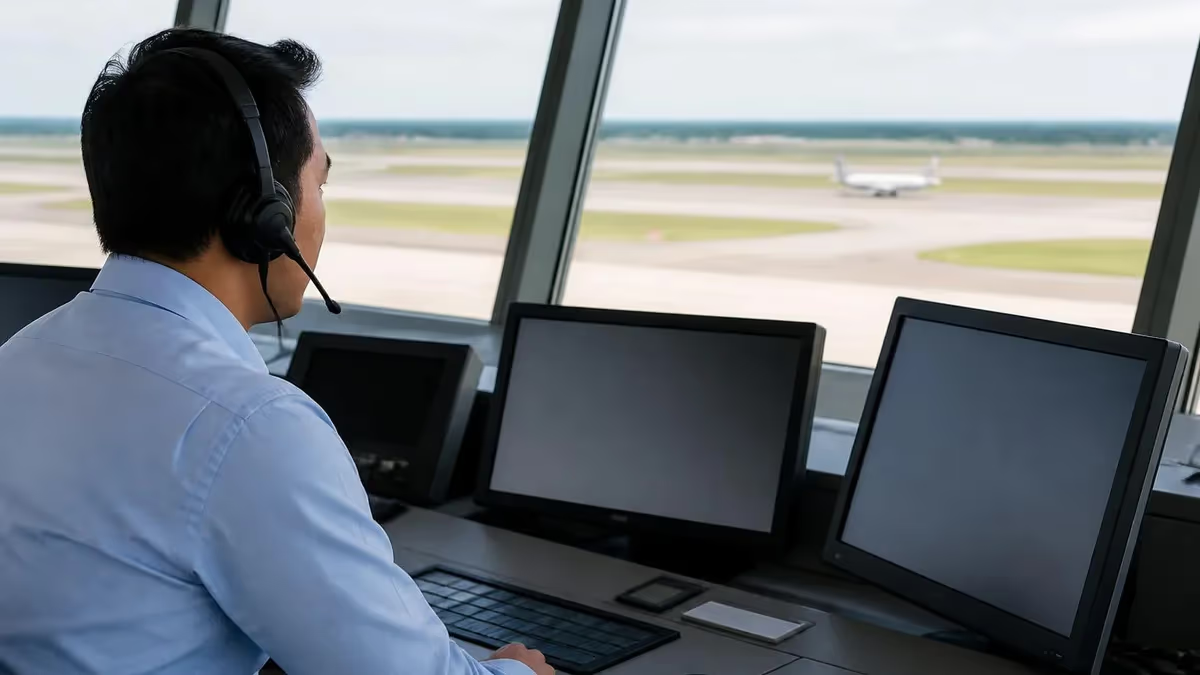
Travelers are seeing it at every gate this year: agents pulling bags off the jet bridge, sizing them in metal frames, and slapping checked-bag tags on anything that bulges. The FAA cracking down on carry-on bags is no longer a rumor — it's a coordinated enforcement push that started rolling out in late 2025 and is now fully in force across U.S. carriers in 2026. If you fly without knowing the new rules, you're walking into a $35 to $100 gate-check fee, a missed boarding window, or worse — a flagged passenger record that follows you to your next flight.
Here's what most travelers misunderstand: the FAA itself doesn't set carry-on size limits. Airlines do. But the FAA does enforce stowage safety — what fits where, how heavy a bin can hold, and whether flight attendants can close overhead doors before pushback. That's the angle behind the 2026 crackdown.
Bins overflowing with oversized bags slow boarding, delay departures, and create injury risk when 22-pound rollers come down on someone's head mid-turbulence. The FAA's Safety Management System (SMS) framework now requires airlines to document every overweight or oversized stowage incident, and that paper trail is driving the gate-side enforcement you're seeing today.
This guide breaks down exactly what the FAA crackdown on carry-on bags means in 2026 — the rules that changed, which airlines are toughest, what fines you actually face, and how to prep your bag so you breeze past the sizer every time. By the end you'll know the size limits down to the inch, the weight cutoffs, the personal-item rules, and the five mistakes that get bags pulled at the gate.
FAA carry-on crackdown by the numbers

Why the FAA is cracking down on carry-on bags right now
The crackdown didn't appear overnight. Three things converged in 2025 to push the FAA toward harder enforcement. First, post-pandemic load factors hit record highs — U.S. flights are running 86% full on average, which means more bags fighting for the same overhead bin space. Second, checked-bag fees ballooned to $40 and beyond on most major carriers, pushing more passengers to stuff oversized rollers into the cabin to avoid the fee. Third, the FAA logged a 41% jump in stowage-related injury reports between 2023 and 2025, mostly bins overflowing or bags shifting mid-flight.
The agency responded with a Safety Alert for Operators (SAFO) directing every Part 121 air carrier to tighten gate-side enforcement, document oversized bag incidents in their SMS data, and audit cabin baggage compliance quarterly. Airlines that miss audit thresholds face FAA action — which means flight attendants and gate agents are now under direct pressure to enforce the limits that have been on the books for years but rarely measured against the sizer.
The result for travelers: the days of slipping through with a slightly oversized bag are over. Sizer frames are back at gates that haven't used them in years. Boarding-zone bag checks happen even before you reach the jet bridge. And the airline can — and increasingly does — refuse to let you board until the bag fits, gets gate-checked, or gets checked back at the ticket counter for a higher fee.
The FAA crackdown explained in one paragraph
The FAA didn't change the size of carry-on bags — that's still the airline's call. What changed is enforcement. Under the 2025 SAFO and 2026 SMS audit cycles, airlines must now document every oversized or overweight carry-on stowage incident. That data feeds back into safety reviews, which means gate agents and flight attendants have direct authority — and pressure from above — to stop, size, weigh, and gate-check non-compliant bags before boarding.
Carry-on size limits by U.S. airline in 2026
Almost every major U.S. carrier publishes a 22 x 14 x 9 inch limit for standard carry-on bags. That's roughly 56 x 36 x 23 centimeters, including wheels and handles. The wheels-and-handles part trips people up most often — that 24-inch suitcase you measured at home? Add the wheels and the retracted handle and it's already 25 inches, which means it won't fit the sizer frame. Manufacturer marketing pages often quote bag-body measurements only, then add half an inch to two inches once wheels and handles are included.
Personal item dimensions vary more. Most legacy carriers use a 17 x 13 x 8 inch envelope for personal items — purses, laptop bags, small backpacks. Budget airlines like Spirit, Frontier, and Allegiant publish smaller personal-item limits (often 18 x 14 x 8 or 16 x 15 x 8) and charge extra for a standard carry-on on top. Read your fare class carefully — a "basic" or "saver" ticket on most airlines includes only the personal item, not the standard carry-on.
Weight limits split the field. Major U.S. domestic carriers like Delta, United, and American don't impose a hard weight limit on standard carry-ons in coach, though they reserve the right to gate-check if the bag is visibly straining. International carriers and smaller regional airlines often cap carry-ons at 22 to 40 pounds. If you're connecting onto a partner airline, the strictest carrier's limit applies for the whole journey.
Major U.S. carriers — 2026 carry-on rules
22 x 14 x 9" carry-on + 17 x 13 x 8" personal item. No published weight limit in coach but bags will be gate-checked if they don't fit the sizer.
10 x 16 x 24" (slightly larger) + 18.5 x 8.5 x 13.5" personal item. Still includes 2 free checked bags — least crackdown pressure of the majors.
Personal item free at 18 x 14 x 8". Carry-on costs extra ($35–$65+ if pre-booked, $99+ at gate). Strictest sizer enforcement of any U.S. carrier.
22 x 14 x 9" + standard personal item. Blue Basic (JetBlue) and Saver (Alaska) fares now require checked-bag fee for full-size carry-on — only personal item is free.
Gate-check fees and FAA fines you actually face
The financial pain of getting caught with an oversized carry-on hurts more than most travelers expect. Gate-check fees in 2026 run $35 to $100 per bag depending on the airline and fare class — and that's usually higher than the standard checked-bag fee you'd have paid at the ticket counter. Spirit's gate-check fee can hit $99 for a single bag if you didn't pre-pay online. United and American charge $35 to $50 on most routes for gate-checking the first bag. Frontier hits $99 if you're caught at the gate with an oversized carry-on you didn't pay for in advance.
Beyond the airline fees, there's the FAA side. Direct fines on passengers for carry-on violations are rare but very real when they happen. Refusing to comply with flight attendant stowage instructions falls under 14 CFR 121.317 and 14 CFR 91.11 — interference with crewmembers. The maximum civil penalty is up to $37,000 per violation. Most passenger-fine cases involve travelers who refused to stow a bag, argued with crew, or removed gate-checked bag tags and tried to bring the bag onboard anyway.
You can also get yourself flagged on a no-fly list managed by individual airlines if you escalate at the gate. Most U.S. carriers maintain internal "do not transport" lists for passengers who interfere with crew, and a documented gate incident can land you there for months. The crackdown isn't just about money — it's about your future ability to board.

If a gate agent tells you to size your bag, do it. If it doesn't fit, accept the gate-check and move on. Arguing, raising your voice, or trying to slip past creates a flight attendant interference record that follows your booking history. Some carriers have internal "watch lists" for repeat offenders that lead to denied boarding on future flights. The $50 gate-check is annoying — being denied boarding on your honeymoon flight is much worse.
By scenario: what to do if you're caught
If the agent flags your bag at check-in before you reach security, you can usually pay the standard checked-bag fee (around $35–$40 for the first bag on most domestic routes). This is the cheapest outcome — much less than gate-checking later.
How to pack a carry-on that beats the crackdown
Avoiding the gate-check costs nothing more than buying the right bag and packing it right. Start with the bag itself. Look for soft-sided rollers from manufacturers who publish total dimensions including wheels and handles — not just body measurements. Travelpro, Briggs & Riley, and the Away Carry-On model all publish total exterior dimensions and meet 22 x 14 x 9 with margin. Avoid hard-shell expansion bags that bulge out past 9 inches once you zip the expansion panel.
Weight management matters even on airlines that don't publish strict weight limits. A carry-on that visibly strains your arm to lift gets flagged. Aim for 25 to 30 pounds total. Pack heavy items at the bottom (near the wheels) and keep electronics, liquids, and breakables on top for easy access at security. If you fly internationally on a strict-weight carrier, weigh your bag at home with a luggage scale — they're $15 on Amazon and pay for themselves the first time you avoid an overweight charge.
Personal-item strategy is where most travelers leave money on the table. A larger, structured personal item — a roller backpack, an under-seat tote with wheels, or a structured laptop bag — holds way more than people realize. Pack your bulkier toiletries, a change of clothes, and any "if I lose my main bag" essentials in the personal item. That way if you do get gate-checked, you still have everything critical with you in the cabin.
Pre-flight bag checklist
- ✓Measure your bag including wheels and handles — not just the body
- ✓Confirm your airline's exact dimensions on their official site before flying
- ✓Weigh your bag at home if flying a strict-weight carrier
- ✓Keep medications, electronics, and ID in your personal item
- ✓Carry-on bag expansion zipped closed — never expanded
- ✓Personal item under 17 x 13 x 8" for most carriers
- ✓Soft-sided bag if you're close to size limits — compresses into bin easier
- ✓Boarding pass loaded on phone with bag fees pre-paid where applicable
Five mistakes that get your bag gate-checked
Most gate-check incidents come from the same handful of avoidable mistakes. Knowing what gets flagged keeps you out of the line waiting at baggage claim.
Hard-shell bags with expansion panels. A 22 x 14 x 9 hard-shell becomes 22 x 14 x 10.5 once you unzip the 1.5-inch expansion. Gate agents see the bulge from across the gate. Either don't expand the panel or buy a non-expansion model.
External attachments and bungee cords. Coats strapped to the outside, jackets clipped to the handle, oversized neck pillows tied around the body — all of it gets measured as part of the bag. Stuff outer layers inside, not outside.
Bringing a third bag. The standard allowance is one carry-on plus one personal item. Carrying a duty-free shopping bag, a coffee cup, and a laptop bag in addition to your roller and personal item gets you flagged. Consolidate to two pieces before boarding.
Wheeled personal items that are oversized. A wheeled underseat tote can be a great personal-item solution, but check the dimensions. Some "personal item" rollers are 18 x 14 x 9 — fine on Spirit's personal-item allowance but not on a tighter carrier. Match the bag to the strictest airline you'll fly on that trip.
Late boarding with a full bin. Even if your bag is the right size, late boarders find every bin full and get gate-checked anyway. Board with your zone or earlier if you must keep your bag in the cabin. This is the single most common cause of gate-checks for compliant bags.

Should you upgrade to priority boarding?
- +Guaranteed overhead bin space — board before bins fill up
- +Skip the gate-check lottery for late boarders
- +Often cheaper than the actual gate-check fee on premium carriers
- +Less stress at boarding and faster off the plane on arrival
- +Some priority products include free seat selection
- −Adds $15–$40 per leg — recurring cost on round-trip and connecting flights
- −Doesn't protect against forced gate-checks for oversized bags
- −Not always available on basic-economy or budget-airline fares
- −Pointless if you're already a status flyer with priority included
- −Doesn't help on full flights with bin shortages even with priority
Pros and Cons at a Glance
| Pros | Cons |
|---|---|
| Guaranteed overhead bin space — board before bins fill up | Doesn't protect against forced gate-checks for oversized bags |
| Skip the gate-check lottery for late boarders | Not always available on basic-economy or budget-airline fares |
| Often cheaper than the actual gate-check fee on premium carriers | Pointless if you're already a status flyer with priority included |
| Less stress at boarding and faster off the plane on arrival | Doesn't help on full flights with bin shortages even with priority |
FAA crackdown on international and connecting flights
International rules tighten the screws further. Most international carriers — British Airways, Lufthansa, Air France, Cathay Pacific, Emirates — enforce stricter weight limits (typically 17 to 22 pounds for carry-on in economy) and use sizer frames more aggressively than U.S. domestic flights. If your trip starts on a U.S. carrier and connects to an international partner, the international airline's limits apply for the full itinerary on most codeshare bookings.
The U.S. crackdown also catches international travelers on the return leg. You might board a 30-pound carry-on in London with no problem, but when you connect at JFK onto a domestic U.S. flight, FAA-driven gate enforcement could still catch the bag if it's visibly oversized. Plan for the strictest airline on your itinerary, not the most lenient.
Regional jets and short-haul flights are another trap. Smaller aircraft — Embraer 145, CRJ-200, and similar — have overhead bins that won't accept standard 22 x 14 x 9 carry-ons. Many regional carriers will gate-check virtually every full-size carry-on as standard procedure, no fee charged but you'll still wait at the jet bridge on arrival. Pack your essentials in the personal item before boarding any regional flight.
Elite frequent-flyer status gets you earlier boarding (so bins are still open) and often a fee waiver if your bag has to be checked. But status doesn't override the size rules. Oversized bags get gate-checked for status flyers too — the difference is usually no fee. If you fly enough to chase status, you're past the point where carry-on enforcement should be a stress point anyway.
What the crackdown means for the next 12 months
Expect continued tightening through the rest of 2026. The FAA's quarterly SMS audit cycle started in Q1 2026 and runs through 2027. Airlines that consistently miss compliance benchmarks face escalating regulatory pressure, which translates directly into harder gate-side enforcement. Insiders at multiple carriers report that gate-check rates are up between 60% and 90% year-over-year, depending on the route and hub.
There's also legislative pressure. A 2025 House subcommittee hearing on cabin baggage safety floated the idea of standardizing carry-on dimensions across all U.S. airlines — a move that would end Spirit-style basic fare loopholes but also potentially limit Southwest's slightly larger 24-inch allowance. No bill has passed yet, but the conversation is live. If a standardized federal carry-on rule does pass, expect a 22 x 14 x 9 baseline locked in by law.
For travelers, the path forward is simple: assume strict enforcement, buy the right bag, pack with margin, and arrive at the gate early. The era of casually oversized carry-ons is over. The travelers who adapt now save themselves hundreds of dollars in fees and the headache of unexpected gate-checks on every flight.
How flight attendants enforce the new rules
The crackdown isn't only at the gate. Flight attendants are now trained — and audited — on cabin-baggage compliance once you're onboard. If a bag won't slide fully into the overhead bin without the door pressing it down, the FA will pull it back out and tag it for gate-check, even if you already boarded. Bags placed at your feet but blocking the seat in front are also pulled and rerouted. The old habit of stuffing a too-big bag sideways with the wheels sticking out is now an automatic incident report.
Personal items at the seat get the same scrutiny. Bags that don't fit fully under the seat in front of you have to go in the overhead bin or get gate-checked. The space under bulkhead seats is also off-limits during taxi, takeoff, and landing — flight attendants will hand back any bag that won't fit under a non-bulkhead seat, and bulkhead passengers must stow even small bags overhead during taxi.
The reasoning is direct: any bag that isn't properly stowed is a projectile during turbulence or an evacuation hazard. Flight attendants have always had this authority — what changed is the documentation requirement. Every stowage exception they make now goes into a logbook that feeds the SMS data the FAA reviews. Crews who under-report face their own internal review. Translation: the discretion that used to let an oversized bag slide is gone.
Booking and check-in tactics that beat the crackdown
Smart bookings start before you even pick a fare. Look up the bag rules for every leg of your itinerary, then plan for the strictest. A trip from Boston to Berlin via London might involve three different carriers with three different size limits — pack to the tightest one. Booking sites like Google Flights now show bag-fee comparisons by fare class, which lets you see the real cost of a "basic" fare versus a standard one once you include the carry-on fee.
Online check-in 24 hours before departure is the cheapest moment to pay any required bag fees. Pre-paid checked-bag fees run roughly half what you'd pay at the gate. If you suspect your carry-on is borderline, pre-pay for a checked bag online and bring just the personal item into the cabin. Sleep easier, save money, walk past the sizer with nothing to size.
Boarding-zone strategy matters as much as bag choice. Most carriers now publicly disclose how many overhead bins are available on each aircraft type. Routes flown on smaller jets — A220s, 737-700s, regional jets — have far less bin space per passenger than routes flown on widebodies. Check the aircraft type before booking if carry-on space matters. Smaller bag for smaller plane is a reliable rule of thumb.
Learn more in our guide on faa jobs near me. Learn more in our guide on faa web scheduler. Learn more in our guide on faa n registration. Learn more in our guide on faa tfr map.
You can continue preparing with the faa practice test, which includes answer explanations for every question.
You can continue preparing with the faa written practice test, which includes answer explanations for every question.
Bag types ranked for the 2026 sizer
Compresses into the bin. Most forgiving for borderline sizes. Top pick if you're at the 22" limit.
Reliable if true dimensions match 22 x 14 x 9. Avoid models with side expansion panels.
Folds flat. Stowable in most bins. Counts as your carry-on if it can hold standard contents.
Easiest dual-bag solution for budget carriers. Soft duffel as carry-on, backpack as personal item — both fit any sizer.
FAA Questions and Answers
About the Author

Commercial Pilot & FAA Certification Specialist
Embry-Riddle Aeronautical UniversityCaptain Jennifer Walsh graduated with honors in Aerospace Engineering from Embry-Riddle Aeronautical University and holds FAA Airframe & Powerplant and Airline Transport Pilot certificates. With 11 years of commercial aviation experience and 6 years as a ground school instructor, she guides aviation mechanics and student pilots through FAA written exams and practical tests.
Join the Discussion
Connect with other students preparing for this exam. Share tips, ask questions, and get advice from people who have been there.
View discussion (9 replies)