
Excel Test Prep: The Complete Study Guide to Mastering Excel Skills and Certifications
Master Excel test prep with practice quizzes, VLOOKUP tips, and study guides. 🎯 Covering formulas, functions, and certification strategies.

Whether you are preparing for a job interview, a workplace skills assessment, or a formal Microsoft Office certification, strong excel test prep fremont and nationwide resources can make the difference between passing and falling short. Excel remains the gold standard in spreadsheet software, used by millions of professionals in finance, operations, marketing, data analytics, and beyond.
A structured approach to studying Excel — covering everything from basic navigation to advanced formulas — gives candidates a measurable edge when the stakes are high. This guide serves as your complete certification and skills prep hub, walking you through what to study, how to practice, and where to find the best free resources online.
Many learners are surprised to discover that Excel assessments test a remarkably wide range of competencies. Understanding how to do a VLOOKUP in Excel, for instance, is considered an intermediate skill by most employers, yet it appears on entry-level assessments with regularity. Similarly, tasks like merging cells, creating drop-down lists, and freezing header rows show up on timed assessments and must be executed quickly and accurately. Knowing these operations conceptually is not enough — test-takers must be able to perform them from memory under time pressure, which is exactly why deliberate, exam-focused practice is so valuable.
The landscape of Excel certifications has matured considerably over the past decade. Microsoft's own Microsoft Office Specialist (MOS) credential for Excel is widely recognized by employers and universities alike, and it validates skills across spreadsheet navigation, data management, formula creation, and data visualization. Third-party assessments from platforms like Indeed, LinkedIn, and Kforce are also increasingly common in the hiring process. Regardless of which assessment you face, the underlying skills are largely the same, which means that a comprehensive study plan built around core Excel competencies prepares you for all of them simultaneously.
One of the most effective study strategies is to combine reading with active practice. Reading about how to freeze a row in Excel or how to create a drop-down list is useful context, but those skills only become test-ready through repeated hands-on exercises. The ideal preparation sequence involves learning the concept, seeing a worked example, attempting the task yourself in a live spreadsheet, and then answering practice questions that test your recall and accuracy under simulated exam conditions. This four-step loop — learn, observe, practice, test — is the backbone of every successful Excel certification journey.
For students and professionals looking for targeted excel test prep resources, PracticeTestGeeks.com offers a curated library of free Excel quizzes that mirror the difficulty and format of real-world assessments. From basic multiple-choice questions testing cell formatting and keyboard shortcuts to advanced formula problems involving nested functions and array operations, the quizzes span the full spectrum of Excel competency levels. Using these resources consistently in the weeks before your assessment is one of the most cost-effective investments you can make in your professional development.
It is also worth noting that Excel skills are not static — each new version of Excel introduces features that appear on updated versions of certification exams. Excel 365, for example, introduced dynamic array functions like FILTER, SORT, XLOOKUP, and UNIQUE, all of which have begun appearing on modern MOS exams. Staying current with the version of Excel your exam targets is therefore an important part of test preparation strategy. This guide covers both the enduring fundamentals and the newer features, ensuring you are prepared regardless of which version your assessment uses.
Finally, understanding the structure of your target exam before you begin studying helps you allocate your preparation time wisely. Some assessments are heavily weighted toward formula writing, while others emphasize data management and chart creation. Knowing which skills carry the most weight allows you to prioritize your study sessions for maximum impact. The sections that follow break down every major topic area, offer study schedules and checklists, and point you toward the best practice resources available for free today.
Excel Certification & Job Market by the Numbers

4-Week Excel Test Prep Study Schedule
- ▸Review Excel interface: ribbons, tabs, Name Box, and formula bar
- ▸Practice cell formatting: bold, number formats, borders, alignment
- ▸Learn SUM, AVERAGE, COUNT, MIN, and MAX functions
- ▸Master how to freeze a row in Excel using View > Freeze Panes
- ▸Complete the Free Excel Basic and Advance Questions and Answers quiz
- ▸Practice VLOOKUP in Excel with real dataset exercises (exact and approximate match)
- ▸Learn IF, AND, OR, and nested IF statements
- ▸Study how to create a drop-down list in Excel via Data Validation
- ▸Practice sorting, filtering, and removing duplicates
- ▸Take the Free Excel Formulas Questions and Answers quiz
- ▸Build PivotTables from scratch and practice refreshing data
- ▸Learn how to merge cells in Excel and when to avoid it for data integrity
- ▸Create bar, line, pie, and combo charts with proper labels
- ▸Explore SUMIFS, COUNTIFS, and AVERAGEIFS for multi-criteria analysis
- ▸Complete the Free Excel Functions Questions and Answers quiz
- ▸Take at least three full timed practice tests under exam conditions
- ▸Review every question you answered incorrectly and re-practice the skill
- ▸Study keyboard shortcuts for the 20 most common Excel operations
- ▸Read through Microsoft's official MOS exam objectives checklist
- ▸Take the Excel MCQ and Trivia quizzes for final confidence-building
The core Excel skills tested on virtually every professional assessment fall into four broad categories: data entry and formatting, formula and function writing, data management and analysis, and visualization and presentation. Within each category, there are specific techniques that appear far more frequently than others. Understanding this distribution helps you study smarter rather than harder, concentrating your limited preparation time on the areas most likely to produce points on test day. The sections below walk through each category in depth, with emphasis on the techniques examiners favor most.
Data entry and formatting skills form the foundation of any Excel assessment. At the basic level, this means understanding cell references (relative, absolute, and mixed), applying number formats such as currency, percentage, and date, and using keyboard shortcuts to speed up common operations. At the intermediate level, formatters must know how to apply conditional formatting rules to highlight cells that meet specific criteria — for example, turning all values above a threshold red or flagging blank cells in a data column. These visual tools are frequently tested because they demonstrate practical data-communication skills that employers value immediately on the job.
Formula and function writing is typically the most heavily weighted category on Excel certification exams. VLOOKUP in Excel remains one of the most commonly tested functions, and mastering it requires understanding all four arguments: lookup_value, table_array, col_index_num, and range_lookup. A small but critical detail is that setting range_lookup to FALSE ensures an exact match, which is what most business scenarios require. Examinees who rush through VLOOKUP questions without verifying the fourth argument frequently make errors that cost them points. Beyond VLOOKUP, exams test INDEX/MATCH combinations, SUMIFS, COUNTIFS, IFERROR, TEXT, LEFT/RIGHT/MID, and DATE functions with increasing frequency as certification levels rise.
Data management skills cover the mechanics of keeping spreadsheet data clean, organized, and reliable. Knowing how to create a drop-down list in Excel — using the Data tab's Data Validation feature — is a fundamental data integrity technique that prevents users from entering invalid entries in key fields. Equally important is understanding how to sort data by multiple columns, apply multi-level filters, use the Remove Duplicates tool, and convert data ranges to Excel Tables for dynamic referencing. Excel Tables, in particular, are increasingly tested because they automatically expand named ranges, which makes formula maintenance far easier in real-world workbooks.
Visualization skills round out the core competency set. Bar charts, line charts, pie charts, and combo charts all appear on assessments, and examiners often ask test-takers to add data labels, change axis titles, modify chart colors, or switch between chart types. PivotTables and PivotCharts are tested on intermediate and advanced exams and require candidates to understand field placement (rows, columns, values, filters), aggregation methods, and slicer controls. These tools are among the most powerful in Excel's toolkit, and competence with them signals a level of data fluency that employers specifically seek in analysts, financial professionals, and operations staff.
Worksheet management is another consistently tested area that many candidates underestimate. This includes renaming, moving, copying, and color-coding worksheet tabs; hiding and unhiding rows and columns; protecting worksheets and workbooks with passwords; and setting print areas with custom headers and footers.
Knowing how to freeze a row in Excel — specifically how to lock the top header row so it remains visible while scrolling through a large dataset — is a practical skill that demonstrates comfort with working on real-world spreadsheets rather than toy examples. These administrative skills may seem mundane, but they appear regularly on both basic and intermediate assessments.
Finally, linking and cross-referencing between worksheets is a skill that separates intermediate from advanced Excel users. Creating formulas that pull data from another sheet using the syntax SheetName!CellReference, building named ranges that span multiple sheets, and using 3D references to summarize data across identical-structured worksheets are all advanced techniques tested on MOS Expert and similar high-level exams. Even learners who are not targeting advanced certifications benefit from understanding these concepts, as they make everyday workbooks significantly more powerful and maintainable over time.
VLOOKUP, Drop-Down Lists, and Freezing Rows Explained
VLOOKUP stands for Vertical Lookup, and it searches the leftmost column of a table for a specified value, then returns data from a column to the right. The syntax is =VLOOKUP(lookup_value, table_array, col_index_num, [range_lookup]). Always set the fourth argument to FALSE for exact matches in business scenarios — leaving it TRUE (or omitting it) enables approximate matching, which can return unexpected results when your data is not sorted. A common exam trap involves a VLOOKUP returning #N/A, which typically means the lookup value does not exist in the first column of the range, or there is a leading/trailing space causing a mismatch.
For many data tasks, INDEX/MATCH is preferred over VLOOKUP because it can look left, handles column insertions gracefully, and often runs faster on large datasets. The combined formula =INDEX(return_range, MATCH(lookup_value, lookup_range, 0)) mirrors exact-match VLOOKUP behavior but without the column-numbering limitation. On MOS Expert exams, you should be comfortable with both approaches and know when each is appropriate. Practice building both from scratch with sample datasets until you can write either formula in under 30 seconds without consulting documentation.

Self-Study vs. Formal Excel Training: What's Right for You?
- +Self-study is completely free using resources like PracticeTestGeeks, Microsoft's own tutorial library, and YouTube
- +You can study at your own pace and focus on the specific skill gaps most relevant to your target exam
- +Hands-on practice with real Excel files builds muscle memory faster than watching video lectures alone
- +Free practice tests reveal your weak areas immediately so you can redirect study time efficiently
- +No scheduling constraints — you can study during commutes, lunch breaks, or weekends on any device
- +The skills you build transfer directly to your job, giving you immediate practical value beyond the certification
- −Without a structured curriculum, self-study can leave gaps in obscure but tested topics like array formulas or Power Query
- −It requires strong self-discipline to maintain a consistent study schedule without external accountability
- −Free resources vary widely in quality; some practice questions use outdated Excel versions or inaccurate answer keys
- −No instructor to clarify confusing concepts quickly — misunderstandings can persist and compound over time
- −Formal courses often include exam vouchers and retake guarantees that self-study paths do not provide
- −Networking opportunities and employer-recognized training certificates are typically only available through formal programs
Pros and Cons at a Glance
| Pros | Cons |
|---|---|
| Self-study is completely free using resources like PracticeTestGeeks, Microsoft's own tutorial library, and YouTube | Without a structured curriculum, self-study can leave gaps in obscure but tested topics like array formulas or Power Query |
| You can study at your own pace and focus on the specific skill gaps most relevant to your target exam | It requires strong self-discipline to maintain a consistent study schedule without external accountability |
| Hands-on practice with real Excel files builds muscle memory faster than watching video lectures alone | Free resources vary widely in quality; some practice questions use outdated Excel versions or inaccurate answer keys |
| Free practice tests reveal your weak areas immediately so you can redirect study time efficiently | No instructor to clarify confusing concepts quickly — misunderstandings can persist and compound over time |
| No scheduling constraints — you can study during commutes, lunch breaks, or weekends on any device | Formal courses often include exam vouchers and retake guarantees that self-study paths do not provide |
| The skills you build transfer directly to your job, giving you immediate practical value beyond the certification | Networking opportunities and employer-recognized training certificates are typically only available through formal programs |
Excel Exam-Day Readiness Checklist
- ✓Complete at least three full-length timed practice tests before your exam date.
- ✓Review all incorrect answers and re-practice each failing skill in a live Excel workbook.
- ✓Memorize the keyboard shortcuts for Cut, Copy, Paste Special, Undo, Find/Replace, and AutoSum.
- ✓Confirm which version of Excel your exam targets (Excel 2019, 2021, or Microsoft 365) and practice in that version.
- ✓Master the four VLOOKUP arguments and practice writing the formula from memory in under 30 seconds.
- ✓Practice creating a drop-down list, freezing rows, merging cells, and applying conditional formatting without menus.
- ✓Build at least two PivotTables from scratch, including adding slicers and changing value field summarization.
- ✓Review how to protect a worksheet, set print areas, and add custom headers and footers.
- ✓Practice SUMIFS, COUNTIFS, and IFERROR in multi-criteria scenarios with realistic sample data.
- ✓Get a full night of sleep before the exam and arrive with your login credentials ready to go.
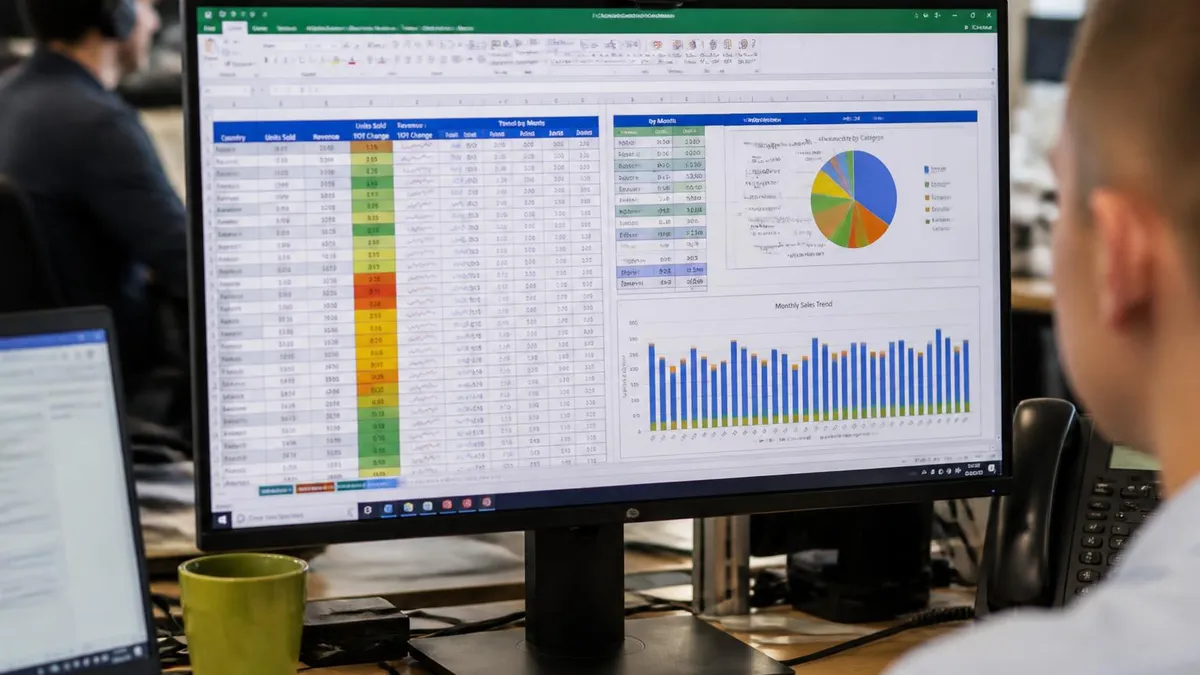
The 80/20 Rule of Excel Exam Prep
Research into MOS exam score distributions shows that roughly 80% of exam points come from just 20% of Excel's feature set: VLOOKUP/XLOOKUP, IF logic, PivotTables, conditional formatting, data validation, and chart creation. Mastering these six areas before moving on to niche topics is the highest-ROI preparation strategy available to any test-taker, regardless of timeline or experience level.
Microsoft offers two tiers of Excel certification under the Microsoft Office Specialist (MOS) program: MOS Excel Associate and MOS Excel Expert. The Associate credential validates everyday spreadsheet competencies — creating and managing workbooks, applying cell formatting, using basic formulas and functions, creating charts, and managing worksheets. The Expert credential goes deeper, testing Power Query, advanced formula techniques, PivotTable customization, What-If Analysis tools like Goal Seek and Scenario Manager, and macro-enabled workbook management. Both exams are performance-based, meaning you work in a live simulated Excel environment rather than answering abstract multiple-choice questions.
The MOS Excel Associate exam (Exam MO-200 for Excel 2019, MO-201 for Excel 365) consists of approximately 35 tasks organized into five to seven projects. Each project provides a partially completed Excel workbook and a set of instructions. You must complete the tasks in any order within each project, then move to the next project.
The total testing time is 50 minutes, which sounds generous until you realize that navigating an unfamiliar interface while under time pressure can make even simple tasks feel slow. Practicing in timed environments is therefore essential — not just for knowledge, but for building the procedural speed the exam demands.
The MOS Excel Expert exam (MO-201 or MO-202) adds complexity in several key areas. Custom number formats, advanced conditional formatting using formula-based rules, structured references within Excel Tables, auditing tools like Trace Dependents and Precedents, and importing data from external sources via Power Query are all tested. The Expert exam is widely regarded as a genuine differentiator in the job market — candidates who hold this credential demonstrate a level of Excel mastery that most self-taught users never reach, even after years of daily spreadsheet work.
Beyond Microsoft's own certifications, a growing number of employers administer proprietary Excel assessments during the hiring process. The Kforce Excel test, LinkedIn Skill Assessments for Excel, and Indeed Assessments all test overlapping but not identical skill sets. LinkedIn's Excel assessment, for example, includes scenario-based questions about which function to use in a given situation, as well as questions about best practices for data organization and workbook security. Passing LinkedIn's assessment earns a badge that appears on your profile, signaling proficiency to recruiters browsing the platform — a low-effort, high-visibility credential worth pursuing alongside formal certifications.
For students at community colleges and universities, the IC3 (Internet and Computing Core Certification) and the ICDL (International Computer Driving Licence) also include Excel components that appear on academic transcripts and resumes. These credentials are more common outside the United States but are recognized by multinational employers and government agencies in many countries. If you are studying at an institution affiliated with the Certiport testing network, check whether your campus offers voucher subsidies or free exam retakes through institutional agreements — these programs can significantly reduce the cost of certification for enrolled students.
Industry-specific Excel certifications are also worth considering for professionals in finance, accounting, and data analysis. The Financial Modeling & Valuation Analyst (FMVA) credential from the Corporate Finance Institute, for example, includes rigorous Excel testing as part of its financial modeling curriculum. Candidates learn advanced Excel techniques specifically applied to building three-statement financial models, discounted cash flow analyses, and sensitivity tables — skills that command premium salaries in investment banking, private equity, and corporate finance. These specialized certifications often carry more weight in their target industries than generalist Microsoft credentials.
Regardless of which certification path you pursue, the preparation strategy remains consistent: start with a skills gap assessment, build a structured study schedule, practice with realistic exam simulations, and review your errors systematically. The certification itself is a milestone, but the genuine Excel proficiency you develop along the way is the lasting professional asset. Every hour invested in structured Excel test prep pays dividends in daily productivity, career advancement, and the confidence that comes from truly mastering one of the most widely used professional tools in the world.
Microsoft MOS exams must be purchased through Certiport's authorized testing center network, and exam vouchers typically expire 12 months after purchase. If you fail an MOS exam, you must wait 24 hours before your first retake and 2 days before each subsequent attempt. Planning your registration date so that you have at least two weeks of buffer before the voucher expires is strongly recommended — this gives you time for a retake if needed without forfeiting your exam fee.
Advanced Excel features that appear on Expert-level exams deserve dedicated attention in the final weeks of your study schedule. Power Query, Microsoft's built-in data import and transformation tool, allows users to connect to databases, web pages, CSV files, and other Excel workbooks, then clean and reshape the imported data using a graphical interface.
On exams, Power Query tasks typically involve removing unnecessary columns, splitting columns by delimiter, changing data types, and appending or merging queries from multiple sources. While Power Query has its own dedicated ribbon tab, its functionality integrates seamlessly with PivotTables and Excel Tables, making it a powerful addition to any analyst's toolkit.
What-If Analysis tools — specifically Goal Seek, Data Tables, and Scenario Manager — are tested on Expert exams because they represent Excel's capacity for quantitative modeling beyond simple calculation. Goal Seek answers the question: what input value is needed to achieve a specific output? For example, if a sales target requires a specific profit margin, Goal Seek can calculate the required unit price.
Data Tables create a matrix of outcomes for one or two variable inputs, which is invaluable for sensitivity analysis in financial modeling. Scenario Manager allows users to save and compare multiple sets of input assumptions in a single workbook, making it easy to toggle between optimistic, pessimistic, and base-case projections.
Named ranges are a fundamental data management technique that improves formula readability and maintainability but are surprisingly underutilized by self-taught Excel users. Instead of writing =SUMIFS(D2:D500, C2:C500, "North"), a workbook with named ranges might read =SUMIFS(Revenue, Region, "North") — far easier to audit and modify.
Creating named ranges via Formulas > Name Manager, scoping them to specific worksheets, and using them inside Data Validation source fields are all exam-testable skills. The Evaluate Formula tool (Formulas > Evaluate Formula) is another auditing feature that walks through formula calculations step by step, which is invaluable both for exam troubleshooting and for real-world error diagnosis.
Macros and basic VBA (Visual Basic for Applications) knowledge is tested on MOS Expert exams at a foundational level — specifically, recording a macro, assigning it to a button, and running or deleting macros through the Developer tab. Deep VBA programming is not tested on the MOS credential, but candidates must know how to enable the Developer tab, understand the difference between macro-enabled (.xlsm) and standard (.xlsx) file formats, and recognize the security implications of enabling macros from untrusted sources. This is the kind of procedural knowledge that is easy to overlook during self-study but consistently appears on exam tasks.
Array formulas represent one of the more intellectually demanding topics in Excel test prep. Traditional array formulas, entered with Ctrl+Shift+Enter in older Excel versions, perform calculations across multiple cells simultaneously. Microsoft 365 introduced dynamic arrays that spill results automatically, along with new functions like FILTER, SORT, SORTBY, UNIQUE, SEQUENCE, and RANDARRAY that use this behavior natively. On modern MOS exams targeting Excel 365, candidates may encounter tasks requiring dynamic array functions. Understanding how spill ranges work, how to reference them using the # operator, and how to handle #SPILL! errors is part of comprehensive exam preparation for current certifications.
Collaboration features are another area increasingly represented on Excel assessments, reflecting the reality that most Excel workbooks today are shared among teams. Track Changes, workbook sharing settings, comment vs. note distinctions (in Excel 365, comments support threaded replies while notes are static annotations), and co-authoring behavior in OneDrive-connected workbooks are all testable. Protecting specific cell ranges while leaving others editable — using the Format Cells > Protection tab combined with the Protect Sheet dialog — is a practical worksheet security technique that appears regularly on intermediate and expert assessments.
Linking these advanced skills back to your overall preparation plan, the most effective approach is to build mastery in layers. Spend your first two weeks cementing the foundational skills, your third week tackling intermediate formula and data management techniques, and your fourth week on advanced features and timed simulation tests.
If you find a topic particularly challenging — dynamic arrays, Power Query, or PivotTable customization, for example — allocate an extra study session specifically to that topic rather than hoping repeated exposure to other material will shore up the weakness. Targeted, deliberate practice on your specific gaps is far more efficient than general review of topics you already understand well.
Building test-taking speed is just as important as building knowledge, and it is the element most often neglected by candidates who study exclusively from reading materials and videos. Timed practice tests reveal a fundamentally different challenge: the pressure of the clock affects decision-making, causes second-guessing, and can trigger small procedural errors that would never occur during relaxed practice.
The antidote is deliberate exposure to timed conditions throughout your preparation — not just in the final week. Aim to complete at least one timed practice session per week starting from week one, even if your score is low initially. Your score will improve as your procedural speed and confidence increase together.
Keyboard shortcut mastery is a high-use skill that compounds across all Excel tasks. Learning the top 25 Excel shortcuts — including Ctrl+Shift+L for filters, Alt+= for AutoSum, Ctrl+1 for Format Cells, Ctrl+Shift+$ for currency format, and F4 for toggling absolute/relative references — can save 30 to 60 seconds per task on a performance-based exam. Over 35 tasks, that time savings adds up to potentially 20+ minutes of reclaimed time, which you can redirect toward more complex or unfamiliar tasks. Dedicate 15 minutes per study session to shortcut drills using a shortcut reference sheet until the most common ones become automatic.
Error interpretation is a skill that separates confident Excel users from those who panic when a formula returns unexpected results. Knowing that #REF! means a cell reference is invalid (often caused by a deleted row or column), #VALUE! means the function received an incompatible data type, #DIV/0! means a formula is attempting to divide by zero, and #NAME? means Excel doesn't recognize a function name (usually a typo) allows you to diagnose and fix errors quickly.
On performance-based exams, you may be asked to correct a broken formula — and recognizing the error type instantly guides you to the right solution without wasted trial-and-error.
Practice with realistic sample data, not toy datasets with three rows and five columns. Real-world Excel proficiency is built on handling datasets with hundreds or thousands of rows, where sorting by the wrong column or forgetting to lock a reference before copying a formula causes cascading errors. Download free sample datasets from government open data portals, Kaggle, or Microsoft's own sample workbook library, and practice applying VLOOKUP, PivotTables, conditional formatting, and data validation on data that actually requires careful attention. This kind of realistic practice builds the situational awareness that multiple-choice studying alone cannot replicate.
Group study and peer accountability are underrated tools for Excel certification prep. Finding a study partner who is also preparing for an Excel assessment creates mutual accountability, enables peer teaching (which deepens understanding for both parties), and provides a sounding board for confusing concepts. If no in-person study partners are available, online communities like the Excel subreddit, Microsoft Answers forums, and LinkedIn Excel groups are active communities where learners share practice problems, answer each other's questions, and discuss exam experiences. Engaging with these communities even briefly can surface study strategies and exam insights that individual self-study misses entirely.
On exam day, read each task instruction carefully before touching the spreadsheet. Performance-based exams often include multiple sub-tasks within a single instruction, and missing a sub-task because you acted before finishing the read is a common, entirely preventable source of lost points. For tasks you find difficult, complete what you can, skip, and return at the end — most performance-based exams allow navigation between tasks within a project. Managing your time and mental energy deliberately across the full duration of the exam is just as important as any individual technical skill you have practiced.
After your exam — whether you pass or need to retake — document what you found most challenging while the experience is fresh. This debrief note becomes your roadmap for continued improvement or for helping others who ask about your preparation experience. The Excel skills you have built through structured test prep will outlast any single certification, continuing to add value to your professional work for years to come. Investing the time now to build genuine, deep Excel competency is one of the most practical professional development decisions any knowledge worker can make in today's data-driven workplace.
Sample Excel Practice Questions
Try these questions from our free Excel practice tests. The correct answer and an explanation follow each question.
Which Excel tool allows you to test multiple input values and see their effect on formula results simultaneously?
- A. Data Table
- B. Goal Seek
- C. Scenario Manager
- D. Solver
Answer: A. Data Table
Data Tables allow you to substitute multiple input values into formulas and display all results in a table format.
What does the IFERROR function do?
- A. Returns TRUE if a cell contains an error
- B. Replaces error values with a specified result
- C. Counts cells that contain errors
- D. Highlights cells with errors
Answer: B. Replaces error values with a specified result
IFERROR evaluates an expression and returns a custom value if it produces an error, otherwise returns the expression result.
What is the Inquire add-in used for?
- A. Creating surveys
- B. Analyzing workbook structure, comparing workbooks, tracing relationships
- C. Inquiring about features
- D. Managing data queries
Answer: B. Analyzing workbook structure, comparing workbooks, tracing relationships
Inquire provides advanced analysis: workbook comparison, cell relationship diagrams, and structure analysis.
What does =TRIM(" Hello World ") return?
- A. " Hello World "
- B. HelloWorld
- C. Hello World
- D. Hello World
Answer: C. Hello World
TRIM removes leading and trailing spaces and collapses multiple internal spaces to a single space.
Excel Questions and Answers

Excel to PDF: 5 Ways to Convert Your Spreadsheet

Excel COUNTA Function — Complete Guide (2026)

How to Create Hyperlinks in Excel: The Complete 2026 Guide to Linking Cells, Sheets, Files, and URLs

How to Use SUMIFS in Excel: The Complete Guide to Multi-Criteria Summing

Excel Data Validation: How to Restrict Input, Create Drop-Downs, and Prevent Errors
About the Author

Business Consultant & Professional Certification Advisor
Wharton School, University of PennsylvaniaKatherine Lee earned her MBA from the Wharton School at the University of Pennsylvania and holds CPA, PHR, and PMP certifications. With a background spanning corporate finance, human resources, and project management, she has coached professionals preparing for CPA, CMA, PHR/SPHR, PMP, and financial services licensing exams.