
EPA 608 Test Answer Sheet: Free Practice Questions & Exam Prep 2026
Master the EPA 608 test answer sheet with free practice questions, section breakdowns, and proven study tips. Pass your Section 608 exam in 2026. ✅
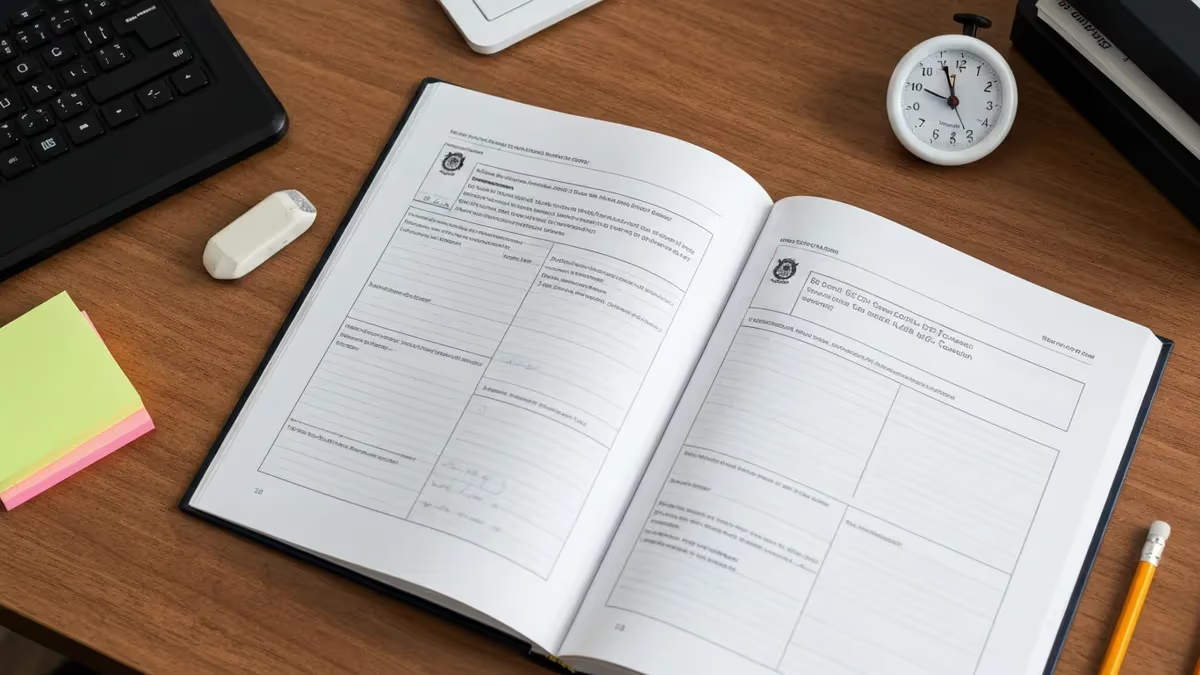
The EPA 608 test answer sheet is your roadmap to passing one of the most important certifications in the HVAC industry. Whether you are a first-time test taker or retaking to improve your score, understanding what the exam covers — and practicing with realistic questions — dramatically increases your chances of walking out of the testing center with a passing grade. The Section 608 certification is federally mandated for any technician who purchases or handles refrigerants, making it a non-negotiable credential for professional HVAC work across every state.
The EPA 608 exam is administered through EPA-approved testing organizations and covers four distinct certification types: Type I for small appliances, Type II for high-pressure systems, Type III for low-pressure systems, and Universal certification for technicians who want to work across all equipment categories. Each type tests a different knowledge base, but all sections share common core concepts around refrigerant safety, environmental regulations, and proper recovery procedures. Understanding which type you need before you sit down to study will focus your preparation on the right answer sheet questions.
Many candidates underestimate the exam difficulty. The Universal exam, for example, includes questions from all four sections and requires a score of 70 percent or higher on each section to pass. That means you cannot compensate for weakness in one area by excelling in another — every section must be cleared independently. This structure makes targeted practice with a realistic epa 608 test answer sheet format absolutely essential rather than optional preparation.
Practice tests serve a dual purpose in your preparation strategy. First, they expose gaps in your knowledge before the real exam does. If you consistently miss questions about refrigerant cylinder color codes or leak detection requirements, you know exactly where to spend your remaining study hours. Second, repeated exposure to exam-style questions trains your brain to recognize the phrasing and logic of correct answers, which speeds up your actual test-taking and reduces careless errors under pressure.
One of the most effective study strategies is to review not just which answer is correct, but why the other three options are wrong. EPA 608 questions are carefully crafted to include plausible distractors — answer choices that sound reasonable but contain a subtle inaccuracy. Technicians who drill on epa 608 test answers with full explanations consistently score higher than those who memorize isolated facts without context.
The refrigerant landscape is also evolving rapidly, and the EPA updates its Section 608 regulations to reflect new environmental policy. Hydrofluorocarbons (HFCs) are now being phased down under the AIM Act, and questions about next-generation low-GWP refrigerants are increasingly appearing on the exam. Staying current with regulatory updates and understanding the environmental rationale behind refrigerant rules will give you an edge on questions that go beyond simple memorization.
This guide covers everything you need to build a complete answer sheet strategy: the exam format, key topic areas, practice question categories, and a proven study schedule. Work through each section below, take the linked practice quizzes, and return to weak areas until your practice scores consistently exceed 80 percent. At that level of preparation, the actual EPA 608 exam should feel familiar and manageable rather than stressful and unpredictable.
- Each EPA Section 608 certification test must include at least 25 questions from the core group and at least 25 questions from each relevant technical group (Type I, Type II or Type III). (ecfr.gov)
- The passing score for the closed-book EPA Section 608 Type I, Type II, Type III and Universal certification tests is 70 percent. (ecfr.gov)
- The passing score for an EPA Section 608 Type I certification test taken in the mail-in format is 84 percent. (ecfr.gov)
- There is no single EPA fee for the Section 608 exam; each EPA-approved certifying program may charge reasonable fees to give the test. (ecfr.gov)
- EPA Section 608 Universal certification can be earned in one sitting or by combining passing scores on separate Type I, Type II and Type III tests. (ecfr.gov)
- EPA Section 608 Technician Certification credentials do not expire. (U.S. Environmental Protection Agency (EPA), Stationary Refrigeration Program. Section 608 tests are given by EPA-approve)
- EPA Section 608 Technician Certification never needs to be renewed because the credentials do not expire. (U.S. Environmental Protection Agency (EPA), Stationary Refrigeration Program. Section 608 tests are given by EPA-approve)
- EPA Section 608 Type II, Type III and Universal certification require a closed-book, proctored test given in a secure setting by an EPA-approved certifying program. (ecfr.gov)
- To earn EPA Section 608 Universal Certification, the core test must be taken as a proctored exam, because an open-book core test cannot be used toward Universal. (U.S. Environmental Protection Agency (EPA), Stationary Refrigeration Program. Section 608 tests are given by EPA-approve)
Facts verified Oct 15, 2026 against U.S. Environmental Protection Agency (EPA), Stationary Refrigeration Program. Section 608 tests are given by EPA-approve. Dates that have passed are removed automatically.
EPA 608 Exam at a Glance
| Item | Detail | Official source |
|---|---|---|
| Number of questions | At least 25 core questions plus at least 25 per type (Type I, II, III) | ecfr.gov |
| Passing score | 70% (closed-book Type I, II, III and Universal) | ecfr.gov |
| Passing score (Type I (mail-in)) | 84% (mail-in Type I) | ecfr.gov |
| Exam fee | Set by each EPA-approved certifying program ("reasonable fees"); EPA sets no fixed fee | ecfr.gov |
| Retake policy (Universal) | Universal can be earned all at once or by combining passed Type I, II and III tests | ecfr.gov |
| Validity | Lifetime (does not expire) | U.S. Environmental Protection Agency (EPA), Stationary Refrigeration Program. Section 608 tests are given by EPA-approve |
| Renewal | No renewal required | U.S. Environmental Protection Agency (EPA), Stationary Refrigeration Program. Section 608 tests are given by EPA-approve |
| Delivery | Closed-book, proctored test from an EPA-approved certifying program (Type II, III, Universal) | ecfr.gov |
| Delivery (Universal) | Proctored core test required; open-book core does not count toward Universal | U.S. Environmental Protection Agency (EPA), Stationary Refrigeration Program. Section 608 tests are given by EPA-approve |
| Eligibility | Required for technicians who could release refrigerant; supervised apprentices exempt | U.S. Environmental Protection Agency (EPA), Stationary Refrigeration Program. Section 608 tests are given by EPA-approve |
| Score release | Within 30 days of the test date | ecfr.gov |
Facts verified Oct 15, 2026 against U.S. Environmental Protection Agency (EPA), Stationary Refrigeration Program. Section 608 tests are given by EPA-approve. Dates that have passed are removed automatically.
EPA 608 Certification by the Numbers

EPA 608 Exam Format & Section Breakdown
| Section | Questions | Time | Weight | Notes |
|---|---|---|---|---|
| Core (Section 608 Basics) | 25 | 45 min | 25% | Required for all certification types |
| Type I — Small Appliances | 25 | 45 min | 25% | Sealed systems under 5 lbs refrigerant |
| Type II — High-Pressure Systems | 25 | 45 min | 25% | R-22, R-410A, and similar refrigerants |
| Type III — Low-Pressure Systems | 25 | 45 min | 25% | R-11, R-123, and centrifugal chillers |
| Total | 100 | 3 hours | 100% |
The core topics that appear most frequently on the EPA 608 answer sheet fall into six broad categories: refrigerant properties and identification, environmental regulations under Section 608 of the Clean Air Act, recovery and recycling procedures, leak detection and repair requirements, safety protocols, and refrigerant handling equipment. Each of these categories appears in both the core section and the type-specific sections, though the depth and technical specificity increases when you move into Type II and Type III questions about high-pressure and low-pressure systems respectively.
Refrigerant identification is one of the most commonly tested topic areas and one where many candidates lose easy points. The exam expects you to know cylinder color codes — for example, R-22 cylinders are light green, R-410A cylinders are pink, and R-134a cylinders are light blue. You must also know the refrigerant's chemical classification (HCFC, HFC, CFC, or natural refrigerant), its ozone depletion potential (ODP), and its global warming potential (GWP). Questions will ask you to distinguish between refrigerants by their properties, boiling points, and the types of systems they are used in.
Environmental regulations form the legal backbone of the entire exam. The Montreal Protocol phases out ozone-depleting substances internationally, while the Clean Air Act Section 608 establishes domestic rules for refrigerant handling. The AIM Act of 2020 added another regulatory layer by creating a phase-down schedule for HFCs based on their GWP values. Exam questions regularly test whether you understand the difference between a phase-out (complete elimination) and a phase-down (gradual reduction), and which refrigerants are subject to each type of regulatory action.
Recovery procedures are heavily tested because improper recovery is one of the most common violations that technicians commit in the field. The exam will ask about required recovery levels — expressed as vacuum levels in inches of mercury (in. Hg) or as system pressure — that must be achieved before opening a system for repair. These recovery levels vary depending on the system type, the refrigerant involved, and the capacity of the equipment. A recovery level of 10 in. Hg vacuum is required for systems containing less than 200 pounds of refrigerant using R-11 or R-113, for instance.
Leak detection and repair rules are another major exam category. Technicians must know the leak rate thresholds that trigger mandatory repair obligations — currently 15 percent for comfort cooling equipment and 35 percent for industrial process refrigeration per year. The exam also covers acceptable leak detection methods: electronic detectors, ultrasonic detectors, fluorescent dye, and bubble solution each have appropriate use cases and limitations. Questions will ask you to identify the most effective detection method for a given scenario and to understand the documentation requirements after a leak is found and repaired.
Safety is woven throughout every section of the exam. Questions about refrigerant toxicity, asphyxiation risks, proper ventilation procedures, and personal protective equipment (PPE) requirements appear regularly. For example, you need to know that R-123 is mildly toxic and requires special attention to ventilation compared to most other common refrigerants. Safe cylinder handling, including the prohibition against filling cylinders above 80 percent capacity and the rules against mixing refrigerants in recovery cylinders, is also tested frequently.
Understanding refrigerant handling equipment completes the core knowledge base. Recovery machines, reclaim equipment, and recycling units each have different definitions and regulatory implications under Section 608. A recovery machine removes refrigerant from a system and stores it in a cylinder without necessarily cleaning it.
A reclaim operation returns refrigerant to ARI 700 purity standards, which is the only standard that allows refrigerant to be resold as a virgin product. Knowing these distinctions cold — and being able to answer questions about equipment certification requirements under UL and EPA standards — will add several correct answers to your practice test score immediately.
Section-by-Section EPA 608 Study Strategies
Type I covers sealed systems containing five pounds or less of refrigerant, including household refrigerators, window air conditioners, and packaged terminal units. The key concepts for this section include passive recovery techniques, the use of self-contained recovery equipment, and the specific recovery efficiencies required before servicing. Because these systems are sealed from the factory, the exam focuses heavily on what technicians must do when a system is punctured or a component must be replaced, including the required recovery levels and proper disposal procedures for appliances at end of life.
To maximize your Type I score, focus on the definitions that distinguish Type I equipment from other categories — particularly the five-pound threshold — and memorize the exceptions that apply to small appliances regarding recovery equipment certification. Type I practice questions often include scenario-based problems where you must identify whether a specific action is permitted, required, or prohibited. Working through at least 50 Type I practice questions before the exam will help you internalize the subtle regulatory distinctions that separate correct answers from close-but-wrong distractors on the actual answer sheet.

Universal vs. Single-Type EPA 608 Certification: Which Is Right for You?
- +Universal certification covers all refrigerant types and system categories in one credential
- +Opens access to a wider range of job opportunities and employer requirements
- +Higher earning potential — Universal-certified technicians command premium wages
- +Eliminates the need to return for additional certifications as your career expands
- +Single exam session covers all four sections, saving time compared to multiple sittings
- +Demonstrates comprehensive knowledge that distinguishes you from single-type technicians
- −Requires passing all four sections at 70 percent or higher — no averaging between sections
- −More study material to master before the exam, increasing prep time significantly
- −Higher cognitive load on exam day with 100 questions across very different system types
- −Type III (low-pressure) content is less relevant for most residential technicians day-to-day
- −Some testing organizations charge a slightly higher fee for Universal versus single-type
- −Failing one section means retaking only that section, but adds scheduling complexity
EPA 608 Exam Day Preparation Checklist
- ✓Complete at least three full-length practice exams under timed conditions before your test date.
- ✓Score 80 percent or higher consistently on practice tests before scheduling the real exam.
- ✓Review all incorrect practice answers and read the explanations — not just the right letter.
- ✓Memorize refrigerant cylinder color codes for R-22, R-410A, R-134a, R-404A, and R-123.
- ✓Know the recovery level requirements (in inches of Hg) for each system type and refrigerant category.
- ✓Understand the difference between recovery, recycling, and reclamation under EPA Section 608.
- ✓Review leak rate thresholds: 15% for comfort cooling, 35% for industrial process refrigeration.
- ✓Bring a valid government-issued photo ID that matches your registration name exactly.
- ✓Arrive at the testing center at least 15 minutes early to complete check-in procedures.
- ✓Get adequate sleep the night before — cognitive performance drops sharply with less than seven hours.

The 70% Rule Applies to EACH Section Independently
Many Universal candidates are surprised to learn that a 90 percent score on Type II cannot compensate for a 65 percent score on Type III. Every section must independently clear the 70 percent threshold. Identify your weakest section early in your preparation and allocate proportionally more study time there — this single strategy prevents the most common reason Universal candidates fail and must retake the exam.
Understanding the scoring system for the EPA 608 exam helps you set realistic preparation targets and avoid the trap of over-studying topics you already know well. The exam is scored on a section-by-section basis, and each section contains 25 questions for the Universal exam. To pass any individual section, you must answer at least 18 of those 25 questions correctly — that is the 70 percent minimum translated into raw numbers. For the Core section alone (Type I, Type II, or Type III certification), the same 70 percent threshold applies regardless of which certification type you are pursuing.
If you fail one or more sections of the Universal exam, you are not required to retake the entire exam. Most EPA-approved testing organizations allow you to retake only the sections you failed, which saves both time and money. However, the retake policy and associated fees vary by testing organization, so confirm the specific rules with your chosen test site before you schedule. Some organizations require a waiting period between attempts — typically 24 to 72 hours — to prevent candidates from immediately retaking a section they just failed without any additional preparation.
Score reporting is typically immediate for computer-based exams. You will receive your section scores before leaving the testing center, and if you pass, your certification card is either issued on the spot or mailed within a few weeks depending on the testing organization. The EPA 608 certification does not expire once earned — it is a lifetime credential. However, regulatory updates to Section 608 have sometimes prompted voluntary recertification programs, and staying current with refrigerant regulations through continuing education is advisable even after you have your certification in hand.
Many candidates find that their practice test scores on their first attempt cluster around 60 to 65 percent — just below the passing threshold. This is actually a healthy starting point if you have two to four weeks of study time remaining. The delta between 65 and 70 percent represents roughly one or two additional correct answers per section, which is achievable through focused review of your most-missed topic categories. Tracking your practice scores by topic area — not just by overall percentage — gives you the data-driven feedback you need to close that gap efficiently.
The difficulty distribution within the exam is not uniform. EPA statistics and technician reports consistently indicate that the Core section and Type II section are more heavily weighted toward application and regulatory interpretation than pure recall. This means that memorizing facts alone is insufficient for the highest-stakes questions. You must also be able to apply regulatory logic to novel scenarios — for example, determining whether a specific service action is required, permitted, or prohibited given a set of system conditions and refrigerant quantities.
Retake candidates — technicians who are taking the exam for a second or third time — should focus their preparation differently from first-time candidates. If you know which section you failed, build a targeted question bank around that section's topic categories and drill it intensively for at least one week before rescheduling.
Retake candidates who simply study the same material the same way typically see minimal score improvement. Changing your study method — for example, switching from reading to active recall or joining a study group — often produces better results than simply putting in more hours with the same approach.
One often-overlooked factor in pass rates is test anxiety. The EPA 608 exam is not extraordinarily difficult for well-prepared candidates, but anxiety can cause even knowledgeable technicians to second-guess correct answers or misread question stems. Practice exams taken under realistic timed conditions are the most effective way to reduce test anxiety, because they make the testing experience feel familiar. By the time you sit down for the real exam, the format, pacing, and question style should feel like a routine exercise rather than a high-stakes unknown.
As of January 1, 2018, technicians must provide proof of EPA 608 certification to purchase refrigerants with a Global Warming Potential (GWP) of 50 or greater in containers larger than 2 pounds. Selling refrigerant to uncertified individuals is a federal violation with fines up to $44,539 per day per violation. Do not attempt to purchase regulated refrigerants before your certification card arrives.
Maximizing your score on the EPA 608 exam comes down to a combination of content knowledge, strategic test-taking, and efficient use of your study time in the weeks before the exam. The most impactful single action you can take is to work through a large volume of practice questions — ideally 200 to 300 questions distributed across all sections — and rigorously review every question you get wrong. Passive reading of study guides produces familiarity with the material; active practice question drilling produces the pattern recognition that translates directly into correct answers under exam conditions.
Time management during the actual exam deserves specific attention. With 25 questions per section and approximately 45 minutes allocated per section in the Universal format, you have roughly 1.8 minutes per question. This is generous time for most questions, but complex scenario-based questions can easily consume three to four minutes if you are not careful.
The best strategy is to move through the section answering every question you know confidently, flagging uncertain questions, and then returning to flagged questions with whatever time remains. Never spend so long on one difficult question that you run out of time for questions you would have answered correctly.
The phrasing of answer choices on the EPA 608 exam follows predictable patterns that experienced test-takers learn to recognize. Absolute language — words like "always," "never," "must," and "prohibited" — often signals a rule-based question where the correct answer is a specific regulatory requirement. Comparative language — "most appropriate," "best method," "primary reason" — signals a judgment-based question where you need to weigh options against each other. Recognizing these patterns helps you allocate mental energy appropriately: rule questions reward memorization, while judgment questions reward conceptual understanding.
Understanding common wrong-answer patterns also improves your score significantly. EPA 608 distractors typically fall into three categories: answers that are true statements but do not answer the specific question asked, answers that apply a real rule to the wrong scenario, and answers that contain one plausible element alongside one clearly incorrect element. When you are uncertain about a question, eliminating the obviously wrong distractors and choosing between the remaining options gives you a 50 percent chance on the hardest questions — far better than random guessing across four choices.
Study groups are an underutilized resource for EPA 608 preparation. Working through practice questions with one or two other candidates creates opportunities to explain your reasoning aloud — a process that exposes gaps in understanding that silent solo studying often misses. When you can explain why R-410A requires different recovery equipment than R-22, or why passive recovery is acceptable for Type I but not for most Type II scenarios, you have achieved the depth of understanding that produces consistent exam performance rather than lucky correct guesses.
The two weeks immediately before the exam should be your most intensive study period, but they should also include strategic rest and consolidation. Many candidates make the mistake of trying to learn entirely new material in the final days before the exam. This is counterproductive — new information learned under time pressure is poorly consolidated and easily confused under exam stress.
Instead, the final week should focus entirely on reinforcing material you have already studied: reviewing your practice test mistakes, drilling your weakest topic areas, and taking one final full-length practice exam three to four days before your scheduled test date.
On the day before the exam, avoid intensive studying. A light review of key facts — refrigerant color codes, recovery level numbers, leak rate thresholds — is fine, but trying to cram new concepts the night before the exam typically hurts performance rather than helping it.
Prioritize a full night of sleep, eat a normal meal before the exam, and arrive at the testing center with enough time to check in calmly. The preparation you have done over the previous weeks is what will carry you to a passing score — not last-minute cramming. Trust your preparation, read each question carefully, and work through the exam with steady confidence.
Building an effective study schedule for the EPA 608 exam does not require months of preparation, but it does require consistent, structured effort over at least two to four weeks. The most successful candidates treat their EPA 608 prep the same way they would approach any professional certification: with a written study plan, daily practice sessions, and measurable milestones that track their progress toward the 70 percent passing threshold. Ad hoc studying — picking up study materials occasionally whenever time permits — produces inconsistent results and leaves significant knowledge gaps that show up on the real exam.
Begin your preparation by taking a diagnostic practice exam across all four sections before you have studied anything. Your initial score tells you exactly where your baseline knowledge sits and which sections will require the most effort. Most working HVAC technicians who have hands-on experience will score reasonably well on Type II questions based on practical knowledge alone, but struggle with Type III low-pressure content and with the precise regulatory language tested in Core questions. Let your diagnostic score drive your time allocation rather than guessing where to focus.
Allocate your study time roughly as follows for a four-week preparation plan: spend the first week on Core concepts and Type I material, the second week on Type II high-pressure systems, the third week on Type III low-pressure systems, and the fourth week on integrated review and full-length practice exams. Within each week, aim for 30 to 45 minutes of focused practice per day rather than long marathon sessions on weekends only. Distributed practice is significantly more effective for retention than massed practice, especially for regulatory detail that must be recalled precisely under exam conditions.
Use multiple study resources rather than relying on a single source. The EPA's own Section 608 regulations, available on the EPA website, provide the authoritative source for all regulatory rules. Published study guides from ESCO Institute and Mainstream Engineering provide organized summaries that are easier to study from than raw regulatory text. Practice question banks — including the free practice tests available on this site — test your knowledge in exam-realistic formats. Each resource type serves a different function, and combining them produces faster learning than using any single source exclusively.
Flashcards remain one of the most efficient tools for memorizing the specific numerical values and refrigerant identifiers that appear repeatedly on the exam. Create cards for refrigerant color codes, recovery level requirements, leak rate thresholds, cylinder capacity limits, and GWP values for common refrigerants. Review these cards daily during your first two weeks of preparation, then shift to weekly review once the information feels solid. The goal is automatic recall — you should be able to answer questions about R-410A cylinder color or recovery vacuum requirements in under three seconds without active retrieval effort.
Joining an online HVAC technician community or forum can supplement your solo study efforts with real-world context. Many experienced technicians share exam tips, flag frequently tested topics, and describe question types that surprised them on their own exam. This crowdsourced intelligence about the exam can help you avoid spending excessive time on rarely tested topics and ensure you are focusing on the high-yield content areas that actually determine whether candidates pass or fail. Community study is not a replacement for rigorous practice, but it is a valuable complementary resource that costs nothing but time.
Finally, approach the EPA 608 exam with the right mindset: this is a knowledge test about a subject area you will use throughout your career, not an arbitrary obstacle. Every topic the exam covers — refrigerant safety, environmental regulations, proper recovery procedures — directly affects the quality and legality of your work in the field.
Technicians who approach the exam with genuine curiosity about the underlying principles — not just memorizing facts to pass a test — tend to score higher and retain the knowledge longer. The credential you earn from passing the EPA 608 exam is a foundation for a safer, more professional, and more compliant HVAC career.
EPA 608 Questions and Answers

Mainstream Engineering EPA 608: Complete Study Guide & Certification Prep
EPA 608 Practice Test 2026 — Free Questions

EPA 608 Universal Practice Test: Master All Refrigerant Sections Before Exam Day

EPA 608 Study Guide 2026 — Section 608 Certification Prep for HVAC
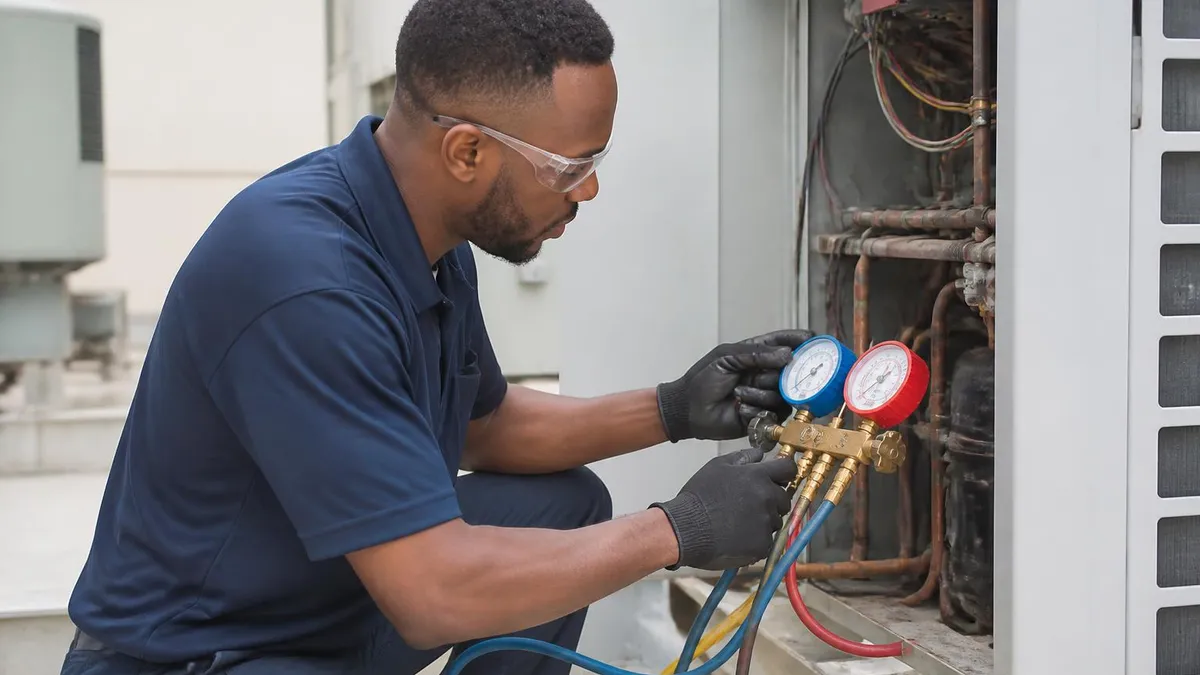
EPA 608 Certification Online: Complete Study Guide & Exam Prep 2026
About the Author

NATE Certified HVAC Technician & Licensing Exam Trainer
Universal Technical InstituteMike Johnson is a NATE-certified HVAC technician and EPA 608 universal-certified refrigerant handler with a Bachelor of Science in HVAC/R Technology. He has 19 years of commercial and residential HVAC installation and service experience and specializes in preparing technicians for NATE certification, EPA 608, A2L refrigerant safety, and state HVAC contractor licensing examinations.