

EEG Practice Test
Updated October 2026Facts verified Oct 25, 2026 against ABRET Neurodiagnostic Credentialing and Accreditation
- The R. EEG T. exam is a computer-based multiple-choice exam presented in two sections; ABRET does not publish a question count.[1]
- The R. EEG T. passing standard is set by the ABRET Board as the number of questions needed to be minimally competent; no numeric cut score is published.[1]
- The ABRET R. EEG T. examination application fee is $700.[1]
- After three unsuccessful R. EEG T. attempts within two years, candidates must wait six months and submit 20 more EEG-related ASET CEUs before retesting.[1]
- The R. EEG T. credential is awarded for five years.[2]
- The R. EEG T. exam can be taken at a Prometric test center or through live remote proctoring from home.[1]
- R. EEG T. candidates get an unofficial result before leaving the test center, and the official result comes about 4–6 weeks after the exam.[1]
Numbers in brackets link to the official sources listed under Sources & last verified. Dates that have passed are removed automatically.
EEG Exam at a Glance
| Item | Detail | Source · Verified |
|---|---|---|
| Number of questions (R. EEG T.) | Computer-based multiple-choice, two sections[1] | ABRET Neurodiagnostic Credentialing and Accreditation · Oct 25, 2026 |
| Passing score (R. EEG T.) | Board-set passing standard (number not published)[1] | ABRET Neurodiagnostic Credentialing and Accreditation · Oct 25, 2026 |
| Exam fee (R. EEG T.) | $700 application/exam fee[1] | ABRET Neurodiagnostic Credentialing and Accreditation · Oct 25, 2026 |
| Retake policy (R. EEG T.) | After 3 fails in 2 years, wait 6 months + 20 ASET CEUs[1] | ABRET Neurodiagnostic Credentialing and Accreditation · Oct 25, 2026 |
| Validity (R. EEG T.) | 5 years[2] | ABRET Neurodiagnostic Credentialing and Accreditation · Oct 25, 2026 |
| Delivery (R. EEG T.) | Prometric test center or live remote proctoring[1] | ABRET Neurodiagnostic Credentialing and Accreditation · Oct 25, 2026 |
| Score release (R. EEG T.) | Unofficial result at test end; official in about 4–6 weeks[1] | ABRET Neurodiagnostic Credentialing and Accreditation · Oct 25, 2026 |
| Late registration deadline (R. EEG T. recertification) | Grace period to January 31, +$100 late fee[3] | ABRET Neurodiagnostic Credentialing and Accreditation · Oct 25, 2026 |
| Testing window (R. EEG T.) | 3 months from 'Eligible to Test'; tested Mon–Sat[1] | ABRET Neurodiagnostic Credentialing and Accreditation · Oct 25, 2026 |
What changed for EEG in 2026
- Oct 25, 2026: Passing score (R. EEG T.) changed to Board-set passing standard (number not published) (previously Criterion-referenced standard set by the Board (number not published)).[1]
- Oct 25, 2026: Retake policy (R. EEG T.) changed to After 3 fails in 2 years, wait 6 months + 20 ASET CEUs (previously One attempt per application; after 3 fails in 2 years, wait 6 months + 20 ASET CEUs).[1]
- Oct 25, 2026: Validity (R. EEG T.) changed to 5 years (previously 5 years (expires December 31)).[2]
Note: The R. EEG T. exam is a single computer-based, multiple-choice exam administered by Prometric on ABRET's behalf. It is delivered in two sections of 120 minutes each (4 hours total testing time), covering pre-study procedures, performing the EEG study, post-study procedures, and ethics/professional issues. There is no separate oral or practical component.
EEG Technologist Flashcards
Quick review for key EEG concepts and terminology
👁️What causes eye blink artifacts?
Eye blink artifacts are caused by the movement of the eyelid over the cornea, generating a positive potential field that affects frontal electrodes (Fp1, Fp2).
GET EEG EXAM PREP📉What is an impedance check?
An impedance check verifies the quality of the connection between the electrode and the scalp. Acceptable impedance for clinical EEG is typically below 5 kOhms.
TRY EEG MOCK EXAMWhat is the EEG Medical Test?
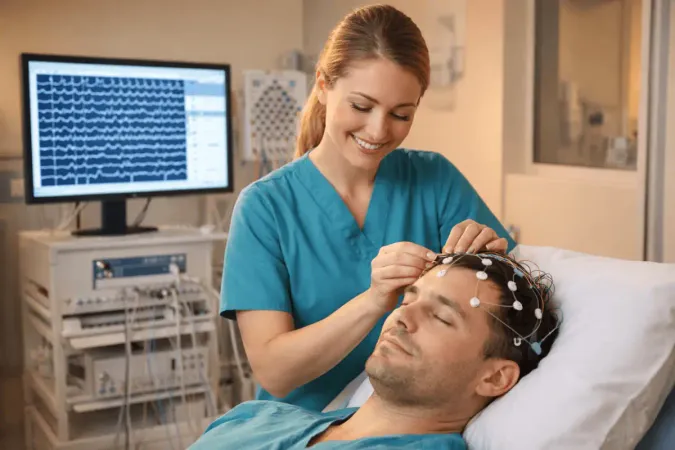
The eeg medical test is a non-invasive procedure that records the brain's electrical activity. It is the primary diagnostic tool for epilepsy but is also used for sleep disorders, encephalopathies, and coma evaluation. Understanding eeg test is for what purpose is fundamental for technologists.
The total cost to become a certified EEG technologist ranges from $7,000 to $25,000 including education. However, many employers offer tuition reimbursement for exam fees. Try our NCLEX practice test. Practice with the free EEG - Electroencephalography practice test on PracticeTestGeeks (400+ questions with answer explanations).
Free EEG - Electroencephalography Study Tools
Interactive EEG - Electroencephalography resources on PracticeTestGeeks, free to start:
- Free EEG Routine Questions and Answers 1 — 11 questions with instant scoring and answer explanations
- EEG - Electroencephalography flashcards — review key terms and concepts card by card
- EEG - Electroencephalography study guide — topic-by-topic overview of what the exam covers
- EEG - Electroencephalography cheat sheet — one-page printable summary for last-minute review
According to ABRET Neurodiagnostic Credentialing and Accreditation, “is a computer-based examination composed of multiple-choice, objective questions with a total testing time of four (4) hours.”[1]
EEG Practice Test Questions
Prepare for the EEG - Electroencephalography exam with our free practice test modules. Each quiz covers key topics to help you pass on your first try.
EEG - Electroencephalography Abnormal Epil...
EEG Mock Test covering - Electroencephalography Abnormal Epileptiform Patterns Questions and Answers. Online EEG Test practice with instant feedback.
EEG - Electroencephalography Activation Pr...
Free EEG Quiz on - Electroencephalography Activation Procedures Questions and Answers. EEG Exam prep questions with detailed explanations.
EEG - Electroencephalography Artifact Iden...
EEG Practice Questions for - Electroencephalography Artifact Identification Questions and Answers. Build confidence for your EEG certification exam.
EEG - Electroencephalography Electrode Pla...
EEG Test Online for - Electroencephalography Electrode Placement and Montages Questions and Answers. Free practice with instant results and feedback.
EEG - Electroencephalography Instrumentati...
EEG Study Material on - Electroencephalography Instrumentation and Calibration Questions and Answers. Prepare effectively with real exam-style questions.
EEG - Electroencephalography Neuroanatomy ...
Free EEG Test covering - Electroencephalography Neuroanatomy and Physiology Questions and Answers. Practice and track your EEG exam readiness.
EEG - Electroencephalography Non-Epileptif...
EEG Exam Questions covering - Electroencephalography Non-Epileptiform Abnormalities Questions and Answers. Master EEG Test concepts for certification prep.
EEG - Electroencephalography Normal EEG Wa...
Free EEG Practice Test featuring - Electroencephalography Normal EEG Waveforms Questions and Answers. Improve your EEG Exam score with mock test prep.
EEG - Electroencephalography Patient Safet...
EEG Mock Exam on - Electroencephalography Patient Safety and Ethics Questions and Answers. EEG Study Guide questions to pass on your first try.
EEG - Electroencephalography Pediatric and...
EEG Test Prep for - Electroencephalography Pediatric and Neonatal EEG Questions and Answers. Practice EEG Quiz questions and boost your score.
EEG Evoked Potentials
EEG Questions and Answers on Evoked Potentials. Free EEG practice for exam readiness.
EEG ICU and Continuous EEG Monitoring
EEG Mock Test covering ICU and Continuous EEG Monitoring. Online EEG Test practice with instant feedback.
EEG Routine
Free EEG Practice Test featuring Routine. Improve your EEG Exam score with mock test prep.
EEG Sleep Staging and Sleep EEG
EEG Mock Exam on Sleep Staging and Sleep EEG. EEG Study Guide questions to pass on your first try.
Worked examples: how to reason through EEG questions
These are practice questions written for this site, not questions from the real exam. Each explanation shows why the right answer is right and why the others are wrong.
Example 1
Question: Photomyogenic (photomyoclonic) response, which can mimic a photoparoxysmal response, differs in that it:
- Outlasts the stimulus train
- Is frontally predominant muscle artifact time-locked to each flash
- Consists of generalized spike-wave discharges
- Begins with a posterior predominance
Answer: B. Is frontally predominant muscle artifact time-locked to each flash
Explanation:
The correct answer is that a photomyogenic response is frontally predominant muscle artifact time-locked to each flash. The muscle under the forehead and around the eyes twitches with each light pulse, so the spikes on the tracing follow the stimulus rhythm and stop when the flashing stops.
Outlasting the stimulus train is wrong because that behavior points toward a true cerebral photoparoxysmal response, which can continue after the flashes end. Generalized spike-wave discharges are also wrong, since that is the pattern of the cerebral response, not of muscle artifact. A posterior onset is wrong too: the muscle artifact is frontal, while the cerebral response tends to begin over the back of the head.
Rule to remember: if the activity is frontal, looks like muscle, and locks to every flash, think artifact. If it spreads, outlasts the stimulus, or looks like spike-wave, think cerebral.
Example 2
Question: Which EEG frequency band is most prominent during deep NREM sleep (stage N3)?
- Delta (0.5–4 Hz)
- Theta (4–8 Hz)
- Alpha (8–13 Hz)
- Beta (13–30 Hz)
Answer: A. Delta (0.5–4 Hz)
Explanation:
Delta, 0.5 to 4 Hz, is correct. Deep NREM sleep, stage N3, is also called slow-wave sleep because the record fills with high-amplitude, slow delta activity.
Theta, 4 to 8 Hz, is wrong because it is typical of drowsiness and lighter sleep stages, not the deepest stage. Alpha, 8 to 13 Hz, is wrong because it is the relaxed, eyes-closed waking rhythm over the posterior head and fades as sleep begins. Beta, 13 to 30 Hz, is wrong because it is fast activity linked with alertness, concentration and some medications, and it is not the signature of deep sleep.
Rule to remember: as sleep deepens, the dominant frequency slows. Waking alpha gives way to theta, and the deepest stage is dominated by delta.
Example 3
Question: A burst suppression pattern on EEG is most consistent with which clinical scenario?
- Stage II sleep in a healthy adult
- Severe diffuse cerebral dysfunction such as deep anesthesia or anoxic brain injury
- Focal temporal lobe lesion
- Benign rolandic epilepsy
Answer: B. Severe diffuse cerebral dysfunction such as deep anesthesia or anoxic brain injury
Explanation:
The correct answer is severe diffuse cerebral dysfunction, such as deep anesthesia or anoxic brain injury. Burst suppression alternates bursts of activity with periods of very low voltage, and it reflects a brain that is profoundly depressed as a whole.
Stage II sleep in a healthy adult is wrong because normal sleep has its own recognizable features, such as spindles, and continuous background activity, not long flat gaps. A focal temporal lobe lesion is wrong because a focal problem produces a focal abnormality, while burst suppression is generalized. Benign rolandic epilepsy is wrong because it is a childhood epilepsy syndrome with focal spikes and a normal background, not a suppressed one.
Rule to remember: a diffuse, markedly depressed background with bursts points to a global cause, so think sedation, anoxia or similar severe injury.
How to use these practice tests
Start with the official material. Download the current R. EEG T. handbook from abret.org and read what it says about eligibility, the exam, and the retake rules, since the passing number is not published and the handbook is the authority.
Then take a diagnostic pass on our general sets, the free EEG practice test and the EEG exam questions quiz. Note which topics cost you the most misses.
Work through topic sets next, spending more time where you missed more. Good starting points are electrode placement and montages, artifact identification, normal waveforms and abnormal epileptiform patterns. Use sleep staging and ICU and continuous monitoring for the specialty material.
After every miss, read the explanation, then write the rule in your own words and check it against your textbook or lab protocols. Our questions are written by us and are not real exam questions, so treat them as practice for reasoning, not a preview of the test.
In the final days, redo only the questions you missed, review instrumentation and patient safety, and confirm your testing option, either a test center or remote proctoring, along with your testing window.
EEG Technologist Career Paths
Specializing in different areas of neurodiagnostics opens doors to advanced roles.
Pediatric EEG
Specializes in performing EEGs on neonates and children, requiring patience and knowledge of developmental patterns.
LTM TechLong-
Term Monitoring technologists work in Epilepsy Monitoring Units (EMU), observing patients for days to capture seizures.
IOM Tech
Intraoperative Monitoring involves monitoring nervous system integrity during spinal and brain surgeries.
Sleep Tech
Polysomnography (PSG) involves monitoring sleep cycles to diagnose disorders like sleep apnea.
EEG Test Day Checklist
- ✓Valid Government ID (2 forms)
- ✓ABRET Authorization Email
- ✓Arrive 30 mins early
- ✓Review 10-20 System
- ✓Comfortable clothing (layer)
- ✓Leave electronics in car/locker
- ✓Hydrate and eat beforehand
- ✓Positive mindset!
Master the EEG Exam
Get instant access to 500+ free practice questions, detailed flashcards, and a complete study guide. Start your journey to becoming a Registered EEG Technologist today!
Earn your CEUs through ASET webinars, regional conferences, or journal quizzes. Keeping your certification active is essential for career advancement and potential travel opportunities.
EEG: Pros and Cons
- +EEG certification validates expertise recognized by employers nationwide
- +Certified professionals typically earn 15-20% higher salaries
- +Opens doors to advanced positions and leadership roles
- +Demonstrates commitment to professional standards and ethics
- +Builds a strong professional network through certification communities
- −Exam preparation typically requires 2-4 months of dedicated study
- −Certification and exam fees can range from $150-$500+
- −Must complete continuing education to maintain active certification
- −Pass rates vary — thorough preparation is essential for success
- −Some certifications require prerequisite experience or education
Pros and Cons at a Glance
| Pros | Cons |
|---|---|
| EEG certification validates expertise recognized by employers nationwide | Must complete continuing education to maintain active certification |
| Opens doors to advanced positions and leadership roles | Pass rates vary — thorough preparation is essential for success |
| Demonstrates commitment to professional standards and ethics | Some certifications require prerequisite experience or education |
Sample EEG - Electroencephalography Practice Questions
Try these questions from our free EEG - Electroencephalography practice tests. The correct answer and an explanation follow each question.
To minimize the risk of electrical shock to the patient, what is the single most important electrical safety practice in the EEG laboratory?
- A. Using a notch filter to remove 60 Hz interference.
- B. Ensuring all electrodes have an impedance below 1 kOhm.
- C. Plugging all patient-connected equipment into the same properly grounded, hospital-grade outlet cluster.
- D. Applying a separate ground electrode for each piece of monitoring equipment.
Answer: C. Plugging all patient-connected equipment into the same properly grounded, hospital-grade outlet cluster.
Using a single, common ground point for all equipment connected to the patient prevents the formation of ground loops and minimizes the risk of leakage currents passing through the patient. Plugging the EEG machine and any other connected devices into the same outlet block ensures they share a common ground reference. Applying multiple ground electrodes from different pieces of equipment can be dangerous and is known as 'double grounding'.
Pattern-reversal VEPs are preferred over flash VEPs in clinical practice primarily because they:
- A. Are faster to perform
- B. Require less patient cooperation
- C. Produce more consistent waveforms with smaller normal variance
- D. Do not require specialized equipment
Answer: C. Produce more consistent waveforms with smaller normal variance
Pattern-reversal stimuli generate highly reproducible P100 components with tight normative ranges, making subtle latency delays more detectable than with flash VEPs.
Which practice best protects patient confidentiality when transmitting an EEG recording electronically to an interpreting neurologist at another facility?
- A. Send via standard email with the patient's name in the subject line for easy identification
- B. Use a HIPAA-compliant encrypted platform with patient identifiers limited to the minimum necessary
- C. Attach the file to a shared public cloud folder for easy access
- D. Print the record and fax it to the neurologist's personal fax number
Answer: B. Use a HIPAA-compliant encrypted platform with patient identifiers limited to the minimum necessary
HIPAA requires that electronic protected health information be transmitted only through encrypted, secure channels with minimum necessary disclosure.
A 5-year-old girl is evaluated for frequent staring spells. During hyperventilation, the EEG shows a 12-second burst of generalized, synchronous, and symmetric 3 Hz spike-and-wave discharges with an abrupt onset and offset. The patient was unresponsive during the event. This EEG finding is the classic hallmark of:
- A. Lennox-Gastaut Syndrome
- B. Childhood Absence Epilepsy
- C. Benign Rolandic Epilepsy
- D. Juvenile Myoclonic Epilepsy
Answer: B. Childhood Absence Epilepsy
The classic electroclinical signature of Childhood Absence Epilepsy (CAE) is the presence of generalized, symmetric, 3 Hz spike-and-wave discharges that are associated with clinical absence seizures (staring, unresponsiveness). [12, 19, 22] These events are often provoked by hyperventilation, have an abrupt start and stop, and occur in otherwise neurologically normal children. The other listed syndromes have distinctly different EEG and clinical features.
EEG Questions and Answers
Official Resources
- ABRET Neurodiagnostic Credentialing and Accreditation — the board that administers the R. EEG T. registration exam, publishes eligibility pathways, and sets the content outline you should study from.
- American Clinical Neurophysiology Society (ACNS) — issues the EEG guidelines, terminology, and technical standards that exam questions are based on.
Sources & last verified
- ABRET Neurodiagnostic Credentialing and Accreditation — number of questions, passing score, exam fee, retake policy (official source). “is a computer-based examination composed of multiple-choice, objective questions with a total testing time of four (4) hours.” Verified Oct 25, 2026 · source checked Oct 16, 2026.
- ABRET Neurodiagnostic Credentialing and Accreditation — validity (official source). “The R. EEG T. credential is awarded for five years.” Verified Oct 25, 2026 · source checked Oct 16, 2026.
- ABRET Neurodiagnostic Credentialing and Accreditation — late registration deadline (official source). “There is a one (1) month grace period until January 31st for an additional $100 fee ($200 total).” Verified Oct 25, 2026 · source checked Oct 16, 2026.
How we verify: editorial & fact-checking policy. Report an error: contact us.
How this page was made: written with AI tools and published by Nathan Beja, founder of Practice Test Geeks, who is responsible for its content. Exam facts are checked against the official sources listed below. Not reviewed by a subject-matter expert. Editorial policy
Sources & references
Exam facts on this page (fees, format, dates, passing scores) are checked against these official sources; the date is our last check. Editorial policy
- abret.org — Late registration, score validity, test delivery, fees, exam format, passing score, retake policy, score release, test dates · verified Oct 2026