
Theory 4 in 1 APK: The Complete UK Guide to Using the Official DVSA App and Passing Your Driving Theory Test
Theory 4 in 1 APK explained 🎯 — download guide, features, practice tips & what's inside the official DVSA app for UK learner drivers in 2026 September.
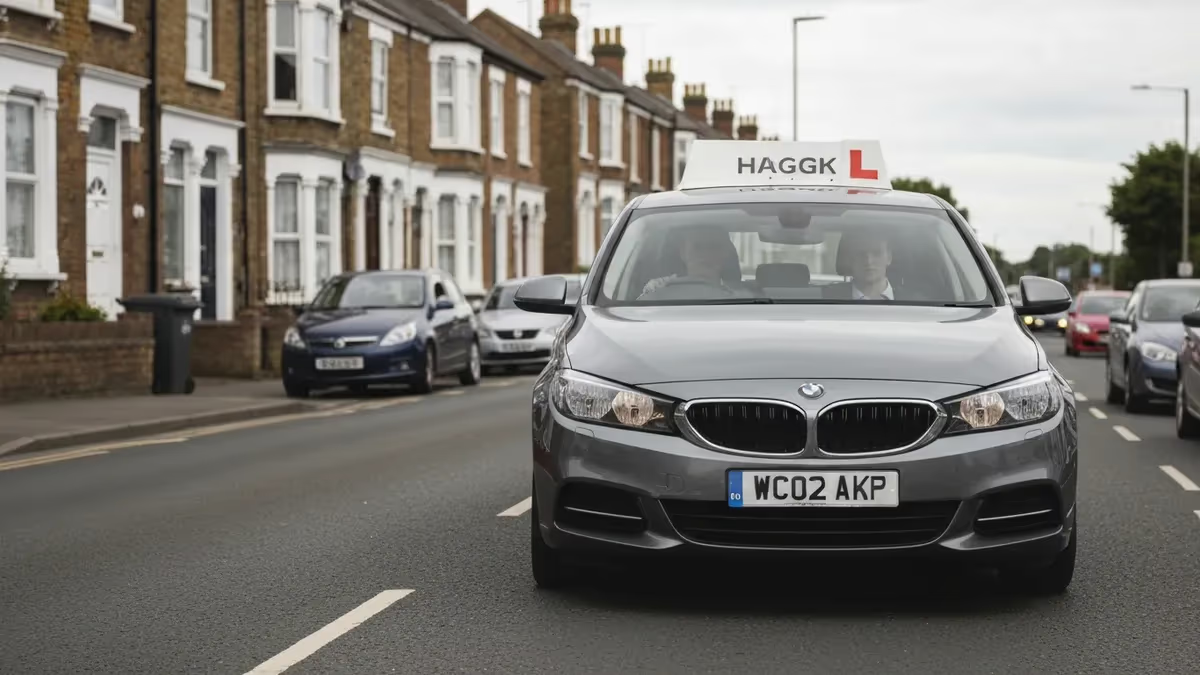
The theory 4 in 1 apk is one of the most searched terms among UK learner drivers preparing for the DVSA driving theory test, and for good reason — the official app packs four distinct study tools into a single download: a question bank, hazard perception video clips, a revision guide, and mock tests. Understanding what this app contains, how to install it correctly, and how to use each of its four sections strategically is the difference between scraping a pass and scoring comfortably above the theory 4 in 1 apk threshold on your first attempt.
Before you download any APK file for Android or open the App Store on iOS, it is worth clarifying exactly what the DVSA-endorsed app offers versus the many third-party clones that crowd search results. The official app is published by Driving Standards Ltd under licence from the Driver and Vehicle Standards Agency and is updated regularly to reflect changes to the Highway Code, new road signs, and revised hazard perception scoring criteria. Third-party APK files from unverified sources may contain outdated question banks or, worse, malware that puts your device at risk.
The four modules inside the genuine DVSA theory test app mirror the actual examination structure almost perfectly. Module one gives you access to the complete bank of official DVSA multiple-choice questions — over 800 in total — organised by topic so you can drill weak areas rather than ploughing through the whole set every session. Module two delivers the hazard perception video clips using the same scoring algorithm as the real test, giving you genuine feedback on click timing and whether your responses fall within the legitimate window rather than registering as pattern clicks.
Module three is a full revision guide that contextualises each rule you encounter in the question bank. Instead of just memorising the correct answer, you read a brief explanation of the underlying Highway Code principle, which dramatically improves your ability to answer novel phrasing on test day. Many candidates who fail their theory test report that the actual exam used wording they did not recognise even though the underlying concept was familiar — reading the revision guide closes that gap by building conceptual understanding rather than rote recall.
Module four ties everything together with timed mock tests that replicate the real examination format: 50 multiple-choice questions in 57 minutes followed by 14 hazard perception clips. Taking these mocks under exam conditions — phone face-down after pressing start, no pausing the clips — is the single most effective thing you can do in the final fortnight before your booking date. Research consistently shows that retrieval practice under time pressure outperforms re-reading notes by a factor of roughly two to one when it comes to retaining information under stress.
Downloading the APK safely on Android requires visiting the Google Play Store directly rather than sideloading an unsigned package from a forum or file-sharing website. The app is available free of charge at the basic tier, with an optional in-app purchase that unlocks all 800-plus questions and the full hazard perception video library. iOS users find the identical app in the Apple App Store.
If you encounter a website offering a free premium APK crack, treat it as a red flag: cracked apps bypass the subscription mechanism but often ship with modified files that strip out content updates, meaning you could be practising against a question bank that no longer reflects current DVSA materials.
One important nuance that many candidates overlook is compatibility. The app requires Android 8.0 or later and iOS 14 or later to function correctly, and the hazard perception clips depend on a stable internet connection of at least 4G speed during playback — the video engine does not pre-buffer clips in the same way a streaming service might. If you plan to study on your commute, download the multiple-choice and revision sections for offline use overnight, then save the hazard clips for times when you have reliable Wi-Fi.
Theory 4 in 1 APK: Key Numbers
What Is the Theory 4 in 1 App? A Module Breakdown
Access all 800+ official DVSA multiple-choice questions organised by category. Filter by topic, mark questions for review, and track your score percentage so you can see exactly where your knowledge has gaps and direct revision time efficiently.
Watch real DVSA-style hazard clips and click when you spot developing hazards. The app scores each click against the valid response window, replicating the actual exam algorithm so your timing calibration is accurate before test day arrives.
Read concise explanations for every rule and road sign referenced in the question bank. Understanding the Highway Code principle behind each answer builds genuine comprehension, helping you handle unfamiliar question phrasing on the real test.
Sit timed, full-length mock exams that mirror the DVSA format exactly — 50 questions then 14 hazard clips under real time pressure. Review your results, identify weak categories, and repeat until you consistently exceed the pass mark.
Downloading the theory 4 in 1 app safely is straightforward if you stick to official channels, but the process trips up a surprising number of candidates who stumble across unofficial APK mirror sites while searching on their phones. The safest route is always the platform store native to your device: Google Play for Android users and the Apple App Store for iPhone and iPad users.
Open the store, type the app name into the search bar, and check that the publisher is listed as Driving Standards Ltd — this is the authorised developer that holds the DVSA content licence. If the publisher name differs, move on.
For Android users who insist on sideloading, it is technically possible to install an APK file downloaded from outside the Play Store, but you must first enable installation from unknown sources in your device settings. Doing so lowers the security posture of your device and means you bypass Google's malware scanning.
If the APK has been tampered with — even subtly — you may never know until your device starts behaving oddly. The only scenario where sideloading is genuinely justified is if you are in a country where the Play Store does not serve the app, which is not a situation most UK learner drivers will face.
Once installed, creating an account is the next step. The free tier lets you access a subset of questions — typically the first two topic categories — along with a handful of hazard clips. This is useful for a quick trial, but serious preparation requires the full unlock.
The premium subscription, which typically costs between £4.99 and £9.99 depending on promotional pricing, opens the complete question bank and all hazard perception footage. Compare this to the £23 cost of a theory test booking and the economics are obvious: spending a few pounds on comprehensive revision materials is trivially good value if it means you pass first time rather than rebooking.
After purchasing, your progress is tied to your account rather than your device, which means you can switch between a phone and a tablet without losing your revision history, bookmarked questions, or mock test scores. This matters more than it might seem: many candidates do focused question-bank sessions on their phone during commutes and then sit longer mock tests on a tablet at home where the larger screen makes the hazard clips easier to assess. Syncing your account across devices costs nothing extra and is configured automatically when you log in.
App updates are released several times per year and should be applied promptly. The DVSA updates its official question bank periodically — typically when the Highway Code is revised or when national speed limit rules, road sign standards, or vehicle regulations change. If your app is running a version from twelve months ago, you risk practising against questions that have since been modified. Enable automatic updates in your device settings or check for updates manually before each revision session if you prefer manual control.
One underappreciated feature is the offline mode. After you have downloaded the app and logged in while connected to the internet, the multiple-choice question bank and revision guide text cache locally on your device. This means you can revise on a train, in a waiting room, or anywhere else with poor signal. The hazard perception clips are streamed rather than cached by default, so you will need connectivity for those — but you can queue them to download over Wi-Fi in the app settings before leaving home if you know you will be offline for a sustained period.
Accessibility options within the app include adjustable text size and a high-contrast display mode for candidates with visual impairments. The audio narration feature, which reads questions aloud, is particularly helpful for learners who find extended reading on a small screen fatiguing. These features are enabled in the app settings menu under Accessibility and do not affect the scoring or timing of any practice or mock test sessions, so there is no downside to using them if they make your revision experience more comfortable.
Using Each of the Four Modules Effectively
The most effective way to use the question bank module is to start with a diagnostic run through all topics without any preparation, recording your baseline score in each category. Categories where you score below 70% in your first pass are your priority revision targets. Spend the first week of your study plan drilling these weak topics exclusively, using the app's filter to surface only those questions rather than mixing them with areas you already know well.
Once you have raised weak categories above 80%, switch to mixed-topic sessions that randomise across the entire 800-question bank. This forces your brain to access knowledge without the contextual cue of knowing which subject area the question belongs to — exactly the condition you face in the real exam. Revisit bookmarked questions daily in the final week and aim for three consecutive sessions with no bookmarked question answered incorrectly before you sit your test date.
Theory 4 in 1 APK: Advantages and Limitations
- +Contains the complete official DVSA question bank — no unofficial or guessed questions included
- +Hazard perception clips use the same scoring algorithm as the real DVSA examination
- +Progress syncs across multiple devices, letting you revise on phone and tablet seamlessly
- +Offline access for the question bank and revision guide means no dependency on mobile data
- +Regular updates ensure the content reflects the current Highway Code and test standards
- +Accessibility features including audio narration and high-contrast mode support diverse learners
- −Hazard perception clips require internet streaming and cannot always be cached for offline use
- −The free tier only unlocks a fraction of the full question bank, limiting initial value
- −Third-party APK files claiming to be the same app are frequently outdated or contain malware
- −Some candidates find the app interface less intuitive than dedicated web-based revision platforms
- −No built-in spaced repetition algorithm — you must manually filter and prioritise weak topics
- −Premium subscription price varies and is occasionally higher than comparable third-party apps
Theory 4 in 1 APK Study Checklist
- ✓Download the app from Google Play or the Apple App Store — never from a third-party APK site.
- ✓Create an account and purchase the premium unlock to access all 800+ questions and hazard clips.
- ✓Enable automatic updates so the question bank stays current with the latest DVSA changes.
- ✓Run a diagnostic session across all topic categories and record your baseline score for each.
- ✓Identify any topic category where you scored below 70% and mark it as a priority focus area.
- ✓Complete at least 30 minutes of question-bank drilling per day across a minimum of four weeks.
- ✓Practice hazard perception clips daily, clicking once and only once per developing hazard spotted.
- ✓Take a full timed mock test at least three times per week in the fortnight before your test date.
- ✓Review every incorrect mock test answer immediately using the in-app explanation and revision guide.
- ✓Download question-bank content for offline use before commuting so revision time is never wasted.
Consistent short sessions beat infrequent marathon revision
Research into spaced learning consistently shows that practising for 30 minutes daily across four weeks produces significantly stronger retention than cramming for eight hours in the final two days. The theory 4 in 1 app's progress tracking makes it easy to maintain daily streaks — use it as your primary accountability tool rather than relying on willpower alone to keep sessions regular.
Hazard perception is the section of the DVSA theory test that causes the most last-minute anxiety among learner drivers, partly because it feels fundamentally different from the multiple-choice section and partly because the scoring system is opaque to candidates who have not practised with the official clips. The theory 4 in 1 app's hazard perception module is the closest proxy available for the real thing, and understanding how the underlying scoring works will help you use the module far more effectively than simply clicking through clips at random.
Each hazard perception clip is between one and two minutes long and depicts a real driving scenario filmed from the driver's perspective. Within each clip there is at least one — and on one designated clip, two — developing hazards that the scorer is looking for. The clip's scoring window opens a short time before the hazard develops fully and closes once it is obvious.
The earlier within this window you click, the higher your score for that clip: five points for the earliest zone, four for the next, and so on down to one point for the latest zone. Clicking outside any zone scores zero, and clicking five or more times in rapid succession on a single clip scores zero regardless of timing.
The practical implication of this scoring model is that you should train yourself to click at the moment you first perceive a change in the scene that could become dangerous — not when danger is confirmed. If a child is running toward the kerb, click as the child begins to run, not when they reach the edge.
If a van is pulling out of a side road, click when it first begins to move, not when it is blocking your path. This sounds simple in description but requires genuine practice to execute reliably, because human instinct is to wait for certainty before responding.
A common mistake among first-time candidates is clicking repeatedly throughout a clip in hopes of hitting the scoring window by volume. The app's feedback screen will show you when this happens — a cluster of clicks in one area with a zero score is the signature of pattern clicking. If you see this in your practice results, slow down your response and focus on identifying the single key moment in each clip. One deliberate, well-timed click on a genuine developing hazard is worth more than a flurry of clicks around the rough vicinity of danger.
Some hazard perception clips contain a secondary hazard — typically a fixed road feature like a sharp bend, a pedestrian crossing, or a junction — as well as the primary developing hazard. These fixed hazards are present to prevent you from clicking randomly throughout the clip, since clicking on a non-hazard does not score points but clicking repeatedly in the vicinity of a non-hazard can still trigger the pattern-click penalty.
The best approach is to watch each clip attentively from the start, note any fixed hazards as contextual warnings, and then click once and deliberately when you see movement or behaviour that is actively developing into danger.
The app's review screen after each hazard clip session shows a timeline of your clicks overlaid on the scoring window, which is an extraordinarily useful teaching tool. Look at the distance between your click marker and the opening of the scoring window.
If your clicks consistently fall just before the window opens, you are reading the hazard correctly but your reaction is slightly early — consider whether you are clicking at the very first frame of change rather than a fraction of a second into the change. If your clicks fall consistently after the window closes, you are waiting too long and need to accelerate your identification of developing movement.
Candidates who take the time to review every clip result in the app — not just the ones where they scored zero — typically improve their hazard perception score by eight to twelve points across a four-week practice period.
That improvement margin is meaningful: the pass mark for hazard perception is 44 out of 75, and many candidates who fail the theory test overall do so because a hazard perception score in the high thirties dragged them below the threshold even when their multiple-choice result was comfortably passing. The clips module in the theory 4 in 1 app is your most direct tool for preventing that specific failure mode.

Searching for a free premium APK of the theory test app on third-party sites carries real risks: unofficial files may contain malware, use outdated question banks that no longer reflect current DVSA standards, or strip out hazard perception clips entirely. Always download from Google Play or the Apple App Store and verify the publisher is Driving Standards Ltd before installing any app on your device.
Building an effective mock test routine using the theory 4 in 1 app is a skill in itself, and the candidates who pass first time almost universally describe a structured approach rather than an ad-hoc one. The most reliable structure is to spend the first two weeks of your preparation exclusively on the question bank and revision guide, building topical knowledge before exposing yourself to the time pressure and format of a full mock. Starting with mocks before you have sufficient topical coverage simply means practising failure, which can dent confidence without improving knowledge.
From week three onward, introduce two or three full mocks per week alongside continued question-bank drilling. A full mock session — 50 questions plus 14 clips — takes approximately 90 minutes including the review period, so plan these on evenings or weekend mornings when you have sufficient uninterrupted time. The worst thing you can do is start a mock and abandon it halfway through because something came up, since partial mocks do not give you the pacing feedback that comes from completing all 50 questions and checking how much time you have remaining at the end.
In the final week before your test date, increase mock frequency to daily if your schedule permits. Your target at this stage is not to learn new material — it is to consolidate what you know under exam conditions and to identify any remaining weak spots that need a last burst of focused drilling.
If you are consistently scoring 47 or 48 out of 50 on mocks but slipping to 44 or 45 when a particular topic category appears, that category is your final revision priority. Use the question filter in module one to pull out just those questions and run through them twice on the day before your test.
Rest and sleep are non-negotiable in the 48 hours before your test date. The theory test is a cognitive exercise requiring sustained concentration over nearly an hour, and sleep deprivation measurably reduces both reaction speed — critical for hazard perception timing — and the ability to recall memorised information accurately under pressure.
Do not schedule a marathon revision session the night before your test. Instead, do one short mock in the morning of the day before to check your confidence, review any flagged questions, and then stop revising by early evening. Eat well, sleep adequately, and arrive at the test centre rested.
On the morning of the test itself, a brief 15-minute warm-up session in the app can help activate your recall without overloading your working memory. Run through 20 or 30 random questions from the full bank — not a new topic area — and then close the app. The goal is to get your brain into the mode of answering driving theory questions, not to cram additional information. Think of it as a mental warm-up in the same way an athlete stretches before a race: the aim is activation, not new learning.
At the test centre, remember that you have 57 minutes for 50 questions — just over a minute per question on average. For the vast majority of questions you will have an instinctive response within ten seconds. Flag any question you are uncertain about and move on rather than spending three or four minutes agonising over it. Return to flagged questions after completing the rest of the paper, which gives you a fresh perspective and ensures you do not waste time that could be spent on questions you do know.
After completing the theory test successfully, your certificate is valid for two years. During that window you must pass the practical driving test. If you are studying for both simultaneously, the theory 4 in 1 app's road signs and vehicle rules content is directly relevant to the practical test too — a well-maintained mental model of the Highway Code makes your on-road driving more deliberate and your responses to examiner instructions more fluid. Using the app's revision guide beyond just test preparation is a habit that will serve you throughout your life as a driver.
Understanding the broader context of why the DVSA created the theory 4 in 1 format helps you appreciate why each module is included and how they complement each other.
The driving theory test was introduced in its current format to address a specific gap that existed when the practical driving test was the only assessment: new drivers were passing practical tests with adequate vehicle control skills but insufficient understanding of the rules, signs, and risk management principles that underpin safe driving. The theory test addresses this gap directly, and the four-module app structure maps directly onto the test's dual assessment of knowledge and perception.
The multiple-choice section (modules one and four) tests declarative knowledge — facts, rules, signs, distances, limits. These are things that can be memorised and recalled accurately under time pressure with sufficient practice. The hazard perception section (module two) tests procedural knowledge — the ability to observe a moving scene, interpret what is developing, and respond at the appropriate moment.
No amount of reading about hazard perception substitutes for actually watching clips and practising the click-timing discipline. This is why the app's separation of these into distinct modules is pedagogically sound: you need different kinds of practice for different kinds of knowledge.
The revision guide (module three) acts as the connective tissue between the other three modules. When you encounter a question about stopping distances at 70 mph, the revision guide explains not just the answer but why that stopping distance is what it is — the relationship between thinking distance, braking distance, road surface conditions, and vehicle weight.
When you understand the principle, you can derive the correct answer even if you forget the precise figure, and you can apply the same reasoning to novel scenarios presented with unfamiliar phrasing. This conceptual scaffolding is what separates candidates who pass comfortably from those who scrape through or fail by one or two marks.
Many candidates who use the theory 4 in 1 app exclusively for revision discover an unexpected benefit: they become noticeably better at reading the road during their driving lessons. Instructors frequently comment that learners who have engaged seriously with the hazard perception module are quicker to identify and respond to risks during practical lessons — they have already trained their perceptual attention to scan for developing hazards, and this skill transfers directly to real driving. The app is not just a test preparation tool; used well, it accelerates your development as a safe, attentive driver.
For candidates who are resitting the theory test after a previous failure, the app's diagnostic tools are especially valuable. Rather than repeating the same generic revision programme that preceded your first attempt, start by identifying the specific topic categories and hazard perception patterns that cost you marks.
If your result letter shows you scored 38 out of 50 on multiple choice and 41 out of 75 on hazard perception, your priorities are clearly different from someone who scored 42 on multiple choice but only 38 on hazard perception. Tailor your second attempt programme to your specific failure profile rather than starting from scratch.
The social dimension of theory test preparation is often underestimated. Studying alongside a friend who is also preparing — sharing mock test scores, quizzing each other on road signs, or discussing hazard clip interpretations — adds accountability and can surface misunderstandings that solo study misses. The theory 4 in 1 app's shareable progress statistics make it easy to compare scores with a study partner without either person needing access to the other's account. Even a brief ten-minute comparison of results and reasoning after each session can consolidate your understanding more effectively than ten additional minutes of solo drilling.
Finally, be realistic about preparation timelines. The DVSA recommends that candidates spend a minimum of 20 hours on theory test preparation, and first-time pass rates for candidates who report less than ten hours of study are substantially lower than those who report more than twenty.
The theory 4 in 1 app makes it easy to track cumulative study time through its session history — check this number honestly rather than assuming your preparation is sufficient because the test date is approaching. If your logged time is under fifteen hours two weeks before your test, extending your booking by two to three weeks and banking additional app sessions is almost always a better decision than sitting the test underprepared and paying to rebook.
For a fuller set of questions on this topic, see our free hazard perception test resource.
For a fuller set of questions on this topic, see our theory test practice resource.
DVSA Questions and Answers
UK Theory Test Pass Mark: Car, Bike, LGV, PCV & ADI Scores

Free Theory Test App: The Complete UK Guide to Choosing, Using and Passing With Mobile Practice in 2026

Cancelling Driving Test: The Complete UK Guide to Refunds, Rebooking and Avoiding Lost Fees in 2026
Driving Test Nerves: The Complete UK Guide to Calming Anxiety and Passing First Time in 2026

Mock Driving Test: Complete UK Guide to Passing Your Theory and Practical Exams
About the Author

Licensed Driving Instructor & DMV Test Specialist
Penn State UniversityRobert J. Williams graduated from Penn State University with a degree in Transportation Management and has spent 20 years as a certified driving instructor and DMV examiner consultant. He has personally coached thousands of applicants through written knowledge tests, skills assessments, and commercial driver licensing programs across more than 30 states.