
How to Change Your DVSA Practical Driving Test: Complete UK Guide 2026
Need to change your DVSA practical driving test? Learn how to reschedule, 🎯 what fees apply, and how much notice you need to avoid losing your fee.
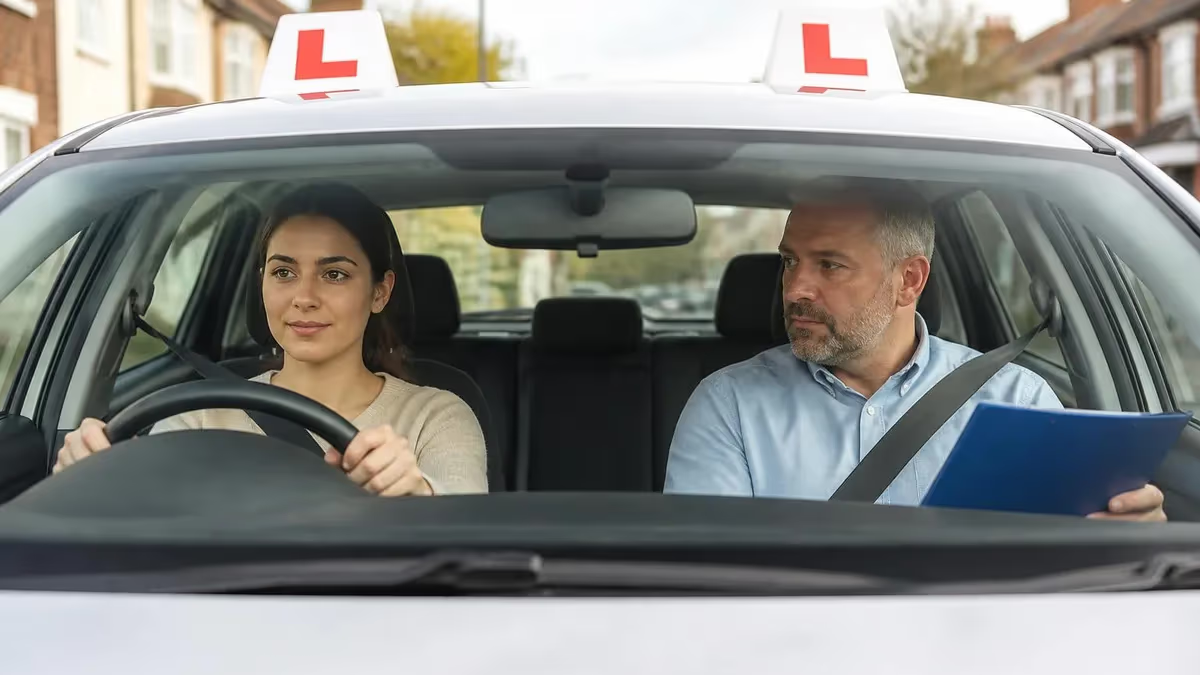
If your circumstances have changed and your current test date no longer works, knowing exactly how to change practical test appointments through the DVSA is essential. Thousands of UK learner drivers reschedule their practical driving tests every month, and the process is straightforward as long as you act with enough notice. Understanding the rules around fees, cancellation windows, and the online booking system will save you time, money, and unnecessary stress during what is already a nerve-wracking period of your learning journey. Practice with the free DVSA UK Driving Theory practice test on PracticeTestGeeks (7 questions with answer explanations).
The DVSA — the Driver and Vehicle Standards Agency — manages all practical driving test bookings across England, Scotland, and Wales. Whether you need to move your test due to illness, a change in your instructor's availability, a family commitment, or simply a feeling that you are not yet ready to take the test, the agency provides a clear process for rescheduling. The key rule to remember is that you must give at least 10 full working days' notice before your test date if you want to avoid losing your test fee entirely.
Many learners discover too late that changing a test date is not as simple as picking up the phone and requesting a new slot. The DVSA requires changes to be made through specific channels — primarily the online service at gov.uk — and there are strict rules about when changes can and cannot be made without financial penalty. Getting to grips with these rules before you need to use them is far better than scrambling at the last minute when a problem arises.
It is worth noting that rescheduling your practical test is entirely separate from rescheduling your theory test. If you have not yet passed your theory test, you cannot sit your practical test at all, so always check that your theory test certificate is still valid before booking or rescheduling. Theory test passes are valid for two years from the date of the test, and a practical test appointment that falls outside this validity window will automatically be cancelled by the DVSA.
Before you attempt to change your practical test date, gather all the information you will need: your booking reference number, your driving licence number, and your preferred alternative dates. Having these details ready before you log on to the booking system will make the process much faster. The DVSA online portal is generally available around the clock, so you can make changes at a time that suits you rather than waiting for a phone line to open.
This guide covers everything you need to know about rescheduling your DVSA practical driving test in 2026. From step-by-step instructions for using the online system, to guidance on what happens when you change your test within the restricted three-day window, to tips for finding the earliest available test slots, we have compiled the most useful and accurate information available to help you navigate the process with confidence and minimal disruption to your learning programme.
Free DVSA UK Driving Theory Study Tools
Interactive DVSA UK Driving Theory resources on PracticeTestGeeks, free to start:
- DVSA UK Driving Theory flashcards — review key terms and concepts card by card
- DVSA UK Driving Theory study guide — topic-by-topic overview of what the exam covers
- DVSA UK Driving Theory cheat sheet — one-page printable summary for last-minute review
DVSA Practical Test Changes by the Numbers
Key Facts at a Glance
| Item | Value | Details |
|---|---|---|
| Minimum Notice Required | 3 Days | Clear working days before test |
| Standard Test Fee (weekday) | £62 | Lost if cancelled with insufficient notice |
| Theory Test Validity | 2 Years | Must be valid on practical test date |
How to Change Your DVSA Practical Test: Step by Step
Log In to the DVSA Booking Portal
Select 'Change Test Date or Time'
Search for Available Slots
Select Your New Date and Confirm
Receive Your Confirmation Email
Understanding the fee structure for changing your practical driving test is critical before you make any decisions about rescheduling. The standard weekday practical car test fee in 2026 is £62, while evening and weekend tests cost £75. If you change your test date with at least 10 full working days' notice, your original payment is simply transferred to the new booking. You will not be charged an additional fee just for making the change, which is a common misconception among learner drivers.
The 10 full working days rule is often misunderstood. The DVSA calculates this by counting working days — Monday to Friday, excluding bank holidays — and the day of the test itself does not count. So if your test is on a Thursday, you would need to make the change by the end of the previous Monday at the latest.
If your test falls on a Monday, you must act by the Wednesday of the week before. Weekends do not count as working days, which catches many learners out when they try to change a Monday test on a Friday evening.
If you cancel or change your test with fewer than 10 full working days' notice, you will forfeit your entire test fee. There is no partial refund in this situation. The DVSA is very clear that this rule applies regardless of the reason for the late change — whether it is illness, a sudden work commitment, or a vehicle breakdown. The only exception is where the DVSA itself cancels or changes your test, in which case you are entitled to a full refund or a free rebooking.
There is one important exception to the fee forfeiture rule: if you or someone you live with tests positive for COVID-19, or if you have a medical condition that genuinely prevents you from taking the test safely, the DVSA may consider a refund on compassionate grounds. However, this process involves contacting the DVSA directly rather than using the online system, and you should not rely on this route as a backup plan for last-minute changes. Always aim to give at least the required 10 full working days' notice wherever possible.
Some learners wonder whether it is possible to change their test multiple times using the same original fee. The answer is yes — as long as each change is made with the required notice, you can reschedule as many times as you need without paying an additional fee. However, the DVSA does monitor patterns of repeated rescheduling, and there is no official limit on the number of times you can change your booking, provided the notice rules are followed each time the change is made.
If you originally booked a test at an inconvenient test centre because it was the only available option at the time, you can also use the rescheduling process to move your test to a different centre entirely. Simply select a different test centre when searching for available slots. This is particularly useful if a closer centre opens up new slots after you have already booked. Remember that different test centres cover different areas and driving environments, which may affect how you prepare with your instructor.
DVSA Practice Test Questions
Prepare for the DVSA - UK Driving Theory Test exam with our free practice test modules. Each quiz covers key topics to help you pass on your first try.
DVSA Eco-Friendly Driving and Vehicle Loading
DVSA Exam Questions covering Eco-Friendly Driving and Vehicle Loading. Master DVSA Test concepts for certification prep.
DVSA Hazard Awareness
Free DVSA Practice Test featuring Hazard Awareness. Improve your DVSA Exam score with mock test prep.
DVSA Incidents, Accidents and First Aid
DVSA Mock Exam on Incidents, Accidents and First Aid. DVSA Study Guide questions to pass on your first try.
DVSA Motorway Rules and Smart Motorways
DVSA Test Prep for Motorway Rules and Smart Motorways. Practice DVSA Quiz questions and boost your score.
DVSA Rules of the Road (Highway Code)
DVSA Questions and Answers on Rules of the Road (Highway Code). Free DVSA practice for exam readiness.
DVSA - UK Driving Theory Hazard Awareness ...
DVSA Mock Test covering - UK Driving Theory Hazard Awareness and Perception. Online DVSA Test practice with instant feedback.
DVSA - UK Driving Theory Motorway Rules an...
Free DVSA Quiz on - UK Driving Theory Motorway Rules and Regulations. DVSA Exam prep questions with detailed explanations.
DVSA - UK Driving Theory Road and Traffic ...
DVSA Practice Questions for - UK Driving Theory Road and Traffic Signs. Build confidence for your DVSA certification exam.
DVSA - UK Driving Theory Rules of the Road
DVSA Test Online for - UK Driving Theory Rules of the Road. Free practice with instant results and feedback.
Notice Periods, Methods and Special Circumstances
The DVSA requires a minimum of 10 full working days before your test date if you want to change your booking without losing your fee. Working days are Monday to Friday and exclude English bank holidays — the test date itself is not counted. This means if your test is on a Wednesday, your last opportunity to change without penalty is the end of the previous Thursday. Plan ahead and use the gov.uk online tool rather than waiting until the last minute.
Bank holidays create particular complications when calculating your notice window. If a bank holiday falls within the 10 full working days before your test, your effective deadline shifts back by an additional day. For example, if you have a test on the Tuesday after a Monday bank holiday, you effectively need to make your change by the Wednesday of the previous week. The DVSA website has a useful guide for calculating these dates, but when in doubt, always act earlier than you think necessary to avoid an accidental fee forfeiture.
Should You Change Your Practical Test or Sit It Anyway?
- +Reduces anxiety if you feel genuinely unprepared, leading to a calmer and more confident test performance
- +Allows more time to practise specific manoeuvres or road types you are not yet confident with
- +Gives you time to resolve vehicle issues so your instructor's car is in perfect condition on the day
- +Enables you to choose a date when you are not tired, unwell, or distracted by other pressures
- +May allow you to book a slot at a less busy time of year when examiners have slightly more flexibility
- +Costs nothing extra provided you give at least 10 full working days' notice before the test
- −You will likely wait several weeks or months for the next available slot, especially in busy areas
- −Delaying your test extends the overall cost of learning to drive, including additional instructor lessons
- −Repeated rescheduling can knock your confidence and create a habit of avoiding difficult situations
- −Test availability can be unpredictable and you may struggle to find a slot that suits your instructor
- −Your theory test certificate has a two-year validity, so excessive delays risk invalidating it
- −The driving test syllabus or rules could change during a long delay, requiring additional preparation
Practical Test Change Checklist: Before You Reschedule
- ✓Confirm you have at least 10 full working days before your current test date before attempting any change.
- ✓Locate your booking reference number — check your original confirmation email if you cannot remember it.
- ✓Ensure your driving licence number is to hand as the portal requires it to verify your identity.
- ✓Check that your theory test certificate will still be valid on any new test date you are considering.
- ✓Speak to your driving instructor before rescheduling to confirm they are available on your preferred new date.
- ✓Log in to the gov.uk DVSA booking portal and verify your current booking details before making changes.
- ✓Search for available slots at your preferred test centre and note at least two or three alternative dates.
- ✓Confirm the new booking and wait for the confirmation email before closing the portal session.
- ✓Save the confirmation email and note the new booking reference in a safe and easily accessible place.
- ✓Notify your driving instructor of the confirmed new date and agree on a pre-test lesson plan together.
Act Early to Protect Your Test Fee
The single most important rule when changing your DVSA practical test is the 10 full working days' notice requirement. Miss this window by even a few hours and your entire test fee — up to £75 for evening and weekend slots — is forfeited with no automatic refund. Set a calendar reminder as soon as you book your test so you never accidentally let the deadline pass.
One of the most common reasons learners decide to change their practical test is a sudden concern about readiness. Perhaps a recent lesson did not go well, or you have not had enough practice on a particular type of road that features in your test route. Whatever the reason, it is important to make this decision rationally rather than in the immediate aftermath of a bad lesson. Speak to your driving instructor and ask for an honest assessment of your current standard — they are best placed to advise whether rescheduling will genuinely benefit your chances of passing.
If your instructor advises that you are ready to test despite some nerves, try to trust their professional judgement. Many learners who reschedule because of anxiety end up in a cycle of avoidance, repeatedly moving their test back without making meaningful progress. The practical driving test is designed to assess normal driving ability, not perfection. Examiners understand that candidates are nervous and make allowances for the natural tension of a test environment, within reason. Sustained, confident driving throughout the test carries far more weight than occasional minor errors.
When you do decide to change your test, use the extra time productively. Draw up a structured revision plan with your instructor that focuses specifically on the areas where your performance is weakest. If you are uncertain about reverse bay parking or parallel parking, arrange dedicated sessions on these manoeuvres. If you find roundabouts or dual carriageways challenging, ask your instructor to include more of these features in upcoming lessons. Targeted practice is significantly more effective than simply adding more general driving hours without a clear objective in mind.
It is also worth reviewing the DVSA's official guidance on what the examiner is looking for during each part of the test. Many learners are surprised to discover that minor faults accumulate over the course of the test and that a large number of minors — even without any serious faults — can result in a fail. Understanding exactly what constitutes a minor versus a serious or dangerous fault will help you prioritise where to focus your remaining preparation time before the new test date.
If you changed your test because of illness or injury, make sure you are genuinely fully recovered before attending the rescheduled appointment. Driving when you are not feeling your best — whether due to medication, fatigue, or ongoing symptoms — not only affects your performance but could also raise safety concerns. If your condition has not resolved by the time your rescheduled test approaches, you may need to contact the DVSA again and explain the ongoing medical situation. Keep your instructor informed throughout so they can provide appropriate support and practical guidance.
For learners who are changing their test date specifically because they want more time, consider whether your current preparation is as efficient as it could be. Supplementing your driving lessons with hazard perception practice, mock theory revision, and guided reading of the Highway Code can all make a meaningful difference to your overall driving awareness and decision-making. A well-rounded learner who understands the theory behind safe driving is generally better prepared for the practical test than one who has simply accumulated a large number of driving hours without structured study.
You can continue preparing with the change practical test, which includes answer explanations for every question.
You can continue preparing with the free hazard perception test, which includes answer explanations for every question.
You can continue preparing with the theory mock test, which includes answer explanations for every question.

Your theory test certificate is only valid for two years from the date you passed. If you are rescheduling your practical test to a date that falls after your theory certificate expires, your practical test booking will be automatically cancelled. Check the expiry date of your theory pass certificate before choosing a new test date, and if necessary, rebook your theory test before looking for practical test slots.
Finding the earliest available practical test slot is a challenge faced by thousands of learners across the UK, and it is especially acute in cities and densely populated areas where demand consistently outstrips supply. Once you have successfully changed your current test to a new date, you do not have to stay locked into that appointment. The DVSA system allows you to keep checking for earlier cancellations, and many learners use this approach to significantly reduce their waiting time by monitoring availability regularly and pouncing on newly opened slots.
Cancellations tend to appear at specific times of day — often early in the morning or late at night when the system updates. Checking the booking portal at these times gives you the best chance of spotting a newly available slot before another learner takes it. Some third-party services and apps also monitor DVSA cancellations and send alerts when a slot opens at your preferred test centre, though you should exercise caution when using unofficial services and never share your login credentials with any third party.
Test centre choice can have a significant impact on how long you wait for a slot. If you are willing to travel to a test centre in a less populated area, you may find shorter waiting times and potentially different — sometimes easier — test routes.
Discuss this option with your instructor before making a final decision, as some test centres cover road types that may not feature in your usual lessons. An unfamiliar driving environment could add unnecessary stress on the day of the test, so any change of centre should be accompanied by at least one or two practice drives in that area beforehand.
If you are in a situation where you need to take your test urgently — for example, because you have a job offer that requires a full driving licence — you should make this clear when contacting the DVSA. While there is no formal priority queue for practical test bookings, the DVSA may be able to advise on test centres with the shortest current waiting times. Your driving instructor may also have useful local knowledge about which centres tend to have more availability and at what times of the month new slots typically appear.
Another option for learners who need a test slot quickly is the DVSA's short notice cancellation service. This service notifies registered users when a test slot becomes available at short notice — typically within a few days — due to a cancellation by another candidate. Signing up for this service is free and can be done through the gov.uk booking portal. While availability through this route is not guaranteed, many learners have successfully secured test dates several weeks earlier than their original appointment by staying active on the cancellation list.
It is also worth remembering that test availability tends to increase after school holidays when examiners return from authorised leave and testing resumes at full capacity. January, September, and October have historically offered better availability than the summer months, when both examiners and test centres operate with reduced capacity due to annual leave schedules. Planning your test preparation timeline around these seasonal patterns can give you a practical advantage when it comes to securing an early date.
Making the most of the time between changing your practical test and the new appointment date requires a disciplined and structured approach to preparation. Rather than treating the extra weeks as a buffer during which you can take a break from learning, think of it as a focused revision sprint. Sit down with your instructor early in the process and agree on a clear set of goals for the remaining lessons. Identify the specific fault categories that came up most often in your mock tests and design a lesson plan that addresses each one in a systematic way.
Mock tests are one of the most effective tools available to learner drivers in the final weeks before their practical assessment. Ask your instructor to conduct at least two or three full mock tests on routes that replicate the format and duration of the real test.
Treat each mock as though it is the real thing — start on time, wear what you would wear on test day, and try to adopt the same mental preparation routine. This builds familiarity with the test format and helps reduce the performance anxiety that causes many learners to make mistakes they would not make during normal lessons.
Your preparation should extend beyond the car. Spend time reviewing the DVSA's official Highway Code publication and pay particular attention to any updates issued since you first began studying. Road signs, give-way rules, and speed limit regulations are all areas where the examiner will expect confident and automatic responses. Online practice resources and official DVSA apps can supplement your in-car training with question-and-answer sessions that reinforce your theoretical knowledge in a time-efficient way.
On the day before your rescheduled test, aim for a light revision session rather than an intensive cramming session. Go over the main manoeuvres in your mind — emergency stop, reverse bay parking, parallel parking, and pulling up on the right — without creating additional pressure for yourself. Eat well, stay hydrated, and get a full night of sleep. Physical and mental wellbeing on test day has a measurable impact on driving performance, and the time you invest in rest and recovery the night before is just as valuable as any additional lesson.
On test day itself, plan to arrive at the test centre with at least ten minutes to spare. Use this time to familiarise yourself with the test centre environment, use the facilities, and do a brief warm-up drive with your instructor in the immediate vicinity if time allows. Inform your examiner if you are nervous — they are trained to put candidates at ease and will not penalise you for acknowledging your anxiety. Take deep breaths before pulling away from the test centre and focus on driving as you would in any normal lesson.
Finally, remember that a rescheduled test is not a step backward — it is a deliberate and sensible decision to maximise your chance of passing first time. Statistics consistently show that learners who take their test when they feel genuinely ready perform significantly better than those who rush. The extra preparation time you have secured is an investment in your driving future. Use it wisely, stay consistent in your lessons, and approach your new test date with the confidence that comes from thorough and well-planned preparation.
Sample DVSA UK Driving Theory Practice Questions
Try these questions from our free DVSA UK Driving Theory practice tests. The correct answer and an explanation follow each question.
You are driving in heavy rain and your vehicle begins to aquaplane. What should you do?
- A. Brake hard to regain grip
- B. Steer sharply to the left
- C. Ease off the accelerator and avoid braking until you regain grip
- D. Accelerate to drive through the water
Answer: C. Ease off the accelerator and avoid braking until you regain grip
Aquaplaning occurs when water builds up under the tyres faster than the tread can disperse it, causing a loss of contact with the road. You should ease off the accelerator smoothly and avoid braking or steering until the tyres regain grip.
When should you use the left-hand lane on a three-lane motorway?
- A. Only when joining or leaving the motorway
- B. When travelling at any speed, unless overtaking
- C. Only when driving below 50 mph
- D. When carrying heavy loads
Answer: B. When travelling at any speed, unless overtaking
On a motorway, you should normally drive in the left-hand lane regardless of your speed. The middle and right-hand lanes are for overtaking only. Once you have finished overtaking, you should return to the left-hand lane. Staying in the middle or right lane unnecessarily is called 'lane hogging' and is an offence.
You arrive at the scene of a collision. A casualty is unconscious but breathing. What position should you place them in?
- A. Flat on their back
- B. The recovery position
- C. Sitting upright
- D. Face down
Answer: B. The recovery position
An unconscious but breathing casualty should be placed in the recovery position to keep the airway open and prevent choking.
Under the Highway Code hierarchy of road users, who bears the greatest responsibility for the safety of others?
- A. Pedestrians
- B. Cyclists
- C. Drivers of large vehicles
- D. All road users equally
Answer: C. Drivers of large vehicles
The 2022 Highway Code update introduced a hierarchy of road users. Those who can cause the greatest harm (drivers of large vehicles, then car drivers) bear the greatest responsibility to reduce the danger they pose to more vulnerable road users.
DVSA Questions and Answers
DVLA Theory Test Booking: Complete Step-by-Step Guide for UK Learners
Driving Theory Test App: The Complete Study Guide for UK Learners
How to Book Your DVSA Practical Driving Test: Complete UK Guide

Learn to Drive in the UK: Complete Beginner's Guide to Getting Your Licence

DVSA Car Practical Test: Complete Guide to Passing First Time
Sources & references
Prepared by the Practice Test Geeks editorial team using AI-assisted drafting; exam facts are checked against the official sources below. Editorial policy
- gov.uk — Time limit · verified Oct 2026
- gov.uk — Eligibility, registration, test dates · verified Oct 2026
- gov.uk — Passing score, retake policy, score release · verified Oct 2026
- gov.uk — Exam format · verified Oct 2026
- gov.uk — Exam format, time limit · verified Oct 2026
- gov.uk — Fees · verified Oct 2026
- gov.uk — Eligibility · verified Oct 2026