
Are Doctors Required to Report Seizures to the DMV? A Complete Guide to DMV Medical Reporting
Are doctors required to report seizures to the DMV? Learn medical reporting rules, driver safety laws & how a DMV representative can help. ✅
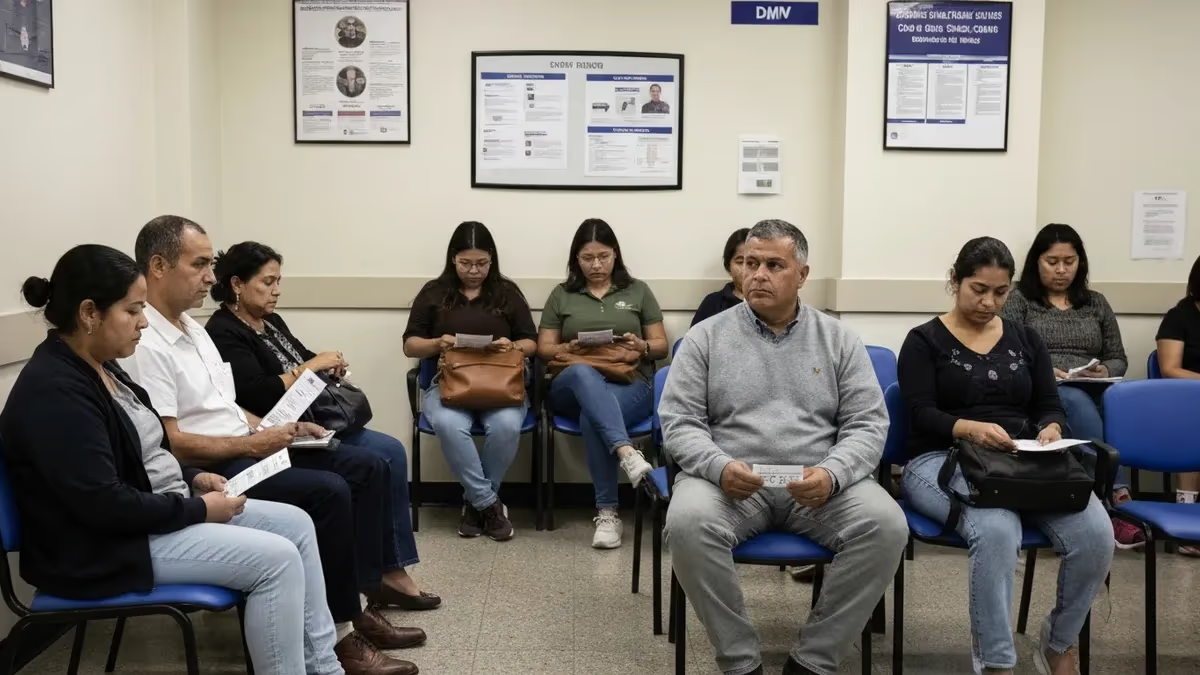
Are doctors required to report seizures to the DMV? This question sits at the intersection of public safety, patient privacy, and motor vehicle law — and the answer varies dramatically depending on which state you call home. In most states, a physician who treats a patient with a seizure disorder must notify the Department of Motor Vehicles if that condition could impair safe driving. Understanding how mandatory reporting works, and what role a DMV customer service representative plays in the follow-up process, can help drivers navigate a system that can feel both confusing and high-stakes.
The rationale behind medical reporting laws is straightforward: operating a motor vehicle is a privilege that requires the physical and cognitive ability to do so safely. Seizures, blackouts, and other sudden incapacitation events are among the most serious road-safety concerns a licensing authority faces. When a driver loses consciousness behind the wheel, the risk of a fatal crash rises sharply. State legislatures and DMV administrators have therefore created frameworks requiring healthcare providers — and sometimes patients themselves — to flag these conditions so licensing decisions can be made based on current medical evidence.
Knowing your rights and obligations within these frameworks is essential whether you are a patient, a caregiver, or someone studying for the DMV representative exam. Each state sets its own seizure-free driving period before a license can be issued or reinstated. These periods range from as few as three months (in California after a medical review) to as long as twelve months in many other jurisdictions. A DMV representative is often the first point of contact when a driver needs to understand what documentation is required to restore driving privileges after a medical review.
Medical reporting also intersects with broader dmv medical reporting procedures that cover conditions beyond epilepsy — including syncope, diabetes, sleep apnea, vision disorders, and certain psychiatric diagnoses. A knowledgeable DMV customer service representative can direct drivers to the correct medical review forms, explain the appeals process, and clarify what a treating physician must submit. This article walks through all of that in detail, drawing on state statutes, DMV guidelines, and exam content relevant to the DMV representative certification.
If you are studying for the DMV representative exam, you will encounter questions about privacy statutes such as HIPAA and how they interact with state mandatory reporting laws. Federal law generally defers to state medical reporting requirements in the context of motor vehicle licensing, meaning that a physician who files a report with the DMV is not violating HIPAA as long as the disclosure is required or authorized by state law. Understanding this legal nuance is critical for anyone who will be advising the public as a DMV customer service representative.
This guide covers the full landscape: which states mandate physician reporting versus voluntary reporting, what seizure-free intervals are required nationwide, how the DMV medical review process works step by step, and practical advice for drivers whose licenses have been suspended following a medical event. We also provide links to free practice tests so candidates preparing for the DMV representative exam can test their knowledge of these rules in a realistic exam setting.
DMV Medical Reporting by the Numbers
State-by-State Medical Reporting Frameworks
Six states — California, Delaware, New Jersey, Nevada, Oregon, and Pennsylvania — legally require physicians to report patients with seizure disorders or other impairing conditions directly to the DMV. Failure to report can expose providers to civil liability in some of these jurisdictions.
Most states offer physicians immunity from civil suit if they voluntarily report a patient's impairing condition but do not mandate it. Doctors in these states rely on patient self-reporting, with the DMV trusting drivers to disclose relevant medical histories on license applications and renewals.
Nearly every state requires applicants and license holders to self-report conditions such as epilepsy, recurring blackouts, or significant cognitive impairments on their DMV paperwork. Knowingly providing false information is a criminal offense that can result in license revocation and fines.
In all 50 states, courts and law enforcement agencies may report medically relevant events — such as a crash caused by a seizure — directly to the DMV. These mandatory third-party reports trigger an automatic medical review regardless of whether the physician filed a separate report.
Once a medical report reaches the DMV — whether from a physician, a court, or a law enforcement agency — the agency initiates a structured medical review process. A DMV customer service representative may be the first staff member a driver speaks with after receiving a notice that their license is under review. Understanding how this process unfolds helps representatives provide accurate, empathetic guidance rather than leaving nervous drivers without direction. The review typically begins with a written notice advising the driver that a medical evaluation has been requested and explaining the documentation needed to proceed.
The driver is usually required to submit a completed medical evaluation form signed by a licensed physician, neurologist, or specialist who has direct knowledge of the condition. This form typically asks the treating doctor to describe the diagnosis, the date of the last seizure or medical episode, current medications and their effectiveness, any side effects that could impair driving, and a professional opinion on whether the patient is safe to operate a motor vehicle. The DMV's medical review unit — separate from the front-line customer service staff — then evaluates this form, sometimes in consultation with an independent medical advisor.
Processing times vary by state and by the complexity of the medical history involved. California's Driver Safety Branch, for example, aims to complete routine medical reviews within 30 to 60 days of receiving all required documentation. States with smaller populations or fewer resources may take longer. A DMV representative should be able to tell a driver how to check the status of their review, whom to contact if the review is taking longer than expected, and what the next steps are if the DMV requests additional information from the treating physician.
If the medical review unit determines that the driver is not safe to operate a vehicle, the license will be suspended or revoked. The driver then has the right to request a formal hearing to contest the decision. A DMV customer service representative can explain the appeals process, including the deadline for requesting a hearing (usually 10 to 14 days from the date of the suspension notice), the forms required, and whether the suspension is stayed pending the hearing outcome. This hearing process is an important consumer protection mechanism and is frequently tested on the DMV representative exam.
Drivers who successfully complete a seizure-free waiting period and submit the required medical documentation will need to apply for license reinstatement. In many states, this means paying a reinstatement fee, submitting a new physician's report confirming the seizure-free period, and in some cases completing a behind-the-wheel evaluation. A DMV representative handles the paperwork intake for reinstatement applications and must be familiar with the specific forms, fees, and timelines that apply in their jurisdiction.
It is worth noting that medical review cases are handled with heightened confidentiality. The information submitted during a medical review — physician reports, diagnosis details, medication lists — is protected under both state privacy statutes and federal law. DMV representatives who access this information are subject to strict confidentiality requirements and can face disciplinary action for unauthorized disclosure. Training on these privacy obligations is a core component of DMV customer service representative onboarding programs across the country.
For drivers who need to speak with someone about their specific case, the process of reaching the right person can itself be confusing. In New York, for example, many drivers search for guidance on how do I speak to a DMV representative in NY — and the answer is that medical review cases are typically handled by the Driver Improvement Unit, not the standard license transaction counters. Knowing which unit handles which type of inquiry allows a well-trained representative to route callers correctly on the first contact, improving both efficiency and customer satisfaction.
DMV Customer Service Representative: Handling Medical Reporting Cases
The seizure-free driving interval is the period a person must go without a seizure before the DMV will reinstate or issue a driver's license. California uses a flexible system where a physician can recommend reinstatement after as few as three months if the seizure was provoked and unlikely to recur — but unprovoked seizures typically require six months to one year. Texas and Florida both require a six-month seizure-free period confirmed by a treating neurologist, while states like Virginia and Illinois require a full twelve months in most cases.
Importantly, the seizure-free interval clock typically resets if the driver experiences any additional seizure, even one that occurs while asleep. Some states make exceptions for nocturnal-only seizures — where episodes occur exclusively during sleep and the driver has never had a daytime episode — and allow license retention with physician documentation. DMV representatives should be aware that these nuances exist and direct drivers to the medical review unit rather than attempting to give definitive medical or legal opinions on eligibility.
Mandatory vs. Voluntary Physician Reporting: Pros and Cons
- +Mandatory reporting ensures consistent identification of at-risk drivers regardless of whether a patient self-discloses.
- +Reduces the burden on patients who may fear losing their license and avoid disclosing a condition voluntarily.
- +Creates a clear legal framework that protects physicians who file reports from civil lawsuits by patients.
- +Improves road safety by triggering medical reviews before a dangerous crash provides the first signal of impairment.
- +Standardizes the information the DMV receives, making medical review decisions more consistent and defensible.
- +Supports DMV customer service representatives by giving them a predictable process to explain to drivers and families.
- −Mandatory reporting can damage the physician-patient relationship and discourage patients from seeking treatment for fear of losing their license.
- −Overly broad reporting requirements may flag drivers with well-controlled conditions who pose no meaningful road safety risk.
- −Creates significant administrative burden for physicians in mandatory states, particularly those in neurology and internal medicine.
- −States with mandatory reporting show mixed evidence of actual road safety improvement compared to voluntary reporting states.
- −Privacy advocates argue that mandatory disclosure undermines patient confidentiality rights even when HIPAA exceptions apply.
- −Inconsistent standards across state lines create confusion for drivers who relocate — a condition triggering review in one state may not in another.
Medical Reporting Compliance Checklist for Drivers and DMV Staff
- ✓Obtain and complete the correct state-specific medical evaluation form from the DMV website or a DMV customer service representative.
- ✓Have your treating neurologist or primary care physician complete the physician certification section with their license number and signature.
- ✓Document the exact date of the most recent seizure or medical episode in writing, confirmed by medical records.
- ✓Confirm the seizure-free waiting period required in your state before submitting reinstatement paperwork.
- ✓Gather supporting records such as EEG reports, MRI results, and medication logs that support the physician's fitness-to-drive opinion.
- ✓Submit the completed medical evaluation form to the correct DMV unit — the medical review office, not the standard license counter.
- ✓Request written confirmation of receipt from the DMV and keep a copy of everything submitted for your own records.
- ✓Follow up with the DMV medical review unit if you have not received a decision within the timeframe stated in your suspension notice.
- ✓If your license is suspended following review, file a written hearing request within the deadline stated in your notice (typically 10–14 days).
- ✓Upon reinstatement, pay all applicable fees and comply with any restrictions such as daytime-only driving or proximity-to-home limitations.
Medical Review Cases Require Specialized Routing — Not Front-Counter Decisions
A front-line DMV customer service representative should never attempt to determine whether a driver with a reported medical condition is eligible to drive. Medical eligibility decisions are made exclusively by the DMV's medical review unit, often in consultation with an independent medical advisor. A representative's role is to ensure the driver has the correct forms, understands the submission process, and knows how to reach the medical review unit — nothing more, and nothing less.
The role of a DMV customer service representative in medical reporting cases goes well beyond simply handing out forms. Representatives serve as the human face of a process that can be emotionally charged — drivers facing potential license suspension are often frightened, frustrated, or grieving the loss of independence. A well-trained representative who can explain the process clearly, answer procedural questions accurately, and direct drivers to appropriate resources plays a genuinely important role in public service. This is why DMV representative exam content covers medical review procedures in meaningful depth.
One practical skill that representatives develop early is the ability to distinguish between different types of driver actions and the forms associated with each. A driver who is proactively disclosing a new diagnosis before any DMV contact has been made will need different paperwork than a driver responding to a suspension notice triggered by a physician's mandatory report.
A driver appealing a suspension uses a different process than a driver applying for reinstatement after completing the required seizure-free waiting period. Getting these distinctions right on the first interaction saves the driver multiple trips and reduces processing errors in the medical review unit.
In New York, one of the most frequently asked questions among drivers and students is how do I speak to a DMV representative in NY about a medical review case. New York's DMV routes medical cases through its Driver Improvement Unit, which operates separately from the walk-in service centers.
Drivers typically must contact this unit by mail or phone rather than visiting in person, and the representative at a standard DMV office should know how to direct these calls appropriately. For candidates studying for the representative exam in New York or any other state, understanding this internal routing is an important operational detail.
The DMV representative exam tests not only procedural knowledge but also interpersonal communication skills. Medical reporting scenarios often appear in the form of customer service vignettes where the candidate must choose the most appropriate response to a distressed driver. The correct answer almost always involves empathy, accurate information about next steps, and clear direction to the appropriate resource — while avoiding any statement that could be construed as a legal or medical opinion. Practicing these scenarios on timed multiple-choice tests is one of the best ways to build confidence before the actual exam.
Beyond individual cases, DMV representatives who work in states with mandatory physician reporting sometimes encounter situations where a physician's report is incomplete, illegible, or missing required information. In these cases, the representative's role is to contact the driver in writing, explain exactly what is missing, and give a specific deadline for resubmission. Many states' medical review units use standardized deficiency letters for this purpose, and a representative should know how to initiate the deficiency notice process rather than simply sitting on an incomplete file.
Drivers who hold commercial driver's licenses (CDLs) face a stricter medical reporting framework than those holding standard Class D licenses. Federal Motor Carrier Safety Administration (FMCSA) regulations prohibit CDL holders from driving a commercial motor vehicle if they have a current clinical diagnosis of epilepsy or any other condition likely to cause loss of consciousness.
Even a single seizure may result in permanent disqualification from commercial driving under federal standards, though an exemption program exists for certain well-controlled cases. A DMV representative handling CDL-related medical inquiries must be aware of this stricter federal standard and direct commercial drivers to both the state medical review process and the FMCSA's Medical Exemption Program as appropriate.
For drivers who do not hold a CDL, the reinstatement pathway — while demanding — is navigable for many people with well-controlled seizure disorders. Statistics from states like California and Oregon show that a significant majority of drivers who complete the medical review process and submit strong physician documentation ultimately have their licenses reinstated with or without driving restrictions. A DMV customer service representative who communicates this realistic picture of the process can reduce unnecessary anxiety and encourage drivers to engage constructively with the review rather than simply ignoring the notice and driving with an invalidated license.
If the DMV suspends your license following a medical review and you continue to drive, you are committing a criminal offense in every U.S. state — not merely a traffic infraction. Penalties include fines, possible jail time, and significantly extended license revocation periods. If you are involved in an accident while driving on a medically suspended license, you may also face civil liability that is not covered by standard auto insurance policies.
Preparing for the DMV representative exam requires a solid understanding of medical reporting rules, but it also demands familiarity with the broader consumer protection and dispute resolution framework that governs DMV operations. Medical review cases are a subset of a larger category of adverse licensing actions that drivers may contest through administrative hearings. A DMV customer service representative who understands both the medical reporting pathway and the hearing process is better equipped to serve drivers at every stage of a difficult situation. The exam tests both domains, often in the same question scenario.
One of the most effective preparation strategies for the DMV representative exam is to practice with realistic multiple-choice questions that mirror the format and difficulty of the actual test. Free practice tests focused on consumer protection, dispute resolution, and vehicle safety standards are available through resources like PracticeTestGeeks.com.
Candidates who complete several full-length practice sessions before test day consistently report higher first-attempt pass rates than those who rely on reading alone. The combination of content review and timed practice is especially important for topics like medical reporting, where the nuances between states and license classes can be easy to confuse under pressure.
Understanding the medical review timeline is another area where detailed knowledge pays off on the exam. Candidates should know not just that a seizure-free period is required, but the specific sequence of events: the initial report triggers a notice, the driver submits documentation, the review unit evaluates the file, a decision is issued, and the driver either has their license reinstated or receives a suspension notice with hearing rights. Being able to trace this sequence accurately — and identify the representative's role at each step — is exactly the kind of applied knowledge the exam rewards.
Candidates should also understand the interaction between state DMV medical reporting requirements and federal laws like the Americans with Disabilities Act (ADA). The ADA does not prevent states from applying medically justified fitness-to-drive standards, but it does require that any restriction be based on individualized assessment rather than a blanket policy that categorically excludes all people with a particular diagnosis.
A DMV that automatically refused to issue any license to anyone who had ever had a seizure, regardless of current medical status, would likely violate the ADA. The individualized review process that states have developed is in part a response to this legal requirement, and exam questions occasionally probe whether candidates understand this connection.
Another nuanced topic that appears on the DMV representative exam is the concept of conditional or restricted licenses. Rather than a binary decision between full reinstatement and full suspension, many states offer intermediate options.
A driver with a seizure disorder might receive a license restricted to daytime driving only, or one that prohibits driving on highways, or one that requires a check-in with the medical review unit every six months. A DMV customer service representative should be able to explain what a restricted license means in practical terms and how a driver can apply to have restrictions modified or removed as their medical situation improves.
Study materials that cover these topics in depth are essential for anyone serious about passing the DMV representative exam on the first attempt. Free printable practice tests in PDF format can supplement digital practice, allowing candidates to simulate paper-based testing conditions and annotate questions for review.
Combining these resources with a clear understanding of your state's specific medical reporting statutes — which you can verify through your state's DMV website or official code — gives you the most complete preparation possible. Be sure to review content on consumer protection procedures as well, since medical review hearings fall squarely within that domain on most state exams.
Finally, it is worth emphasizing that the knowledge tested on the DMV representative exam is not purely academic — it directly serves real people in difficult situations. A driver who has just received a seizure-related license suspension is facing a major disruption to their daily life, their employment, and their sense of independence.
A representative who can explain the process clearly, point to the right forms, and give an honest picture of the timeline is providing a genuinely valuable public service. The exam exists precisely to ensure that every person who sits behind a DMV counter has the knowledge to deliver that service effectively and consistently.
When it comes to practical exam preparation, time management is as important as content knowledge. The DMV representative exam in most states is a timed multiple-choice test, and candidates who have not practiced answering questions under time pressure often find themselves rushed at the end.
The recommended approach is to complete at least three full-length timed practice tests before your actual exam date, reviewing every question you answered incorrectly and understanding exactly why the correct answer is right. Medical reporting and consumer protection questions are worth spending extra time on because they appear frequently and require nuanced reasoning rather than simple recall.
One common error candidates make on medical reporting questions is confusing the driver's obligations with the physician's obligations. The exam will present scenarios from both perspectives, and it is important to keep them distinct. A physician's duty to report is governed by state law and — in mandatory states — is not discretionary. A driver's duty to self-report is also legally required on license applications and renewals in virtually every state. A DMV representative's duty, by contrast, is procedural: to receive documentation, route it appropriately, communicate status updates, and explain processes without crossing into medical or legal advice territory.
Another practical tip for exam day is to pay close attention to qualifiers in question stems. Words like "always," "never," "must," and "may" significantly change the meaning of an answer choice in a way that can catch unprepared candidates off guard.
Medical reporting questions, in particular, often hinge on whether a particular action is mandatory or discretionary, immediate or subject to review, state-governed or federally preempted. Reading each question and each answer choice carefully — rather than stopping at the first answer that sounds plausible — is a habit that separates high scorers from those who narrowly miss the passing mark.
Practical experience at a DMV office, even in a volunteer or shadowing capacity, is one of the best supplements to formal study. Seeing how the office routes medical inquiries, how staff members explain suspension notices, and how the front counter interacts with the medical review unit gives context that no study guide can fully replicate. If you are preparing for the DMV representative exam and have the opportunity to spend time observing at your local office, take it. The practical intuition you build from direct observation will serve you well both on the exam and on the job.
For those who learn best through active recall rather than passive reading, flashcard systems work particularly well for DMV representative content. Creating cards for each state's seizure-free interval, for the specific HIPAA exception that covers mandatory reporting, for the ADA's individualized assessment requirement, and for the typical hearing request deadline gives you a portable study tool that can be used during commutes, breaks, and any spare moment in your schedule. The repetition that flashcard systems enforce is highly effective for embedding factual details that are easy to confuse under exam pressure.
Group study with other candidates preparing for the same exam can also be valuable, particularly for working through hypothetical scenarios. Describing how you would handle a specific customer situation — a driver who insists their physician's report was submitted weeks ago and the DMV has lost it, for example — and getting feedback from peers helps you refine your understanding of both the procedure and the interpersonal communication skills the exam assesses. Discussion also surfaces knowledge gaps that solo study might leave undetected.
Ultimately, passing the DMV representative exam and serving effectively in the role both require the same underlying commitment: a genuine desire to help members of the public navigate a system that can feel complex and intimidating. Medical reporting is one of the most sensitive areas a representative will encounter, and handling it with accuracy, empathy, and professionalism is the hallmark of excellent public service. Use the practice resources available to you, know the rules thoroughly, and carry that knowledge confidently into both the exam room and the service window.
DMV Questions and Answers

DMV Customer Service Representative: Complete Career Guide & Permit Test Practice

DMV Learners Permit Practice Test: Complete 2026 Prep Guide for First-Time Test Takers

Colorado DMV Walk-In Locations: How to Talk to a DMV Customer Service Representative

DMV Representative Practice Test PDF (Free Printable 2026)

Colorado DMV Renew Registration: Complete 2026 Guide to Renewing Your Vehicle Tags Online, By Mail, and In Person
About the Author
Licensed Driving Instructor & DMV Test Specialist
Penn State UniversityRobert J. Williams graduated from Penn State University with a degree in Transportation Management and has spent 20 years as a certified driving instructor and DMV examiner consultant. He has personally coached thousands of applicants through written knowledge tests, skills assessments, and commercial driver licensing programs across more than 30 states.
Join the Discussion
Connect with other students preparing for this exam. Share tips, ask questions, and get advice from people who have been there.
View discussion (8 replies)