
How Hard Is the CSWA Exam? Difficulty, Scoring and Prep Reality Check 2026
🎯 How hard is the CSWA exam? Moderately: 3 hours, 70% to pass. See what trips candidates up, the scoring rules, and how to prepare.

The CSWA exam is moderately hard: it is an entry-level test, but it is timed, hands-on, and requires you to build real SOLIDWORKS models within 3 hours while scoring at least 70%. Candidates who finished a beginner course and practiced timed modeling usually find it fair, while those who only watched tutorials often struggle.
How Hard is the Cswa Exam: Key Facts (Updated October 2026)
| Fact | Details | Source |
|---|---|---|
| Delivery | All CSWA testing is online through the TesterPRO Client software, with candidates logging in to the VirtualTester Web Client | SOLIDWORKS Certification Program |
| Time limit | 3 hours | SOLIDWORKS CSWA page |
| Passing score | At least 70% | SOLIDWORKS CSWA page |
| Who it is for | Users new to SOLIDWORKS who have completed a beginner course | SOLIDWORKS CSWA page |
| CSWA Academic format | 14 questions worth 240 points; 165 points needed to pass | SOLIDWORKS CSWA Academic |
| Academic delivery | Offered only through qualified schools and Academic Certification Providers, in a proctored setting | SOLIDWORKS CSWA Academic |
| Recommended preparation (Academic) | At least 150 hours of classroom instruction in SOLIDWORKS CAD, engineering design principles and best practices | SOLIDWORKS CSWA Academic |
| Retake rule | Wait at least 14 days between attempts; each attempt needs a new exam credit | SOLIDWORKS Certification Program |
If you want a fast way to judge your readiness, start with timed solidworks practice instead of reading more notes. The exam rewards speed and accuracy inside the software, so the best predictor of success is how many full-length modeling attempts you have already finished. Most people who fail run out of time on the later segments rather than lacking the concepts. Treat difficulty as a time-management problem first and a knowledge problem second.
So how hard is the CSWA exam in practice? Think of it as a driving test rather than a written quiz. You are not recalling definitions; you are sketching, extruding, revolving, mating, and measuring inside SOLIDWORKS while a clock runs. The questions are not tricky, but they are layered, because one wrong dimension early in a part can throw off the mass-properties answer you must report at the end. Numeric accuracy matters more than most newcomers expect.
The exam is aimed at users who are new to SOLIDWORKS and have finished a beginner course. SOLIDWORKS suggests roughly 150 hours of instruction for academic candidates, which tells you the bar is not trivial. Someone with a weekend of video tutorials will find it hard. Someone who has modeled dozens of parts, built a few assemblies, and created basic drawings will find it manageable, even if the clock feels tight during the three-hour sitting.
Difficulty also depends on your starting point. Students in a structured CAD class usually have the vocabulary of sketch relations, features, and mates under control, and they only need exam-style repetition. Self-taught users often know clever shortcuts but skip fundamentals like fully defining sketches, choosing the correct origin, or reading a drawing view. Those gaps surface quickly on test day, so an honest self-assessment of your weakest area is worth more than another general tutorial.
Expect the hardest moments in the intermediate and advanced part questions, the multi-step modeling tasks where you must follow a dimensioned drawing exactly and then report a volume, center of mass, or mass value. Assembly questions add mate logic and sometimes ask you to modify a component and re-report a result. Many candidates describe the early drafting and basic modeling questions as comfortable, then feel the pressure climb as the remaining time drops.
This guide breaks down the format, the scoring, the sections where candidates lose points, and a realistic preparation plan. You will also find free quiz links, a checklist, and answers to the questions people ask most often. If you want sample material first, open our cswa practice exam walkthrough, then come back here to build a study schedule around your weakest areas and your own calendar.
One more point on difficulty: the pass mark is firm but not extreme. A 70% threshold means you can miss several items and still pass, provided you do not leave entire modeling questions blank. Every answer is a numeric value computed from your own model, so there is no guessing your way through. Plan to attempt every question, and bank the easier points first before spending a long time on one stubborn feature.
How Hard Is the CSWA Exam by the Numbers

Is the CSWA Exam Hard? What Each Section Tests
These questions check that you understand drawing views, dimensions, and annotations. They are usually the gentlest part of the exam, but misreading a view or a dimension scheme here can create habits that hurt you later.
You build simple parts from a dimensioned drawing using sketches, extrudes, and cuts, then report a property such as volume or mass. Speed comes from clean, fully defined sketches and the right origin choice.
These tasks add features like revolves, fillets, chamfers, and patterns. Difficulty rises because you must combine several features accurately and keep the model rebuilding without errors under time pressure.
Expect more complex geometry, equations or modified dimensions, and a final value that depends on every earlier step. This is where careful reading and unit checks protect the most points.
You insert components, apply mates, and report a result such as center of mass for the finished assembly. Correct mate selection and verification matter more than speed in this segment.
How Hard Is the CSWA Exam for Beginners?
Beginners usually rate the CSWA exam as moderately hard, mostly because of the time pressure rather than the topics. A new user who completed a course can model the parts, but doing it quickly while reading a dimensioned drawing is a different skill. The first timed attempt tends to feel rushed. By the third full practice run, most people see their pacing improve noticeably, and that is often the difference between passing and failing.
Start by understanding what makes questions hard. Each modeling problem gives you a part drawing with dimensions, relations, and sometimes a changed value halfway through. You must build the part, apply the stated material, and then report a mass property. If you misread one note, such as a symmetric extrude or a through-all cut, the final number will not match any answer option. That is why careful reading counts as much as software skill.
Sketching is the foundation, so weakness there makes everything harder. You need to be comfortable with horizontal, vertical, tangent, coincident, and equal relations, and you must know when a sketch is fully defined. Our practice cswa exam guide pairs well with the free 2D sketching quiz below, because it lets you test relation logic without opening the software. Ten focused minutes a day beats one long weekend session.
Assembly questions are where many beginners lose confidence. You are asked to mate components using coincident, concentric, distance, and angle mates, then report a result such as the center of mass of the finished assembly. A mate applied to the wrong face flips a component, and every downstream number changes. The fix is a habit: select faces deliberately, check each mate in the FeatureManager tree, and rotate the model to verify before moving on.
Another layer of difficulty is the modification step. Exam questions often tell you to change a dimension, edit a feature, or alter the material, and then report the updated value. Candidates who work in a single clean file handle this easily, while those with messy rebuild errors waste minutes. Practice editing finished models until changing a dimension feels as routine as drawing the original sketch in the first place.
Do not overlook the software environment. The test runs through the TesterPRO client with a web login, and you work in your own installed copy of SOLIDWORKS. That means a slow computer, an unfamiliar interface layout, or a missing template can cost real minutes. Run through your setup the day before, confirm your units match what the drawing uses, and keep your most-used toolbars visible so nothing slows your hands during the sitting.
Overall, a beginner who has completed a course, practiced timed models, and reviewed mass properties should consider the CSWA exam a challenging but fair first credential. It is harder than a multiple-choice quiz and easier than professional-level certifications such as the CSWP. The goal is not perfection; it is clearing 70% with steady, careful work across every segment of the three-hour sitting, including the assembly questions that come last.
Is the SolidWorks CSWA Exam Hard Without a Sample CSWA Exam?
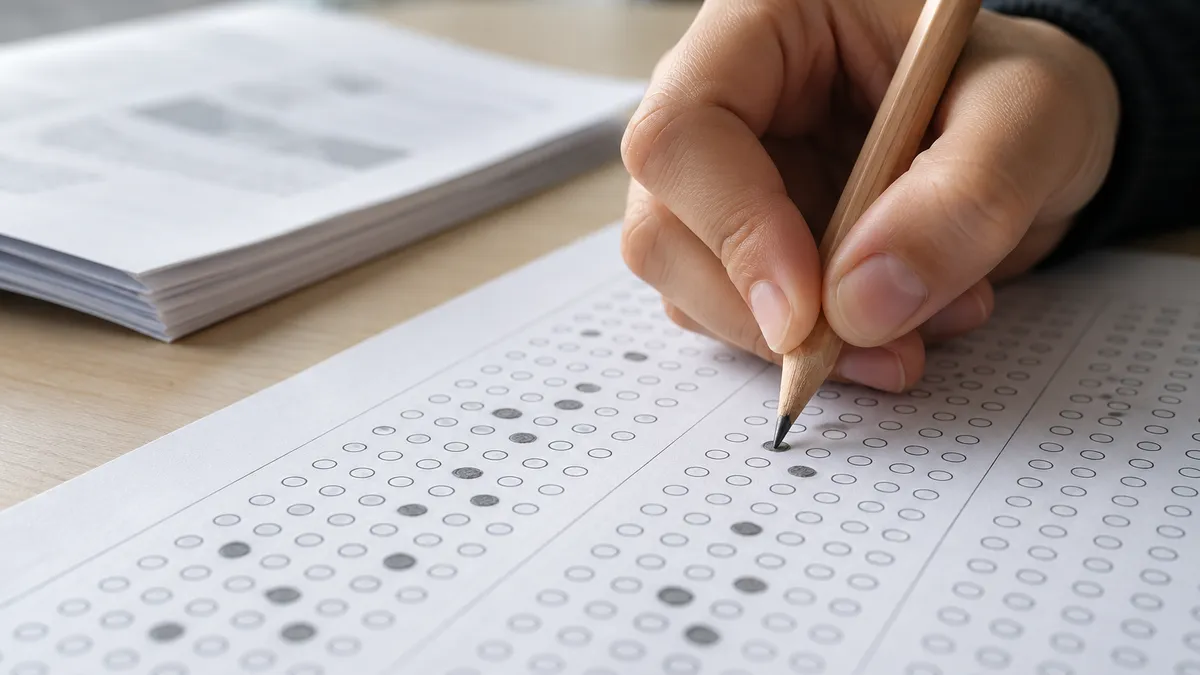
Without a sample CSWA exam, the test feels harder than it is, simply because the format is unfamiliar. You do not know how a dimensioned drawing is presented, how the question asks for a mass property, or how answer options are phrased. A single practice run removes most of that surprise and shows where your real weaknesses are hiding.
A good practice exam also trains reading discipline. The questions contain small details, such as a material name, a units note, or a modified dimension, that decide whether your final number is right. Practicing on realistic material builds the habit of scanning for those details before you touch the software, which protects points on exam day.
Is the CSWA Exam Hard Enough to Be Worth Taking?
- +It is an entry-level credential designed for users new to SOLIDWORKS.
- +The 3-hour limit gives realistic time if you practice pacing.
- +Questions follow predictable patterns that reward repetition.
- +Free quizzes and mock models make preparation inexpensive.
- +A pass gives students and job seekers a concrete CAD credential.
- +Results are objective numbers, so there is little ambiguity in grading.
- −The exam is timed and hands-on, so reading tutorials alone is not enough.
- −One early modeling mistake can ruin a later numeric answer.
- −A 70% pass mark leaves limited room to skip whole questions.
- −Unit or material errors cost points even when the model looks correct.
- −Retakes require a 14-day wait and a new exam credit.
- −Academic candidates are expected to have around 150 hours of instruction.
How Hard Is the CSWA Exam to Prepare For? A 10-Step Checklist
- ✓Confirm you have completed a beginner SOLIDWORKS course before booking.
- ✓Model at least ten dimensioned parts from scratch under a timer.
- ✓Practice fully defining every sketch before adding features.
- ✓Set Document Properties and units before drawing anything.
- ✓Assign the stated material right after the first feature.
- ✓Rehearse reading mass, volume, and center of mass in the dialog.
- ✓Build three assemblies using coincident, concentric, and distance mates.
- ✓Take two full three-hour mock sittings and score them against 70%.
- ✓Test your computer, login, and toolbar layout the day before.
- ✓Write a per-segment time budget and keep it beside you on test day.
Difficulty is mostly pacing, not knowledge
Candidates rarely fail because a concept was impossible. They fail because they spent too long on one part and rushed the rest. Practice with a clock, and the exam becomes far more predictable.
Is the CSWA Exam Hard to Pass on the First Try?
The CSWA exam is hard enough that some first-time candidates miss the 70% mark, yet it is very passable with structured preparation. SOLIDWORKS does not publish an official pass rate, so any specific percentage you see online is only an estimate. What we can say with confidence is that the required score is firm, the time limit is three hours, and every retake requires another exam credit and a 14-day wait.
Why do first attempts fail? The most common reason is pacing. Candidates spend forty minutes perfecting one advanced part and then rush the assembly questions at the end. Because every question contributes points toward the total, which is 240 on the Academic version, a rushed assembly can cost as much as a hard part. Set a time budget per segment before you start, and glance at the clock after each question you finish.
The second common reason is unit and precision errors. The exam specifies units such as millimeter-gram-second or inch-pound-second, and your answer must match an option closely. If your document is in the wrong unit system, your volume or mass will be off even though your model looks perfect. Always confirm units in Document Properties before sketching, and double-check decimal places in the answer options before you commit to a choice.
A third issue is material assignment. Mass-properties questions depend on the density of the material, so applying a different alloy than the one stated, or forgetting to apply a material at all, changes the answer completely. Build the habit of assigning the material right after the first feature, then verifying it in the Mass Properties dialog. This tiny routine protects points that many candidates throw away every single sitting.
Copying a remembered number never helps, because answers depend entirely on the model you build. That said, reviewing worked solutions is valuable for learning method. A walkthrough in the style of associate cswa full exam answers shows how to reach a result step by step, so you can reproduce the process on new dimensions rather than hoping to recall a figure you once saw.
Confidence plays a role too. Many candidates who attempt the exam underprepared treat it as a trial run, then discover the 14-day waiting period and the extra credit cost. Treat your first attempt as the real one. Take at least two full timed mock sittings in the week before, score them honestly against the 70% line, and only book the exam when you pass both with some margin to spare.
Finally, remember what a pass actually proves. The CSWA shows an employer or instructor that you can create, modify, and assemble basic models and read simple drawings. It is not a test of design brilliance. Candidates who accept that framing tend to relax, work methodically, and finish with minutes to spare, while those who chase perfect, elegant models run out of time and lose easy points.

You must wait at least 14 days between CSWA attempts, and each attempt needs its own exam credit. Do not book until your timed mocks consistently clear 70%.
How Hard Is the CSWA Exam Compared With CSWP and Other Certifications?
The CSWA is the easiest of the SOLIDWORKS credentials because it sits at the entry level of the certification path. It is designed for users who are new to the software and have completed a beginner course. The Certified SOLIDWORKS Professional (CSWP) comes next and expects deeper skill in complex modeling and design intent. If you can pass the CSWA comfortably, you are well positioned to begin preparing for the next step.
Compared with multiple-choice professional exams, the CSWA feels different rather than simply harder or easier. There is no memorizing lists of terms. Instead, you demonstrate skill by producing a correct model and reading values from it. People who are strong at theory but weak at hands-on software work often find it harder than expected, while confident daily SOLIDWORKS users sometimes find it surprisingly gentle.
The Academic version is a useful comparison point. It consists of 14 questions worth 240 points, requires 165 points to pass, and is offered only through qualified schools and Academic Certification Providers in a proctored setting. It can be taken in one 180-minute sitting or as two 90-minute parts. Knowing that structure helps you understand how much weight each question carries in the overall score.
Looking at a sample helps you judge the real level. Our cswa exam sample page shows the style of questions, the way drawings are presented, and the kinds of values you are asked to report. Spend twenty minutes comparing it to your current skill. If the modeling steps feel familiar, you are close. If they feel foreign, plan several more weeks of practice.
Difficulty also changes with the version of SOLIDWORKS and the interface you use at work or school. Candidates who learned on an older release may need a few sessions to find tools in the newer layout. This is a small cost but a real one during a timed sitting, so practice on the same version and display setup you will use for the exam itself.
Compared with engineering licensing exams or university finals, the CSWA is modest in scope. The topics are narrow, the question types repeat, and the skills build directly on beginner coursework. That narrowness is good news: you can prepare efficiently by drilling the same five areas rather than studying a sprawling syllabus. Focused repetition beats broad reading almost every time.
In short, the CSWA is an approachable credential that still requires respect. It is hard for people who skip practice and fair for people who put in the hours. If you give yourself a few weeks of timed modeling, careful reading habits, and honest self-scoring, the difficulty drops from intimidating to routine, and the 70% target becomes a realistic goal.
How Hard Is the CSWA Exam? Final Prep Advice
The CSWA exam is hard to pass only if you arrive unprepared, and these final tips close that gap. Begin with a four-week plan: one week for sketching and drafting, one for basic and intermediate parts, one for advanced parts and mass properties, and one for assemblies and full mocks. Even five focused hours per week adds up to a meaningful amount of hands-on practice.
Build your own mini exam bank. Take ten drawings from a textbook or practice set, model each one, and record the time and the final mass or volume. Redo the slowest three a week later and try to beat your times. This repetition builds muscle memory for common features like extruded cuts, fillets, and patterns, which is exactly what makes the real exam feel familiar.
Develop a fixed start-up routine for every question. First, read the entire prompt and underline the units, material, and any modified dimension. Second, set the document units. Third, assign the material. Fourth, sketch on the correct plane from the correct origin. A repeatable routine removes decisions, and fewer decisions means fewer mistakes when your attention is split between the clock and the model.
Verify before you answer. Once the model is finished, open Mass Properties and compare the volume or mass against what you would expect. If a block that should weigh a few hundred grams reports several kilograms, a dimension or unit is wrong. This sanity check takes thirty seconds and routinely saves points, because a plausible-looking model with a wrong unit is the most common source of lost marks.
Manage your energy as well as your time. Eat beforehand, use a quiet room, and silence notifications. A three-hour modeling sitting is a concentration test, and fatigue causes misread dimensions. If you hit a wall on one feature, flag it, move on, and return after finishing other questions. Momentum from completed items keeps stress low and makes the stubborn problem easier when you come back.
Use the free quizzes on this site to cover knowledge gaps between modeling sessions. The materials and mass properties set is especially useful, because those calculations decide many final answers. Short multiple-choice drills on drawing views, dimensions, and assembly management also reinforce vocabulary that appears in the drafting competencies segment, giving you easy points that free up time for the harder modeling work.
On test day, log in early, confirm the TesterPRO client works, and open SOLIDWORKS before the clock starts. Keep a calculator and scratch paper nearby if permitted. Start with the questions you can do fastest, then work toward the hardest. If you pass, celebrate and add the credential to your resume; if not, use the 14-day window to fix the specific segments that cost you points.
CSWA Questions and Answers

CSWA Practice Test - Ace Your Certification Exam 2026

CSWA Practice Test: Free Prep Guide for the SolidWorks Associate Exam

Solidworks CSWA Practice Problems: Sample Exam Questions and Answers Guide

CSWA Exam Sample: Free Practice Questions & Format Breakdown

A Complete Guide to the CSWA Certification

Mastering the CSWA: Your Path to Certified SOLIDWORKS Associate Success

CSWA Certification Guide: Certified SOLIDWORKS Associate Exam
How this page was made: written with AI tools. Exam facts are checked against the official sources listed below. Not reviewed by a subject-matter expert. Editorial policy
Sources & references
Exam facts on this page (fees, format, dates, passing scores) are checked against these official sources; the date is our last check. Editorial policy
- solidworks.com — Test delivery, eligibility, exam format · verified Oct 2026
- solidworks.com — Test delivery, eligibility · verified Oct 2026
- solidworks.com — Passing score, retake policy, time limit · verified Oct 2026