
CSWA Exam Sample: Free Practice Questions & Format Breakdown 2026 October
Free CSWA practice exam with answers and detailed explanations for every question, instant scoring and hints. Matched to the current CSWA exam. ❓

The CSWA exam sample is your single best tool for previewing what Dassault Systèmes throws at candidates on test day. Before you pay for the real Certified SolidWorks Associate exam, you can download an official sample test that mirrors the live format, uses the same Tester Pro interface, and includes the same blend of multiple-choice questions and single-answer entry questions tied to real CAD model files. If you've been hunting for free CSWA practice questions, this guide walks you through every legitimate source, every paid prep route worth your money, and every gotcha that trips first-time candidates.
If you are searching for a CSWA practice problems, start with the free questions on this page: every answer comes with an explanation, and the study notes below cover the CSWA exam topics in order.
Here's the short version. The CSWA exam runs 180 minutes and you answer 14 questions. You need 165 points out of 240 to pass, roughly 69%.
Roughly half the questions ask you to build a part or assembly inside SolidWorks itself, measure something specific, then type the numeric answer into the testing client. The other half are multiple-choice, often covering sketch relations, view types, mating conditions, or feature theory.
The official Dassault Systèmes sample test contains a representative slice of every question style. If you can finish the sample with time to spare and hit the mass-properties value within the tolerance window, you're ready.
This article unpacks the sample test piece by piece. You'll see what part-modeling questions look like, how to read an assembly prompt, what tolerances the grading engine accepts, and where to grab the free download.
We also benchmark four major paid providers — Tata Technologies, the LinkedIn Learning (formerly Lynda) CSWA prep series, SolidProfessor, and GoEngineer — so you can decide whether to spend money or stick with free material.
Finally, we cover the most ignored detail of the entire process: you must bring your own licensed copy of SolidWorks to the exam. The test isn't proctored at a Pearson VUE center. You run it on your own machine, and the testing client launches alongside your SolidWorks session.
You can continue preparing with the cswa practice exam, which includes answer explanations for every question.
Free CSWA - Certified Solidworks Associate Study Tools
Interactive CSWA - Certified Solidworks Associate resources on PracticeTestGeeks, free to start:
- CSWA - Certified Solidworks Associate practice test — 100+ questions with instant scoring and answer explanations
- CSWA - Certified Solidworks Associate flashcards — review key terms and concepts card by card
- CSWA - Certified Solidworks Associate study guide — topic-by-topic overview of what the exam covers
- CSWA - Certified Solidworks Associate cheat sheet — one-page printable summary for last-minute review
CSWA Exam at a Glance
Key Facts at a Glance
| Item | Value | Details |
|---|---|---|
| Minutes total | 180 | |
| Questions | 14 | |
| Pass mark (69%) | 165/240 | |
| Exam fee USD | $99 |

What the official CSWA exam sample actually contains
The free CSWA exam sample distributed by Dassault Systèmes is a stripped-down version of the real test. It runs in the same Tester Pro client that you'll use on exam day, so the muscle memory you build practicing on the sample transfers perfectly. The sample includes a mix of question categories: drafting competencies, basic part modeling, intermediate part modeling, advanced part modeling with modification features, and assembly creation. You'll get one or two questions from each bucket, enough to recognize the pattern without giving away the full exam.
When you launch the sample, the first thing you notice is the split-screen layout. The left pane holds the question text, a screenshot of the target part or assembly, dimension callouts, and any material assignments. The right pane is empty — that's where your SolidWorks window sits, side by side with the question.
You build the model, switch to Tools, Evaluate, Mass Properties, copy the value the question asks for, switch back to Tester Pro, and type the number into the answer field. The interface accepts a numeric range, not an exact value, so a 0.001 rounding difference doesn't sink you. But a units mismatch absolutely will.
Most candidates make their first mistake before they even build anything. The sample, like the real exam, specifies units explicitly — usually MMGS (millimeter, gram, second) — and a decimal precision, typically two places. If your SolidWorks template defaults to IPS (inch, pound, second), every measurement will be wrong. Change the document properties before you start building, not after.
The only legitimate source for the free CSWA sample test is the Dassault Systemes customer portal. Create a free account, navigate to the Certification Center, and download the Tester Pro executable plus the bundled CAD files. The sample runs offline and reuses the same client interface as the real exam, so the practice transfers directly to test day.
Exam format breakdown: 180 minutes, 14 questions, 165 to pass
The CSWA exam is timed at three hours. Fourteen questions sounds light until you realize that some of them ask you to model a multi-feature part from a dimensioned drawing, then return a mass-properties value. Those questions can eat 25 minutes each if you're slow with feature ordering or if you have to rebuild because of a referenced sketch error.
The pass mark of 165 out of 240 sounds generous, but the point values are weighted — modeling questions are worth more than multiple-choice questions. Missing two modeling problems can knock you below the threshold even if you ace every theory question.
Question count by approximate topic distribution:
- Drafting competencies (3 questions, multiple choice): orthographic projection, section views, auxiliary views, hidden lines, line conventions.
- Basic part creation (2 questions): straightforward extrudes, revolves, cuts. Mass-properties or volume answer.
- Intermediate part creation (2 questions): adds chamfers, fillets, holes, patterns. Material assignment matters.
- Advanced part creation (3 questions, the modification track): you build a base part, then the question asks how the mass changes after you swap a feature, change a dimension, or update the material.
- Assembly creation (4 questions): download a zip of provided components, mate them per the prompt, return a center-of-mass coordinate or a mass total.
Two important quirks. First, the modification questions reuse the same base part across multiple questions. If you mess up the base, every follow-up question is wrong. Save versions. Second, the assembly questions provide the component files, but you need to mate them in the right order — getting concentric and coincident mates confused costs you the entire question because the center-of-mass coordinate shifts.
Question Distribution
3 multiple-choice questions covering orthographic projection, section views, auxiliary views, hidden line conventions, and third-angle versus first-angle projection standards.
2 modeling questions with straightforward extrudes, revolves, and cuts. You return a mass or volume value extracted from the Mass Properties dialog.
2 modeling questions adding chamfers, fillets, hole wizard features, and linear patterns. Material assignment changes the mass answer, so read the prompt carefully.
3 questions on the modification track. You build a base part once, then answer follow-up questions about how mass changes when a feature, dimension, or material is swapped.
4 questions requiring you to download components, apply concentric and coincident mates in the right order, and return a center-of-mass coordinate measured from the assembly origin.
Where to download the free CSWA sample
The legitimate source for the free CSWA sample test is Dassault Systèmes itself, distributed through the SolidWorks customer portal and the official certification page. You don't need an active SolidWorks subscription to grab the sample, but you do need to register a free account on the SolidWorks site. Once registered, navigate to the Certification Center, locate the CSWA listing, and click the link for the sample test download. The download is a small executable bundled with reference CAD files in a zip.
Step-by-step:
- Visit the SolidWorks customer portal and create a free account using a working email address.
- Verify the email and log in.
- From the dashboard, click Certification, then Certification Programs, then CSWA.
- Scroll to the resources section. Look for "CSWA Sample Test" — it's an executable plus a CAD file zip.
- Download both files to the same directory.
- Extract the CAD files. Note the path — the testing client will ask for it.
- Run the executable to launch Tester Pro in sample mode.
The sample runs offline. There's no internet check, no proctoring overlay, no time pressure unless you set the timer yourself. Use that flexibility — run the sample twice, once untimed to learn the interface, once timed to simulate test conditions.
Paid CSWA Prep Provider Comparison
Dassault reseller running structured CSWA prep courses bundled with proctored exam attempts. $200-$400 for the full package. Closest stylistically to the real exam because instructors see candidate feedback directly. Best for learners who want deadlines and a course structure.
Paid CSWA practice options: are they worth it?
The official sample is excellent for format familiarity but thin on volume. You get a handful of questions. The real exam has 14, and you only see each question once. If you fail, you wait 14 days before retaking, and you pay another exam fee. Paid practice fills the gap with hundreds of additional questions modeled on the real exam style. Four providers dominate the CSWA prep market.
Tata Technologies publishes a CSWA prep course bundled with proctored exam attempts. Their material is the closest stylistically to the real test because Tata is a Dassault reseller — their instructors see candidate feedback firsthand. Expect $200 to $400 for the full bundle. Strongest if you want a structured course with deadlines.
LinkedIn Learning (originally Lynda) runs Gabriel Corbett's CSWA prep series. The video lessons walk through every exam topic with whiteboard explanation and live SolidWorks demos. No exam-style questions, but the explanations are the clearest on the market. Best if you already have SolidWorks experience and need targeted gap filling. Subscription is around $30 per month.
SolidProfessor runs an interactive CSWA track with embedded quizzes after each lesson. Their question bank is large and tracks your weak topics. Subscription model, roughly $40 per month. Best for candidates who learn by doing rather than watching.
GoEngineer offers instructor-led CSWA prep workshops, typically two-day live sessions. Expensive ($600 to $900) but you walk out with a proctored exam voucher and one-on-one feedback. Best for candidates who failed once and need a human to diagnose the mistake.
Pass the CSWA and you've got a portable credential hiring managers recognize in mechanical engineering and product design roles. With targeted prep, focused sample practice, and the right hardware, this is one of the most achievable certifications you can earn in a weekend of study.
The CSWA is not administered at Pearson VUE. You take it on your own computer using your own licensed SolidWorks installation. Student, educational, professional, or 30-day trial seats all work. Verify the software launches and a sample part rebuilds cleanly before the exam starts.
Walking through a sample part-modeling question
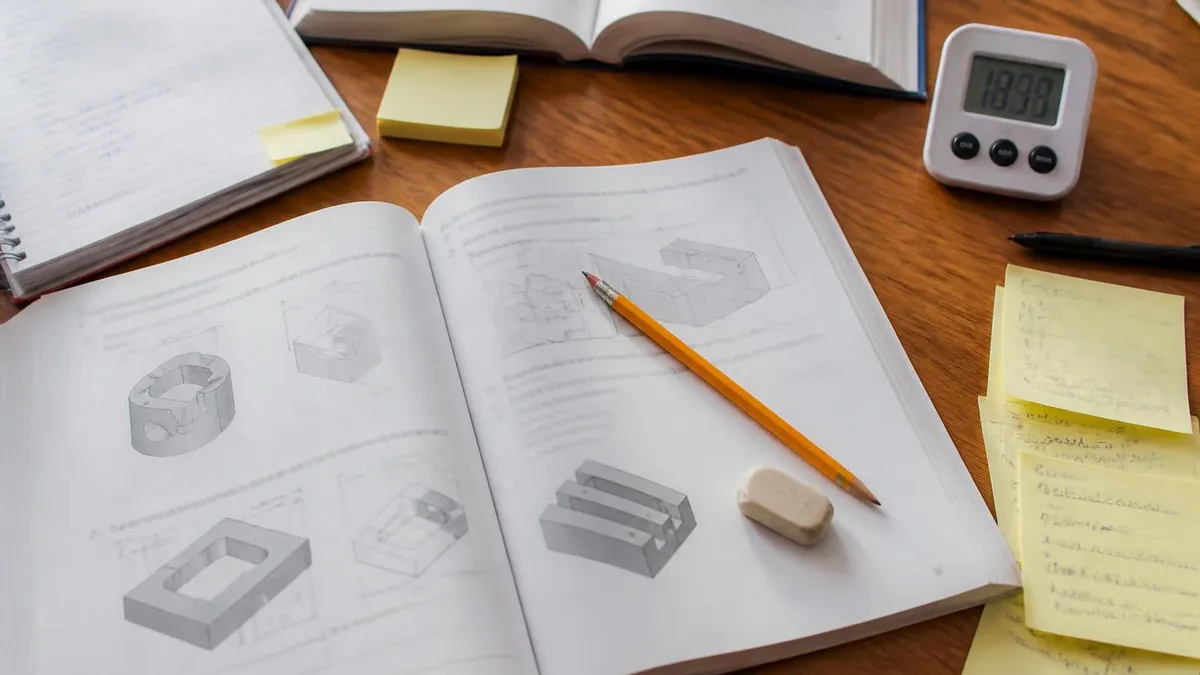
A typical part-modeling question on the CSWA sample looks like this. You see an isometric screenshot of a bracket with seven dimensioned features: a base extrude, two through-holes, a chamfered edge, a fillet on the back face, a cut-extrude pocket, and a 45-degree counter-bore. The prompt specifies units (MMGS), material (1060 Alloy aluminum), and the answer it wants (mass in grams to two decimal places).
The catch is sketch order. The base extrude needs to come from a sketch on the front plane, not the top plane. If you choose the wrong plane, your downstream chamfer and fillet references won't behave correctly because the directional vectors flip. Read the screenshot annotations — they often hint at the plane by showing the coordinate triad orientation.
Once the part is built, go to Tools, Evaluate, Mass Properties. The dialog returns mass, volume, surface area, center of mass, and principal axes. You only need the value the prompt asks for. Copy the mass to two decimals. Switch back to Tester Pro. Type the value. The grading engine accepts a window of roughly plus or minus 1% on most questions, so 142.83 g and 142.85 g both pass if the true answer is 142.84 g. But typing 0.14283 (kg) or 142840 (mg) is an instant failure even though the underlying mass is identical.
Exam Day Checklist
- ✓Licensed SolidWorks installation tested and launching cleanly
- ✓Tester Pro client downloaded and verified with sample test
- ✓Dual monitor or split-screen layout configured for client plus SolidWorks
- ✓Exam credentials email accessible (printed or on phone)
- ✓Stable internet connection confirmed for credential verification
- ✓Document template set to MMGS units and two-decimal precision
- ✓Mass Properties workflow rehearsed: Tools, Evaluate, Mass Properties
- ✓Three uninterrupted hours blocked off, do-not-disturb mode on

Walking through a sample assembly question
Assembly questions follow a predictable rhythm. You download a zip of three to five components. You read a prompt that specifies the mating sequence, the orientation of the base part, and one component that needs a specific angular offset. The answer is usually a center-of-mass coordinate (x, y, z) in a fixed reference frame.
Open SolidWorks, create a new assembly, and bring the base component in first. The first part you insert into an empty assembly becomes fixed at the origin — this is critical because the center-of-mass coordinate is measured relative to that origin. Insert remaining components, then apply mates in the order the prompt suggests: usually concentric first, then coincident, then any angular distance mates.
After all mates are applied, run Mass Properties on the assembly. Make sure the reference is set to the assembly origin, not a component origin. Copy x, y, z to two decimals. Each coordinate has its own tolerance window, so you can lose one and still pass the question by getting the other two right — but most candidates either nail all three or miss all three because the error is usually a mating mistake that shifts the entire assembly.
The most common assembly trap: the prompt says "the angular offset between Component A and Component B is 30 degrees" without specifying which direction. SolidWorks defaults to the smaller arc. If the answer feels wrong, flip the angle direction in the mate dialog before rebuilding from scratch.
Free Sample Versus Paid Practice
- +Free sample uses the exact Tester Pro client you face on exam day
- +No subscription or course fee required to start preparing
- +Sample runs offline with no time pressure unless you set the timer
- +Question style on the sample mirrors the live exam category-by-category
- +Downloadable CAD files give you real model practice not just theory
- −Sample question count is limited so volume of practice is shallow
- −No diagnostic feedback on which topics you missed
- −Sample does not cover edge-case modification questions in depth
- −No instructor walkthrough of advanced mating sequences
- −Paid providers add hundreds of questions and topic tracking the sample lacks
Walking through a sample drawing question
Drawing questions on the CSWA sample are multiple-choice and don't require you to build anything. They test your knowledge of drawing conventions: which view shows a hidden feature, what line type represents a centerline, how an auxiliary view is generated from a parent view, which projection standard (third-angle versus first-angle) governs the layout. The questions usually show a drawing with several views and ask you to identify a specific element.
The most common drawing question style shows three views of a part — front, top, and right — and asks which view best exposes a particular slot or feature. The answer requires you to mentally rotate the part and imagine the projection. Practice this with the sample drawings before exam day; it's a skill that decays if you only model in 3D.
Section views are another favorite. The prompt shows a part with a cutting plane line indicated, and asks what the resulting section view will look like. The answer requires understanding which features the cutting plane intersects and which it skips. Read the cutting plane direction arrows carefully — they point toward the viewer, not away.
Spend 30 seconds per drawing question. They're cheap points, but they add up. Missing all three drawing questions on a real exam is usually enough to push a borderline candidate below the 165-point threshold.
What to bring on exam day
Unlike most certification exams, the CSWA isn't administered at a Pearson VUE center. You take it on your own computer, in your own home or office, using your own copy of SolidWorks. This is the detail that surprises candidates the most. The exam is delivered via the same Tester Pro client used for the sample test, but with your unique exam credentials unlocking the live question bank.
Mandatory:
- A licensed copy of SolidWorks — student, educational, professional, or trial license, any active seat works. The exam doesn't care about the license type, but the software must launch and run normally. A 30-day trial is sufficient if you don't own a license.
- A computer that meets SolidWorks system requirements — at minimum, 16 GB RAM, a CPU from the last six years, and a graphics card on the certified list. Underpowered machines will rebuild models slowly and cost you minutes.
- A second screen or split display — strongly recommended. The Tester Pro client and SolidWorks have to be visible simultaneously. A single laptop screen forces constant alt-tabbing.
- A stable internet connection — needed to verify your exam credentials at launch and to submit the final answer file. The exam itself runs locally once credentials clear.
- The exam credentials email — printed or accessible on your phone, contains the exam ID and unlock code.
Don't underestimate the hardware requirement. A slow machine can rebuild a complex assembly in 45 seconds. Over a three-hour exam, those rebuilds eat 15 to 20 minutes of test time, the equivalent of one full modeling question.
⏱️ How long is the CSWA exam?
The CSWA runs 180 minutes (3 hours) and contains 14 questions covering drafting conventions, part modeling, and assembly mating. You take it on your own licensed SOLIDWORKS installation, not at a proctored testing center.
START CSWA PART MODELING PRACTICE TEST🎯 What score do I need to pass the CSWA exam?
You need 165 out of 240 points, about 69%. Modeling questions carry more weight than multiple-choice theory questions, so strong part-modeling and assembly performance matters most on the CSWA practice exam.
START CSWA ASSEMBLY MATING PRACTICE TEST🖥️ Do I need my own SOLIDWORKS license to take the CSWA sample exam?
Yes. CSWA is not center-administered - you sit it on your own computer with a licensed copy. Student, educational, professional, and 30-day trial seats all qualify as long as the software launches and rebuilds models normally.
START CSWA PART MODELING PRACTICE TEST📐 What kinds of questions appear on the CSWA practice exam?
Expect multiple-choice questions on drafting and view conventions plus modeling questions where you build a part or assembly, then pull a value from the Mass Properties dialog and type the number into the testing client.
START CSWA ASSEMBLY MATING PRACTICE TEST🔢 How precise must my numeric answers be on the CSWA exam?
The grading engine accepts roughly plus or minus 1% tolerance on numeric answers, but units must match the prompt exactly - submitting grams instead of the requested kilograms fails even when the underlying value is correct.
START CSWA PART MODELING PRACTICE TEST🔁 What happens if I fail the CSWA exam?
A failed attempt triggers a 14-day cooldown before you can retake it, and you pay the exam fee again with a freshly generated exam ID. Most retakers pass once they target the specific weak topic, often assembly mating, that tripped them up.
START CSWA ASSEMBLY MATING PRACTICE TEST📚 How long should I prepare with CSWA practice problems?
Most candidates need three to six weeks. Mechanical engineering students with one semester of SOLIDWORKS coursework often need just three weeks, while self-taught users switching from Fusion 360 or Inventor typically need six.
START CSWA PART MODELING PRACTICE TEST🧩 How close is the CSWA sample exam to the real solidworks CSWA exam?
The free official sample mirrors the real exam’s format, timing, and question types using the same testing client interface, but it only offers one fixed question set - treat it as a format primer, not unlimited practice volume.
START CSWA ASSEMBLY MATING PRACTICE TEST🏗️ Are assembly mating questions hard on the CSWA exam?
Assembly questions ask you to apply mates such as coincident, concentric, and distance to position parts correctly, then read an interference or mass value. Candidates who only practiced single-part modeling get tripped up here, so budget extra drill time.
START CSWA ASSEMBLY MATING PRACTICE TEST💼 Should I look at examples of past CSWA exams too?
The official sample alone is thin on volume. Pairing it with this page’s CSWA practice problems and reviewing examples of past CSWA exam question styles - part modeling, assembly mating, drafting theory - gives broader topic coverage before test day.
START CSWA PART MODELING PRACTICE TESTSample CSWA - Certified Solidworks Associate Practice Questions
Try these questions from our free CSWA - Certified Solidworks Associate practice tests. The correct answer and an explanation follow each question.
When inserting the very first component into a new, empty assembly, what is its default state and what does the `(f)` prefix next to its name in the FeatureManager Design Tree signify?
- A. The component is floating, and the `(f)` indicates it is the 'first' component.
- B. The component is flexible, and the `(f)` indicates its sub-assembly components can move.
- C. The component is floating, meaning it has all degrees of freedom.
- D. The component is fixed, and the `(f)` indicates its origin is locked to the assembly's origin.
Answer: D. The component is fixed, and the `(f)` indicates its origin is locked to the assembly's origin.
By default, SolidWorks fixes the first component placed into an assembly. This action locks the component's origin to the assembly's origin, providing a stable, immovable base for all subsequent components. The `(f)` prefix is the visual indicator in the FeatureManager Design Tree that a component is fixed.
What is a 'derived configuration' in SolidWorks?
- A. A configuration imported from another file
- B. A child configuration that inherits settings from a parent configuration
- C. A configuration created automatically by Simulation
- D. A read-only locked configuration
Answer: B. A child configuration that inherits settings from a parent configuration
A derived configuration is a child configuration that inherits properties from a parent configuration and can have additional overrides.
Which action rotates the 3D model view in SolidWorks?
- A. Shift + drag left mouse button
- B. Alt + drag left mouse button
- C. Middle mouse button click and drag
- D. Ctrl + drag left mouse button
Answer: C. Middle mouse button click and drag
Holding and dragging the middle mouse button rotates the 3D model view in the SolidWorks graphics area.
You have created a standard 3-view drawing (Front, Top, Right). If you change the scale of the Front (parent) view, what is the default behavior of the Top and Right (child) views?
- A. A warning will appear, requiring you to update them manually.
- B. They will remain at the original scale.
- C. They will automatically update to match the parent view's new scale.
- D. They will be deleted and must be recreated.
Answer: C. They will automatically update to match the parent view's new scale.
In SolidWorks drawings, projected views (child views) are linked to the view they were created from (the parent view). By default, they inherit properties like scale. Changing the parent view's scale will automatically update the scale of all child views that have this link enabled.
Take the full CSWA - Certified Solidworks Associate practice test
You can continue preparing with the cswa practice exam, which includes answer explanations for every question.
CSWA Questions and Answers
Official Resources
- SOLIDWORKS Certification Program - the official Dassault Systèmes program page for CSWA, CSWP, and CSWE, with exam descriptions, prerequisites, and registration.
- SOLIDWORKS Official Downloads - the official download hub for SOLIDWORKS software and trial licenses, useful if you need a qualifying installation to sit the CSWA sample or real exam.
About the Author

Educational Psychologist & Academic Test Preparation Expert
Columbia University Teachers CollegeDr. Lisa Patel holds a Doctorate in Education from Columbia University Teachers College and has spent 17 years researching standardized test design and academic assessment. She has developed preparation programs for SAT, ACT, GRE, LSAT, UCAT, and numerous professional licensing exams, helping students of all backgrounds achieve their target scores.
Join the Discussion
Connect with other students preparing for this exam. Share tips, ask questions, and get advice from people who have been there.
View discussion (9 replies)