
How CPR Works: When Performing CPR Manually Pumps Blood, Breath, and Life Support Explained
🎯 When performing CPR manually pumps blood to the brain and heart. Learn how CPR works, the ACLS algorithm, AED basics, and infant CPR steps.

When performing CPR manually pumps blood, it does something the stopped heart cannot: it keeps oxygen-carrying blood moving to the brain and heart until a defibrillator or advanced team arrives. In cardiac arrest, the heart's electrical system fails and the pump stops delivering blood. Within seconds the brain runs short of oxygen. Hands pushing hard and fast on the center of the chest stand in for the missing pump, and that one action is the foundation of every life support effort.
Understanding the mechanics removes the hesitation many bystanders feel. CPR does not restart the heart on its own. It buys time. Each compression squeezes the heart between the breastbone and the spine, forcing blood out into the body, and each release lets the chest recoil so the heart can refill. Done well, this rhythm supplies roughly a quarter to a third of normal blood flow, which is enough to protect the brain for a while.
The stakes are large. The American Heart Association estimates that more than 350,000 out-of-hospital cardiac arrests occur in the United States every year, and most happen at home. Survival without any help is very low, yet immediate bystander CPR can double or even triple the chance of survival. Every minute without defibrillation lowers survival by about 7 to 10 percent, so starting compressions before the ambulance arrives matters more than perfect technique.
This guide explains the physiology in plain language: what the heart normally does, why compressions create pressure that moves blood, how rescue breathing fits in, and why the chest must fully recoil. You will also see how a basic rescuer's actions connect to advanced care, including the ACLS algorithm used by hospital teams, PALS certification for pediatric providers, and the role of an AED. If you searched for CPR cell phone repair or CPR phone repair, those are device repair businesses, not resuscitation training.
Many learners also want to know where credentials come from. Organizations such as the American Heart Association, the American Red Cross, and the National CPR Foundation offer CPR training, and employers or licensing boards usually specify which providers they accept. Whichever you choose, the core science is the same because courses follow international resuscitation guidelines. Learning the mechanics first makes every later skill, from infant CPR to advanced life support, easier to understand and remember under pressure.
Rescue breathing adds oxygen to blood that is already circulating, and our guide to how cpr works with breaths explains when to use it. For most adults who collapse suddenly, hands-only CPR is recommended for untrained bystanders because compressions matter most in the first minutes. Trained rescuers, and anyone helping a child or infant, should include breaths because those arrests are more often caused by a loss of oxygen than by a heart rhythm problem.
Read on for the mechanics, the numbers, common mistakes, and practical tips. By the end you should be able to explain why compressions work, describe the correct rate and depth for adults, children, and infants, and understand what an AED does. Pair the reading with the practice questions on this site and with a hands-on class, because feeling the correct depth and rhythm on a manikin is something an article cannot teach.
CPR Blood Flow by the Numbers
The Four Mechanics Behind Manual CPR Blood Flow
Pushing the breastbone down at least 2 inches in an adult raises pressure inside the chest and squeezes the heart. This forces blood into the arteries and toward the brain, replacing the pump action the heart has lost during arrest.
Letting the chest rise completely after each push drops internal pressure and draws blood back into the heart. Leaning on the chest blocks this refill, so each following compression moves less blood than the one before.
A rate of 100 to 120 compressions per minute with pauses under 10 seconds keeps coronary perfusion pressure high. Each interruption lets pressure collapse, and several compressions are needed to rebuild it afterward.
Rescue breaths add oxygen to circulating blood, while an AED shock can reset a chaotic rhythm. Compressions bridge the gap so these treatments have living heart and brain tissue to work with when they arrive.
The Physiology: Why Chest Compressions Move Blood
A healthy heart works as a two-sided pump, sending oxygen-poor blood to the lungs and oxygen-rich blood to the body about 60 to 100 times per minute at rest. In cardiac arrest, most often caused by ventricular fibrillation, the heart muscle quivers without squeezing, or stops altogether. Pressure in the arteries falls toward zero within seconds. Compressions recreate that pressure artificially, which is why the basic answer to how CPR works is simple: you become the pump.
Researchers describe two overlapping mechanisms. In the cardiac pump theory, pressing the sternum squeezes the heart directly between the breastbone and spine, closing the valves and ejecting blood. In the thoracic pump theory, compression raises pressure throughout the chest, pushing blood toward the arteries while one-way valves in the veins prevent backflow. Most experts believe both contribute, and their balance varies with chest size, technique, and how long the arrest has lasted.
The release phase is equally important. When you lift your weight off the chest, it recoils, pressure inside drops below that of the veins, and blood flows back into the heart. Leaning on the chest between compressions keeps pressure high, prevents refilling, and reduces blood flow with every push. Rescuers should let the chest rise completely each time, keeping their hands in contact with the skin but applying no downward force during the release.
Coronary perfusion pressure explains why interruptions are dangerous. This is the difference between pressure in the aorta and in the right atrium during the relaxation phase, and it drives blood into the heart's own arteries. Studies link a coronary perfusion pressure of about 15 mmHg or higher with return of spontaneous circulation. Each pause lets that pressure collapse, and after restarting it takes several compressions to rebuild, so every second of hands-off time has a real cost.
That is why guidelines emphasize chest compression fraction, the share of total resuscitation time spent actively compressing. The target is at least 60 percent, and high-performing teams reach 80 percent or more. Practical steps include pre-charging the defibrillator while compressing, switching rescuers every two minutes before fatigue sets in, and limiting pulse checks to 10 seconds or less. Even a brief, unnecessary pause lowers blood flow to the brain and heart.
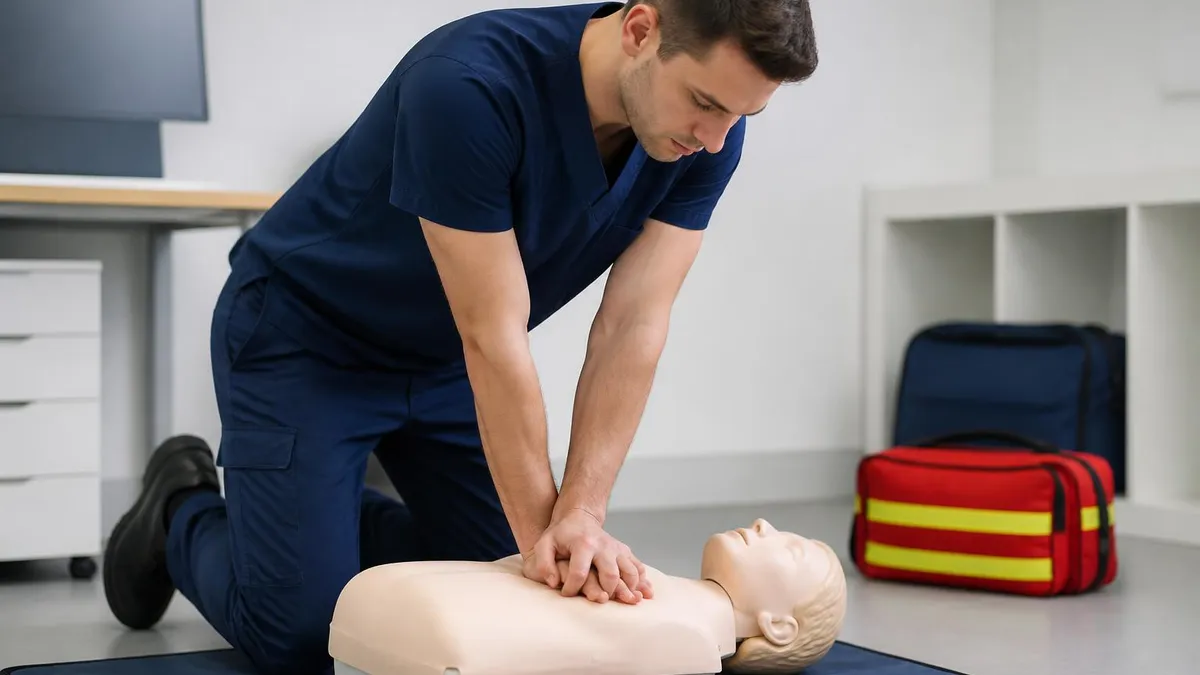
The recommended technique follows from this physiology. For adults, place the heel of one hand on the lower half of the breastbone, put the other hand on top, lock your elbows, and push at least 2 inches but no more than 2.4 inches. Aim for 100 to 120 compressions per minute, about the tempo of Stayin' Alive. Pushing too slowly reduces flow, while pushing too shallow fails to generate enough pressure to move blood effectively.
Compressions alone provide only about 25 to 30 percent of normal cardiac output, which is why they are a bridge rather than a cure. Their job is to keep brain and heart tissue alive until defibrillation or advanced treatment corrects the underlying problem. Good CPR also makes a shockable rhythm more likely to respond, because oxygenated heart muscle converts back to an effective rhythm more readily. Think of CPR as holding the door open until the rescue team can fix what is wrong.
Adult, Child, and Infant CPR: How the Technique Changes
For adults and adolescents past puberty, use the heel of one hand on the lower half of the sternum with the other hand on top. Push at least 2 inches but no more than 2.4 inches, at 100 to 120 per minute, and allow full recoil. Most adult arrests are cardiac in origin, so hands-only CPR is an excellent choice for untrained rescuers until an AED or EMS arrives.
Add breaths if you are trained. One or two rescuers use 30 compressions followed by 2 breaths, pausing compressions for less than 10 seconds. Attach an AED as soon as it arrives, follow its prompts, and resume compressions immediately after each shock. Continue until EMS takes over, the person starts breathing normally, or you are too exhausted to continue safely.
Hands-Only CPR vs. CPR With Rescue Breaths: Which Is Better?
- +Hands-only CPR is easy to remember and start without hesitation
- +No mouth-to-mouth contact removes hygiene concerns for bystanders
- +Continuous compressions keep coronary perfusion pressure high
- +Dispatchers can coach callers through hands-only CPR by phone
- +CPR with breaths supplies fresh oxygen when the cause is breathing-related
- +Breaths are essential for infants, children, and drowning victims
- −Hands-only CPR loses effectiveness as oxygen in the blood runs out
- −Hands-only is less suited to children and infants with breathing-caused arrest
- −Giving breaths requires training and a good seal on the airway
- −Pausing for breaths can lower compression fraction if done slowly
- −Over-ventilation can raise chest pressure and reduce blood return
- −Untrained rescuers may hesitate because they fear doing breaths wrong
Life Support Checklist: Steps to Pump Blood Correctly
- ✓Check the scene is safe before approaching the person.
- ✓Tap the shoulders and shout to check for responsiveness.
- ✓Look for absent or gasping breathing for no more than 10 seconds.
- ✓Call 911 or tell a bystander to call and fetch an AED.
- ✓Place the person on their back on a firm, flat surface.
- ✓Push hard and fast in the center of the chest at 100 to 120 per minute.
- ✓Compress at least 2 inches in adults and about 1.5 inches in infants.
- ✓Allow full chest recoil and avoid leaning between compressions.
- ✓Switch rescuers every two minutes to keep compressions strong.
- ✓Turn on the AED, attach the pads, and follow its voice prompts.
Every Pause Costs Blood Flow
Blood flow to the brain and heart drops to nearly zero the moment compressions stop, and it takes several pushes to rebuild. Keep hands-off time under 10 seconds, even when switching rescuers or placing AED pads. Continuous, high-quality compressions are the best gift a bystander can give.
What Does AED Stand For? Defibrillation and the ACLS Algorithm
AED stands for automated external defibrillator, a portable device that analyzes the heart rhythm and delivers an electric shock when it detects a shockable rhythm. Public places such as airports, gyms, and schools increasingly keep them on the wall. The device speaks step-by-step instructions, so no medical training is required. Using an AED early is the most important link after calling 911, because ventricular fibrillation rarely corrects itself without a shock.
To use one, turn it on, attach the pads as pictured on the packaging, and let the device analyze while nobody touches the patient. If it advises a shock, make sure everyone stands clear and press the button. Then resume compressions immediately, since the heart often needs time to rebuild effective circulation after a shock. The AED will prompt another analysis after about two minutes. Never delay pad placement to finish a cycle of compressions.
AED pads must go on bare, dry skin. Remove clothing, wipe away sweat or water, and shave heavy chest hair only if it blocks contact and a razor is available. Place one pad on the upper right chest below the collarbone and the other on the left side below the armpit. For children under eight, use pediatric pads if available; if not, adult pads can be used, placed front and back so they do not touch.
Hospital and paramedic teams work from the ACLS algorithm, the structured flowchart for advanced cardiovascular life support. It begins with the same basics, high-quality CPR and early defibrillation, then splits by rhythm. Ventricular fibrillation and pulseless ventricular tachycardia are shockable, while asystole and pulseless electrical activity are not. Teams check the rhythm every two minutes, and the leader assigns roles for compressions, airway, medication, and recording so no task interrupts the others.
In the shockable branch of the ACLS algorithm, the team delivers a shock, resumes CPR for two minutes, and gives epinephrine 1 mg after the second shock, repeating every three to five minutes. Amiodarone, 300 mg first and 150 mg for a second dose, or lidocaine may be added for persistent fibrillation. In the non-shockable branch, epinephrine is given as soon as possible, and the team searches for reversible causes, remembered as the Hs and Ts.
The Hs and Ts are a memory aid for treatable causes: hypovolemia, hypoxia, hydrogen ion (acidosis), potassium abnormalities, hypothermia, tension pneumothorax, tamponade, toxins, and thrombosis in the lungs or coronary arteries. Reversing one of these can turn a hopeless arrest into a recoverable one. Advanced providers earn credentials through ACLS courses, which use megacode simulations to practice running the algorithm, interpreting rhythms, and leading a team under time pressure.
Basic rescuers do not need to memorize drug doses, but understanding the algorithm shows why your actions matter. When paramedics arrive, the quality of the compressions you gave, the time to first shock, and the notes you provide about when the person collapsed shape every decision they make. Tell them what you saw, how long compressions have been running, and whether an AED shock was delivered. That short handoff saves precious minutes.
Never wait to find a pulse, locate a perfect surface, or finish a class before acting. CPR is for people who are unresponsive and not breathing normally. If an AED is nearby, send someone for it immediately, and keep compressing until it is ready to analyze.
Respiratory Rate, Rescue Breaths, and Position Recovery
Compressions move blood, but blood needs oxygen. Respiratory rate, the number of breaths per minute, is one of the first signs a rescuer assesses. A healthy resting adult breathes about 12 to 20 times per minute; children breathe faster, and infants may breathe 30 to 60 times per minute. In cardiac arrest, breathing is absent or only gasping. Agonal gasps are not normal breathing, and they should never delay the start of compressions.
Standard CPR uses a ratio of 30 compressions to 2 breaths for one rescuer, with each breath delivered over about one second so the chest visibly rises. Oxygen already in the blood and lungs lasts several minutes in sudden cardiac arrest, which explains why hands-only CPR works well for adults who collapse suddenly. Breaths matter more when the cause is respiratory, such as drowning, drug overdose, or choking, and for infants and children.
When a person has a pulse but is not breathing normally, rescuers give breaths alone at one breath every six seconds for adults, about ten per minute. For infants and children, give one breath every two to three seconds, about 20 to 30 per minute. After an advanced airway is placed during resuscitation, the team gives a breath every six seconds without pausing compressions. Avoid over-ventilating, because excessive breaths raise chest pressure and reduce blood return to the heart.
The recovery position is a different skill, and searches for position recovery often confuse it with CPR. It applies only to a person who is unresponsive but breathing normally and has a pulse. Roll them onto their side with the top knee bent and head tilted slightly back, so fluid drains from the mouth and the tongue does not block the airway. If breathing stops or becomes abnormal, return the person to their back and start CPR.
Children and infants need special attention. PALS certification, short for Pediatric Advanced Life Support, trains clinicians to recognize respiratory failure and shock early, because most pediatric cardiac arrests follow breathing problems rather than sudden rhythm failure. Rescuers with PALS skills use weight-based drug doses, pediatric algorithms, and age-specific equipment. Lay rescuers do not need PALS, but they should know that infants and children benefit from prompt breaths along with compressions.
For infant CPR, place two fingers just below the nipple line on the center of the chest, or use the two-thumb encircling technique if two rescuers are present. Compress about one-third the depth of the chest, roughly 1.5 inches (4 cm), at 100 to 120 per minute. A single rescuer uses 30 compressions to 2 breaths, and two rescuers use 15 to 2. Cover the infant's mouth and nose together with your mouth for each gentle puff.
Because infants are small, force and breath volume must scale down. A small puff of air from your cheeks, not a full lungful, is enough to make the chest rise. If you are alone with an unresponsive infant, give two minutes of CPR before leaving to call 911, or put your phone on speaker while you work. Taking an infant CPR course with a manikin is the best way to learn the correct hand positions.
Practical Tips to Remember and Perform CPR Under Pressure
Knowing the science helps, but performing CPR in a stressful moment is a practical skill. Start with three actions in order: check for responsiveness and breathing, call 911 or ask a bystander to call and bring an AED, and begin compressions. If you are alone with a phone, put it on speaker and let the dispatcher coach you. Dispatchers are trained to guide callers through compressions, and their coaching measurably improves bystander performance.
Rate and depth are the hardest things to judge without feedback. Use a song with roughly 110 beats per minute, such as Stayin' Alive or Baby Shark, to keep a steady tempo. For depth, push until you feel the resistance of the chest give way, aiming for about a third of the adult chest depth. Do not worry about cracking ribs; rib fractures are common and survivable, while no compressions is not.
Fatigue is the silent threat. Compression quality drops noticeably after about two minutes of continuous effort, even when rescuers feel fine. If a second person is available, swap roles every two minutes, taking less than five seconds to switch. Use your body weight rather than arm strength by positioning your shoulders directly above your hands. Kneel close to the chest and keep your back straight so the force travels down in a straight line.
Choose training that fits your goals. Community classes teach hands-on skills on manikins and often use feedback devices that show depth and rate. Providers include the American Heart Association, the American Red Cross, and others such as the National CPR Foundation. Healthcare workers typically need a Basic Life Support course, while advanced clinicians add ACLS and PALS. Always confirm with your employer or licensing board which provider and format they accept before paying for a course.
Renew your skills on schedule. Most CPR cards remain valid for two years, but skills fade much sooner, often within six months to a year without practice. Brief refreshers, quiz practice, and manikin sessions help maintain muscle memory. Reviewing scenarios, such as a collapse at a gym or an infant who stops breathing, prepares you mentally. Writing down the steps and practicing them aloud also improves recall under stress.
Know the legal and emotional realities. Every US state has Good Samaritan protections for laypeople who act in good faith, though details vary. Afterward, it is normal to feel shaken, even when the person does not survive. Talk to someone, and remember that your actions gave the person their only chance. Paramedics, hospitals, and community organizations can often connect rescuers with debriefing resources if the event was upsetting.
Finish your preparation by testing yourself. Use the practice questions linked on this page to check your recall of compression rate, depth, ratios, and AED steps, then book a hands-on class to practice with a manikin. Share what you learn with family, coworkers, and friends, since most cardiac arrests happen at home and the person nearest the patient is usually someone you know. The skills are simple, and a few hours of practice can save a life.
CPR Questions and Answers

Mouth to Mouth CPR: When to Use Rescue Breathing, How to Do It Safely, and Why Hands-Only CPR Often Replaces It in 2026
Adult CPR: Complete Step-by-Step Guide to Hands-Only and Standard CPR in 2026

CPR Scenarios: Real-Life Practice Cases for Adult, Child, and Infant Emergencies
CPR Course: How to Choose the Right Training Program

CPR Card: What It Is, How to Verify & Replace (2026)
How this page was made: written with AI tools and published by Nathan Beja, founder of Practice Test Geeks, who is responsible for its content. Exam facts are checked against the official sources listed below. Not reviewed by a subject-matter expert. Editorial policy
Sources & references
Exam facts on this page (fees, format, dates, passing scores) are checked against these official sources; the date is our last check. Editorial policy
- redcross.org — Test delivery, score validity, renewal, passing score · verified Nov 2026
- cpr.heart.org — Test delivery, eligibility, score validity · verified Nov 2026
- elearning.heart.org — Fees, passing score · verified Nov 2026