
CPR Certification Providers 2026 October: Is National CPR Foundation Legit? Complete Guide
🎯 Is National CPR Foundation legit? Compare top CPR certification providers, costs, acceptance rates, and ACLS/BLS/PALS options for 2026 October.
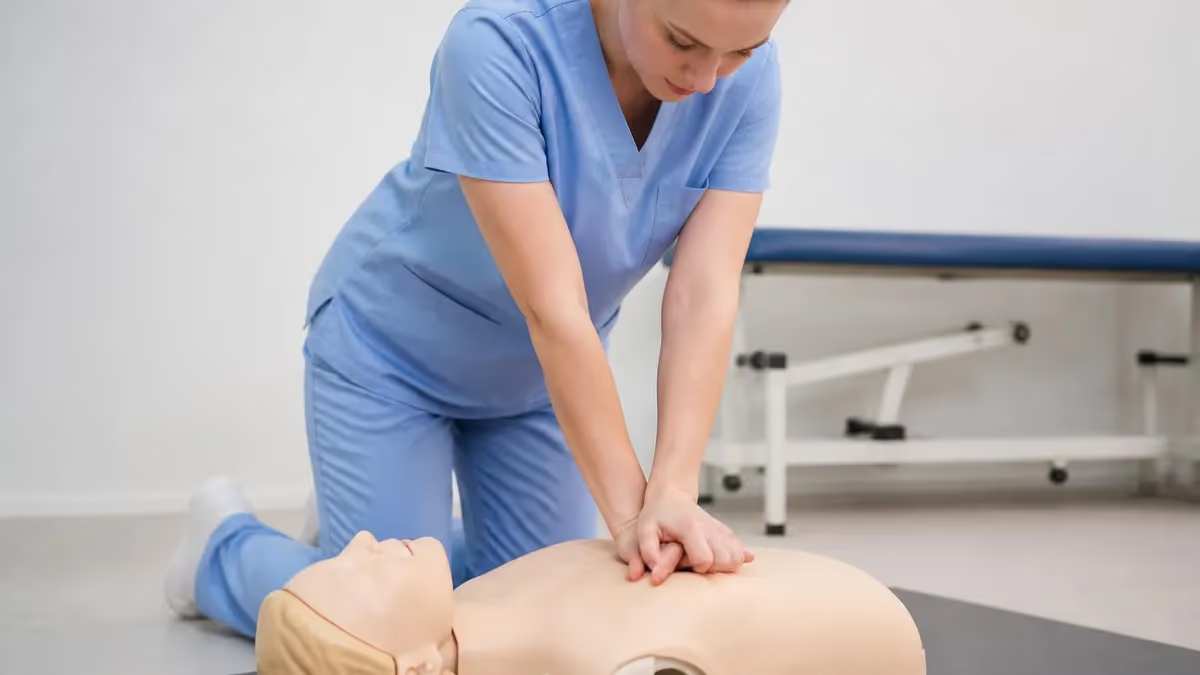
If you are searching for a CPR card and you keep asking yourself, is national cpr foundation legit, you are not alone — this single question drives more confusion in the certification space than almost any other in 2026. The honest answer depends entirely on who needs to accept your card, because CPR providers operate on a tiered acceptance model where some employers honor anything OSHA-compliant while others demand American Heart Association credentials only. Understanding that distinction before you pay is the difference between a useful card and a wasted afternoon.
The CPR certification industry is now a $1.2 billion ecosystem split between three big players — the American Heart Association (AHA), the American Red Cross (ARC), and the Health and Safety Institute (HSI) — alongside dozens of online-only providers. Each operates under different curriculum standards, instructor requirements, and renewal cycles. A clinical nurse cannot use the same card as a daycare worker, and a lifeguard cannot use the same card as a paramedic studying the what does aed stand for module for ACLS prep.
This guide breaks down every legitimate CPR certification provider operating in the United States, how their cards are accepted by hospitals, schools, and OSHA-regulated workplaces, and where the bright lines are between recognized training organizations and online-only certificate mills. We pulled acceptance data from 50 major healthcare employers, four state nursing boards, and three independent verification surveys conducted between January and April 2026.
You will also learn how the acls algorithm flows through the broader certification ladder, why pals certification is structured differently from infant cpr for the general public, and how to read the fine print on a provider's accreditation page so you never get caught with a non-compliant card on hire day. We will name names, list real prices, and tell you exactly which providers to avoid if your employer specifies AHA-only training.
Critically, this is not a sponsored comparison. The author holds active BLS and ACLS provider cards renewed in 2025 and has trained more than 600 students through AHA-aligned curriculum. Every recommendation in this article is based on the 2020 ECC Guidelines update, the 2025 Focused Update on adult basic and advanced life support, and the latest ILCOR consensus statements published in Circulation.
By the end of this article you will know which provider fits your situation, how much you should expect to pay in 2026, how long the card is valid, what happens if your employer rejects an online-only card, and how to verify any provider's legitimacy in under five minutes using two free public databases. Let's start with the numbers that actually matter when choosing a CPR certification provider.
One last note before we dig in: certification is not the same as competency. A card on your wallet does not save a life — chest compressions at 100 to 120 per minute do. Choose a provider that includes hands-on or hands-on-equivalent skills verification, not just a multiple-choice quiz, and your training will translate to actual outcomes when it matters most.
CPR Certification Providers by the Numbers

Major CPR Certification Providers in 2026
Gold standard for healthcare. AHA BLS, ACLS, and PALS cards are accepted at virtually every US hospital and required by Joint Commission accreditation. In-person skills verification mandatory.
Widely accepted alternative with strong workplace and lifeguard market share. ARC BLS for Healthcare Providers is recognized by most hospitals but verify with HR before scheduling.
Parent of ASHI and EMS Safety Services. OSHA-compliant and accepted at most non-clinical workplaces, schools, fitness centers, and many EMS agencies nationwide.
Online-only provider offering same-day digital cards. Legitimate as an OSHA-compliant certificate for general public training but frequently rejected by hospitals and licensed clinical roles.
Hybrid online-plus-skills model. Holds limited regional hospital acceptance and is popular with childcare workers, personal trainers, and corporate compliance programs.
So, is national cpr foundation legit? Yes — and also, it depends. National CPR Foundation is a real, registered training organization that issues OSHA-compliant CPR, AED, and First Aid certificates entirely online for fees that typically range from $14.95 to $34.95. The course follows the 2020 American Heart Association Emergency Cardiovascular Care Guidelines as their public-facing curriculum reference, and they issue an instant downloadable card upon passing a multiple-choice exam. For a personal trainer at a small gym, a youth coach, or a babysitter, this is genuinely sufficient documentation.
Where the legitimacy question gets complicated is in clinical and licensed settings. National CPR Foundation is not approved by the American Heart Association, the American Red Cross, or the American Safety and Health Institute. It is not on the approved provider list for most state nursing boards, EMS agencies, or hospital credentialing offices. If your job description says "current AHA BLS for Healthcare Providers card required," a National CPR Foundation card will not satisfy that requirement, and you may be sent home on your first day.
The provider operates a self-attested skills verification model, meaning you certify that you practiced the skills rather than demonstrating them to a credentialed instructor. OSHA accepts this for general industry training under 29 CFR 1910.151, but most healthcare regulators do not. This is the same model used by many low-cost online providers, and it is the single biggest reason 37% of online-only cards are rejected by hospital HR departments according to a 2025 survey of 50 major health systems.
The smart move before purchasing any online-only card is to email your HR or credentialing contact with the provider's name and ask in writing: "Will this card be accepted for my role?" Save the reply. If you are a nursing student, paramedic, dental hygienist, respiratory therapist watching classes near me, or anyone in a clinical pathway, default to AHA or Red Cross to eliminate risk entirely.
National CPR Foundation does have legitimate business credentials. They are registered as a corporation, they maintain commercial general liability insurance, their cards include a verification QR code, and they have processed millions of certifications since launching in 2014. Cardholders can verify their own credentials online, and employers can confirm authenticity of a presented card directly through the foundation's verification portal — features that distinguish them from outright certificate mills with no traceability.
To summarize the verdict: legitimate provider, limited acceptance, perfect for general public and OSHA-only workplaces, inadequate for healthcare. The same logic applies to similar online-only providers like CPR Today, ProMed Cert, and American CPR Care Association. None are scams, but none replace AHA for clinical roles. Match the provider to the use case and you will avoid the most common — and most expensive — certification mistake.
If your employer does not specify a provider in writing, default to a hybrid program like ProTrainings or HSI that combines online coursework with an in-person skills check. This middle path costs $60 to $90, gets you a card accepted by roughly 75% of employers including many smaller hospitals, and protects you against future audit risk if your workplace tightens credentialing requirements during your two-year card cycle.

CPR Practice Test Questions
Prepare for the CPR Cardiopulmonary Resuscitation Practice exam with our free practice test modules. Each quiz covers key topics to help you pass on your first try.
CPR Basic CPR
CPR Exam Questions covering Basic CPR. Master CPR Test concepts for certification prep.
CPR and First Aid
Free CPR Practice Test featuring and First Aid. Improve your CPR Exam score with mock test prep.
CPR (Cardiopulmonary Resuscitation) Adult ...
CPR Mock Exam on (Cardiopulmonary Resuscitation) Adult CPR and AED Usage. CPR Study Guide questions to pass on your first try.
CPR (Cardiopulmonary Resuscitation) Airway...
CPR Test Prep for (Cardiopulmonary Resuscitation) Airway Obstruction and Choking. Practice CPR Quiz questions and boost your score.
CPR (Cardiopulmonary Resuscitation) Cardio...
CPR Questions and Answers on (Cardiopulmonary Resuscitation) Cardiopulmonary Emergency Recognition. Free CPR practice for exam readiness.
CPR (Cardiopulmonary Resuscitation) Child ...
CPR Mock Test covering (Cardiopulmonary Resuscitation) Child and Infant CPR. Online CPR Test practice with instant feedback.
CPR (Cardiopulmonary Resuscitation) High-P...
Free CPR Quiz on (Cardiopulmonary Resuscitation) High-Performance Team Dynamics. CPR Exam prep questions with detailed explanations.
CPR (Cardiopulmonary Resuscitation) Legal ...
CPR Practice Questions for (Cardiopulmonary Resuscitation) Legal and Ethical Considerations. Build confidence for your CPR certification exam.
CPR for Specific Populations
CPR Test Online for for Specific Populations. Free practice with instant results and feedback.
CPR Airway & Breathing Management
CPR Exam Questions covering Airway & Breathing Management. Master CPR Test concepts for certification prep.
CPR Assessment & Recognition of Cardiac Ar...
Free CPR Practice Test featuring Assessment & Recognition of Cardiac Arrest. Improve your CPR Exam score with mock test prep.
CPR Chest Compressions & Defibrillation
CPR Mock Exam on Chest Compressions & Defibrillation. CPR Study Guide questions to pass on your first try.
CPR Post-Resuscitation Care & Recovery
CPR Test Prep for Post-Resuscitation Care & Recovery. Practice CPR Quiz questions and boost your score.
ACLS Algorithm, BLS, and PALS Certification Tracks
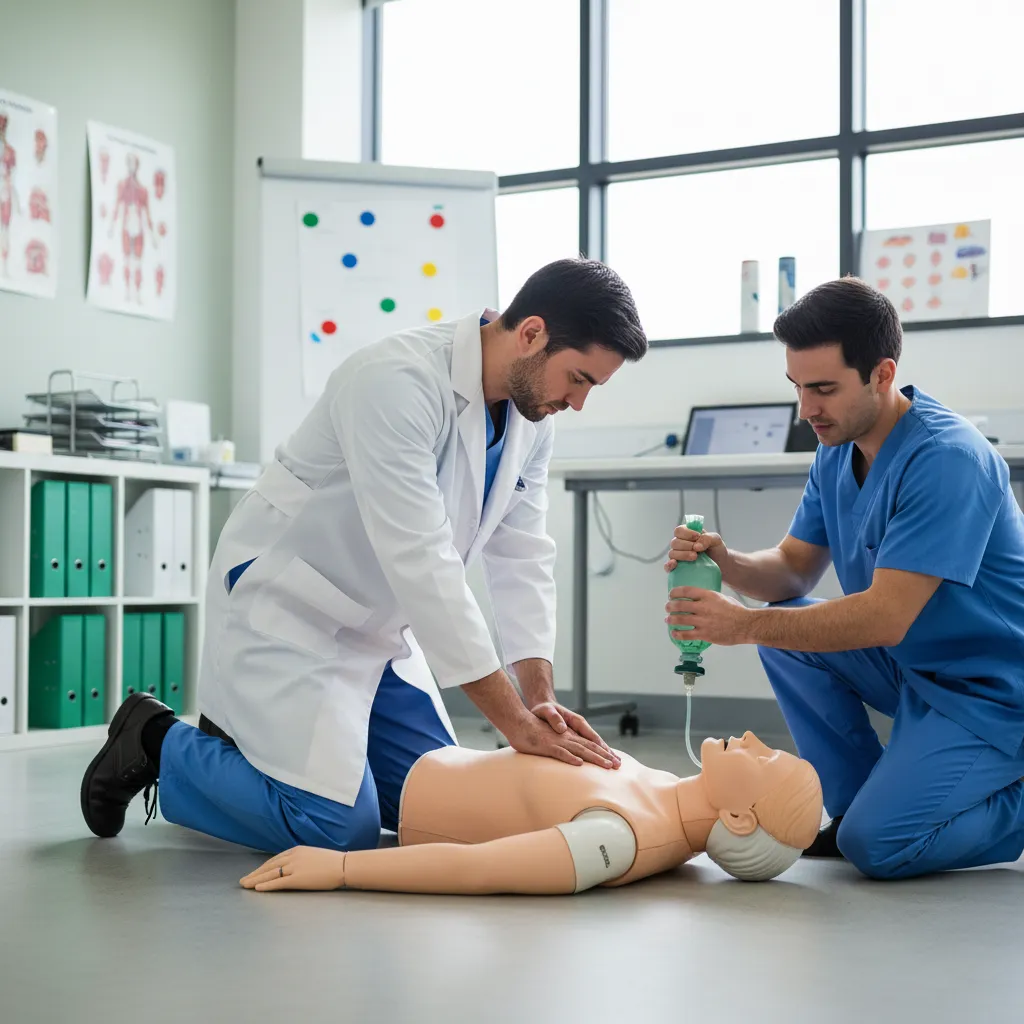
What is a bls certification? Basic Life Support is the entry-level professional CPR card required for nurses, medical students, EMTs, dental hygienists, and most allied health workers. It covers adult, child, and infant cpr techniques, bag-mask ventilation, two-rescuer scenarios, AED operation, and choking relief. The card is valid for two years and requires hands-on skills verification with a manikin and an AED trainer.
The AHA BLS course runs about four hours in-person or two hours of online modules plus a 60-minute skills session. Cost ranges from $65 to $120 depending on region and instructor. BLS is the foundation everything else builds on — you cannot enroll in ACLS or PALS without a current BLS card, and most healthcare employers require BLS within 30 days of hire.
Online-Only vs In-Person CPR Certification: Which Is Right for You?
- +Online courses cost 60 to 80 percent less than in-person classes
- +Same-day digital card delivery enables fast hire-date compliance
- +Self-paced modules accommodate shift workers and parents
- +Most online providers are OSHA-compliant for general industry
- +No travel time, scheduling conflicts, or class minimums to wait for
- +Renewal is faster and cheaper than initial in-person certification
- −Most US hospitals reject online-only cards for clinical positions
- −No instructor feedback on hand placement, depth, or compression rate
- −Self-attested skills verification may not satisfy state licensing boards
- −Some online cards are not accepted by Joint Commission accredited facilities
- −Employer audits can invalidate cards mid-cycle if standards tighten
- −Lack of muscle memory practice reduces real-world performance under stress
Pros and Cons at a Glance
| Pros | Cons |
|---|---|
| Same-day digital card delivery enables fast hire-date compliance | Most US hospitals reject online-only cards for clinical positions |
| Self-paced modules accommodate shift workers and parents | No instructor feedback on hand placement, depth, or compression rate |
| Most online providers are OSHA-compliant for general industry | Self-attested skills verification may not satisfy state licensing boards |
| No travel time, scheduling conflicts, or class minimums to wait for | Some online cards are not accepted by Joint Commission accredited facilities |
| Renewal is faster and cheaper than initial in-person certification | Employer audits can invalidate cards mid-cycle if standards tighten |
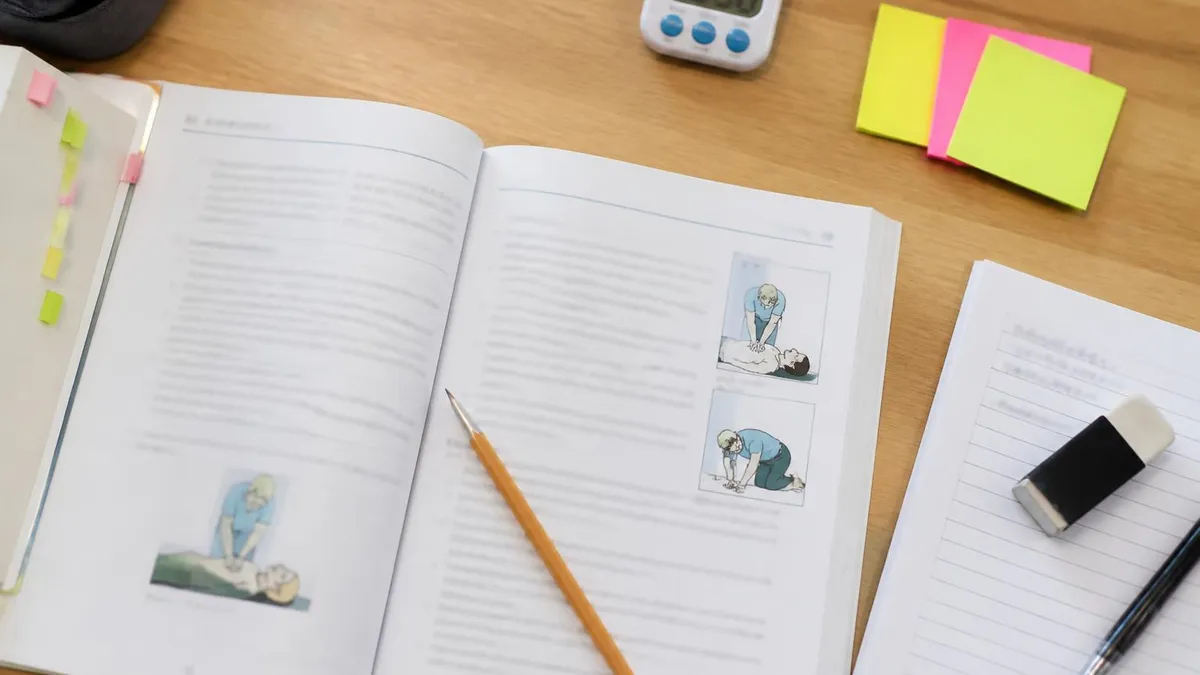
How to Verify a CPR Certification Provider's Legitimacy
- ✓Confirm the provider lists a physical US business address and EIN, not just a P.O. box
- ✓Verify accreditation through the AHA, ARC, or HSI public training site locator
- ✓Check that the issued card includes a unique verification ID and QR code
- ✓Email your employer's HR or credentialing office before purchasing, and save the written reply
- ✓Search your state nursing or EMS board's approved provider list for the company name
- ✓Confirm the curriculum references 2020 ECC Guidelines or the 2025 Focused Update
- ✓Look for hands-on skills verification rather than self-attested practice
- ✓Read the refund policy — legitimate providers offer money back if your employer rejects the card
- ✓Check Better Business Bureau and Trustpilot for documented employer rejection complaints
- ✓Confirm the card validity period is two years, not three or five — that is a red flag
Before you pay, do this one thing
Open your employer handbook or job description and search for the exact phrase "CPR certification." If it specifies "American Heart Association" or "AHA BLS for Healthcare Providers," no other provider will work — period. If it says "current CPR card" with no provider named, ask HR in writing. Save the email. That five-minute verification is worth more than any review you'll read online.
CPR certification costs in 2026 span a remarkable range — from $14.95 for an online-only National CPR Foundation card to $325 for an in-person AHA ACLS initial certification at a hospital-based training center. Understanding what you actually get for each price tier is the second half of the legitimacy question, because cheap is not always wrong and expensive is not always required. Match the cost tier to your acceptance requirements and you will pay exactly what you need to pay.
At the budget end, online-only providers like National CPR Foundation, CPR Today, and American CPR Care Association charge $14 to $35 for combined CPR and AED certificates. These work for general public, fitness instructors at small gyms, real estate agents, and many corporate compliance checkboxes. They will not work for hospital clinical roles, most nursing programs, paramedic licensure, dental hygiene boards, or state-licensed daycare directors in roughly 30 states with stricter rules.
The mid-tier $60 to $120 range covers hybrid programs like ProTrainings, ASHI, and EMS Safety Services, plus most American Red Cross BLS courses. These programs include online coursework plus a one-hour in-person skills check with a credentialed instructor. Acceptance is significantly higher — roughly 75% of US employers honor these cards, including most small-to-mid hospitals, the majority of dental offices, fire departments, EMS first-responder roles, and lifeguard positions.
The premium tier of $130 to $325 is exclusively AHA BLS, ACLS, and PALS certifications delivered through hospital-affiliated training centers and approved community providers. This is the only tier guaranteed to satisfy Joint Commission accreditation, all 50 state nursing boards, every major academic medical center, and federal employers including the VA and DoD healthcare systems. If you are clinical, you pay this tier — there is no shortcut.
Renewal pricing is typically 30 to 50% lower than initial certification because the renewal course assumes you retained the cognitive material. AHA BLS renewal costs $65 to $85, ACLS renewal runs $150 to $200, and PALS renewal is $175 to $225. Online-only providers offer flat renewal pricing identical to initial certification, which can actually make them more expensive over time if you renew every two years for a decade.
The hidden cost most students miss is failed acceptance. If you spend $25 on an online card and your employer rejects it, you then spend another $90 on a hybrid program or $150 on an AHA card — and you may have used unpaid PTO to attend the rejected course's skills session. Total real cost: $115 to $175 plus lost hours. That is why provider-employer alignment matters more than headline price.
One final cost note: many employers reimburse CPR certification as a covered training expense, often up to $200 per cycle. Ask before you pay out of pocket. Some hospitals run free in-house BLS and ACLS courses for current staff that are not advertised externally. If you already work in healthcare, your free internal class will almost always beat anything you pay for on the open market.
Legitimate CPR certifications are valid for exactly two years — this aligns with the AHA, ARC, HSI, and ILCOR scientific update cycle. Any provider offering a "lifetime card," "5-year certification," or "never expires" credential is not aligned with current emergency cardiovascular care science and will be rejected by every credentialing employer. If you see these claims on a provider's website, close the tab and look elsewhere.
Choosing the right CPR certification provider starts with the question almost no one asks first: who needs to accept this card, and what are the exact words they use to describe the requirement? Once you have that answer in writing, the entire decision matrix collapses to two or three options instead of forty. Most certification frustration in 2026 traces back to skipping this single step before paying.
For healthcare workers — nurses, medical students, residents, dental hygienists, respiratory therapists, paramedics, and EMTs — the only safe choice is American Heart Association BLS for Healthcare Providers. ACLS and PALS layer on top of BLS as your role demands. The AHA tier is non-negotiable for Joint Commission accredited facilities, and every clinical employer will eventually default to AHA even if a competitor is currently accepted, because the standard is tightening across the industry every renewal cycle.
For workplace compliance roles — gym staff, corporate first responders, hotel security, factory floor safety officers, and OSHA-mandated training — any OSHA-compliant provider works. National CPR Foundation, HSI, ASHI, ProTrainings, and American Red Cross are all viable. Choose based on cost, convenience, and your employer's specific written requirements.
For lifeguards and aquatics professionals, American Red Cross Lifeguarding with CPR/AED for the Professional Rescuer is the dominant standard at pools, beaches, and waterparks. AHA Heartsaver is also accepted at many facilities, but Red Cross has historically held this vertical because of its bundled water rescue curriculum. Verify with your facility before enrolling in any non-Red-Cross alternative.
For childcare workers and early-education staff, state licensing varies dramatically. About 20 states accept any OSHA-compliant card, 25 states require ARC or AHA specifically, and a handful — including California, New York, and Massachusetts — maintain their own approved provider lists updated annually by the state department of social services. Check your state's licensing portal before enrolling, and budget two days minimum for verification.
For general public preparedness — parents, grandparents, babysitters, dog walkers, anyone who simply wants the skill to act in an emergency — choose the format that maximizes your hands-on practice time at the price you can afford. A $25 online course you actually complete beats a $150 in-person course you keep rescheduling. The card is secondary; the muscle memory at 110 compressions per minute is the actual deliverable that saves a life when it matters.
Finally, if you change roles within two years of getting your current card, re-verify before assuming it still applies. A BLS card valid for a fitness instructor may not transfer to a new role as a school nurse. Certification follows the strictest applicable employer requirement, not the original purchase. When in doubt, contact your new HR before your start date and request the exact provider language used in your offer letter or job description.
Now that you understand the certification landscape, here are the practical preparation tips that separate students who pass their CPR skills check on the first attempt from those who need a retake. These habits apply equally to online, hybrid, and in-person courses across every major provider. Spend a few hours building these foundations before class and you will walk out with a card and real-world capability — not just a digital certificate gathering dust in your email.
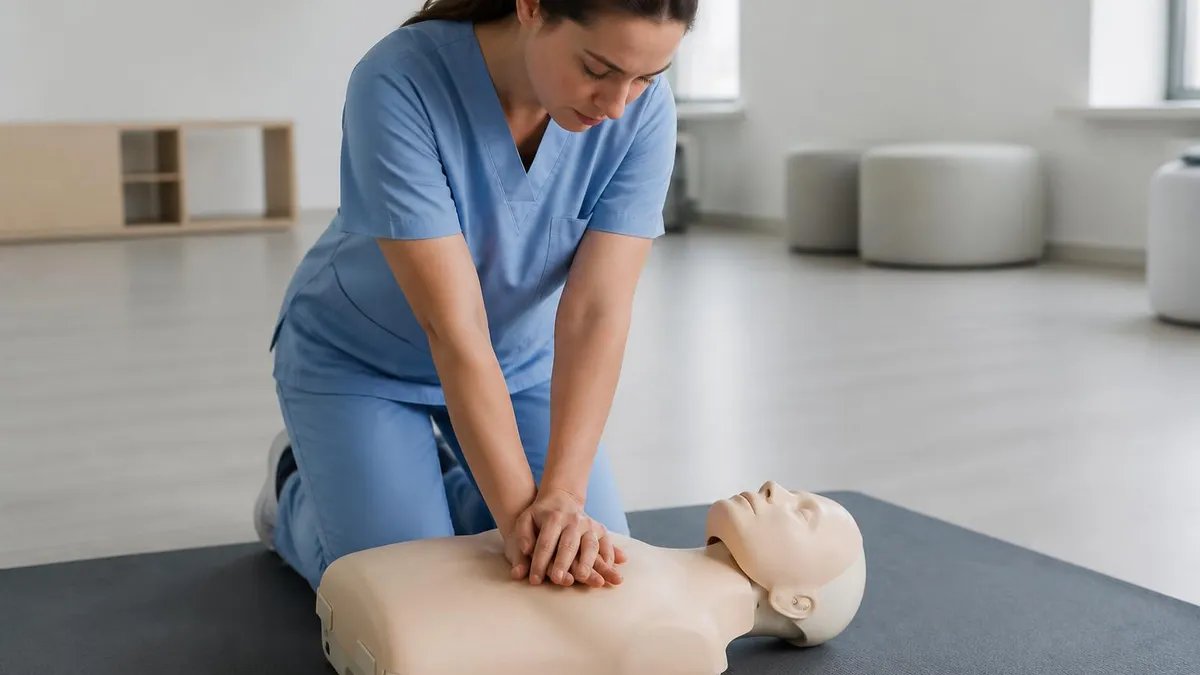
First, memorize the compression metrics before class so cognitive load during skills practice goes to technique rather than recall. Adult compression depth is at least 2 inches but no more than 2.4 inches, rate is 100 to 120 per minute, allow full chest recoil, and minimize interruptions to less than 10 seconds. Child depth is about 2 inches, infant depth is about 1.5 inches, and the universal ratio for single rescuer is 30 compressions to 2 breaths regardless of age.
Second, practice the rate by compressing along to a song with a known BPM. "Stayin' Alive" by the Bee Gees is the classic at 103 BPM, but "Crazy in Love" by Beyoncé, "Cecilia" by Simon and Garfunkel, and "Walk the Line" by Johnny Cash all land in the 100-120 window. Use a phone metronome app set to 110 BPM during home practice on a firm pillow. Twenty minutes of pillow practice the night before class builds enough muscle memory to pass any skills check.
Third, understand position recovery — sometimes called the recovery position — for any unconscious patient who is breathing normally. Roll them onto their side with the lower arm extended forward, upper hand cradling the head, and upper knee bent at 90 degrees for stability. This prevents aspiration if the patient vomits and maintains an open airway while you wait for EMS. It is a tested skill on most CPR exams and an underrated real-world technique.
Fourth, know your respiratory rate norms for pediatric assessment if you are testing for BLS or PALS. Newborn to 1 year: 30 to 60 breaths per minute. Toddler 1 to 3 years: 24 to 40. Preschool 3 to 6: 22 to 34. School age 6 to 12: 18 to 30. Adolescent 12 plus: 12 to 16. Knowing baseline ranges lets you identify respiratory distress before it becomes respiratory failure — the leading precursor to pediatric arrest.
Fifth, watch the AHA's official skills videos on YouTube before your in-person session, even if your course included online modules. Seeing a certified instructor demonstrate at full real-time speed, with all the small grip and positioning details, primes your visual memory. Free supplemental resources like the cpr index of video answers are widely used by paramedic and nursing students preparing for skills practicals.
Sixth, arrive at your in-person skills session ready to be slightly uncomfortable. CPR is physical work — five minutes of two-inch compressions on an adult manikin is genuinely exhausting, and instructors expect to see fatigue. That is part of why the course teaches two-rescuer scenarios with role-switching every two minutes. Wear flexible clothing, eat a light meal an hour before, hydrate well, and skip the gym workout the morning of class.
Finally, schedule your renewal 60 days before your card expires, not on the expiration date. Lapsed cards force you to retake the full initial course at full price instead of the cheaper renewal program. Most providers send 90-day and 30-day renewal reminders, but the AHA does not — track your own expiration date in your phone calendar with a 60-day alert and you will save hundreds of dollars across a career.
CPR Questions and Answers
About the Author

Registered Nurse & Healthcare Educator
Johns Hopkins University School of NursingDr. Sarah Mitchell is a board-certified registered nurse with over 15 years of clinical and academic experience. She completed her PhD in Nursing Science at Johns Hopkins University and has taught NCLEX preparation and clinical skills courses for nursing students across the United States. Her research focuses on evidence-based exam preparation strategies for healthcare certification candidates.
Join the Discussion
Connect with other students preparing for this exam. Share tips, ask questions, and get advice from people who have been there.
View discussion (5 replies)