
Correctional Officer Strike in New York: What COs Need to Know 2026 September
Correctional officer strike in New York explained. Causes, impact on COs, worker rights, and what aspiring officers should know. 🎯 Full guide inside.
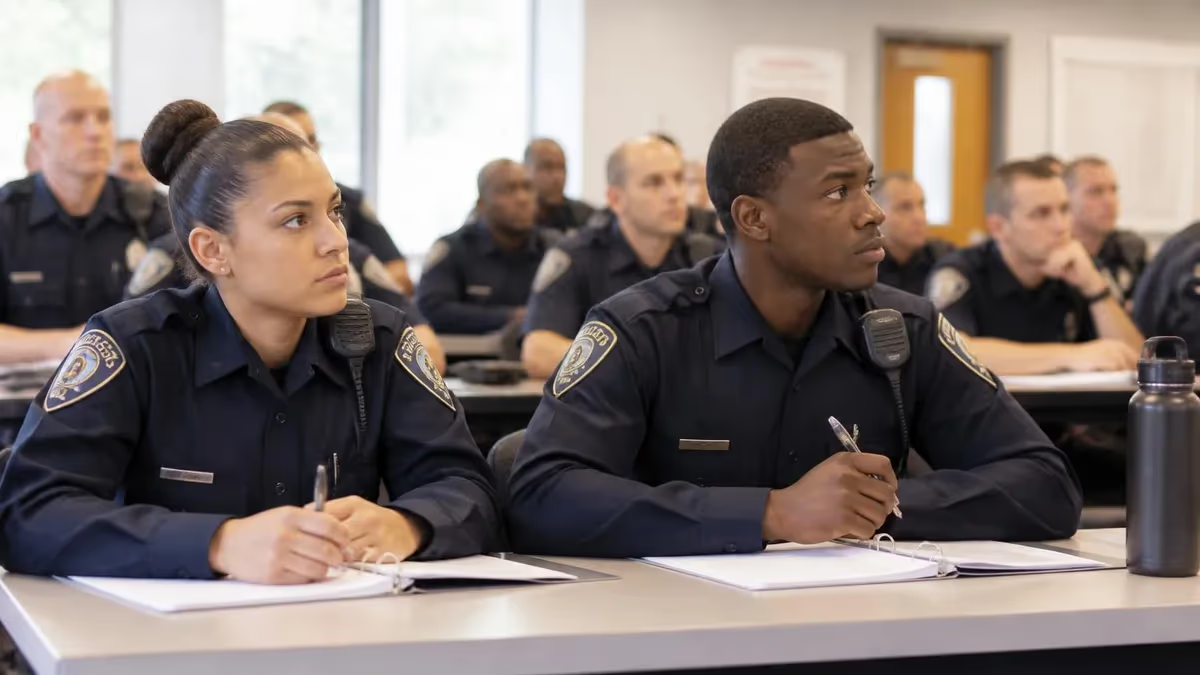
The correctional officer strike in New York has become one of the most significant labor actions in the history of the state's prison system, drawing attention from policymakers, union advocates, and anyone considering a career in corrections. When officers walk off the job, it exposes deep tensions between the demands placed on front-line staff and the institutional responses from management and government. Understanding these events is essential whether you are a working CO, a union delegate, or someone preparing to enter the field.
New York State's correctional facilities house tens of thousands of incarcerated individuals across dozens of facilities, making the Department of Corrections and Community Supervision (DOCCS) one of the largest correctional systems in the country. The officers who staff these facilities — often referenced through brand phrases like collars and co when discussing uniform culture — face staffing shortages, mandatory overtime, and safety concerns that have periodically pushed the workforce to its breaking point. These pressures are not unique to New York; similar dynamics play out wherever officers feel unsupported.
Labor actions in corrections are uniquely complex. Unlike employees in most private-sector industries, correctional officers in New York are governed by the Taylor Law, which prohibits public employees from striking. This legal framework means that any organized work stoppage carries serious legal and financial consequences for participants, including fines and potential termination. Despite this, desperate working conditions have led officers to engage in collective actions that mirror strikes in effect even when they cannot be called one legally.
The roots of officer unrest typically trace back to a convergence of pressures: chronic understaffing that forces COs to work double or triple shifts, inadequate mental health support after traumatic incidents, concerns about contraband introduction through visiting protocols, and disputes over disciplinary procedures. These grievances do not appear overnight — they accumulate over years of contract negotiations, policy changes, and budget cuts that leave facilities short-handed while inmate populations remain steady or grow.
From a career preparation standpoint, understanding the labor landscape of New York corrections is genuinely important. Officers entering the system today will navigate union membership, contract cycles, and collective action norms from their very first day of employment. The New York State Correctional Officers and Police Benevolent Association (NYSCOPBA) represents thousands of officers and has been central to every major labor dispute in recent decades. Knowing how this union operates and what it has fought for gives new officers context for the profession they are entering.
For those studying for the CO civil service exam, awareness content about correctional officer strike new york dynamics and broader labor issues provides valuable real-world context that can inform answers on situational judgment sections. The exam tests not just procedural knowledge but your understanding of institutional culture, officer responsibilities, and professional conduct — areas deeply shaped by the labor history of the field.
This article explores the causes, legal context, impact, and career implications of correctional officer work stoppages in New York State, providing the comprehensive background that every aspiring and current CO deserves to have. Whether you landed here after researching duluth trading co gear for your uniform needs or arrived directly seeking labor law information, the content ahead covers every essential angle of this important topic.
NY Corrections Labor by the Numbers

History of Major NY Correctional Officer Labor Actions
1979 — First Major Work Stoppage
1991 — Attica Anniversary Protests
2021 — COVID-Era Vaccine Mandate Dispute
2022-2023 — Rikers and Staffing Crisis
2025 — Renewed Contract Negotiations
The Taylor Law — formally the Public Employees Fair Employment Act — is the foundational legal constraint shaping every labor dispute involving New York correctional officers. Enacted in 1967, the law grants public employees the right to organize and collectively bargain while explicitly prohibiting strikes. Any employee who participates in a strike can lose two days of pay for every day they are on strike, and unions can face decertification and substantial fines. These penalties are designed to make formal strikes economically devastating, pushing disputes toward arbitration instead.
Despite these penalties, the law has not eliminated collective action — it has simply changed its form. When officers believe conditions have become intolerable, they engage in what labor researchers call "blue flu" campaigns: coordinated sick calls that have the practical effect of a work stoppage without the legal label of a strike. Facilities that normally operate with three hundred officers on duty may find themselves with fewer than one hundred, forcing management to call emergency mutual aid from other facilities and to mandate remaining staff into extended shifts sometimes exceeding twenty hours.
The legal gray area around blue flu campaigns has been litigated repeatedly. Courts have generally found that proving coordination — turning individual sick calls into a collective action — is difficult without direct evidence like group texts or meeting minutes explicitly organizing the action. NYSCOPBA leadership typically walks a careful line during these episodes, publicly encouraging members to follow the law while declining to order anyone back to work through formal channels if management is not addressing the underlying safety concerns.
Arbitration under the Taylor Law framework has produced mixed results for officers. On compensation matters, arbitrators have generally recognized that New York CO salaries must be competitive with surrounding states to stem the flow of trained officers to federal prisons, New Jersey, Connecticut, and other jurisdictions. On working conditions — particularly mandatory overtime caps and staffing minimums — arbitration outcomes have been less favorable, often deferring to management's operational discretion.
Understanding this legal landscape helps explain why correctional officer labor actions feel different from private-sector strikes. There are no picket lines, no formal strike votes, and no public announcements — just an unusually high number of sick day requests filed at facilities across the state on the same morning. The opacity is not deception; it is a rational adaptation to legal constraints that officers and their union have navigated for over fifty years.
New officers entering DOCCS facilities today are briefed on Taylor Law obligations during their academy training. They are told clearly that participation in an illegal strike can cost them their careers. And yet, when conditions deteriorate badly enough, even officers who fully understand the legal risk sometimes conclude that the personal cost of continuing to work in an unsafe environment exceeds the legal penalty. This calculation — individual safety weighed against institutional compliance — lies at the heart of every major correctional officer labor action in New York history.
For those preparing for their CO civil service examination, labor law and officer rights are legitimate areas of situational knowledge. Exam questions may present scenarios involving officer conduct during disputes, proper channels for grievance reporting, and the limits of collective action. Understanding the Taylor Law framework and how NYSCOPBA operates within it provides the kind of grounded, practical knowledge that informs strong answers on professional conduct sections of the assessment.
Key Causes of Correctional Officer Unrest in New York
Chronic understaffing is the single most frequently cited driver of CO unrest statewide. When facilities operate at 60–70% of their authorized officer headcount, remaining staff are mandated into back-to-back shifts that stretch their physical and cognitive limits well beyond safe thresholds. Officers working sixteen or more consecutive hours report impaired decision-making, elevated stress responses, and significantly higher rates of physical confrontation with incarcerated individuals — outcomes that harm everyone in the facility.
Mandatory overtime is not occasional in New York's correctional system — for many officers it has become a near-daily reality. NYSCOPBA data from recent contract cycles shows that some officers logged over 1,500 hours of overtime in a single year, equivalent to working an additional thirty-seven full weeks on top of their regular schedule. This level of sustained overwork produces burnout, family strain, and health deterioration that drives experienced officers to retire early or transfer, worsening the staffing shortage that created the problem in the first place — a vicious cycle that labor actions are partly intended to break.
Joining NY Corrections During Labor Unrest: Weighing the Decision
- +Strong union representation through NYSCOPBA provides contract protections from day one of employment
- +New York CO salaries average $78K base with significant overtime earning potential exceeding $100K
- +Defined benefit pension after 25 years of service provides financial security unavailable in most private jobs
- +Civil service employment status makes termination difficult without documented cause and due process
- +Active contract cycles mean working conditions are regularly renegotiated, with recent gains on overtime caps
- +Academy training is paid at full salary, and tuition assistance programs support ongoing education
- −Taylor Law prohibits formal strikes, limiting officers' most powerful labor leverage in disputes
- −Mandatory overtime during staffing shortages can disrupt family life and personal health significantly
- −Facilities in some regions face 30%+ vacancy rates, increasing workload on every officer who stays
- −PTSD and mental health risks are elevated, and support systems remain underfunded and stigmatized
- −Public sympathy during labor actions can be difficult to build when the work happens behind closed doors
- −Contract arbitration outcomes are unpredictable and can take years to resolve, leaving grievances unaddressed
CO Rights and Union Protections — What Every Officer Should Know
- ✓Join NYSCOPBA immediately upon hire to access full contract protections and legal representation
- ✓Document every instance of mandatory overtime, including date, shift length, and supervising officer
- ✓File a formal grievance through your union rep within the contractual time limit for any rights violation
- ✓Report all workplace injuries — including psychological trauma — through the official incident report process
- ✓Request a Weingarten representative before any investigatory interview that could lead to discipline
- ✓Review your contract annually; know your pay step, benefit entitlements, and leave accrual rates
- ✓Participate in PERB complaint processes when management implements unilateral policy changes mid-contract
- ✓Attend union meetings to stay informed about contract status and collective action decisions
- ✓Know your Taylor Law obligations — participating in an illegal strike can result in loss of two days pay per day out
- ✓Access the Employee Assistance Program for confidential mental health support without fear of career impact
Union Membership Shapes Your Career From Day One
Every new correctional officer in New York State enters a workplace defined by decades of collective bargaining. Your salary, overtime rules, disciplinary procedures, and safety protocols are all products of union contracts negotiated by NYSCOPBA. Understanding how your union works — and participating actively in it — is not optional career advice. It is the foundation of your professional protection in one of the most demanding jobs in public service.
The impact of correctional officer work stoppages extends far beyond the officers themselves, reshaping operations across entire facility systems and creating ripple effects that reach incarcerated individuals, their families, administrators, and the broader public. When a facility loses a significant portion of its officers to coordinated sick calls or to attrition accelerated by labor disputes, the consequences are immediate and cascading. Programs get cancelled, visitation gets suspended, and the remaining officers face conditions that directly increase the probability of incidents.
Incarcerated individuals in New York's correctional facilities are perhaps the most immediately affected by labor disruptions. When staff ratios drop below safe thresholds, programming — education, vocational training, substance abuse treatment — is the first casualty. These programs have documented positive effects on recidivism reduction and institutional safety, meaning that staffing crises don't just harm officers in the short term; they undermine rehabilitation outcomes that affect public safety for years afterward. Labor advocates and criminal justice reformers have sometimes found unexpected common ground on this point.
The financial impact on state government is substantial. Emergency overtime during staffing crises typically costs New York taxpayers tens of millions of dollars annually. Mutual aid transfers between facilities — bringing officers from as far as three hundred miles away to cover vacancies — add transportation, lodging, and overtime costs on top of base pay.
Labor disputes that result in PERB proceedings, arbitration, and litigation add legal costs that compound over time. The irony is that the state often spends more reacting to staffing crises than it would cost to proactively address the underlying compensation and conditions issues that drive officers out.
For facility administrators, managing through labor unrest requires a careful balance between enforcing institutional rules and maintaining enough officer goodwill to keep facilities functional. Superintendents who respond to grievances with heavy-handed discipline tend to accelerate departures and deepen resentment.
Those who communicate transparently with staff and advocate for their facilities' resource needs with central office tend to maintain better retention and fewer acute crises. The management culture at individual facilities — similar to the brand culture distinctions between a duluth trading co approach (durable, worker-focused) versus a purely corporate posture — makes an enormous difference in how labor tensions manifest day to day.
The media coverage of correctional officer labor actions in New York has historically been limited compared to teacher or transit worker disputes. Corrections happens behind closed doors, and public sympathy for the workforce is complicated by the nature of the work.
Labor advocates have argued that this invisibility perpetuates the conditions that cause unrest — when the public does not see the staffing numbers, the mandatory overtime hours, or the injury rates, it is easier for state officials to deprioritize the funding needed to address them. Recent advocacy campaigns by NYSCOPBA have worked to make these conditions more visible through social media, legislative testimony, and public information campaigns.
The career implications for officers who participate in or are affected by labor actions are real and lasting. Officers who receive Taylor Law penalty deductions see those deductions reflected in their retirement benefit calculations in some circumstances. Officers who are terminated for participation in an illegal strike lose not just their jobs but their pension credits, a consequence severe enough to deter all but the most desperate collective actions. NYSCOPBA maintains a legal defense fund precisely because the consequences of collective action, when they occur, require vigorous representation to ensure officers are treated fairly under applicable law.
For those who are preparing for the CO civil service examination and considering a career in New York State corrections, this landscape is important context rather than a deterrent. The vast majority of officers complete full careers without ever being involved in a formal labor action. They benefit from union protections, earn competitive salaries with substantial overtime, retire with defined benefit pensions, and look back on careers defined by meaningful public service. Understanding the labor environment helps new officers set realistic expectations and make informed choices about the profession they are entering.

Participating in a strike as a New York State public employee is illegal under the Taylor Law and carries automatic financial penalties of two days pay lost for every day of participation. Unions can also face decertification and heavy fines. Before taking any collective action, consult your NYSCOPBA representative to understand what is legally protected and what is not — the consequences of an unauthorized work stoppage can follow you through your entire career and into retirement.
Preparing for a career in New York State corrections in the current labor environment requires a realistic, well-informed mindset. The challenges that have driven labor unrest — understaffing, mandatory overtime, mental health pressures — are real, documented, and ongoing. At the same time, the profession offers genuine rewards: job security in a civil service framework, strong union representation, competitive compensation, and the knowledge that your work contributes to public safety in a tangible way every single day you report for duty.
The civil service examination is the first gate into this career, and performing well on it is both a practical necessity and a signal of your commitment to the profession. Strong exam performance improves your rank on the eligible list, which directly affects which facilities and which shifts you have access to when hiring offers come. Candidates who rank high enough can sometimes choose between geographic locations, which matters enormously for quality of life — a posting near a major metropolitan area versus a rural facility hundreds of miles from home creates very different lifestyle realities.
Once hired, the academy experience shapes your foundational understanding of facility operations, use of force policy, legal authority, inmate rights, emergency procedures, and professional conduct standards. The academy also introduces you formally to the union structure and your rights as a public employee. Officers who pay attention during this phase and ask good questions emerge with a much clearer picture of what they are walking into when they report to their first facility assignment.
Understanding rank structure matters for career planning in ways that intersect directly with labor relations. The path from correction officer to sergeant, lieutenant, captain, and beyond involves a combination of seniority, civil service examination performance, and evaluation scores. Sergeant and above are typically management-level positions that are not represented by NYSCOPBA — they fall under a different union, the Correction Captains Association or comparable bodies depending on the facility type.
Officers thinking about long-term advancement need to understand this transition, because it changes their relationship to collective bargaining fundamentally. Resources like the correctional officer strike new york ranks guide provide detailed information on this progression and what each level entails.
The time you invest in exam preparation today directly determines the career options available to you tomorrow. Officers who enter with a deep understanding of the institutional landscape — including the labor history and union structure that shapes daily working life — are better equipped to navigate their early years on the job without being caught off guard by the realities they encounter. Informed officers make better professional decisions, build stronger relationships with colleagues, and advance more consistently through their careers.
New York's correctional system is changing, and the officers being hired now will shape what it looks like a decade from now. Investments in staffing, in mental health infrastructure, in training quality, and in compensation competitiveness are all under active policy discussion. The ivy city co of corrections policy — fashionable reform rhetoric without structural funding — is increasingly being challenged by union advocates and corrections professionals who demand concrete changes rather than talking points. Officers entering today can be part of that advocacy while building strong individual careers.
Whatever brings you to this field — a family tradition of public service, the job security, the mission, or simply the opportunity — the work is demanding, meaningful, and deeply shaped by the collective history of those who came before you. Take the time to understand that history, prepare thoroughly for the examination, and walk into your first facility with eyes open to both the challenges and the genuine professional rewards that New York State corrections can offer over the course of a full career.
Practical preparation for a CO career in New York begins well before your first exam date, and it extends through the academy and into your early years on the job. Officers who approach preparation systematically — treating it the way sourdough and co bakers treat their craft, with attention to process and patience for the slow work of building competence — consistently outperform those who cram at the last minute and hope for the best. The civil service exam rewards breadth of knowledge, situational judgment, and reading comprehension skills developed over time.
Start with the official exam announcement from the New York State Department of Civil Service. This document specifies the subject areas covered, the format of the exam, the scoring methodology, and any special requirements for the specific posting. Exam announcements vary slightly depending on whether you are applying for a state DOCCS position or a county jail position, and the requirements are different again for the New York City Department of Correction. Make sure you are studying for the right test before investing significant preparation time.
Practice tests are your most powerful preparation tool. They accomplish several things simultaneously: they familiarize you with question formats, they identify your knowledge gaps, they build the test-taking stamina needed to sustain focus across a multi-hour exam, and they give you measurable benchmarks for your preparation progress. The time in co preparation — meaning the time you invest in the field before entering it formally — pays dividends that compound throughout your career. Officers who understood the exam deeply tend to understand the job more deeply too, because the exam tests concepts that are directly relevant to facility operations.
Physical preparation matters alongside academic preparation. Many New York CO positions include a physical fitness component as part of the hiring process, though the specific requirements vary by jurisdiction. Building cardiovascular endurance, core strength, and functional fitness — the kind developed through consistent activity rather than extreme short-term training — serves you both in the hiring process and in the physical demands of daily facility work. Officers who arrive physically prepared handle the academy's fitness requirements more easily and enter facility assignments in better condition to manage the demands of the work.
Mental preparation is the dimension most candidates underestimate. Correctional work involves moral complexity, emotional labor, and exposure to human suffering at a scale that requires psychological resilience. Developing healthy coping strategies before you start — strong social support systems, regular physical activity, good sleep hygiene, and a clear sense of why this work matters to you — protects you during the adjustment period of your first year. Officers who enter with these foundations in place adapt more smoothly and are less likely to develop the burnout patterns that drive early departures from the profession.
Networking with current and former correctional officers during your preparation phase provides context that no study guide can fully replicate. Conversations with working COs reveal the practical culture of specific facilities, the informal norms that govern officer behavior, the relationships between union representatives and management at different postings, and the real day-to-day experience of shift work in a correctional setting. This kind of knowledge helps you make better decisions about which facilities to prioritize on your preference list and what to expect in your first months on the job.
Financial preparation is also worth addressing directly. The gap between exam application and your first paycheck can stretch six to eighteen months depending on the exam cycle, background investigation, and academy scheduling. Officers who enter with manageable personal finances — limited high-interest debt, adequate emergency savings — handle this timeline without the stress that can distract from exam preparation and academy performance. The glenwood springs co united states region illustrates a broader point: cost of living varies enormously across the state, and the salary that feels generous near one facility may feel tight near another. Factor location into your planning.
CO Questions and Answers

Correctional Officer Ranks: Complete Guide to CO Hierarchy, Insignia & Promotion Paths 2026

Correctional Officer Physical Test: Complete Training Guide & Requirements 2026
Colorado Correctional Officer — Corrections Career Guide 2026

Correctional Officer Jobs in CT: Complete Career Guide for Connecticut 2026
Correctional Officer Practice Test PDF 2026
About the Author

Educational Psychologist & Academic Test Preparation Expert
Columbia University Teachers CollegeDr. Lisa Patel holds a Doctorate in Education from Columbia University Teachers College and has spent 17 years researching standardized test design and academic assessment. She has developed preparation programs for SAT, ACT, GRE, LSAT, UCAT, and numerous professional licensing exams, helping students of all backgrounds achieve their target scores.
Join the Discussion
Connect with other students preparing for this exam. Share tips, ask questions, and get advice from people who have been there.
View discussion (9 replies)