
Community Corrections Officer: Career Overview, Duties & What to Expect
Everything about becoming a community corrections officer — 🎓 duties, salary, requirements, and how to pass the CO exam in Colorado and beyond.

The term collars and co captures something real about correctional work: it blends the authority of law enforcement with the counseling instincts of social work, and nowhere is that blend more visible than in the role of a community corrections officer. Unlike officers who work inside prison walls, community corrections officers supervise individuals who have been released on probation, parole, or work-release programs, helping them reintegrate into society while ensuring public safety. It is a demanding, nuanced career that rewards people who can hold firm boundaries and offer genuine support at the same time.
Community corrections officers operate across a wide spectrum of settings — halfway houses, day reporting centers, electronic monitoring programs, and traditional field supervision caseloads. On any given shift, an officer might conduct a home visit in a residential neighborhood, review drug-test results at a reporting kiosk, coordinate with a employer about a client's attendance record, or testify at a revocation hearing. The breadth of responsibility makes the job far more varied than many people expect when they first consider a corrections career.
Colorado has one of the most developed community corrections systems in the United States, with over 30 community corrections programs operating across the state under the oversight of the Colorado Department of Public Safety. Cities like Glenwood Springs, CO, United States serve as regional hubs where halfway houses and day-reporting centers serve offenders from multiple surrounding counties. Understanding the structure of Colorado's system is essential for anyone who wants to build a career in this field, but the core competencies transfer directly to programs in every other state as well.
From a career perspective, community corrections work offers stability and advancement opportunities that rival many white-collar fields. Entry-level officers in Colorado typically start between $42,000 and $52,000 per year, with experienced supervisors earning well above $70,000. Benefits packages at state-run programs frequently include defined-benefit pension plans, generous paid leave, and tuition reimbursement — perks that even well-regarded employers like Duluth Trading Co. or HCA Healthcare Co UK rarely match in comparable entry-level roles. When you factor in job security and public service loan forgiveness eligibility, the total compensation picture is genuinely competitive.
The pathway into community corrections is structured but accessible. Most positions require a bachelor's degree in criminal justice, social work, psychology, or a related field, plus a clean background and the ability to pass a written exam, physical fitness assessment, and psychological evaluation. Some agencies — particularly those in rural counties — will consider candidates with an associate's degree plus relevant experience. Once hired, new officers complete a formal academy before working supervised caseloads, and ongoing professional development is a standard expectation throughout the career.
Preparation for the written examination is where many candidates stumble. The exam covers legal standards for supervision, offender classification principles, stress management, report writing, and scenario-based judgment questions. Candidates who study systematically and use practice tests to identify knowledge gaps consistently outperform those who rely on general familiarity with the field. The sections ahead will walk you through every dimension of the role, the hiring process, and proven strategies for exam success so you can enter this career fully prepared.
Whether you are drawn to community corrections because you want to reduce recidivism, because you value the time-in-CO benefits of working for a state agency, or simply because you want a career with genuine impact, this guide gives you the full picture. Read every section carefully — the details matter, and understanding them before your first interview will set you apart from candidates who walk in underprepared.
Community Corrections Officer by the Numbers

Core Duties of a Community Corrections Officer
Officers maintain active supervision of 40–80 clients simultaneously, conducting regular check-ins, reviewing compliance with court-ordered conditions, and documenting every contact in the case management system. Accurate, timely documentation is as critical as the supervision itself.
Unannounced home visits verify that clients are living where they claim, free of prohibited contraband, and complying with residency conditions. Officers must assess safety risks for themselves and the household before entering and document all observations thoroughly.
Random and scheduled urinalysis is a cornerstone of supervision. Officers collect samples, maintain chain of custody, review results, and respond appropriately when tests are positive — ranging from an administrative sanction to a revocation recommendation depending on history and severity.
Officers connect clients to treatment programs, job training, housing resources, and educational opportunities. A well-crafted case plan addresses the dynamic risk factors driving criminal behavior — substance abuse, unemployment, unstable housing — and tracks progress over time.
When clients violate conditions, officers prepare detailed violation reports and may testify at revocation hearings. Clear, factual, bias-free writing is essential because judges and attorneys rely on officer reports to make decisions that affect years of someone's life.
Hiring requirements for community corrections officers vary by state and agency, but a consistent baseline exists across most jurisdictions. Applicants must typically hold a bachelor's degree in criminal justice, social work, psychology, counseling, or a closely related field. Agencies that handle specialized populations — such as sex offenders or individuals with severe mental illness — often prefer candidates with graduate coursework in forensic psychology or clinical social work. A few agencies, particularly smaller nonprofit contractors in rural areas, will substitute significant related experience for the degree requirement, but this exception is increasingly rare as the field professionalizes.
The background investigation is the most consequential screening stage for many candidates. Officers have access to sensitive personal information, carry authority to recommend incarceration, and work with a population that can be manipulated or exploited. Agencies conduct thorough criminal history checks, credit reviews, driving record audits, and interviews with past employers, neighbors, and personal references. A felony conviction is almost universally disqualifying. Misdemeanor convictions are evaluated individually — a decade-old minor offense is treated very differently from a recent domestic violence charge. Candidates should pull their own background report before applying and be prepared to explain any negative entries honestly.
Physical fitness standards for community corrections officers are generally less demanding than those for sworn law enforcement, but they are not trivial. Officers need sufficient strength and stamina to conduct extended field work, respond to physical altercations if necessary, and maintain alertness through long shifts that may include on-call duties. Many agencies require candidates to pass a basic fitness test during the hiring process and to maintain a minimum fitness level as a condition of employment. Starting a structured exercise program three to six months before applying is sound strategy for candidates who are not already active.
The written examination tests knowledge across several domains: legal authority and limitations, supervision techniques, offender classification criteria, report writing, ethics, and situational judgment. Candidates who treat the exam as an afterthought — reasoning that their degree has already covered the material — tend to underperform. The exam is standardized and timed, and the scenario-based judgment section in particular rewards deliberate preparation over general intelligence. Using structured practice tests helps candidates recognize the specific reasoning patterns the exam rewards and build the pacing discipline needed to finish on time.
Psychological evaluations are standard components of the hiring process at most state and county agencies. These evaluations typically include a written personality inventory — often the MMPI-2 or a similar instrument — plus an interview with a licensed psychologist. The evaluation is not a pass-fail trap for mentally healthy candidates; it is designed to identify traits like extreme impulsivity, poor stress tolerance, or authoritarian rigidity that would undermine effective supervision.
Candidates who are honest, consistent, and self-aware during this phase typically move through without difficulty. Attempting to game the inventory by giving socially desirable answers to every question often produces an invalid profile, which itself becomes a flag.
Medical examinations round out the pre-employment screening sequence. Officers must be free of conditions that would prevent them from performing essential job functions — sustained field work, driving, carrying required equipment, and responding to emergencies. Candidates with managed chronic conditions like controlled hypertension or well-controlled diabetes are not automatically disqualified; agencies conduct individual assessments. Disclosing conditions honestly and providing documentation from a treating physician that you are medically cleared for the job is always the better approach than hoping the issue goes undetected.
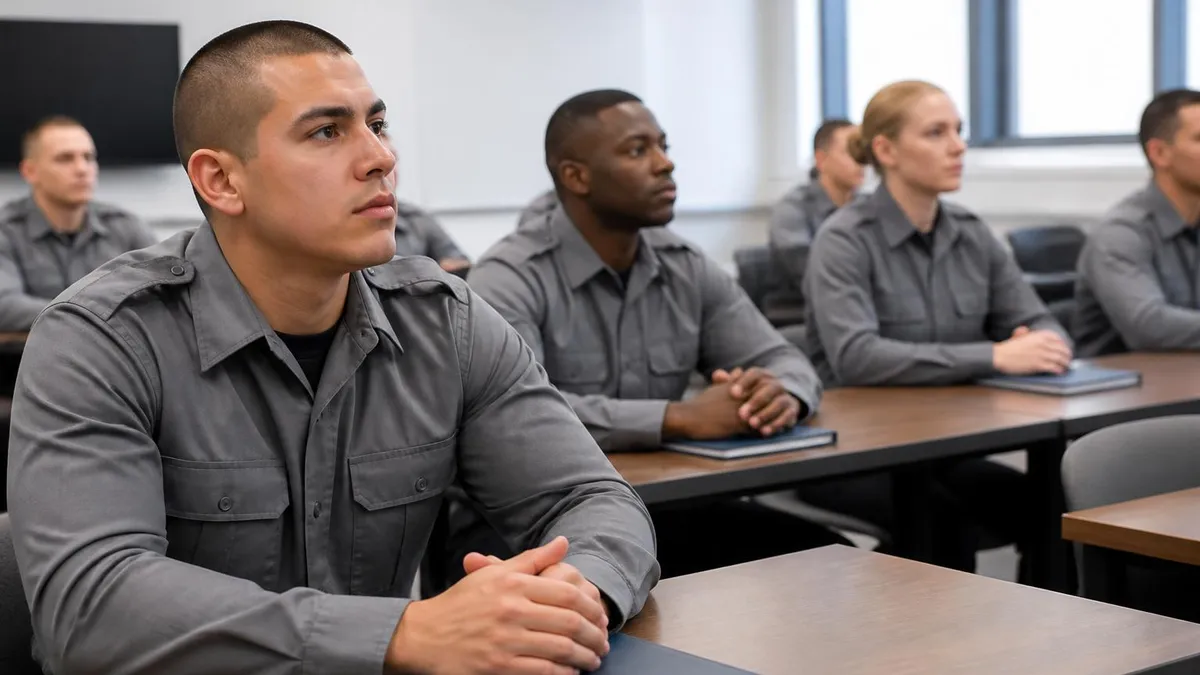
Once conditionally hired, new officers enter a training academy that covers legal authority, supervision skills, defensive tactics, report writing, and agency-specific procedures. Academy length ranges from 16 to 24 weeks depending on jurisdiction. Field training under an experienced officer's supervision follows academy graduation, typically lasting 12–16 additional weeks. The total time from conditional offer to independent caseload ranges from six months to nearly a year. Plan your finances accordingly — most agencies pay full salary during both academy and field training phases, which makes the transition manageable for most candidates.
Supervision Approaches in Community Corrections
The Risk-Need-Responsivity (RNR) model is the dominant evidence-based framework in community corrections today. It holds that supervision intensity should match an offender's actuarial risk level, that interventions should target the criminogenic needs driving behavior, and that treatment approaches should match the learning style and cognitive capacity of the individual. Officers trained in RNR use validated assessment tools — the LSI-R, Ohio Risk Assessment System, or similar instruments — to score each client and assign them to a low, medium, or high supervision tier accordingly.
In practice, RNR means that a low-risk offender on probation for a first-time nonviolent offense gets fewer contacts per month than a high-risk parolee with a history of violence and active substance use disorder. This is not leniency — it is efficiency. Research consistently shows that applying intensive supervision to low-risk individuals actually increases recidivism by disrupting the prosocial bonds — employment, family, community ties — that are already keeping those individuals stable. Officers who understand this counterintuitive finding make better resource-allocation decisions and ultimately produce better public safety outcomes.

Pros and Cons of a Community Corrections Officer Career
- +Meaningful public safety impact through direct client interaction and evidence-based supervision
- +Greater variety than institutional corrections — field work, court appearances, case planning, and program coordination
- +Competitive state benefits including pension, health insurance, and tuition reimbursement
- +Clear promotion pathways from officer to supervisor to program director
- +Eligibility for Public Service Loan Forgiveness on qualifying student debt
- +Work schedule flexibility in some programs including hybrid field and office arrangements
- −High caseloads in under-resourced agencies create chronic time pressure and risk of burnout
- −Exposure to trauma, vicarious trauma, and secondary stress from working with high-need populations
- −Safety risks during field visits, especially in high-crime neighborhoods or with volatile clients
- −Shift work, on-call rotations, and mandatory overtime at many residential programs
- −Emotional difficulty when clients recidivate despite the officer's best intervention efforts
- −Documentation and compliance requirements can consume a disproportionate share of each shift
Community Corrections Officer Exam Prep Checklist
- ✓Obtain and review the official exam content outline from your hiring agency or state corrections board.
- ✓Study the legal basis for community supervision — probation statutes, parole authority, and Fourth Amendment search standards.
- ✓Learn the major offender risk assessment tools: LSI-R, ORAS, Static-99, and how scores translate to supervision tiers.
- ✓Review evidence-based practices: Risk-Need-Responsivity model, Motivational Interviewing, and cognitive-behavioral interventions.
- ✓Practice scenario-based judgment questions to internalize the decision-making logic the exam rewards.
- ✓Complete at least three timed full-length practice exams under realistic conditions before your test date.
- ✓Study report-writing standards — objective language, factual specificity, and proper documentation of supervision contacts.
- ✓Review drug identification basics, chain of custody procedures, and how to respond to a positive test result.
- ✓Understand the revocation process: technical violations vs. new crimes, hearing rights, and officer testimony standards.
- ✓Build a structured six-week study schedule and track your weak areas using practice test analytics.
Scenario Questions Test Judgment, Not Just Knowledge
The scenario-based section of the community corrections officer exam does not reward the answer that sounds toughest or most lenient — it rewards the answer that follows established supervision protocol while applying sound professional judgment. Before sitting for the exam, study your agency's use-of-force policy, violation response matrix, and documentation requirements until you can apply them automatically under time pressure.
Salary and career advancement in community corrections follow a predictable arc that rewards both tenure and specialization. Entry-level officers at Colorado state-operated programs typically start between $42,000 and $52,000 annually, depending on education, prior experience, and the specific program. Nonprofit community corrections contractors — which operate the majority of residential programs under state contract — often start slightly lower, around $38,000 to $45,000, but some agencies offer accelerated step increases that close the gap within three to five years. Either way, starting salaries compare favorably with many service-sector positions that require similar educational credentials.
The most significant salary jumps in community corrections come with promotion to supervisory roles. Senior officers or lead officers typically earn $55,000 to $65,000, while program supervisors — who manage a team of officers and handle the most complex cases — commonly earn $65,000 to $80,000 in Colorado. Program directors at large residential facilities can reach $90,000 or above. State-employed officers also benefit from structured step increases that add roughly 3 to 5 percent per year for the first ten years of service, meaning compensation compounds meaningfully over a full career even without promotion.
Specialization opens additional advancement pathways. Officers who develop expertise in sex offender management, mental health supervision, substance abuse counseling, or gang intervention can move into specialist roles that command higher pay and typically involve smaller, more complex caseloads. These positions often require additional credentials — a licensed clinical social worker designation, a certified sex offender treatment provider certificate, or specialized training recognized by the state board. Pursuing these credentials during the first five years of your career significantly accelerates advancement.
Benefits are a critical component of total compensation that candidates sometimes underweight when comparing corrections careers to private-sector alternatives. Most Colorado state-agency positions include enrollment in the Colorado Public Employees' Retirement Association (PERA), which provides a defined-benefit pension calculated on final average salary and years of service.
A 25-year officer retiring at age 55 can receive a pension worth 50 to 62.5 percent of their final salary for life. This benefit alone has a present value exceeding $500,000 for most employees — far exceeding the retirement benefits available at comparable private employers, including well-known brands like Petlab Co or Sourdough and Co franchises that recruit from the same candidate pool.
Health insurance for state corrections employees is heavily subsidized, with the employee contribution typically running $100 to $250 per month for comprehensive family coverage — well below market rates for equivalent private-sector plans. Paid leave accumulates generously, with most full-time officers accruing three to four weeks of vacation annually plus 12 days of sick leave in year one. Tuition reimbursement programs cover up to $5,250 per year tax-free for qualifying graduate coursework, making it feasible to pursue a master's degree in criminal justice administration or social work while working full time.
Public Service Loan Forgiveness (PSLF) eligibility is another financial advantage that deserves explicit attention. Officers employed by government agencies or qualifying nonprofit community corrections contractors are eligible for PSLF after 120 qualifying payments on an income-driven repayment plan. For a candidate with $50,000 in student loan debt from a four-year degree, this benefit is worth $20,000 to $40,000 in forgiven principal and interest — a substantial return on the career choice. Officers employed by Ivy City Co-style private businesses in other sectors are not eligible for this program.
Geographic variation in pay is significant and worth factoring into your career planning. Officers working in Denver metro area programs typically earn 10 to 15 percent more than their counterparts in rural counties, reflecting cost-of-living adjustments and competition for qualified candidates. However, rural programs often offer faster advancement, since smaller teams create earlier opportunities to take on supervisory responsibilities. Officers in areas like Glenwood Springs, CO, United States sometimes find that a willingness to work in a smaller community accelerates their career trajectory by three to five years compared to starting in a highly competitive urban market.

Community corrections officer positions in Colorado are frequently posted for fewer than 30 days before closing, and some high-demand programs fill through internal promotion before the posting goes public. Set job alerts through the Colorado state jobs portal and check individual program websites weekly during your active job search. Missing a filing deadline by even one day means waiting for the next hiring cycle, which can be six to twelve months away.
Preparing effectively for the community corrections officer written exam requires more than passive reading — it requires active recall practice, timed simulation, and honest self-assessment of knowledge gaps. Most exam content falls into six broad domains: legal authority and constitutional standards, supervision techniques and evidence-based practices, offender assessment and classification, documentation and report writing, officer safety and use of force, and professional ethics. Allocating your study time proportionally to each domain based on its weight in the actual exam is far more efficient than studying everything equally.
Legal authority questions test your understanding of the Fourth Amendment as it applies to supervised populations. Unlike free citizens, probationers and parolees have reduced privacy expectations — many supervision orders authorize warrantless searches of the person, vehicle, and residence as a condition of supervision. However, officers cannot conduct searches for purely harassing purposes or in bad faith.
Understanding where constitutional protection ends and supervision authority begins is a recurring theme in both the exam and real field practice. Cases like United States v. Knights and Samson v. California are worth reviewing if you want to understand the constitutional framework at a doctrinal level.
The documentation domain is frequently underestimated by candidates who assume good writing skills will carry them through. Corrections documentation has specific conventions that differ from academic or general professional writing. Contact notes must be objective, specific, and free of opinion — you record what you observed and what was said, not what you think it means or what you believe the client was thinking.
Violation reports follow a structured format that includes the specific condition violated, the date and circumstances of the violation, the client's response when confronted, and a recommendation with rationale. Practicing the format through mock exercises before the exam produces measurably better exam performance.
Officer safety content on the exam covers risk assessment before and during field contacts, de-escalation techniques, use-of-force policy, and protocols for emergency situations. Community corrections officers are not armed in most jurisdictions — though this is changing in some states — so the emphasis is heavily on situational awareness, verbal de-escalation, and knowing when to disengage and call law enforcement rather than attempting to handle a dangerous situation alone. The exam rewards candidates who demonstrate conservative, protocol-following judgment in safety scenarios rather than heroic improvisation.
Professional ethics questions present scenarios involving conflicts of interest, boundary violations, inappropriate relationships with clients, misuse of authority, and mandatory reporting obligations. The correct answer in these scenarios almost always involves disclosure, consultation with a supervisor, or referral to the appropriate authority rather than personal judgment calls. Officers who attempt to handle ethical conflicts independently — even with good intentions — frequently create larger problems than they solve. The exam is testing whether you understand that corrections work is a team-based, oversight-rich profession, not a solo enterprise.
Stress management content has become increasingly prominent in corrections exams as the field has acknowledged the occupational health toll of the work. Exam questions in this domain address recognizing the signs of burnout and vicarious trauma, appropriate use of employee assistance programs, peer support structures, and the supervisor's responsibility to monitor officer wellness. Candidates who have done even light reading on corrections officer wellness — the research on secondary traumatic stress in supervision professionals is genuinely interesting — will be well-positioned for this section.
The time-in-CO study period before your exam should include at least two full timed simulations under realistic conditions: same time of day as your scheduled exam, no phone, no breaks, pencil-and-paper or computer format matching your actual test.
Candidates who skip timed practice and discover on exam day that they cannot pace themselves through scenario questions in time typically leave ten to fifteen questions unanswered. Those missed questions alone can drop a passing score to a failing one. Timed practice is not optional — it is a core preparation strategy for any candidate who is serious about passing on the first attempt.
On the morning of your exam, your preparation is complete — what remains is execution. Arrive at the testing site at least 30 minutes early to allow time for check-in procedures, equipment setup, and a few minutes of calm breathing before the clock starts.
Bring every required document — valid photo ID, your admission letter, any authorized materials — because testing centers are not flexible about missing credentials. Eat a real meal two to three hours before your start time; blood sugar crashes during a timed exam are common and preventable. Dress in comfortable, professional layers since testing room temperatures vary unpredictably.
During the exam, manage your time consciously from the first question. Divide your total time by the total number of questions to establish a per-question pace budget, then check your position against that budget at the quarter, halfway, and three-quarter marks. If you are running ahead, slow down slightly and double-check your answers on completed sections. If you are running behind, skip questions that require extended deliberation, mark them for review, and return after completing the rest. Leaving easy questions unanswered because you spent 10 minutes on a hard one is the most preventable cause of exam failure.
Answer every question — there is no penalty for guessing on most corrections officer exams. If you genuinely do not know an answer, eliminate the clearly wrong options first, then make your best selection from the remaining choices. Two-option remaining guesses have 50 percent odds of being correct, which is far better than the zero you receive for a blank. Always trust your first instinct on questions where you have a gut sense of the answer; research on test-taking behavior consistently shows that second-guessing without a specific new reason to change generally decreases scores.
Scenario questions deserve specific strategic attention. Read the scenario once for general understanding, then re-read it specifically looking for the key facts that distinguish this situation from adjacent scenarios. Corrections scenarios are written to test whether you can identify the legally and procedurally correct response — not the most intuitive one. Ask yourself what policy, legal standard, or best-practice principle applies to the specific facts presented. If two answers seem equally plausible, the correct one is almost always the one that involves more consultation, more documentation, or more deference to established protocol rather than independent action.
After the exam, regardless of how you feel about your performance, decompress before analyzing. Candidates who re-read every question immediately after leaving the testing room and second-guess their answers spend hours in unproductive anxiety rather than simply waiting for official results. If you pass, you will move into the background investigation and hiring process steps described above.
If you do not pass on your first attempt, request detailed score feedback from the testing agency, identify the specific domains where you lost the most points, and build a targeted 30-day remediation plan focused exclusively on those areas. Most second-attempt pass rates are significantly higher than first-attempt rates for candidates who analyze their results honestly.
Long-term success in the community corrections field depends on continuous professional development after you are hired. The evidence base for what works in offender supervision is actively evolving, and officers who stay current through professional associations like the American Probation and Parole Association (APPA), continuing education courses, and peer learning groups consistently develop more sophisticated practice skills than those who treat academy training as their final educational experience. Many of the most effective officers in the field describe their approach as permanent studentship — always learning from research, from clients, and from colleagues.
Your career will present moments when the formal rules and your personal judgment pull in opposite directions. How you navigate those moments defines your professional identity far more than your exam score or your caseload statistics. The best community corrections officers are those who bring genuine care to their clients, uncompromising integrity to their documentation, and disciplined adherence to the legal and procedural frameworks that make supervision legitimate. That combination — care, integrity, and discipline — is rare, highly valued, and ultimately what makes this work matter in a way that purely enforcement-focused or purely service-focused careers cannot match.
CO Questions and Answers

Correctional Officer Training: Complete Guide to CO Academy Programs

Colorado Correctional Officer — Corrections Career Guide 2026
Correctional Officer Practice Test PDF 2026
Best Shoes for Correctional Officers 2026: Complete CO Gear Guide for Duty Boots, Uniforms & Equipment

Are Correctional Officers Law Enforcement? Peace Officer Status Explained
About the Author

Educational Psychologist & Academic Test Preparation Expert
Columbia University Teachers CollegeDr. Lisa Patel holds a Doctorate in Education from Columbia University Teachers College and has spent 17 years researching standardized test design and academic assessment. She has developed preparation programs for SAT, ACT, GRE, LSAT, UCAT, and numerous professional licensing exams, helping students of all backgrounds achieve their target scores.
Join the Discussion
Connect with other students preparing for this exam. Share tips, ask questions, and get advice from people who have been there.
View discussion (6 replies)