
CNG Trucks for Sale: Complete Buyer's Guide to New and Used Compressed Natural Gas Vehicles
💡 Shop CNG trucks for sale with confidence. Compare new and used compressed natural gas trucks, prices, tank inspections, and fleet buying tips.

Shopping for cng trucks for sale has become one of the smartest fleet moves in 2026, with diesel prices volatile, emissions rules tightening, and natural gas pricing staying remarkably stable across most US markets. Whether you're a small business owner eyeing a single Class 6 box truck or a fleet manager evaluating fifty Class 8 day cabs, the compressed natural gas market now offers more options than ever before. Buyers can choose from factory-built OEM units, conversions, dedicated CNG engines, and bi-fuel platforms, each with distinct cost and performance profiles.
The American CNG truck market expanded dramatically after the Cummins-Westport ISX12N and the newer Cummins X15N engines reached production scale, giving Class 8 buyers a genuine over-the-road natural gas option for the first time. Smaller chassis like the Freightliner M2-106, Kenworth T370, Peterbilt 220, and Ford F-650 are widely available in dedicated CNG configurations through OEM dealers and specialized upfitters. The used market is now mature enough that buyers can find low-mileage trade-ins under three years old at meaningful discounts versus new sticker prices.
Pricing transparency has improved sharply. A new dedicated CNG Class 8 tractor typically runs $40,000 to $55,000 more than a comparable diesel, while a used CNG day cab with 300,000 miles often trades at parity with diesel or even slightly below because the secondary market is still developing. That spread is the single most important number to understand before you sign anything. It determines payback period, financing structure, and whether grants like VW Settlement funds or EPA DERA awards make sense for your operation.
This guide walks through everything a real buyer needs: what models are actually on dealer lots, how to inspect a used CNG truck, what the tank certification cycle costs, where the fuel infrastructure sits today, and how to negotiate the deal. We'll also cover the differences between high-pressure direct injection, spark-ignited, and dual-fuel powertrains because those engineering choices change your maintenance bill and your total cost of ownership over a seven-year hold. If you want a refresher on the fuel itself before you keep reading, see our What Is CNG? A Plain-English Guide to Compressed Natural Gas primer.
Buyer demographics have shifted too. Five years ago, the typical CNG truck purchaser was a refuse hauler or a transit agency with captive fueling. Today, regional LTL carriers, beverage distributors, ready-mix concrete producers, port drayage operators, school bus contractors, and even owner-operators with dedicated runs along the I-10 and I-40 corridors are buying CNG. Each of these use cases has a different sweet spot for tank size, horsepower rating, and chassis configuration, and the dealer network has finally caught up.
Tax incentives sweeten the deal further. The federal Alternative Fuel Vehicle Refueling Property Credit, state utility rebates from companies like SoCalGas and Atmos Energy, and accelerated depreciation under Section 179 can collectively trim $30,000 to $80,000 off effective acquisition cost on a single Class 8 tractor. Knowing which programs stack and which exclude each other is part of the buying process, and a good CNG truck dealer should walk you through it before you write a check.
CNG Truck Market by the Numbers

Most Common CNG Truck Models You'll Find for Sale
Class 6-7 medium-duty workhorse common in beverage, utility, and municipal fleets. Available with Cummins L9N engine, 60-100 DGE tank capacity, and configurable wheelbases for box, dump, and service body upfits.
Class 8 sleeper and day cab tractors powered by the Cummins X15N 500-hp natural gas engine. Most common in regional and short-haul OTR work, with 160 DGE total tank capacity and 600+ mile ranges.
Dedicated refuse chassis dominating municipal and private waste hauling. Cummins L9N power, low-entry cab, and PTO-ready for automated side and rear loaders. Widely available used from major haulers.
Class 6-7 prep package from Ford allowing dealer or upfitter conversion to dedicated CNG or bi-fuel. Popular for last-mile delivery, landscape, and contractor fleets needing lower acquisition cost.
Cummins L9N-powered vocational and medium-duty platforms for dump, mixer, and refuse applications. Strong dealer network through Navistar and growing presence in the certified pre-owned channel.
The single biggest decision when shopping cng trucks for sale is new versus used, and the math is rarely obvious. A brand-new 2026 Kenworth T680 with the Cummins X15N engine, 160 DGE in roof and saddle tanks, and a basic sleeper configuration lists around $215,000 to $235,000 depending on options. The same truck two years old with 180,000 miles trades for roughly $135,000 to $155,000. That used discount is steeper than diesel equivalents because demand for used CNG remains thinner outside core natural gas corridors.
Medium-duty pricing follows a similar pattern. A new Freightliner M2-106 CNG box truck with a 26-foot body and L9N power runs $165,000 to $185,000 upfitted. A three-year-old version with 120,000 miles, full service records, and current tank certifications can be found in the $95,000 to $115,000 range. School bus chassis, refuse trucks, and transit cutaways have their own pricing bands but show similar 35-45% depreciation curves in the first three years.
Buyers shopping used CNG trucks must factor in tank inspection and recertification costs that diesel buyers never face. Federal Motor Vehicle Safety Standard 304 and NFPA 52 require visual tank inspections every 36 months or 36,000 miles, whichever comes first. A full inspection costs $200 to $600 per tank, and a Class 8 tractor with four to six tanks could face $1,500 to $3,500 every three years. Tanks themselves have a service life of 15 to 20 years stamped on the label, and replacement runs $4,500 to $9,000 per Type 4 carbon-fiber cylinder.
The CNG fuel system inspection a buyer should commission before purchase is similar in spirit to a pre-purchase diesel inspection but more specialized. The Compressed Gas Association and CSA America provide certification programs for inspectors, and most major OEM dealers now have at least one certified technician on staff. Skipping this step is the single most common buyer mistake, and it can hide cracked tanks, corroded fittings, or expired cylinders that would condemn the truck entirely.
Warranty coverage differs significantly between new and used. A new CNG truck typically carries a 2-year/250,000-mile base powertrain warranty plus extended fuel system coverage, and engine makers like Cummins offer additional protection on emissions hardware. Used trucks sold by certified pre-owned programs at brands like Kenworth PremierCare or Peterbilt Red Oval may carry residual factory coverage plus optional extended warranties. Independent dealer used trucks typically come as-is, so the inspection becomes your only protection.
Geographic availability matters more for CNG than diesel. Trucks are most plentiful in California, Texas, Oklahoma, Pennsylvania, New York, and the Pacific Northwest where natural gas corridors developed earliest. Buyers in the Southeast or Mountain West often find inventory thinner and shipping costs of $1.50 to $2.50 per mile add real money. Working with national dealer groups or fleet auction houses like Ritchie Bros, IronPlanet, and Taylor and Martin can broaden the search significantly.
For a deeper dive into how heavy-duty CNG units are engineered and what real-world fleets pay to operate them, see our companion piece on CNG Trucks: How Compressed Natural Gas Powers Heavy-Duty Fleets, Real Costs, and Buying Tips. That article complements this buyer's guide with operational data once you've parked your new purchase in the yard.
CNG Practice Test Questions
Prepare for the CNG - Compressed Natural Gas exam with our free practice test modules. Each quiz covers key topics to help you pass on your first try.
CNG Environmental and Economic Benefits
CNG Exam Questions covering CNG Environmental and Economic Benefits. Master CNG Test concepts for certification prep.
CNG Fleet Management and Driver Operations
Free CNG Practice Test featuring CNG Fleet Management and Driver Operations. Improve your CNG Exam score with mock test prep.
CNG - Compressed Natural Gas CNG Propertie...
CNG Mock Exam on - Compressed Natural Gas CNG Properties and Safety. CNG Study Guide questions to pass on your first try.
CNG - Compressed Natural Gas Codes, Standa...
CNG Test Prep for - Compressed Natural Gas Codes, Standards, and Compliance. Practice CNG Quiz questions and boost your score.
CNG - Compressed Natural Gas Cylinder Insp...
CNG Questions and Answers on - Compressed Natural Gas Cylinder Inspection and Regulations. Free CNG practice for exam readiness.
CNG - Compressed Natural Gas Emergency Pro...
CNG Mock Test covering - Compressed Natural Gas Emergency Procedures and Response. Online CNG Test practice with instant feedback.
CNG - Compressed Natural Gas Facility and ...
Free CNG Quiz on - Compressed Natural Gas Facility and Ventilation Requirements. CNG Exam prep questions with detailed explanations.
CNG - Compressed Natural Gas Fueling Stati...
CNG Practice Questions for - Compressed Natural Gas Fueling Station Operations. Build confidence for your CNG certification exam.
CNG - Compressed Natural Gas Fuel System C...
CNG Test Online for - Compressed Natural Gas Fuel System Components. Free practice with instant results and feedback.
CNG - Compressed Natural Gas Maintenance a...
CNG Study Material on - Compressed Natural Gas Maintenance and Troubleshooting. Prepare effectively with real exam-style questions.
CNG - Compressed Natural Gas System Diagno...
Free CNG Test covering - Compressed Natural Gas System Diagnostics and Repair. Practice and track your CNG exam readiness.
CNG - Compressed Natural Gas Vehicle Conve...
CNG Exam Questions covering - Compressed Natural Gas Vehicle Conversion and Installation. Master CNG Test concepts for certification prep.
CNG Truck Engine and Powertrain Options Explained
Spark-ignited engines like the Cummins L9N and X15N use traditional gasoline-style ignition with a stoichiometric combustion cycle and a three-way catalyst. They run on 100% natural gas with no diesel backup, deliver power output comparable to mid-range diesels, and meet CARB Optional Low NOx standards at 0.02 g/bhp-hr—roughly 90% cleaner than current EPA diesel rules.
SI engines dominate the US heavy-duty CNG market because they're simple, reliable, and certified across most chassis. Maintenance is similar to diesel but with cleaner oil, longer oil drain intervals up to 50,000 miles in some duty cycles, and no DPF regeneration cycles. Spark plugs become a service item, typically replaced every 75,000 to 100,000 miles, adding modest cost.

Buying CNG Trucks for Sale: Pros and Cons
- +Fuel cost savings of $1.50-$2.50 per gallon equivalent vs diesel
- +Significantly lower NOx, particulate, and greenhouse gas emissions
- +Federal and state incentives reduce effective acquisition cost
- +Quieter operation enables nighttime deliveries in noise-restricted zones
- +Domestic fuel supply insulates fleets from oil price volatility
- +Engine oil drain intervals often extend 25-50% longer than diesel
- −Upfront cost premium of $40,000-$55,000 on Class 8 tractors
- −Limited public fueling network outside major corridors
- −Reduced cargo space or payload from on-board tank packaging
- −Mandatory 36-month tank inspections add recurring cost
- −Resale market still thinner than diesel in many regions
- −Range typically 400-600 miles vs 1,000+ miles for diesel
Pre-Purchase Inspection Checklist for Used CNG Trucks
- ✓Verify all tank manufacture dates and confirm remaining service life exceeds 5 years
- ✓Request current FMVSS 304 / NFPA 52 visual tank inspection certificate
- ✓Inspect tank brackets, straps, and mounting hardware for corrosion or cracking
- ✓Pressure-test the entire fuel system to confirm no leaks at fittings or regulators
- ✓Check pressure relief device (PRD) condition and verify factory installation
- ✓Confirm engine ECM records show no excessive misfire or fuel rail pressure faults
- ✓Pull maintenance records for spark plug, oxygen sensor, and catalyst replacement history
- ✓Test all CNG safety interlocks including fill-port shutoff and high-pressure regulator
- ✓Verify VIN, engine serial, and tank serial numbers match all paperwork
- ✓Review any open recalls through NHTSA and engine manufacturer databases
- ✓Inspect for evidence of rapid pressure cycling damage on tank surfaces
- ✓Confirm chassis tax credit and incentive paperwork transferred properly
Always Get a Tank Inspection Before Closing
The single most expensive mistake a used CNG truck buyer can make is skipping the pre-purchase tank inspection. A condemned tank means the truck cannot legally fuel until replaced—and replacement on a Class 8 with six Type 4 cylinders can exceed $40,000 in parts alone. Spending $400 to $1,500 on a certified inspection is the cheapest insurance in the entire transaction.
Fueling infrastructure shapes every CNG truck purchase decision, and the network has matured substantially over the last decade. The US Department of Energy Alternative Fuels Data Center lists more than 1,650 CNG stations, with roughly 900 open to the public. Coverage is dense along major freight corridors including I-5 through California and the Pacific Northwest, I-10 from Los Angeles through Phoenix and Houston, I-40 across Oklahoma and Tennessee, and I-95 from New York through the Carolinas. Operators outside these corridors often need private fueling.
Private fast-fill or time-fill stations on fleet property are how most large CNG operators solve range and downtime issues. A modest fast-fill station serving 10-15 trucks costs $750,000 to $1.4 million installed depending on compressor size, dispenser count, and utility upgrades. Time-fill stations, which slowly fill trucks overnight from a smaller compressor while parked, run $250,000 to $700,000 and suit centralized operations like refuse, transit, and beverage distribution where vehicles return to a single yard.
Fuel pricing has been the standout argument for CNG since the shale gas boom. The national average retail CNG price hovers around $2.50 to $3.20 per gasoline gallon equivalent (GGE), while diesel sits near $3.85 nationally with significant regional spikes. Fleets fueling on private stations using behind-the-meter natural gas often pay $1.00 to $1.50 per GGE all-in including compression. Over a 120,000-mile annual route, that fuel savings alone can clear $15,000 to $25,000 per truck.
Total cost of ownership models from the Department of Energy Argonne National Laboratory consistently show CNG Class 8 trucks reaching diesel parity around 350,000 to 500,000 miles depending on fuel spread, financing terms, and grant support. Faster payback happens in high-mileage routes with stable fueling. Slower payback or no payback at all happens on low-mileage vocational duty cycles or in regions with weak fuel infrastructure. Running your own TCO model with conservative assumptions is non-negotiable before signing.
Maintenance economics deserve careful attention. CNG engines benefit from cleaner combustion that extends oil life and reduces soot loading, but spark plugs, oxygen sensors, and three-way catalysts add service items. Cummins L9N and X15N engines have proven maintenance schedules with 50,000-mile oil drain intervals in good duty cycles and 100,000-mile spark plug intervals. Annual maintenance cost typically runs 5-15% lower than equivalent diesel once technicians are trained.
Driver training is a frequently overlooked piece of the buying decision. CNG fueling is mechanically different from diesel, and operators must understand fill-port procedures, defueling protocols if servicing is needed, and emergency shutoff locations. Several major dealer networks now bundle driver training with new truck purchases, and EPA-funded programs through Clean Cities Coalitions offer free training in many regions. Skipping this leads to fueling errors and avoidable damage.
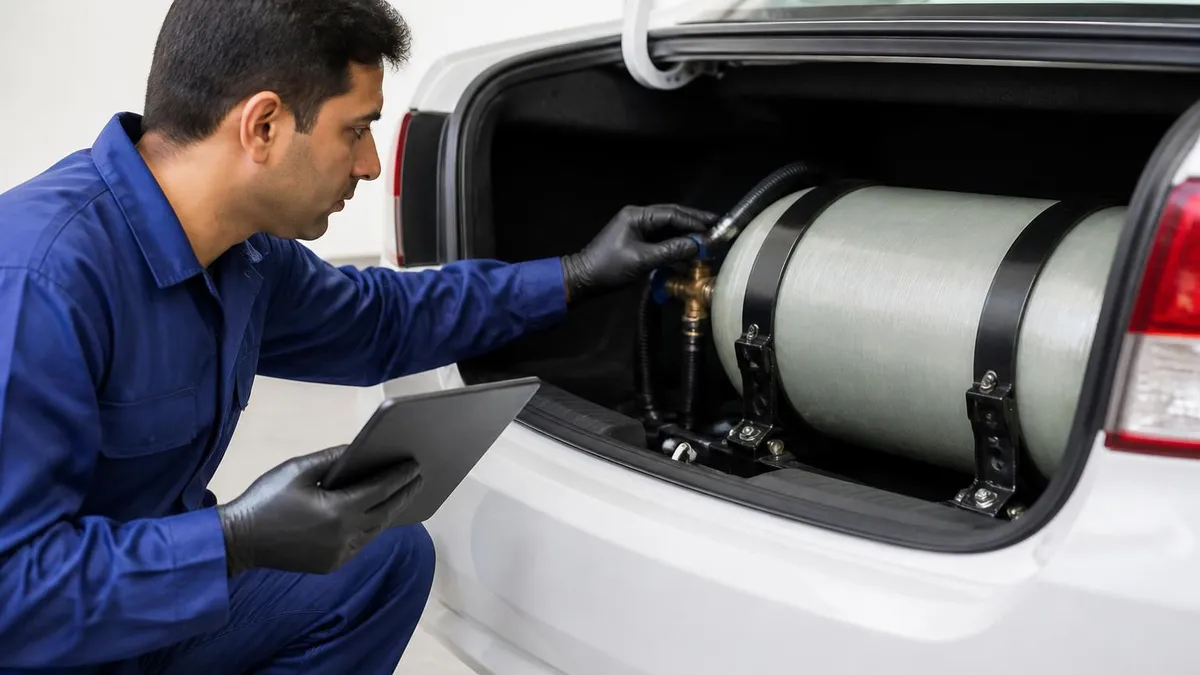
CNG fuel tanks carry a manufacturer-stamped service life of 15 to 20 years from the date of manufacture, not from purchase. After expiration, the tank must be removed and replaced regardless of condition. When evaluating used CNG trucks for sale, calculate remaining tank life carefully—buying a 12-year-old truck with 8 years left on the tanks is very different from buying a 14-year-old truck with 6 years left.
Financing structures for CNG trucks differ from straight diesel deals in important ways. Major equipment finance companies including Daimler Truck Financial, PACCAR Financial, and Navistar Capital offer purpose-built CNG programs with extended terms up to 84 months that reflect the longer payback horizon. Interest rates typically match diesel rates within 50 basis points, and down payment requirements range from 10-20% for established fleets and 20-30% for owner-operators or new buyers without established commercial credit.
Grant stacking is where serious money lives. The Volkswagen Mitigation Trust has awarded billions to state programs that fund CNG truck purchases, typically covering 25-45% of the incremental cost over diesel. EPA Diesel Emissions Reduction Act (DERA) grants cover similar ground for older truck replacements. State-level programs in California (HVIP), Texas (TERP), Pennsylvania, and New York add additional layers. A well-prepared buyer can stack federal, state, and utility incentives covering 40-60% of the CNG premium.
Utility rebates from natural gas providers often go overlooked. SoCalGas, PG&E, Atmos Energy, Spire, and dozens of regional utilities offer per-vehicle rebates ranging from $5,000 to $25,000 for fleet conversion to natural gas. Some utilities also provide direct station construction financing or natural gas vehicle rate riders that reduce the per-therm cost of fueling. Calling your local gas utility before negotiating with the dealer often surfaces incentives the dealer doesn't track.
Negotiating tactics on new CNG trucks resemble diesel deals but with extra leverage points. Dealer floor planning costs on CNG inventory are higher than diesel because units sit longer, so dealers are often motivated to move CNG stock at lower margins to free up floor plan. Asking specifically about days-on-lot inventory, manufacturer fleet incentives, and end-of-quarter dealer cash can reveal $5,000 to $20,000 in additional discounts not advertised. Don't accept the first three quotes.
Used truck negotiation hinges on the inspection report. A clean tank inspection report and complete service records justify full asking price. Any tank concerns, missing inspections, or fuel system issues immediately become $5,000 to $25,000 negotiating wedges. Buyers should also verify the seller has clear title, no liens, and proper paperwork transferring any remaining tank manufacturer warranties. Sloppy paperwork on used CNG trucks delays registration in some states by weeks.
Maintenance planning before delivery saves money long-term. Buyers should establish relationships with at least two qualified CNG service providers within reasonable distance, stock common wear items like spark plugs and oxygen sensors, and budget for the first major service event. Reading our companion piece on CNG Vehicle Maintenance: Complete Guide to Fuel System Care, Leak Detection, and Receptacle Replacement before taking delivery sets you up to avoid the most expensive rookie mistakes.
Finally, take delivery seriously. A new CNG truck should arrive with a complete pre-delivery inspection (PDI) report, all tank certifications current, fuel system pressure-tested, all manuals and warranty documents organized, and driver orientation completed. A used CNG truck should arrive with everything a new truck gets plus a clear path forward on any deferred maintenance flagged during inspection. Don't sign acceptance paperwork until every item on your pre-delivery checklist is verified in person.
Practical buying tips separate fleets that succeed with CNG from fleets that quietly migrate back to diesel after three painful years. The first tip is to match the truck to the route, not the other way around. CNG trucks shine on predictable, high-mileage routes with reliable fueling. They struggle on irregular routes, deep rural deliveries, or applications requiring heavy payload where tank weight cuts into revenue capacity. Mapping your actual route profile before shopping prevents expensive misallocation.
The second tip is to pilot before scaling. Buying one or two CNG trucks for a defined route and operating them for 12-18 months reveals real-world fuel costs, maintenance patterns, driver feedback, and fueling logistics far better than any spreadsheet. Many successful fleets like Waste Management, UPS, and Republic Services started with small pilots in the early 2010s before committing to thousands of units. Replicating that disciplined approach reduces risk dramatically for a single-location buyer.
The third tip concerns tank capacity selection. New buyers often over-spec tanks thinking more range is always better, but extra tanks add weight, reduce payload, occupy frame rail or roof space, and add cost. Right-sizing means choosing the smallest tank configuration that completes your daily route with comfortable margin. A regional carrier running 350-mile loops doesn't need 600 miles of range and gains nothing from the extra tanks except weight penalty and acquisition cost.
The fourth tip is to plan for end-of-life. CNG truck residual values remain less predictable than diesel because the secondary market is still developing. Building a depreciation schedule that assumes conservative resale values—roughly 25-35% of original price at year seven—prevents nasty surprises at trade-in time. Some operators run CNG trucks to 800,000-1,000,000 miles to fully amortize the acquisition premium, treating residual value as a bonus rather than a planning input.
The fifth tip addresses the driver experience. CNG trucks drive differently from diesels. Spark-ignited engines deliver power smoothly but with different torque curves and shift characteristics. Quieter operation changes how drivers perceive speed and engine load. Refueling takes 10-15 minutes at fast-fill stations versus 5-7 for diesel. Investing in real driver training rather than a 30-minute walkthrough produces better fuel economy, fewer fault codes, and happier drivers who don't request transfers back to diesel units.
The sixth tip involves data. Modern CNG engines stream rich telematics through standard J1939 ports, and fleet management systems from Geotab, Samsara, and Verizon Connect provide detailed visibility into fuel consumption, idle time, fault codes, and tank pressure. Acting on this data—not just collecting it—is where real savings emerge. Operators who review weekly telematics reports identify maintenance issues early, train drivers on efficient operation, and document ROI for management or grant compliance.
The final tip is patience. CNG is a long-game investment. The acquisition premium recovers over years, not months. The fueling network grows year by year. Maintenance routines mature with experience. Fleets that approach CNG as a five-to-ten-year strategic commitment, with budget for early-stage learning costs, consistently outperform fleets that expect overnight payback. Done right, CNG trucks deliver lower operating costs, cleaner air, and meaningful insulation from diesel price shocks for a decade or more.
CNG Questions and Answers

What Is CNG? A Plain-English Guide to Compressed Natural Gas
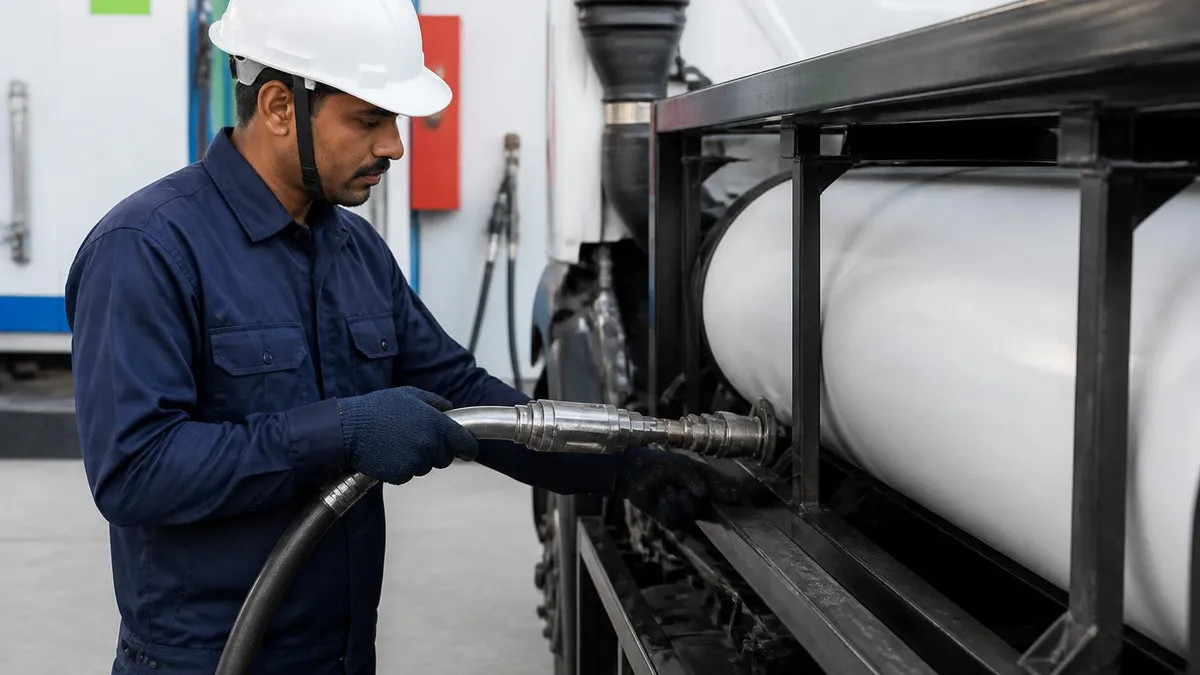
CNG Vehicle Maintenance: Complete Guide to Fuel System Care, Leak Detection, and Receptacle Replacement
CNG Practice Test Video Answers

CNG Gas: What It Is, How It Works, and Why Vehicles Use It

CNG Trucks: How Compressed Natural Gas Powers Heavy-Duty Fleets, Real Costs, and Buying Tips
About the Author

Educational Psychologist & Academic Test Preparation Expert
Columbia University Teachers CollegeDr. Lisa Patel holds a Doctorate in Education from Columbia University Teachers College and has spent 17 years researching standardized test design and academic assessment. She has developed preparation programs for SAT, ACT, GRE, LSAT, UCAT, and numerous professional licensing exams, helping students of all backgrounds achieve their target scores.
Join the Discussion
Connect with other students preparing for this exam. Share tips, ask questions, and get advice from people who have been there.
View discussion (8 replies)