
CNG Trucks: How Compressed Natural Gas Powers Heavy-Duty Fleets, Real Costs, and Buying Tips
CNG trucks cut fuel costs and emissions. Compare models, ✍🏼 ranges, refueling, total cost of ownership, and the biggest pitfalls fleets hit in year one.

Diesel still moves most of the freight in North America. That isn't changing tomorrow. But compressed natural gas trucks have carved out a real and growing slice of the heavy-duty market — refuse haulers, port drayage, regional LTL, transit buses, and yes, plenty of Class 8 sleepers running steady lanes. If you've been watching fuel prices swing and wondering whether CNG is finally worth a hard look, the short answer is — it depends on how you drive, where you fuel, and how long you plan to keep the truck.
This guide walks through the whole picture. The hardware. The economics. The range and refueling realities. The maintenance differences from a diesel rig. Which models are actually available right now from Cummins, Volvo, Kenworth, Peterbilt, Mack, and Freightliner. And the questions every fleet manager should answer before signing a purchase order. By the end you'll have a clear sense of whether CNG vehicles deserve a spot in your next acquisition cycle.
One thing up front. CNG trucks aren't a small-fleet experiment anymore. UPS runs thousands. Waste Management runs more. Republic Services. ABF Freight. Anheuser-Busch's beverage fleet. They've put hundreds of thousands of miles on natural gas tractors and the data is no longer theoretical. The story is more nuanced than "cheaper fuel solves everything" — but it's also better than the skepticism you'll hear from old-school diesel mechanics who haven't worked on one.
Let's start with what makes a CNG truck different under the hood, then move into the dollars and cents.
CNG Trucks by the Numbers
How a CNG Truck Actually Works
A compressed natural gas truck burns methane instead of diesel. The fuel sits in high-pressure cylinders — typically 3,600 psi — mounted behind the cab, under the frame, or on a fairing. From the cylinders, gas flows through a regulator that drops pressure down to what the engine can swallow, then into a fuel injection system that meters it into the cylinders for combustion. The rest of the truck — frame, axles, brakes, suspension, transmission — looks essentially identical to a diesel platform.
The big difference is the engine itself. CNG engines on the market today are spark-ignited (think gasoline-style) rather than compression-ignited like diesel. Cummins-Westport's ISX12N, the workhorse of Class 8 CNG, is a 12-liter spark-ignited engine pulling 400 horsepower and 1,450 lb-ft of torque. That's right in the diesel band for regional and vocational work. Below Class 8, you'll see the ISL G NZ at 320 horsepower for refuse and transit, and the L9N for medium-duty work. All burn natural gas in stoichiometric combustion paired with a three-way catalyst — same emissions strategy as a gasoline car, scaled up.
Fuel storage is where engineering gets interesting. CNG has roughly a quarter of the energy density of diesel per gallon, which means you need more onboard storage to match diesel's range. Most Class 8 tractors carry between 100 and 175 diesel gallon equivalents (DGEs) split across multiple cylinders. That's enough for 400 to 700 miles depending on terrain and load — fine for regional work but tight for long-haul without route planning around fuel stops.
One nuance fleets sometimes miss. There's CNG and there's LNG — liquefied natural gas. Both are natural gas, both burn the same way once vaporized. CNG is stored as a high-pressure gas. LNG is stored cryogenically as a liquid at minus 260 degrees Fahrenheit. LNG packs more energy per gallon (about 60% of diesel) so it's favored for true long-haul fleets that need 1,000+ mile range without sacrificing payload to cylinder weight. CNG dominates in regional, vocational, and return-to-base operations. This guide focuses on CNG — but know the LNG option exists.
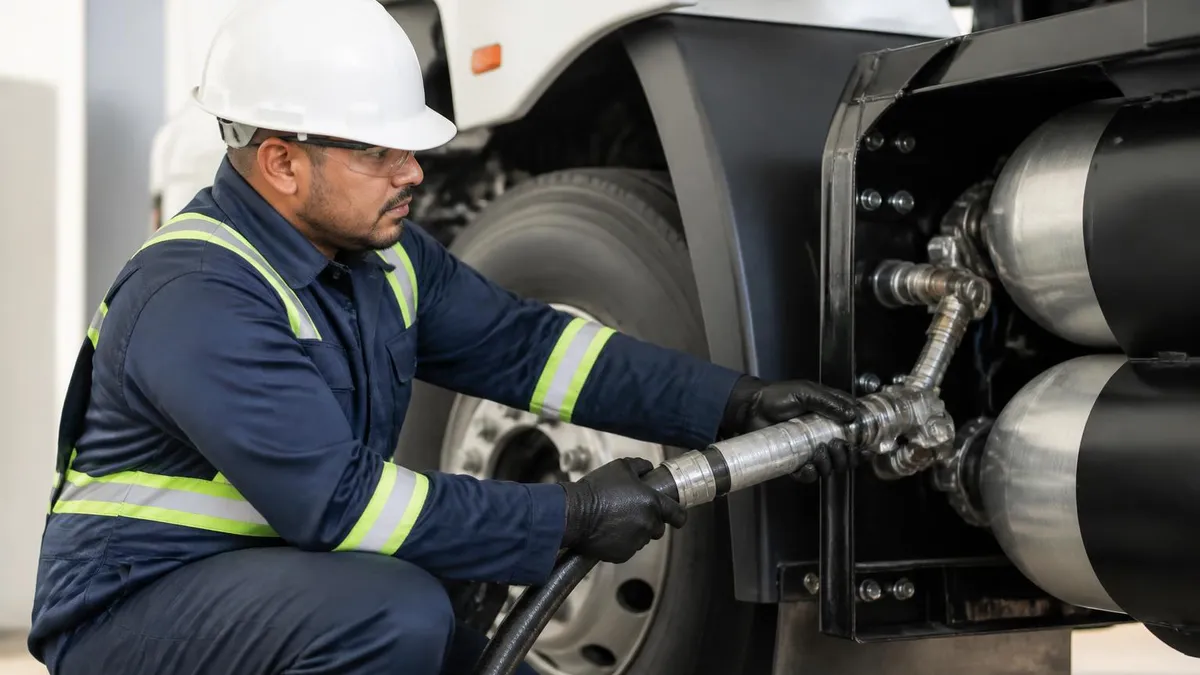
Anatomy of a CNG Truck
Unlike compression-ignition diesel engines, CNG trucks use spark plugs to fire a stoichiometric methane-air mixture. The Cummins-Westport ISX12N is the Class 8 workhorse at 400 horsepower and 1,450 lb-ft of torque. Lower displacement options like the L9N and ISL G NZ serve refuse, transit, and vocational segments. Combustion is cleaner than diesel, eliminating the need for diesel particulate filters and exhaust fluid systems.
Type 3 or Type 4 composite cylinders mounted behind the cab or beneath the frame store methane at 3,600 psi. A typical Class 8 carries 100 to 175 diesel gallon equivalents split across multiple cylinders. Each cylinder is structurally inspected every three years and retires from service after 15 to 20 years regardless of condition. Material choice (aluminum-lined vs all-composite) drives weight and cost tradeoffs.
Fuel exits the cylinders at full storage pressure and passes through a multi-stage regulator that drops pressure to the engine's working level. The regulator is the most maintenance-sensitive component in the gas delivery path and requires periodic inspection of seals and orifices. Pressure relief devices on each cylinder vent excess pressure safely upward in the event of overheating from a vehicle fire or extreme ambient conditions.
CNG's clean combustion means a single three-way catalyst (similar to a gasoline car's catalytic converter) handles all aftertreatment duties. No DPF, no SCR, no DEF tank, no regeneration cycles. The catalyst itself lasts 350,000 to 500,000 miles before replacement is needed. This simplification accounts for much of the maintenance-cost advantage CNG has over modern diesel platforms running EPA 2010 and later emissions equipment.
The Real Economics — Fuel Savings vs Upfront Premium
Here's where the conversation usually starts and ends for a fleet director. CNG trucks cost more to buy. Fuel costs less. The math has to work over the life of the asset, not just on a spec sheet.
A Class 8 CNG tractor typically runs $40,000 to $80,000 more than the equivalent diesel rig. The price gap depends on the OEM, the cylinder configuration, and whether you're buying a factory build or a converted glider. Cylinder packages alone can run $30,000 to $50,000 of that premium. Add another $10,000 to $20,000 for the spark-ignited engine and supporting hardware. Federal tax credits and state grants — the Alternative Fuel Vehicle Refueling Property Credit, EPA DERA grants, California's HVIP voucher — can shave 30 to 50% off the premium for qualifying operations. Don't sign before you've checked your eligibility.
On fuel cost — that's where CNG pays you back. Natural gas, at retail public stations, has historically run $1.50 to $2.50 per DGE (diesel gallon equivalent) versus $3.50 to $5.50 for diesel. The spread varies by region, by season, and by whether you're buying at a retail station or operating a behind-the-fence private fueling site. Fleets running their own compression infrastructure can land delivered fuel costs as low as $0.90 to $1.30 per DGE if utility gas rates and capital amortization work in their favor.
For a truck running 100,000 miles per year at 6 MPG diesel-equivalent, that fuel spread means $30,000 to $60,000 in annual fuel savings versus diesel. Payback on the upfront premium typically lands between 18 months and 4 years depending on mileage, fuel spread, and incentive stack. After that, every mile is pure operating margin. Fleets that run their CNG trucks 8 to 10 years out have absolutely seen seven-figure lifecycle savings on each truck.
But — and this is the part that catches new operators off-guard — those numbers only work if you actually drive the miles. A CNG truck parked half the year because of route reassignments destroys the math. Utilization is everything. Run them hard, run them often, and the economics shine. Park them and they become very expensive paperweights.
The economics gate
Strong CNG payback requires three conditions stacking together. High annual mileage (60,000+ miles per truck), predictable routes with reliable fueling access, and multi-year ownership long enough to recoup the upfront premium. Miss any one and the diesel rig usually wins on TCO.
Range, Refueling, and the Infrastructure Question
Range anxiety is real with CNG. Not the way it is with battery-electric — you're not going to be stranded if you plan ahead — but the available public fueling network is thinner than diesel and routes have to be designed with that in mind.
There are roughly 1,600 public CNG stations across the US, with concentrations in California, Texas, Oklahoma, Utah, and along major freight corridors. Compare that to over 130,000 diesel-capable truck stops nationally. The map is workable for regional fleets running predictable lanes — there's a station within 100 miles of most routes east of the Rockies. It gets sparse in the Mountain West and parts of the Southeast.
That's why most CNG fleets run a hub-and-spoke model with private fueling infrastructure at their main yard. A medium-volume compression station — 200 to 500 DGE per hour throughput — runs $750,000 to $1.5 million installed. It pays for itself in three to five years if you're running 30+ CNG trucks and previously paying retail public fuel rates. Smaller operations partner with public stations like Clean Energy Fuels or Trillium for fleet-card pricing that closes most of the gap.
The refueling experience itself splits into two flavors. Fast-fill is what you'd expect — pull up, connect the high-pressure hose, fill to capacity in 5 to 10 minutes, and roll. Time-fill (also called slow-fill) connects the truck to a low-pressure source overnight, slowly transferring gas at lower compression load. Fleets running return-to-base operations almost always use time-fill — drivers go home, the truck fills overnight, and there's no driver downtime at all. Time-fill is also cheaper to install and operate because the compressors run continuously at lower pressure.
One more consideration. Cold weather. Natural gas gets denser as it cools, which means your effective fuel storage actually goes up in winter. The flip side — cold soaks can stress the regulator and cylinder pressure relief devices, so northern fleets need to specify cold-climate packages and pay attention to maintenance intervals on the gas-handling components.
Fueling Strategy Decision Points
- ✓Map every regular route and identify CNG stations within 25 miles of each leg — both fast-fill capable and time-fill options
- ✓Verify station operating hours, fuel quality reports, and recent uptime data with operators like Clean Energy Fuels or Trillium
- ✓Decide between public retail fueling, fleet card programs with private station partners, or on-site private compression infrastructure
- ✓If considering private infrastructure, budget $750K to $1.5M for a medium-volume station and model amortization across truck count
- ✓Specify cold-climate packages for cylinders, regulators, and gas-handling components in fleets operating north of 40 degrees latitude
- ✓Confirm utility natural gas tariffs and demand-charge structures at your home yard before committing to private compression
- ✓Plan a backup fueling option for at least 10 percent of operations to handle station outages and route exceptions
- ✓Get quotes for renewable natural gas (RNG) sourcing if you operate in California, Oregon, or any LCFS-style program state

What's Available Right Now — Models and OEMs
The Class 8 CNG market is dominated by a handful of OEMs offering factory builds with the Cummins-Westport ISX12N engine. Volvo VNR, Mack LR (vocational) and Anthem (highway), Kenworth T680 and T880, Peterbilt 579 and 567, and Freightliner Cascadia and 114SD all offer factory CNG configurations. Lead times have been steady around 6 to 12 months in 2026 — better than during the 2024 chip-shortage chaos.
Medium-duty CNG lives on different engines. The Cummins L9N (8.9 liters, 320 hp) powers refuse trucks, school buses, and Class 6/7 work. Below that, the Ford F-650 and F-750 offer CNG-prep packages that ship to a qualified upfitter for cylinder installation. Isuzu's NPR-XD with the L9N has become popular for urban delivery and parcel work.
For pickup-truck and van applications, the picture has thinned. GM dropped most factory CNG configurations several years back. Ford still offers the F-250 and F-350 with a gaseous prep package — meaning hardened valves and intake — that ships to an upfitter for full CNG conversion. Cost adds about $9,000 to $12,000 to the truck.
The point — if you're buying Class 8 or vocational CNG, you've got real options across all the major OEMs. Below Class 4, the field is narrower and conversion economics rarely make sense unless you're putting up extreme annual mileage on a fleet of identical vehicles.
Class 8 CNG Tractor Options
The dominant Class 8 CNG engine. 11.9 liters, 400 horsepower, 1,450 lb-ft of torque at peak. Available factory in Volvo VNR, Kenworth T680, Kenworth T880, Peterbilt 579, Peterbilt 567, Mack Anthem, Mack LR, and Freightliner Cascadia. Fully EPA 2010-compliant with three-way catalyst aftertreatment and no DPF or SCR system. Common service intervals run 25,000 to 35,000 miles for oil changes, with spark plug replacement at 50,000 to 80,000 mile windows for typical regional duty.
Maintenance — What Changes vs Diesel
CNG trucks have a reputation for being expensive to maintain. The reputation is half right. The engine itself is often cheaper to maintain because spark-ignited stoichiometric combustion is simpler than the EGR-DEF-DPF system on a modern diesel. No diesel exhaust fluid. No regen cycles. No diesel particulate filter replacements. No EGR cooler failures. The three-way catalyst will eventually need replacement (around 350,000 to 500,000 miles) but that's a single component swap, not the complex aftertreatment service interval diesel demands.
The expensive part is the fuel system. High-pressure cylinders require inspection every 36 months per federal regulations (49 CFR 571.304) and every five years per CSA B51 in Canada. Inspections are visual and structural — a qualified technician examines the cylinders for impact damage, corrosion, and pressure cycling fatigue.
The inspection itself isn't expensive (typically $200 to $500 per truck) but cylinders found out of spec must be replaced, and a single Type 3 or Type 4 composite cylinder runs $3,000 to $7,000 installed. Cylinders also have a hard service life — typically 15 to 20 years from the manufacture date — after which they must be retired regardless of condition.
Spark plugs are the other recurring item. CNG engines run hotter and lean compared to gasoline, which wears plugs faster than you'd expect from a non-diesel engine. Typical interval is 50,000 to 80,000 miles. Plugs aren't expensive but the labor adds up across a fleet.
Oil changes happen at roughly the same interval as diesel (typically 25,000 to 35,000 miles for severe-duty applications) but the oil itself is specified differently. CNG engines use a low-ash CNG-specific motor oil — using standard diesel oil will coat the valves with deposits and cause early failures. Make sure your shop has the right product on the shelf before the truck rolls in.
Finally — the technicians. Working on a high-pressure gaseous fuel system requires training. Not because it's dangerous in normal operation (it isn't) but because the troubleshooting procedures are different and you don't want a tech who hasn't been trained loosening a cylinder fitting on a pressurized line. Most fleets either send their existing diesel techs through OEM training or partner with a local dealer that has a certified CNG service bay.
Where CNG Trucks Make Sense — and Where They Don't
Let's get blunt about fit. CNG trucks shine in three buckets of operation. Outside those buckets, the case is harder.
First — return-to-base regional and vocational fleets. Refuse, transit, delivery, drayage, regional LTL with a fixed home yard. These operations get the full economic upside because they can amortize private fueling infrastructure across high utilization and don't need long-haul range. The vast majority of successful CNG deployments fit this profile.
Second — high-mileage corridor operations. Steady lanes between major freight hubs with reliable public CNG fueling along the route. UPS runs this model on lanes between Ontario, California and Las Vegas. Anheuser-Busch runs it across regional distribution. The economics work because mileage drives the fuel savings high enough to overcome the upfront premium quickly.
Third — fleets operating in air quality non-attainment zones with regulatory pressure or incentive programs. California's South Coast Air Quality Management District, the ports of Los Angeles and Long Beach, the New York metro area. Operators in these regions face either explicit mandates or generous incentive programs that tip the math heavily toward CNG.
Where CNG doesn't fit as well — irregular routes with unpredictable refueling, owner-operators who can't amortize private infrastructure, fleets with mixed lanes that include sparse-coverage geographies like the Mountain West, and operations where annual mileage per truck falls below 60,000. Below that mileage threshold, fuel savings rarely overcome the upfront premium before residual value kicks in.

CNG Trucks — Honest Tradeoffs
- +Fuel cost typically 40 to 60 percent below diesel on a per-mile basis
- +Simpler aftertreatment with no DPF, SCR, or diesel exhaust fluid requirements
- +Cleaner emissions including near-zero NOx options in the L9N and ISL G NZ
- +Strong incentive stacks including HVIP, DERA, and federal tax credits in most states
- +Renewable natural gas option turns the platform carbon-neutral or net-negative
- +Quieter cab and reduced vibration compared to comparable diesel rigs in regional service
- −Upfront premium of 40 to 80 thousand dollars per Class 8 tractor
- −Public fueling network thinner than diesel, especially in the Mountain West and Southeast
- −Cylinder inspection requirements and 15 to 20 year cylinder service life add lifecycle cost
- −Lower payload capacity due to cylinder weight, typically 1,500 to 3,000 pounds penalty
- −Resale market is thinner and pricing is less predictable than equivalent diesel trucks
- −Trained CNG technicians are harder to find outside major freight corridors and urban regions
Pros and Cons at a Glance
| Pros | Cons |
|---|---|
| Simpler aftertreatment with no DPF, SCR, or diesel exhaust fluid requirements | Public fueling network thinner than diesel, especially in the Mountain West and Southeast |
| Strong incentive stacks including HVIP, DERA, and federal tax credits in most states | Resale market is thinner and pricing is less predictable than equivalent diesel trucks |
| Renewable natural gas option turns the platform carbon-neutral or net-negative | Trained CNG technicians are harder to find outside major freight corridors and urban regions |
The Buying Process — Questions to Answer Before You Sign
Whether you're trying out two trucks or rolling out a 100-unit deployment, the same questions need clear answers up front.
Annual mileage per truck. Specifically — what's the average and what's the bottom-quartile? CNG economics work on the average if utilization is even. They fall apart fast if a quarter of your trucks are barely moving.
Fuel sourcing. Are you running on public retail CNG, opening a partnership with Clean Energy Fuels or Trillium, or putting in your own compression station? Each path has different capital requirements and different per-DGE landed cost. Get a real quote — not a brochure — before you finalize the spec.
Incentive eligibility. State HVIP voucher programs. EPA DERA grants. AFRC tax credits. Some incentives stack, others don't. A good clean-fuels consultant will save you more than they cost, especially if you're new to the space. CNG fuel stations coverage on your specific lanes is the other piece — verify with a routing tool, don't trust the published station list alone because closures and reduced hours happen.
Technician capability. Your service partner needs to be trained and licensed for high-pressure gaseous fuel work. If your home dealer doesn't have that, you're either sending the truck farther for service or paying mobile rates. Map this out for your home base and for every major route waypoint.
Cylinder lifecycle plan. The cylinders on your truck have a hard expiration date. Build that into your TCO model from day one. A 12-year-old CNG truck with original cylinders is a very different proposition from one whose cylinders were replaced at year 10.
Resale strategy. The secondary market for CNG trucks is thinner than diesel. Some fleets run them to end-of-life. Others have established trade-in programs through specific dealers. Know your exit before you walk in.
High-pressure cylinders have a hard 15 to 20 year service life from manufacture date — not from truck delivery. Cylinders that age out must be replaced regardless of condition. A full cylinder set replacement on a Class 8 can run 25 to 40 thousand dollars. Build this into your TCO model from day one rather than discovering it in year 14.
Is CNG Safe? The Honest Answer
This question comes up in every fleet meeting and the honest answer is — yes, materially safer than gasoline or diesel in many failure modes. Methane is lighter than air, so leaks dissipate upward rather than pooling at ground level. Auto-ignition temperature is around 1,100 degrees Fahrenheit, much higher than gasoline (about 500F) or diesel (about 400F). The cylinders are tested to withstand impact, fire, and pressure overload well beyond typical accident conditions.
That said — high-pressure gas is high-pressure gas. The hazards differ from diesel and they need to be respected. A pressure-relief device firing into a confined space (a closed garage, a shop bay) can displace oxygen and create an asphyxiation risk. A cylinder damaged by a forklift impact won't immediately explode but does need to be retired from service. Refueling staff need training on emergency shutoffs. CNG station protocols cover all this — but your drivers need to know them too.
Insurance has gotten comfortable with CNG. Major fleet carriers — Progressive Commercial, Sentry, Great West — write standard policies on CNG trucks at rates comparable to diesel. A few specialty considerations come up around private fueling infrastructure, but they're handled with standard endorsements rather than separate policies.
Renewable natural gas from landfills and dairy farms is chemically identical to fossil CNG but carries Low Carbon Fuel Standard credits in California and elsewhere. Most public CNG stations along major freight corridors now sell RNG by default — turning the same truck into a net-negative-carbon platform on a lifecycle basis.
The Road Ahead — Renewable Natural Gas and Hydrogen
One thing that's changed dramatically in the past few years — renewable natural gas. RNG is methane captured from landfills, dairy farms, and wastewater treatment plants, then upgraded and injected into the natural gas pipeline. Burned in a CNG truck, RNG has carbon intensity that's often net-negative on a lifecycle basis — meaning the avoided methane emissions from the capture site more than offset the tailpipe CO2. California's Low Carbon Fuel Standard credits have made RNG the single most economically attractive vehicle fuel in the state for qualifying fleets.
Most public CNG stations along major freight corridors now sell RNG by default. The fuel is chemically identical to fossil natural gas — your truck doesn't know or care which it's burning — but the regulatory credits attached to RNG are reshaping the economics. Fleets reporting to corporate sustainability programs increasingly specify RNG-sourced CNG specifically to claim those carbon reductions on Scope 1 emissions inventories.
What about hydrogen? Hydrogen fuel-cell trucks are coming — Hyundai's Xcient and Nikola's TRE-FCEV are operating in real fleets — but they're priced and ranged differently from CNG. Hydrogen is the future for long-haul zero-emission. CNG (especially RNG-sourced) is the practical present for vocational and regional work. The two aren't really competing for the same buyer today.
Battery-electric is the third option and the picture there is improving fast, but for heavy-duty over-the-road use the energy density and refueling time still favor gaseous fuels for now.
Pulling It Together — Is CNG Right for Your Fleet?
The CNG truck market in 2026 isn't theoretical or experimental. It's a mature segment with deep OEM support, proven economics on the right duty cycles, and a fuel supply that's increasingly low-carbon. Major fleets have logged billions of CNG miles and the data confirms what the spec sheets promise — lower fuel cost per mile, comparable reliability to diesel, and cleaner tailpipe emissions.
What it isn't, is a default upgrade for every diesel truck. Long-haul fleets with unpredictable lanes won't see the same economics. Small operators without the capital to support private fueling will struggle with public station premiums. Low-mileage trucks won't pay back the upfront premium fast enough.
If your fleet runs 60,000+ miles per truck annually, returns to a fixed yard at least three nights a week, and operates within range of either dedicated fueling infrastructure or a reliable public station network — the math works. Strongly. The trucks are available. The technology is mature. And every year more incentive money flows toward operators willing to switch.
Run your TCO model with real numbers from your operation, not someone else's case study. Talk to two or three OEM reps to compare current pricing and lead times. Get a quote from Clean Energy or Trillium on delivered fuel cost at your stations. Pencil out a 10-year ownership horizon. If the numbers come back ahead, your next acquisition cycle is the time to put a few CNG trucks on the road and let your maintenance team and drivers gain real experience with the platform.
The conversation has shifted from "should we try this?" to "how aggressively should we deploy?" — and the answer depends entirely on your specific routes, mileage, and existing infrastructure. Now you have the framework to find your answer.
Sample Compressed Natural Gas Practice Questions
Try these questions from our free Compressed Natural Gas practice tests. The correct answer and an explanation follow each question.
What is the primary chemical component of compressed natural gas?
- A. Propane (C3H8)
- B. Methane (CH4)
- C. Butane (C4H10)
- D. Ethane (C2H6)
Answer: B. Methane (CH4)
Natural gas is composed primarily of methane (CH4), typically 90% or more by volume, with small amounts of ethane, propane, and other gases.
In the event of a leak, how will compressed natural gas (CNG) behave in an open environment?
- A. It will pool on the ground, creating a concentrated hazard.
- B. It will dissipate rapidly upwards into the atmosphere.
- C. It will remain close to the leak source, forming a visible cloud.
- D. It will react with moisture in the air and become inert.
Answer: B. It will dissipate rapidly upwards into the atmosphere.
CNG is lighter than air, with a specific gravity of about 0.6 compared to air's 1.0. This property causes it to rise and disperse quickly when released, reducing the risk of forming a flammable mixture near the ground.
How can a vehicle equipped with a compressed natural gas system be identified?
- A. It is marked with an NGV sign.
- B. It has a natural gas tank.
- C. The engine compartment must be checked.
- D. The vehicle manual book must be checked.
Answer: A. It is marked with an NGV sign.
Explanation: Vehicles equipped with Compressed Natural Gas (CNG) systems are often marked by an NGV (Natural Gas Vehicle) sign. This sign helps easily identify vehicles that use natural gas as fuel.
Which NFPA standard specifically addresses compressed natural gas vehicular fuel systems?
- A. NFPA 30 (Flammable and Combustible Liquids Code)
- B. NFPA 54 (National Fuel Gas Code)
- C. NFPA 52 (Vehicular Natural Gas Fuel Systems Code)
- D. NFPA 58 (LP-Gas Code)
Answer: C. NFPA 52 (Vehicular Natural Gas Fuel Systems Code)
NFPA 52 is the Vehicular Natural Gas Fuel Systems Code and is the primary standard governing CNG fuel systems installed on motor vehicles.
CNG Questions and Answers
About the Author

Educational Psychologist & Academic Test Preparation Expert
Columbia University Teachers CollegeDr. Lisa Patel holds a Doctorate in Education from Columbia University Teachers College and has spent 17 years researching standardized test design and academic assessment. She has developed preparation programs for SAT, ACT, GRE, LSAT, UCAT, and numerous professional licensing exams, helping students of all backgrounds achieve their target scores.
Join the Discussion
Connect with other students preparing for this exam. Share tips, ask questions, and get advice from people who have been there.
View discussion (8 replies)