
Peterson's CLEP: Your Complete Guide to Using Peterson's for CLEP College Board Exam Prep
Master the CLEP college board exams with Peterson's study tools. Free practice tests, study guides & tips to earn college credit fast. 🏆

Peterson's CLEP study resources have helped millions of students navigate the CLEP college board examination system and earn real college credit without sitting through a full semester of coursework. Whether you are a working adult returning to school, a high school student looking to get ahead, or a military service member pursuing higher education, understanding how to use Peterson's alongside the official CLEP test infrastructure can dramatically reduce your time to degree completion. Peterson's has been a trusted name in test preparation for decades, and its CLEP-specific offerings remain among the most comprehensive available anywhere on the market today.
The CLEP test program — administered by College Board — currently offers 34 examinations spanning subjects from humanities and social sciences to mathematics, science, and foreign languages. Each exam allows you to demonstrate college-level knowledge in a specific subject area, and a passing score can earn you three to twelve credits at thousands of participating institutions. Peterson's complements this system by providing targeted practice questions, full-length mock exams, detailed answer explanations, and subject-specific review content that mirrors the scope and difficulty of the actual tests.
Many students wonder what is clep and how the credit transfer process actually works before they commit time and money to preparation. The short answer is that CLEP exams cost $93 each — a fraction of the tuition you would pay for an equivalent course — and more than 2,900 colleges and universities accept CLEP credit in some form. Peterson's helps you reach that passing score efficiently by organizing review material around the exact content outlines published by College Board, so you never waste time studying topics the exam does not actually test.
One of the biggest advantages of Peterson's CLEP preparation is the depth of its diagnostic tools. Before you crack open a textbook or watch a single lecture video, Peterson's online platform lets you take a diagnostic quiz that identifies your strongest and weakest subject areas. This data-driven approach means that a student who already understands microeconomic theory can skip straight to the sections where they are losing points, rather than reviewing material they have already mastered. Personalized study paths save time and reduce frustration, both of which are critical when you are balancing test prep with work or family obligations.
Peterson's also integrates well with free resources like Modern States CLEP preparation, which offers tuition-free online courses and CLEP exam vouchers to eligible students. Combining the structured course content of Modern States with Peterson's rigorous practice exams creates a powerful, cost-effective preparation pipeline. You build foundational knowledge through Modern States video lectures, then stress-test that knowledge against Peterson's timed, full-length practice exams that simulate real testing conditions as closely as possible outside an official Prometric testing center.
CLEP testing covers a wide range of difficulty levels, and Peterson's calibrates its content accordingly. Some exams, such as CLEP College Algebra, require deep procedural fluency with algebraic manipulation, systems of equations, and function notation. Others, such as the CLEP Exam Spanish, assess listening comprehension and reading proficiency at the college level. Peterson's publishes separate study guides for each exam category, ensuring that the review material you are studying is actually relevant to the specific test you have registered for rather than a generic overview of the subject.
Throughout this guide you will find detailed breakdowns of how Peterson's CLEP resources are structured, which exam subjects benefit most from Peterson's approach, how to build a realistic study schedule, and what to expect on test day. By the end, you will have a clear, actionable plan for earning college credit efficiently — backed by one of the most recognized names in standardized test preparation.
CLEP College Board by the Numbers

Peterson's CLEP Resource Categories
Peterson's publishes dedicated print and digital study guides for the most popular CLEP exams. Each guide includes subject review chapters, full-length practice tests, and detailed answer explanations aligned to the College Board content outline.
The Peterson's online test prep portal offers timed, adaptive practice exams with instant scoring. Students can track progress over multiple sessions, identify weak areas by sub-topic, and access performance analytics to guide their remaining study time.
For students who learn better through instruction than reading, Peterson's video content provides concise explanations of high-yield concepts. Videos are organized by subject and sub-topic, making it easy to review a specific concept before moving on to practice questions.
Peterson's digital flashcard decks cover key terms, formulas, and concepts for each CLEP exam category. Spaced repetition algorithms surface cards you have answered incorrectly more frequently, reinforcing weak areas until they become strengths.
Peterson's score predictor analyzes your practice test performance and estimates your probability of passing the real CLEP exam. This helps you decide whether you need another week of targeted study or whether you are ready to schedule your appointment at a Prometric center.
Knowing how to use Peterson's CLEP resources strategically — rather than working through them cover to cover — is the single most important factor in efficient exam preparation. The first step in any serious CLEP study plan is to download the official exam content outline from College Board's website and cross-reference it against the Peterson's guide for your chosen subject. This comparison tells you immediately whether the Peterson's content is up to date and whether it covers every topic area that College Board has flagged as fair game for test questions.
Once you have confirmed content alignment, begin your preparation with a full-length Peterson's diagnostic practice test taken under timed conditions. Sit at a quiet desk, set a timer for the allotted exam time, and work through every question without pausing to look up answers.
The goal of this first practice test is not to score well — it is to generate accurate data about your current knowledge level. Many students skip this step because it feels uncomfortable to realize how much they do not yet know, but that discomfort is exactly the information you need to build an efficient study plan.
After scoring your diagnostic, categorize every question you missed by sub-topic. If you are studying for CLEP College Algebra and you missed eight questions on polynomial functions but answered every linear equation problem correctly, you now know where to focus your next two weeks of study. Peterson's subject review chapters are organized in a way that makes it straightforward to jump directly to the sections covering your weak areas rather than reading every chapter in sequence. This targeted approach can cut your total preparation time by thirty to fifty percent compared to a linear, chapter-by-chapter reading strategy.
Mid-preparation practice tests are equally important. After completing two to three weeks of focused subject review, take another full Peterson's practice exam to measure your progress. Compare your score and sub-topic breakdown against your baseline diagnostic. If your score has improved significantly and your weak areas have narrowed, you are on track. If certain topics continue to give you trouble despite dedicated review, consider supplementing Peterson's with additional resources — textbooks, YouTube lectures, or tutoring — for those specific concepts before your exam date.
If you are curious about where to study clep management, Peterson's offers a dedicated business and management section covering the Principles of Management CLEP exam, which tests organizational theory, human resources, and strategic planning concepts typically taught in introductory business courses. Their management review content is particularly strong, featuring case study examples that mirror the application-level questions College Board favors on this exam.
In the final week before your CLEP test, shift your focus away from learning new material and toward consolidation and confidence-building. Take one or two final Peterson's practice exams, review any remaining trouble spots, and spend extra time on the test-taking strategies outlined in the front matter of most Peterson's guides. Strategies like process of elimination, pacing, and flagging questions for review are not trivial tips — they are proven techniques that can add two to five points to your final scaled score, which can make the difference between passing and needing to retest after a mandatory waiting period.
Finally, use the night before your exam for light review only. Reading through your Peterson's flashcards or skimming key vocabulary terms is fine, but attempting a full practice test the evening before your scheduled exam is counterproductive. Your brain needs time to consolidate everything it has learned, and arriving at the Prometric testing center well-rested and confident is more valuable than cramming one final round of content at midnight.
CLEP Testing Options: Peterson's, Modern States CLEP & College Board
Peterson's CLEP preparation platform is a subscription-based service that provides access to subject-specific study guides, timed practice exams, video content, and diagnostic analytics. A standard monthly subscription typically runs between $15 and $40 depending on the plan level, making it one of the most affordable premium CLEP prep options available. The platform is browser-based, so it works on any device without requiring software installation, and your progress data syncs across devices automatically.
One standout feature of Peterson's platform is its adaptive question engine, which adjusts the difficulty of practice questions based on your performance in real time. If you answer three consecutive questions in a sub-topic correctly, the engine escalates to harder questions. If you miss questions repeatedly, it drops back to foundational content before gradually increasing difficulty again. This mimics how actual learning works and helps prevent you from developing false confidence by drilling easy questions for too long before facing the real exam.
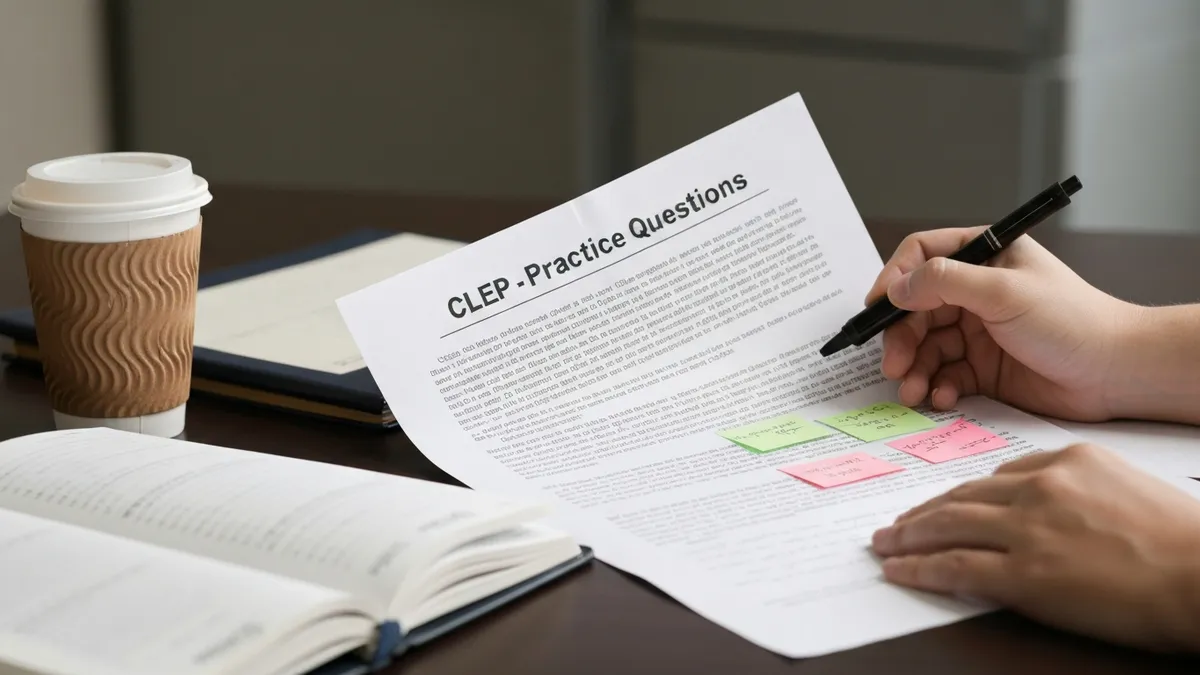
Peterson's CLEP: Pros and Cons for Test Takers
- +Comprehensive subject coverage across all 34 active CLEP exams with dedicated study guides
- +Adaptive online practice platform that personalizes difficulty based on real-time performance data
- +Detailed answer explanations that teach the reasoning behind correct answers, not just the answers themselves
- +Strong integration with free resources like Modern States CLEP for a complete, cost-effective prep pipeline
- +Score predictor tool helps you decide when you are genuinely ready to schedule your exam appointment
- +Flashcard systems with spaced repetition reinforcement for memorizing key terms and formulas efficiently
- −Subscription cost adds up if you are preparing for multiple CLEP exams over several months
- −Some subject guides lag behind College Board content outline updates, so cross-referencing is necessary
- −Video content quality varies by subject; some modules are more polished and comprehensive than others
- −The online platform requires a reliable internet connection, which can be a barrier in low-connectivity environments
- −Less effective for foreign language CLEP exams like CLEP Exam Spanish, which require active speaking and listening practice that no text-based platform can fully replicate
- −Paper-based study guides are bulky and not as easily updated as the digital platform when College Board revises exam content
Pros and Cons at a Glance
| Pros | Cons |
|---|---|
| Adaptive online practice platform that personalizes difficulty based on real-time performance data | Subscription cost adds up if you are preparing for multiple CLEP exams over several months |
| Detailed answer explanations that teach the reasoning behind correct answers, not just the answers themselves | Some subject guides lag behind College Board content outline updates, so cross-referencing is necessary |
| Strong integration with free resources like Modern States CLEP for a complete, cost-effective prep pipeline | Video content quality varies by subject; some modules are more polished and comprehensive than others |
| Score predictor tool helps you decide when you are genuinely ready to schedule your exam appointment | The online platform requires a reliable internet connection, which can be a barrier in low-connectivity environments |
| Flashcard systems with spaced repetition reinforcement for memorizing key terms and formulas efficiently | Less effective for foreign language CLEP exams like CLEP Exam Spanish, which require active speaking and listening practice that no text-based platform can fully replicate |
CLEP Practice Test Preparation Checklist
- ✓Download the official College Board content outline for your chosen CLEP exam and print or bookmark it for reference throughout your study period.
- ✓Verify that your Peterson's guide edition matches the current College Board content outline — check the publication year and compare topic lists.
- ✓Take a full-length Peterson's diagnostic practice test under timed, exam-like conditions before beginning any subject review.
- ✓Score your diagnostic and categorize every missed question by sub-topic to identify your three to five weakest areas.
- ✓Build a study schedule that dedicates the most time to your identified weak areas while maintaining review of stronger topics.
- ✓Complete at least one Modern States CLEP course for your subject to build foundational conceptual understanding before drilling practice questions.
- ✓Take a mid-preparation full-length Peterson's practice exam and compare your sub-topic performance against your original diagnostic results.
- ✓Use Peterson's spaced repetition flashcards daily for at least ten to fifteen minutes to reinforce vocabulary, formulas, and key concepts.
- ✓Identify your target institution's minimum passing score — some colleges require higher than College Board's standard score of 50.
- ✓Schedule your CLEP exam at a Prometric testing center at least two weeks out to ensure your preferred date and time are available.
One CLEP Exam Can Replace a Full 3-Credit College Course
At $93 per exam and with average college course tuition exceeding $1,500 per credit hour at many four-year institutions, a single passed CLEP exam can save students thousands of dollars. Students who pass just five CLEP exams — a realistic goal with Peterson's structured preparation — can enter college as a sophomore, cutting a full year off their degree timeline and dramatically reducing both tuition costs and student loan debt.
When comparing Peterson's to other CLEP preparation resources, it is important to evaluate each platform based on the specific exam you are targeting rather than looking for a single best resource for all situations. Peterson's consistently ranks among the top choices for quantitative subjects — CLEP College Algebra, Calculus, and Natural Sciences — because its practice question difficulty closely matches what College Board actually puts on these exams. Students who use only easier resources for these subjects often find themselves underprepared when they encounter the level of algebraic manipulation or conceptual reasoning the real exam demands.
For social science and humanities CLEP tests — including History of the United States, Western Civilization, and Introductory Psychology — Peterson's faces stronger competition from resources like REA CLEP guides and Instantcert's flash-card-based study system. These alternatives sometimes offer more content depth for reading-heavy subjects, and some students find that a combination approach — using Peterson's for practice exams while supplementing with REA for subject review — outperforms relying on Peterson's alone. The best CLEP prep approach is always the one tailored to the specific exam content and your individual learning style.
It is also worth comparing Peterson's directly against free CLEP preparation options. The College Board provides free sample questions for every active CLEP exam, and Modern States offers free full courses. The question is whether the additional cost of Peterson's is justified for your situation. For most students, the answer is yes, primarily because of the adaptive practice platform and detailed answer explanations. Free resources can tell you what the right answer is; Peterson's shows you why it is right and helps you develop the reasoning skills to handle novel questions you have never seen before.
Military service members and veterans deserve a special mention in any CLEP resource comparison. The Military Tuition Assistance program and organizations like DANTES cover the cost of CLEP exam fees for active duty personnel, making the $93 per exam fee a non-issue. In this context, Peterson's subscription cost is the primary financial consideration, and most service members find it well worth the investment given the significant time savings that come from efficient, targeted preparation. Peterson's has historically offered military discounts and partnerships through DANTES testing programs.
For students targeting language exams, Peterson's has limitations worth acknowledging. The clep exam spanish requires not only reading comprehension but also listening comprehension tested through audio recordings during the exam itself. While Peterson's provides reading-focused review and practice questions, developing the listening comprehension skills necessary for a passing score on the Spanish exam requires supplemental resources — apps like Duolingo, podcasts in Spanish, or conversation practice with native speakers — that no text-based platform can fully replace.
Students preparing for the CLEP College Algebra exam should be aware that Peterson's algebraic review tends to be more thorough than what many competing resources provide. The Peterson's College Algebra guide covers quadratic equations, rational functions, exponential and logarithmic functions, systems of equations, and matrix operations with enough depth to address both procedural and conceptual question types. Students who complete all Peterson's practice sets for this exam typically find the actual College Board exam to be at a comparable or slightly easier difficulty level, which is exactly where you want to be on test day.
Ultimately, the most successful CLEP test-takers are those who treat Peterson's as one tool in a broader preparation toolkit rather than a magic solution. They use Peterson's for structured practice and analytics, College Board materials for authoritative content guidance, Modern States for instructional content, and supplemental subject-specific resources for any areas where Peterson's coverage falls short. This layered approach consistently produces better outcomes than over-reliance on any single platform.

If you do not pass a CLEP exam, you must wait three months before retaking the same exam. This waiting period applies regardless of how close your score was to the passing threshold, and there are no exceptions for extenuating circumstances. This policy makes adequate preparation before your first attempt especially critical — a failed attempt costs you both the $93 exam fee and three months of time that could delay your academic progress.
Maximizing your CLEP score with Peterson's requires understanding how College Board actually scores these exams. CLEP uses a scaled scoring system where raw scores — the number of questions you answer correctly — are converted to a scaled score ranging from 20 to 80. Most colleges accept a scaled score of 50 as passing, which corresponds to roughly C-level performance. However, some institutions require scores of 55, 60, or even higher for specific courses, so confirm your target school's requirements before you set your score goal.
Peterson's practice exams report scores using the same 20–80 scaled scoring system, which makes it straightforward to benchmark your readiness against the passing threshold for your specific institution. One strategic implication of this scoring system is that CLEP exams do not penalize you for wrong answers — only correct answers contribute to your raw score. This means you should always answer every question on the exam, even if you have to guess. Peterson's test-taking strategy sections explain this explicitly and provide guidance on how to make educated guesses when you can eliminate even one or two incorrect answer choices.
Time management is another area where Peterson's preparation pays dividends. Most CLEP exams allocate 90 minutes for approximately 100 questions, giving you about 54 seconds per question. Students who have not practiced under timed conditions frequently run out of time before finishing the exam, leaving potentially easy points on the table in the final sections. Peterson's timed practice exams train you to develop an internal sense of pacing so that reaching the final questions with time to spare becomes automatic rather than something you have to consciously monitor during the real exam.
For students using clep collegeboard official practice resources alongside Peterson's, one important synergy is using College Board sample questions to calibrate the difficulty of Peterson's practice content. If you find that Peterson's practice questions feel significantly harder than the official College Board samples, you should weight your score predictions accordingly — you may be better prepared than your Peterson's practice scores suggest. Conversely, if official College Board questions feel noticeably harder, this is a signal to push harder in your final preparation weeks.
Subject-specific strategies matter enormously when using Peterson's to prepare for different CLEP exams. For the Introductory Psychology exam, Peterson's recommends focusing heavily on research methods, biological bases of behavior, and social psychology — the three sub-areas that historically carry the most weight on the College Board exam. For the U.S. History exams, Peterson's guides emphasize understanding broad thematic narratives over memorizing specific dates, because College Board questions increasingly test your ability to interpret primary sources and draw inferences rather than recall isolated facts.
Students preparing for science-based CLEP exams — Biology, Chemistry, and Natural Sciences — should pay special attention to the laboratory and experimental reasoning questions that appear in each exam. Peterson's science content typically includes sections on experimental design, data interpretation, and scientific reasoning that address this question type directly. These questions are often the ones that trip up otherwise well-prepared students who focused exclusively on content review without practicing the analytical reasoning component that College Board embeds throughout its science exams.
One frequently overlooked aspect of CLEP preparation is understanding the logistics of the testing experience itself. CLEP exams are administered at Prometric testing centers on computer, and the interface includes a question-flagging feature that allows you to mark questions for review before submitting your final answers. Peterson's practice platform simulates this flagging interface, so students who use Peterson's extensively will feel completely comfortable with the navigation mechanics on exam day. Familiarity with the testing interface removes cognitive friction during the real exam, freeing your mental energy for actual question analysis.
Building a realistic and sustainable CLEP study schedule is where many students stumble, even when they have access to excellent resources like Peterson's. The most common mistake is underestimating the preparation time required for unfamiliar subjects. If you took a course in Introductory Sociology in high school and remember the material well, four to six weeks of Peterson's review may be sufficient.
But if you are attempting CLEP College Algebra without having studied algebra in ten years, eight to twelve weeks of daily practice is a more realistic baseline, and some students need longer depending on the depth of their mathematical background.
Peterson's study guides include recommended study schedules in their front matter sections, typically organized into four-week, six-week, and eight-week plans that tell you which chapters to cover each week and how many practice questions to complete. These schedules are a useful starting point, but they assume an average level of prior knowledge. Use your diagnostic test results to adjust the schedule — if your diagnostic reveals that you are already strong in certain topic areas, compress the Peterson's schedule for those sections and reallocate that time to your weaker areas.
Accountability is a surprisingly important factor in CLEP success. Unlike enrolled college courses, CLEP preparation is entirely self-directed, which means there are no attendance requirements, no homework deadlines, and no grade pressure to keep you on track. Many students find it helpful to share their CLEP goals with a study partner, family member, or accountability group — even an informal check-in once a week can significantly improve follow-through on study schedule commitments. Some online CLEP communities on Reddit and Discord also offer structured accountability challenges where members share their preparation timelines and score milestones.
The financial motivation for completing CLEP preparation should never be underestimated as a psychological driver. Every time you feel like skipping a study session, remind yourself of the concrete dollars you will save by passing the exam on your first attempt. A passed CLEP exam at a state university that charges $300 per credit hour saves you approximately $900 for a three-credit course — more than nine times the $93 exam fee.
At private universities charging $1,500 or more per credit hour, the savings can exceed $4,500 per passed exam. Keeping this financial reality front of mind during difficult study sessions can provide the motivational boost needed to push through challenging material.
For students juggling CLEP preparation with full-time work or family responsibilities, consistency matters more than intensity. Forty-five minutes of focused Peterson's practice every day produces better outcomes than a single four-hour cram session once a week. Short, consistent study blocks allow your brain to consolidate information during sleep, which is where long-term memory formation actually occurs. Peterson's mobile-friendly platform makes it easy to squeeze in fifteen minutes of flashcard review during a lunch break or twenty minutes of practice questions during a commute, turning otherwise wasted time into productive preparation time.
When you feel genuinely ready — when your Peterson's practice scores consistently land at or above your target passing score and your sub-topic weaknesses have narrowed significantly — it is time to schedule your CLEP exam. Log in to the College Board CLEP website, find a Prometric testing center near you, and select a date that gives you a few more days of light review but does not drag out the preparation process unnecessarily. Waiting too long after you have peaked in preparation can actually lead to score regression as material fades from active memory without reinforcement.
On exam day, arrive at the testing center at least fifteen minutes early with two valid forms of identification, your registration confirmation, and any materials the testing center requires. CLEP exams are closed-book and no personal items are allowed at the testing station, so everything you need must be stored in your long-term memory. The months of Peterson's preparation you have completed will be your only resource once the timer starts — and if you have prepared thoroughly and honestly, that will be more than enough to earn a passing score and the college credit that comes with it.
CLEP Questions and Answers
CLEP Marketing Exam

CLEP Precalculus Study Guide: Everything You Need to Pass in 2026

CLEP Practice Test 2026: Free Questions, Study Tips & Exam Prep Guide

CLEP Exams 2026–2026 — Types of CLEP Tests, Cost, and How to Get College Credit

What Is CLEP? The College-Level Examination Program Explained (2026)
About the Author

Educational Psychologist & Academic Test Preparation Expert
Columbia University Teachers CollegeDr. Lisa Patel holds a Doctorate in Education from Columbia University Teachers College and has spent 17 years researching standardized test design and academic assessment. She has developed preparation programs for SAT, ACT, GRE, LSAT, UCAT, and numerous professional licensing exams, helping students of all backgrounds achieve their target scores.