
CLEP Prep Books: The Complete Guide to Choosing Study Materials That Actually Work
Find the best CLEP prep books for every subject. 📚 Compare top study guides, free resources & strategies to earn college credit fast.
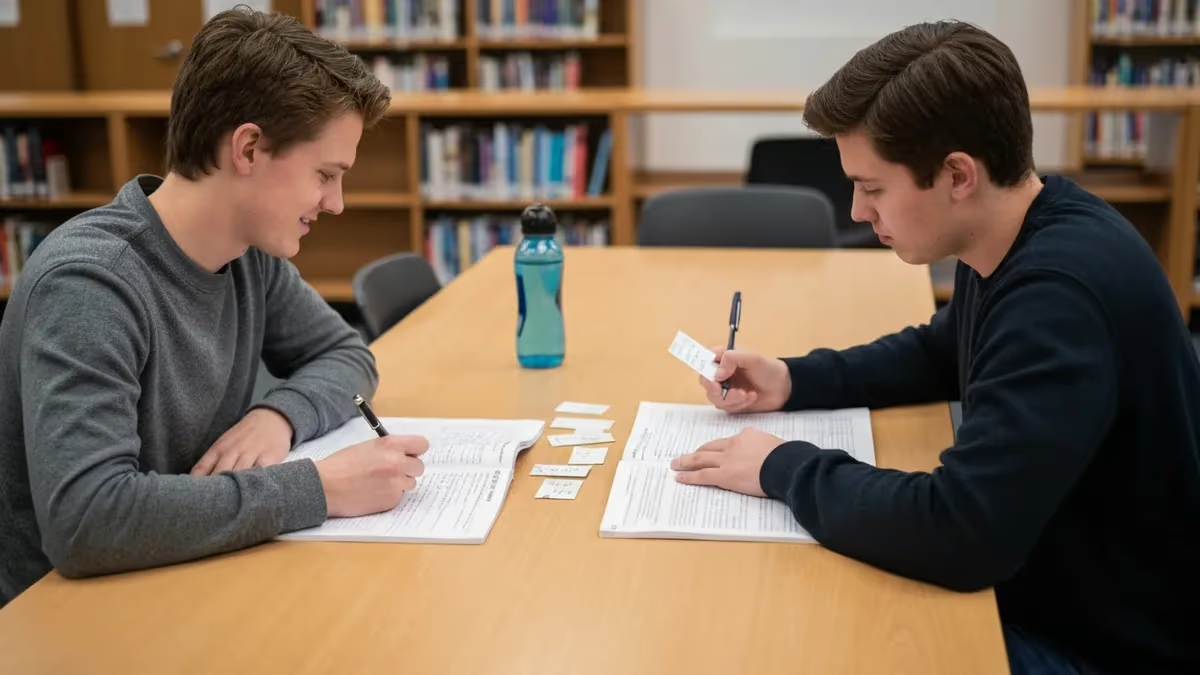
Choosing the right CLEP prep books can mean the difference between earning college credit on your first attempt and paying hundreds of dollars to retake an exam. The CLEP College Board administers 34 exams covering subjects from American Literature to Western Civilization, and each one requires targeted study materials matched to its specific content outline. Whether you are a first-time test-taker or returning to strengthen a weak subject, the prep book you choose shapes every hour of preparation you invest before exam day.
Understanding what is clep is the essential first step before purchasing any study guide. CLEP stands for College Level Examination Program, and it allows students to demonstrate college-level knowledge in exchange for credit hours at more than 2,900 participating institutions. A single passed exam can replace a three- to six-credit course, saving thousands of dollars in tuition and freeing up schedule space for advanced coursework or personal pursuits. With exam fees set at just $93 per test, the return on investment is extraordinary compared to enrolling in the equivalent college course.
The landscape of CLEP prep books has expanded dramatically over the past decade. Traditional publishers like REA, Barron's, and Cliffs have long dominated the market, but newer digital platforms and free resources such as Modern States CLEP now compete for students' attention. Navigating these options requires understanding what each resource offers, how it aligns with the official CLEP content outlines published by College Board, and whether the practice questions accurately reflect the difficulty and style of real exam items.
Not all CLEP tests are created equal in terms of difficulty or the quality of available prep materials. High-volume exams like CLEP College Algebra and CLEP English Composition enjoy strong libraries of prep books, practice tests, and online courses. Less common exams — including certain foreign language tests or specialized humanities subjects — may have only one or two dedicated prep books, making it critical to supplement with official College Board materials and free online resources. Knowing which category your target exam falls into will shape your entire study strategy.
Budget matters too. A single prep book typically costs between $20 and $45, while comprehensive online courses from Modern States CLEP are offered completely free of charge. Students preparing for multiple CLEP tests should weigh the cost of individual books against bundle subscriptions or library access through platforms like Kanopy or Hoopla, which often carry popular test-prep titles at no personal cost. Smart resource selection can keep your total preparation investment well under $100 across multiple exams.
This guide covers everything you need to know about CLEP prep books: how to evaluate study guides before buying, which publishers produce the most accurate content, how to integrate free online resources like Modern States, and how to build a week-by-week study schedule that aligns with your exam date. We also include specific guidance for high-traffic subjects including CLEP College Algebra, CLEP English Composition, and the CLEP exam Spanish series, so you can find tailored recommendations regardless of which subject you are targeting.
By the end of this article, you will understand exactly which prep materials are worth your money and time, how to structure your CLEP testing preparation for maximum efficiency, and how to supplement any book-based study plan with free practice questions that mirror the real exam experience. College credit is closer than you think when you approach CLEP testing with the right tools in hand.
CLEP by the Numbers
Key Facts at a Glance
| Item | Value | Details |
|---|---|---|
| Cost Per CLEP Exam | $93 | vs. $1,000–$3,000 for a college course |
| Typical CLEP Exam Length | 90 min | Some exams run up to 120 minutes |
| Minimum Passing Score (Most Exams) | 50 | On a 20–80 scale |
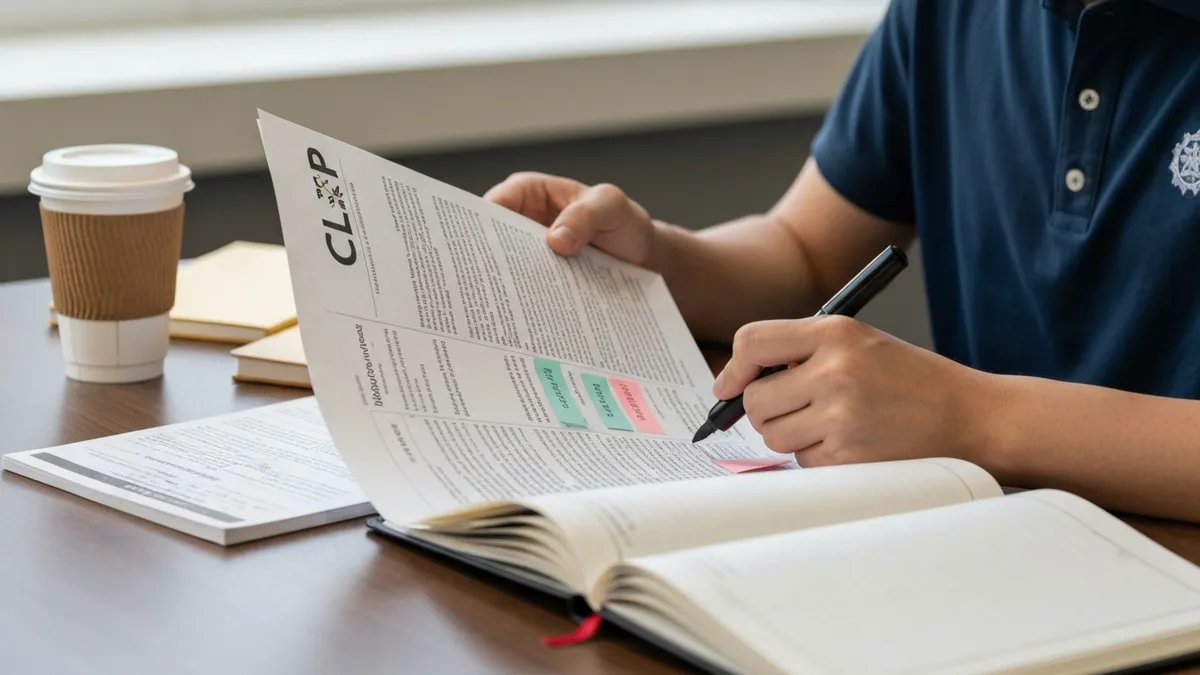
Top CLEP Prep Book Publishers Compared
Research & Education Association produces subject-specific CLEP books with full-length practice tests and detailed answer explanations. REA titles are widely regarded as the gold standard for subjects like CLEP College Algebra, Biology, and U.S. History, offering content that closely tracks the official College Board outlines.
Barron's publishes both general CLEP guides and subject-specific editions. Their diagnostic tests help identify weak areas early, and the review chapters are written at a college textbook level. Barron's is particularly strong for humanities subjects and provides thorough grammar review for English Composition test-takers.
Modern States offers completely free online video courses aligned to each CLEP exam, plus vouchers to cover the exam fee for qualifying students. It is the best zero-cost alternative to traditional prep books and is especially valuable for subjects where dedicated books are limited or out of date.
The College Board publishes a free CLEP Official Study Guide that includes practice questions for every exam. While it is not a subject-deep review book, it is the single most accurate source of exam-style questions available and should always anchor your preparation alongside any third-party prep book.
Cliffs Notes produces concise, affordable CLEP prep books that work well as secondary review tools or quick refreshers for students who already have background knowledge in a subject. They are best paired with REA or Barron's for comprehensive coverage rather than used as a standalone primary resource.
Evaluating a CLEP study guide before you purchase it requires comparing the book's table of contents against the official content outline published by College Board for that specific exam. Every CLEP subject has a freely downloadable fact sheet at the College Board website listing the major content domains and the percentage weight each carries on the exam.
If a prep book's chapters do not correspond to those domains — or if a domain that carries 20 percent of the exam weight receives only two pages of coverage — that book is not your best choice regardless of how well-reviewed it may be online.
The quality of practice questions is the single most important factor to evaluate in any CLEP prep book. Real CLEP questions are written at the introductory college course level, meaning they assume you can apply concepts rather than simply recall definitions. Many lower-quality prep books pad their question banks with recall-based items that are far easier than actual exam questions, giving students false confidence heading into test day. Look for books whose answer explanations reference underlying principles rather than just restating the correct answer, because that explanatory depth signals that the questions themselves were written with genuine rigor.
Publication date matters enormously for subjects whose content evolves over time. CLEP exams in areas like Information Systems, Economics, and Psychology reflect current disciplinary knowledge, and College Board periodically updates exam content outlines. A prep book published five or more years ago may cover material that no longer appears on the exam while omitting topics that have been added. Always cross-reference any book you purchase with the most recent version of the College Board content outline to identify any gaps you will need to fill with supplemental resources.
For the clep collegeboard calculus exam specifically, mathematical notation accuracy in prep books is non-negotiable. Errors in formulas, graphs, or worked examples in math and science books are more damaging than errors in humanities books because a single wrong formula can cascade into misunderstanding an entire topic area. Before committing to a math or science CLEP prep book, scan several worked examples and verify them independently using a trusted textbook or Khan Academy video.
Reader reviews on retailer websites are useful but require critical interpretation. Look specifically for reviews written by test-takers who passed or failed the exam, and note whether reviewers mention how the book's practice questions compared to the actual test difficulty. Ignore reviews that evaluate the book on writing clarity or printing quality alone — those factors are secondary to content accuracy and question quality for CLEP preparation purposes.
Digital supplementation has become essential even when using a traditional print prep book. Most major CLEP prep publishers now include access codes for online practice portals that offer adaptive quizzing, timed test simulations, and performance tracking dashboards. These digital components often provide more practice volume than the print book alone, and the timed test simulations are invaluable for building the pacing skills needed to finish all exam questions within the 90-minute window without rushing through the final section.
Finally, consider your baseline knowledge before choosing between a comprehensive review book and a condensed cram guide. Students who studied the subject recently in high school or on the job may need only a targeted review of weak spots plus heavy practice testing, making a shorter Cliffs Notes guide combined with a full REA practice test bank the right combination. Students approaching the subject cold, however, typically need a thorough content review book first before they can benefit from practice question volume. Honest self-assessment of your starting knowledge level saves both time and money when building your CLEP prep library.
Best CLEP Prep Books by Subject Area
CLEP College Algebra is one of the most popular exams in the entire program, and it benefits from excellent prep book coverage. REA's CLEP College Algebra book is consistently rated the strongest standalone option, offering 525 practice questions across three full-length timed tests alongside chapter-by-chapter review of functions, polynomial equations, rational expressions, exponential and logarithmic functions, and systems of equations. The explanations for incorrect answers are detailed enough to correct conceptual misunderstandings, not just arithmetic errors.
Supplementing your primary prep book with Khan Academy's free Algebra 1 and Algebra 2 course content is highly recommended for students who need to rebuild foundational skills before tackling CLEP-level problems. For students who are comfortable with the content but want additional timed practice, the College Board's official CLEP College Algebra sample questions provide a reliable benchmark for exam-day difficulty. Most test-takers who study six to eight weeks using REA plus Khan Academy report feeling well-prepared for the 90-question, 90-minute exam format.
Dedicated CLEP Prep Books vs. Free Online Resources
- +Comprehensive subject coverage in a single organized reference source
- +Full-length timed practice tests that simulate real exam conditions accurately
- +Detailed answer explanations that correct conceptual errors, not just wrong answers
- +Structured chapter organization that mirrors the official College Board content outline
- +Portable study option that works without internet connectivity or device battery
- +Publisher accountability means content errors are corrected in updated editions
- −Print books can become outdated when College Board revises exam content outlines
- −Cost of $20–$45 per book adds up when preparing for multiple CLEP subjects
- −Question banks are finite — most books offer only 2–4 full practice tests
- −Audio and interactive content is limited or absent in traditional print formats
- −Some subjects have only one available prep book, eliminating comparison shopping
- −No adaptive learning or performance tracking without a supplemental digital portal
CLEP Study Prep Checklist: Before You Open Any Book
- ✓Download the official College Board content outline for your specific CLEP exam subject.
- ✓Verify your target college accepts CLEP credit for that subject and check the minimum passing score they require.
- ✓Register for your exam date at least six to eight weeks in advance to create a firm deadline.
- ✓Take a free diagnostic practice test to identify your current knowledge level before buying any prep books.
- ✓Cross-check any prep book's publication date against the most recent College Board content outline update.
- ✓Sign up for a free Modern States CLEP course for your subject to access video lectures at no cost.
- ✓Create a week-by-week study schedule that allocates more hours to content domains with higher exam weight percentages.
- ✓Gather your calculator policy information — CLEP College Algebra allows an online calculator, but other math exams do not.
- ✓Set up a timed practice test environment at home to acclimate to the 90-minute seated testing experience.
- ✓Join a CLEP student community on Reddit or Facebook to find subject-specific prep tips from recent test-takers.
The Official College Board Study Guide Should Always Be Your Foundation
No third-party prep book — regardless of publisher reputation or price — is more accurate than the official CLEP Official Study Guide published by College Board. It contains real retired exam questions for every subject and is available in print and as a free digital download. Use it alongside any commercial prep book, not instead of one, for the most complete preparation possible.
Modern States CLEP has fundamentally changed the economics of CLEP preparation since its launch. The platform provides free, self-paced video lecture courses for every CLEP exam subject, taught by college professors and aligned directly to the College Board content outlines. Students who complete a Modern States course can also apply for a free exam voucher worth $93, effectively covering the entire cost of their CLEP test. For budget-conscious students, this means it is genuinely possible to earn college credit at no out-of-pocket cost when combining Modern States with free practice questions from College Board's website.
The quality of Modern States content varies somewhat by subject. Courses for mathematics, natural sciences, and introductory social sciences are particularly strong, with lecture videos that build from foundational concepts through exam-level application. Humanities subjects benefit from the breadth of the course content but may lack the depth of analysis found in dedicated prep books for literature-heavy subjects. The ideal approach for most students is to use Modern States as a free lecture supplement to a paid prep book — letting the videos establish conceptual understanding and the book provide structured practice testing.
Beyond Modern States, several other free resources deserve a place in any CLEP preparation plan. Khan Academy covers virtually every topic tested on CLEP College Algebra, Precalculus, Biology, Chemistry, and Psychology through its free video library and adaptive exercise system. Coursera and edX offer free audit access to introductory college courses on nearly every CLEP subject, providing college-level instruction that directly mirrors the knowledge base the exams assess. Public libraries increasingly offer free digital access to prep books through apps like Hoopla and Libby, eliminating the need to purchase print copies for popular subjects.
YouTube has also become a surprisingly rich source of CLEP-specific preparation content. Dedicated channels created by students who have passed multiple CLEP exams offer subject walkthroughs, score reports, and honest comparisons of prep books they used. Searching for your specific CLEP subject alongside terms like "study with me" or "prep review" surfaces hours of free walkthrough content that complements structured prep books. While YouTube should never be your primary source, it excels at clarifying confusing concepts and providing motivational content during long study periods.
Flashcard platforms like Anki and Quizlet host user-created CLEP flashcard decks for nearly every exam subject. These decks vary in accuracy and completeness, so always verify key facts against your primary prep book or the College Board outline before committing them to memory. The best Quizlet CLEP sets are typically created by students who recently passed the exam and often include terms pulled directly from REA or Barron's prep books. Anki's spaced repetition algorithm makes it particularly effective for vocabulary-heavy exams like CLEP Spanish, French, or German.
For students who learn best through structured course formats rather than self-directed book study, platforms like Straighterline and Study.com offer full CLEP-prep courses with graded assignments, instructor feedback, and guaranteed preparation for the exam. These services typically charge $60–$100 per subject, making them more expensive than a single prep book but significantly less expensive than enrolling in the equivalent college course. Study.com in particular has strong CLEP alignment documentation that shows exactly which of its lessons correspond to which sections of the College Board content outline.
The most effective free resource strategy combines the College Board's official sample questions — available without charge through a clep exam practice test — with Modern States video lectures and Khan Academy exercises for skill-building. This three-platform combination covers content instruction, adaptive practice, and official exam simulation, addressing all three dimensions of effective test preparation without spending a dollar beyond the exam fee itself. Students who commit to 40 to 60 hours of preparation using this free stack consistently report passing scores in subjects where they entered with some prior knowledge.

Not every college accepts credit for every CLEP exam subject. Even institutions that participate in the CLEP program may exclude specific subjects, require a minimum score higher than the standard 50, or limit how many CLEP credits can count toward a degree. Confirm your specific college's CLEP policy in writing with your registrar or academic advisor before investing time and money in preparation — policies can change between catalog years and are not always posted accurately on the institution's public website.
Building a realistic study schedule is where most CLEP test-takers either succeed or fail before they ever sit down at the testing center. The most common mistake is underestimating how much preparation a given CLEP exam requires and leaving insufficient time before the exam date.
A useful starting benchmark is to plan for one hour of study per percentage point of content you do not already know confidently. An exam with 100 percent unfamiliar content at 90 total percentage points of coverage means roughly 90 hours of preparation — spread over six weeks, that is 15 hours per week, or about two hours on weekdays and five hours on weekends.
Week one of any CLEP preparation plan should be exclusively diagnostic. Take a full-length timed practice test from your prep book or the College Board's official materials on day one without any prior review. Score your results and map every incorrect answer to its content domain using the book's answer key. This produces a prioritized study agenda based on actual data about your weak areas rather than assumptions about where you might struggle. Students who skip this diagnostic phase often over-study topics they already understand and under-study the domains responsible for most of their wrong answers.
Weeks two through five should follow a rotating content-and-practice pattern rather than studying each domain once and moving on. Research in educational psychology consistently shows that interleaved practice — mixing questions from multiple topics in a single study session — produces stronger long-term retention than blocked practice that exhausts one topic before moving to the next. Prep books typically organize chapters by topic, making it tempting to study chapter by chapter, but you will retain more by completing a chapter's reading and then immediately mixing its practice questions into a rotating pool with questions from previously reviewed chapters.
The final week before your CLEP test should shift almost entirely to full-length timed practice tests under real exam conditions — computer at a desk, no notes, strict time limit, phone in another room. Complete at least two full practice tests in the seven days before your exam and review every incorrect answer immediately after finishing each test.
Time yourself on each section to identify whether pacing is a problem; many students who struggle with CLEP exams do not lack knowledge but run out of time because they spend too long on difficult questions instead of flagging them and moving forward.
Rest and logistics management in the 48 hours before your CLEP testing appointment are as important as any last-minute review. Locate your testing center on a map, confirm the parking situation, and know exactly what identification documents you need to bring. CLEP exams are administered by ProProctor online or at College Board-affiliated testing centers, and the check-in procedures differ between the two formats. Arriving flustered and unfamiliar with the testing environment wastes mental energy that you need for the exam itself.
On exam day, use the first five minutes to read every question prompt carefully before answering, paying attention to words like "except," "least likely," and "best describes" that completely change which answer is correct. CLEP exams do not penalize for guessing, so answer every single question even when you are uncertain — eliminate obviously wrong choices first to improve your odds on items where you are genuinely unsure.
Most CLEP tests present questions in random order across content domains, so you may see a genetics question followed by an ecology question followed by a cell biology question rather than a logical topical sequence.
After passing your CLEP exam, request official score reporting to your institution promptly. College Board sends scores to one institution for free at the time of testing, and additional score reports cost $20 each if requested afterward. Confirm with your registrar's office how quickly CLEP credits post to your transcript and whether they appear as transfer credit, exemption credit, or another designation that might affect your degree audit or financial aid standing. Keeping a copy of your score report and the institution's current CLEP credit policy on file protects you if any administrative discrepancy arises during transcript evaluation.
The final dimension of effective CLEP preparation is understanding how to adapt your study strategy when your initial plan is not producing the score improvements you need. If practice test scores plateau after three weeks of studying, the most common culprits are either surface-level reading during content review or passive re-reading rather than active recall practice. Switching from rereading chapter summaries to self-quizzing — covering the page and trying to recall key concepts from memory — produces dramatically better score gains in a shorter time period.
Active recall works even better when combined with spaced repetition. After correctly answering a flashcard or practice question, wait progressively longer before reviewing it again: one day, then three days, then a week. After missing a question, review it the same day and again the following day before spacing it out.
Anki automates this spacing algorithm, but you can implement it manually with index cards and date labels if you prefer analog study methods. Students who apply spaced repetition to CLEP vocabulary and formula review consistently score higher than students who study the same material for the same total hours using passive methods.
Group study can be valuable for CLEP preparation, but only when structured correctly. The most effective format is the teach-back method: one student explains a concept or works through a problem aloud while the group listens and then identifies any errors or gaps in the explanation. Teaching a concept requires a deeper level of understanding than recognizing the correct answer on a multiple-choice question, and the act of verbalizing your reasoning exposes logical gaps that silent study misses entirely. Online study groups formed through Reddit's r/clep community regularly organize virtual study sessions for popular exams.
Nutrition, sleep, and exercise have documented effects on cognitive performance during exam preparation that most students systematically ignore. Studying for two concentrated hours after a full night of sleep produces better retention than studying for four hours while fatigued. Brief aerobic exercise before a study session — even a 20-minute walk — measurably improves focus and working memory capacity for the following 90 minutes. These are not motivational platitudes; they are effects strong enough to show up in controlled research with student populations, and they are entirely within your control during a six-week prep cycle.
If you are preparing for multiple CLEP exams during the same semester, sequence them strategically by difficulty and your background knowledge. Tackle subjects where you already have strong foundational knowledge first to build confidence and accumulate credits quickly. Reserve the subjects requiring the most preparation time for exam dates when you have the most calendar availability. Avoid scheduling two high-difficulty CLEP tests within the same two-week window — the cognitive load of concurrent intense preparation degrades performance on both exams compared to sequential scheduling with a recovery week in between.
For CLEP exams with essay components — primarily English Composition with Essay and some Humanities subjects — writing practice cannot be substituted by reading alone. Set a timer for 45 minutes and write a complete argumentative essay in response to each College Board practice prompt you can find, then evaluate your own work against the published scoring rubric.
If possible, have a teacher, writing tutor, or college-educated family member provide feedback on your argument structure and paragraph development. The essay component score is reported separately from the multiple-choice score at some institutions, and a weak essay can offset an otherwise strong multiple-choice performance on exams that weight writing heavily.
Ultimately, passing CLEP tests is a skill that improves with practice, reflection, and strategy adjustment. Students who treat CLEP preparation as a one-time read-through of a prep book rarely maximize their scores. Students who treat it as a performance skill — diagnosing weaknesses, practicing deliberately, simulating real conditions, and iterating on their approach — consistently beat the 50-point passing threshold and often score well above it. The right CLEP prep books give you the knowledge base; your discipline and strategy determine whether that knowledge translates into the score that earns you the college credit you deserve.
CLEP Questions and Answers

Biology CLEP Practice Test: Free Questions, Format Breakdown & Study Strategy (2026)

CLEP Calculus Practice Test: Your Complete Guide to Passing the Exam

CLEP Practice Test 2026: Free Questions, Study Tips & Exam Prep Guide

CLEP Precalculus Study Guide: Everything You Need to Pass in 2026

CLEP Exams 2026–2026 — Types of CLEP Tests, Cost, and How to Get College Credit
About the Author

Educational Psychologist & Academic Test Preparation Expert
Columbia University Teachers CollegeDr. Lisa Patel holds a Doctorate in Education from Columbia University Teachers College and has spent 17 years researching standardized test design and academic assessment. She has developed preparation programs for SAT, ACT, GRE, LSAT, UCAT, and numerous professional licensing exams, helping students of all backgrounds achieve their target scores.