
Can You Take CLEP Exam at Home? Complete Guide to Remote Testing Options 2026
Can you take CLEP exam at home? 🎯 Learn remote testing options, requirements, costs & prep tips to earn college credit from anywhere in 2026.
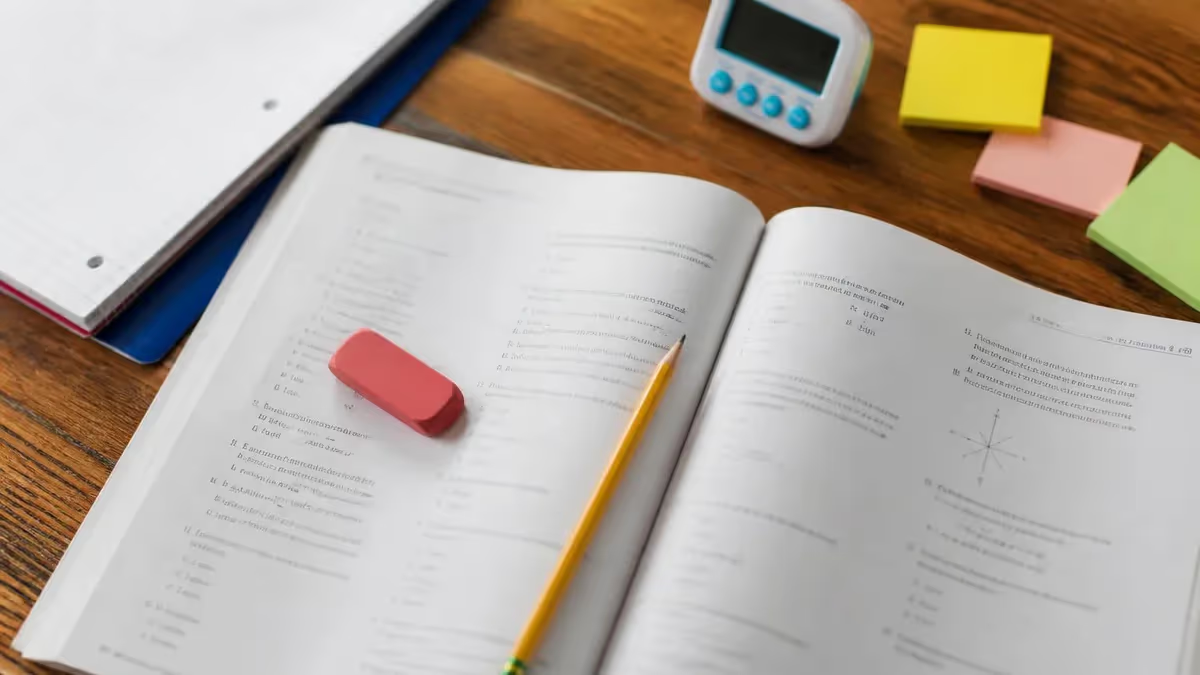
If you have been searching for ways to earn college credit on your own schedule, you have likely asked yourself: can you take CLEP exam at home? The answer involves understanding how the CLEP College Board program has evolved alongside changes in remote proctoring technology. As of mid-2026, the CLEP College Board does not offer a fully independent at-home testing option through its own platform, but test-takers have access to a growing set of hybrid and remote-friendly solutions that make the process far more flexible than it was just a few years ago.
CLEP tests — formally called College-Level Examination Program exams — allow students to demonstrate subject mastery and potentially earn college credit without sitting through an entire semester of coursework. The College Board administers these exams at over 2,000 authorized test centers across the United States and internationally. Many of these centers are located inside community colleges, universities, military bases, and even some libraries, making them reasonably accessible for most people who live within driving distance of a moderately sized city.
The good news for remote learners is that some authorized testing centers allow candidates to schedule appointments that feel nearly as convenient as testing from home. Extended weekday hours, weekend slots, and private testing rooms mean that motivated students can find scheduling options that work around full-time jobs or family obligations. Additionally, military service members and certain other populations have access to special programs that expand where and how they can test, including some remote accommodations through the Defense Activity for Non-Traditional Education Support (DANTES) program.
Understanding what is CLEP and how it compares to other credit-by-exam programs is the first step toward choosing the right path. CLEP offers 34 individual exams across subjects including history, literature, mathematics, science, business, and foreign languages. Each exam typically costs $97 plus any additional proctoring fees charged by the testing center, making the total investment far lower than the tuition for a comparable college course. Many students use programs like Modern States CLEP to access free preparatory coursework and even fee waivers before sitting for their chosen exam.
CLEP testing has become an increasingly popular strategy for non-traditional students, military personnel, homeschoolers, and working adults who want to accelerate their degree completion without accumulating excessive debt. The flexibility of choosing which subjects to test in — combined with the ability to study at your own pace using CLEP practice test materials and online prep courses — makes this program uniquely well-suited to self-directed learners. Whether you are targeting CLEP college algebra, U.S. history, or introductory psychology, a structured preparation plan can dramatically improve your chances of passing on the first attempt.
This guide will walk you through everything you need to know about where you can take CLEP exams, what remote-friendly options currently exist, how to prepare effectively using free and paid resources, and what to expect on test day. You will also find practical advice on registering through the CLEP College Board portal, selecting an authorized testing center, and using tools like clep exam practice test resources to sharpen your skills before sitting down at a testing terminal. By the end, you will have a clear, actionable plan for earning college credit efficiently — regardless of where you live.
- CLEP exams are multiple-choice, and the number of questions depends on the subject; for example, American Government has about 100 questions in 90 minutes. (College Board)
- The CLEP College Composition exam has 50 multiple-choice questions and 2 essays, with a total testing time of 125 minutes. (College Board)
- Most CLEP exams take about 90 to 120 minutes to complete, depending on the exam subject. (College Board)
- CLEP scores are reported on a 20–80 scale, and the American Council on Education recommends that colleges grant credit for a score of 50 or higher, though each college sets its own policy. (College Board)
- Each CLEP exam costs $97, plus a separate test center administration fee or a remote proctoring fee. (College Board)
- Taking a CLEP exam at home with remote proctoring adds a $30 remote proctoring fee on top of the $97 exam fee. (College Board)
- You can't retake a CLEP exam of the same title within three months of the first test date; if you do, the score is canceled and the fees are forfeited. (College Board)
- CLEP scores for exams taken on or after July 1, 2022, stay available for 10 years from the test date; older scores stay available for 20 years. (College Board)
- CLEP exams are taken on computer either at one of more than 2,000 CLEP test centers or at home with remote proctoring through Proctortrack by Verificient. (College Board)
Facts verified Oct 16, 2026 against College Board. Dates that have passed are removed automatically.
CLEP Exam at a Glance
| Item | Detail | Official source |
|---|---|---|
| Number of questions | Multiple choice; e.g. ~100 questions (American Government), ~60 (College Algebra) | College Board |
| Number of questions (College Composition) | 50 multiple-choice questions + 2 essays | College Board |
| Time limit | About 90–120 minutes, depending on subject | College Board |
| Passing score | 50 on a 20–80 scale (ACE recommendation) | College Board |
| Exam fee | $97 per exam + center/remote admin fee | College Board |
| Exam fee (Remote proctoring fee) | $30 remote proctoring fee | College Board |
| Retake policy | Wait 3 months before retaking the same title | College Board |
| Validity | Scores available 10 years (exams from July 1, 2022 on) | College Board |
| Delivery | Test center or at home with remote proctoring | College Board |
| Eligibility | Anyone at a test center; remote: age 13+ (18+ in Illinois), in the U.S. or DANTES-funded | College Board |
| Score release | Immediately on screen; portal within 24 hours | College Board |
| Score release (College Composition / Spanish with Writing) | 2–3 weeks after exam day | College Board |
| Registration opens | Open year-round via My CLEP portal | College Board |
| Testing window | Year-round, scheduled with the test center | College Board |
Facts verified Oct 16, 2026 against College Board. Dates that have passed are removed automatically.
CLEP Testing by the Numbers

How to Schedule and Take a CLEP Exam Step by Step
Create a CLEP College Board Account
Choose Your Exam and Find a Test Center
Register and Pay the Exam Fee
Prepare Using Practice Tests and Study Guides
Arrive at the Testing Center and Take the Exam
Receive Scores and Request Credit Transfer
The most common question prospective test-takers have is whether CLEP testing can be completed entirely from home. As of 2026, the CLEP College Board has not launched a standalone at-home proctoring platform of its own. However, that does not mean remote options are completely off the table. The College Board has explored and, in some periods, offered partnership arrangements with online proctoring services, and the landscape continues to evolve. It is always worth checking the official CLEP website for the most current policy updates, as the program has shown willingness to adapt to the demands of a distributed student population.
One of the most significant remote-friendly developments has been the expansion of CLEP testing access through military programs. The Defense Activity for Non-Traditional Education Support, known as DANTES, partners with the College Board to provide CLEP exams at no cost to active-duty military personnel. Many military installations have on-base testing centers, and some service members stationed in remote or overseas locations have been able to access alternative testing arrangements. If you are serving in the armed forces, contact your installation's education center to learn what options are currently available to you specifically, as policies vary by branch and location.
For civilian test-takers who cannot easily reach a physical testing center, another practical workaround is to look for testing centers that offer extended or flexible scheduling. Some community college testing offices open early in the morning, stay open late on weekdays, or offer Saturday appointments. Calling the testing center directly — rather than relying solely on the online scheduler — often reveals availability that is not shown in the booking system. Being proactive and persistent when scheduling can make a meaningful difference in how soon you can sit for your exam.
Students who are enrolled in accredited online degree programs may find that their own institution operates a remote proctoring platform that is also authorized for CLEP administration. Colleges that use services like ProctorU, Examity, or Honorlock for their own courses sometimes extend those proctoring relationships to accommodate CLEP candidates who are enrolled students. Ask your school's registrar or testing office whether they can help a CLEP exam through their existing remote proctoring infrastructure — many students have successfully completed CLEP tests this way without ever visiting a physical campus.
Modern States CLEP is a nonprofit organization that offers free online courses specifically designed to help students prepare for CLEP exams. After completing a Modern States course, eligible students may receive a voucher that covers the cost of one CLEP exam, effectively making it free. The Modern States platform uses video lectures, quizzes, and practice materials aligned to the actual CLEP content outlines.
This is especially useful for students studying subjects like CLEP college algebra or introductory sociology, where the curriculum is well-defined and the question types are predictable. You can find complementary materials including a spanish practice clep test to round out your study plan.
For homeschooled students and dual-enrollment high schoolers, CLEP exams represent one of the most cost-effective ways to earn college credit while still in secondary school. Many states have policies that make it easier for younger students to access testing centers, and some homeschool co-ops have even established relationships with nearby testing facilities to simplify the scheduling process for their members. If you fall into this category, connecting with a local homeschool support group can open doors to resources — including group study sessions, shared study guides, and coordinated test day transportation — that you might not find on your own.
The bottom line on at-home CLEP testing is this: while a fully independent, unsupervised at-home option does not currently exist through the official CLEP College Board program, the combination of flexible test center scheduling, military program accommodations, institutional remote proctoring partnerships, and free prep resources through Modern States makes CLEP more accessible than it has ever been before. Staying informed about policy changes and being willing to explore all available channels will give you the best chance of finding a testing arrangement that fits your unique circumstances.
CLEP Courses, Prep Resources, and Study Strategies
The Modern States CLEP initiative stands out as the single best free resource for CLEP candidates. Their online courses cover over 30 CLEP subjects and are taught by college professors using video lectures, readings, and built-in quizzes. After completing a course and passing a qualifying assessment, eligible students can apply for a voucher that covers the full $97 exam fee — making the entire process genuinely free if you qualify based on financial need or other criteria.
Beyond Modern States, Khan Academy offers free instruction in many CLEP-relevant topics including college algebra, pre-calculus, history, and economics. YouTube channels dedicated to AP-level coursework are also highly relevant, since AP and CLEP content often overlaps significantly. The College Board itself publishes free official CLEP study guides for each exam, which include content outlines, sample questions, and score interpretation information — always the most authoritative starting point for building your study plan.

Pros and Cons of Taking CLEP Exams for College Credit
- +Significant cost savings compared to paying tuition for a full college course
- +Study at your own pace using free resources like Modern States CLEP courses
- +Earn credit for knowledge you already have from work or life experience
- +Over 2,900 colleges and universities accept CLEP credit nationwide
- +Results are available immediately after most exams with no waiting period
- +Military members can access free exam vouchers through DANTES partnerships
- −No official at-home testing option currently exists through the CLEP College Board
- −Some colleges cap the number of credits you can earn through CLEP exams
- −Certain competitive or specialized programs may not accept CLEP credit at all
- −You must wait three months before retaking any CLEP exam you have failed
- −Testing center availability can be limited in rural or remote geographic areas
- −A passing score of 50 is ACE-recommended, but individual colleges may require higher scores
Pros and Cons at a Glance
| Pros | Cons |
|---|---|
| Significant cost savings compared to paying tuition for a full college course | No official at-home testing option currently exists through the CLEP College Board |
| Study at your own pace using free resources like Modern States CLEP courses | Some colleges cap the number of credits you can earn through CLEP exams |
| Earn credit for knowledge you already have from work or life experience | Certain competitive or specialized programs may not accept CLEP credit at all |
| Results are available immediately after most exams with no waiting period | You must wait three months before retaking any CLEP exam you have failed |
| Military members can access free exam vouchers through DANTES partnerships | Testing center availability can be limited in rural or remote geographic areas |
CLEP Testing Preparation Checklist
- ✓Create a free account on the official CLEP College Board website before beginning your search for a testing center.
- ✓Verify that your target college accepts CLEP credit for the specific exam you plan to take.
- ✓Locate the nearest authorized CLEP testing center using the official test center locator tool.
- ✓Contact the testing center directly to confirm available appointment times and any additional fees.
- ✓Register for your exam online and pay the $97 fee, or apply for a Modern States CLEP voucher if eligible.
- ✓Download the official CLEP content outline for your exam subject and use it to guide your study plan.
- ✓Complete at least one full-length timed practice test early in your preparation to establish a baseline score.
- ✓Spend focused study time on your weakest content areas identified through practice test review.
- ✓Confirm your appointment 48 hours in advance and review the testing center's ID and materials policy.
- ✓Arrive at least 15 minutes early on exam day with two valid forms of government-issued identification.
The Standard CLEP Passing Score Is 50 Out of 80 — But Always Check With Your College
The American Council on Education recommends a score of 50 on a 20–80 scale as the passing threshold for most CLEP exams, which corresponds to roughly a grade of C in the equivalent college course. However, individual institutions set their own minimum score requirements, and some colleges require a 60 or higher to grant credit. Always verify your target school's specific CLEP score policy before you register for an exam, and plan your preparation with that school's cutoff — not just the ACE recommendation — as your true target.
Understanding the full range of CLEP tests available is essential for building an efficient credit-accumulation strategy. The 34 CLEP exams are organized into five broad subject areas: composition and literature, history and social sciences, science and mathematics, business, and world languages. Within each category, you can find exams ranging from introductory-level courses like College Composition to more specialized options like Financial Accounting or Principles of Management. If you are pursuing a general education requirement, focusing on high-yield CLEP tests that satisfy multiple distribution requirements at your institution can dramatically reduce the total number of exams you need to take.
CLEP college algebra is among the most frequently taken exams and is accepted for math credit at the vast majority of institutions that participate in the CLEP program. The exam covers topics including algebraic operations, equations and inequalities, functions and their properties, and number systems. Many students find that a targeted four-to-eight-week study plan using free resources like Khan Academy for content review and dedicated practice test platforms for exam simulation is sufficient to achieve a passing score, even if they have not studied formal algebra in several years.
For students who are strong readers and writers, the CLEP College Composition and College Composition Modular exams provide pathways to satisfying English writing requirements without completing a full semester course. The College Composition exam includes both multiple-choice questions and two essays, which means your preparation needs to include timed writing practice — not just content review. The College Composition Modular exam at some institutions may also require a locally administered writing component, so confirm your institution's specific requirements before choosing between these two options.
World language CLEP exams are particularly valuable for heritage speakers and students who have studied a language extensively outside of formal academic settings. The Spanish Language, French Language, and German Language exams, among others, can award up to twelve semester hours of credit at some institutions for a single exam session — making them among the highest-value opportunities in the entire CLEP catalog. Native or near-native speakers of these languages can sometimes pass these exams with minimal additional preparation, effectively converting years of real-world language exposure into transferable academic credit at a cost of under $100.
Business-focused CLEP exams are especially popular among adult learners who are returning to finish a degree and who have years of practical workplace experience. Exams like Principles of Management, Principles of Marketing, and Introductory Business Law test concepts that many working professionals use daily.
Students who have managed teams, run marketing campaigns, or worked in legal or compliance environments often find that a few weeks of targeted review to learn the academic vocabulary and theoretical frameworks is all they need to pass. The clep courses available through Modern States and Study.com specifically for these business subjects are well-aligned with the actual exam content.
For students planning to attend a specific institution, checking that school's CLEP credit policy before choosing which exams to take is absolutely critical. Some schools accept CLEP credit only for certain subjects, impose maximum credit limits, or exclude CLEP credit for courses in your declared major. The clep college composition page provides detailed information on how specific universities handle CLEP credit transfers, which can help you avoid the frustration of earning a passing score on an exam whose credit your target school does not recognize.
One strategic consideration that many first-time CLEP candidates overlook is the relationship between CLEP exams and Advanced Placement courses. If you completed AP courses in high school but did not score high enough to earn credit at your college, CLEP exams in overlapping subjects give you a second chance to claim that credit.
The content covered in most AP courses closely mirrors CLEP exam content, so AP students often find that a relatively brief CLEP-specific review — focused on any content differences and on the specific question formats used by CLEP rather than AP — is sufficient to prepare effectively for the corresponding CLEP exam.

If you do not pass a CLEP exam on your first attempt, you must wait a minimum of three months before retesting in the same subject. This waiting period applies regardless of the reason for the failed attempt, including technical issues or illness on test day. Plan your study timeline carefully to ensure you are fully prepared before your first attempt, because a failed exam not only costs you three months but also requires you to pay the full $97 fee again when you retest.
Maximizing your CLEP score starts well before you arrive at the testing center. The single most important thing you can do in the weeks leading up to your exam is to simulate real test conditions as closely as possible during your practice sessions. This means sitting down with a timer, working through a full-length practice test without interruptions, and reviewing your answers with the same critical attention you would give to a post-mortem after a poor performance. Students who practice under realistic conditions consistently outperform those who study only through passive reading and note-taking.
Time management during the actual CLEP exam is a skill that requires deliberate development. Most CLEP tests give you 90 minutes to answer between 80 and 120 questions, which works out to less than 90 seconds per question. If you encounter a question that stumps you, mark it and move on rather than letting it consume disproportionate time.
The CLEP testing software allows you to flag questions for review, so you can return to difficult items after working through questions you can answer more quickly. Spending three or four minutes on a single hard question early in the exam can cost you the time you need to answer five easier questions later.
The night before your CLEP exam is not the time for intensive last-minute studying. Your brain consolidates learning during sleep, so a solid seven to eight hours of rest will do more for your performance than staying up late cramming content you have already reviewed dozens of times.
Instead of studying, spend 15 to 20 minutes the evening before reviewing your content outline at a high level, confirming your appointment time and testing center location, and preparing everything you need to bring — ID documents, directions, and any allowed materials. Arriving calm and well-rested gives you a genuine cognitive advantage over test-takers who show up anxious and fatigued.
On exam day, read every question carefully before selecting an answer. CLEP questions are often designed to test whether you understand nuanced distinctions, and many wrong answer choices are crafted to look plausible at a quick glance. Pay attention to qualifying words like "always," "never," "most likely," and "except" — these words frequently determine whether an otherwise-reasonable-looking answer is actually correct.
When you are genuinely unsure between two options, eliminate any answers you know are wrong, then make your best educated guess from the remaining choices. There is no penalty for wrong answers on CLEP exams, so leaving any question blank is always the wrong strategy.
After you finish the exam, you will see a preliminary score on screen for all CLEP exams except College Composition (which involves essay scoring by human raters). This preliminary score is not official, but it gives you an immediate indication of how you performed.
If you passed, you can request that your official scores be sent to your college at no additional charge if you make the request on the same day as your exam. If you request score reporting after the test date, a fee applies. Planning to make this request immediately after learning your score saves you money and ensures your college receives the information as quickly as possible.
For students who need additional support after a disappointing score, the CLEP program also offers score cancellation within a short window following test completion. If you choose to cancel your score, it will not be reported to any institution and will not appear on your score record. This option exists for students who are confident they underperformed significantly and do not want a low score affecting their academic record.
However, score cancellation forfeits your exam fee, so it is best used as a last resort rather than a routine safety net. You can find detailed information about upcoming opportunities to test or retest by checking the spanish clep practice test page for scheduling guidance.
One final piece of advice for serious CLEP candidates: join online communities of other test-takers. Forums like Reddit's r/CLEP are filled with people who have recently passed specific exams and are willing to share exactly which study materials they used, how long they prepared, and what types of questions appeared on their test.
While CLEP test security rules prevent candidates from sharing specific questions, the community knowledge about the emphasis and difficulty level of different content areas is invaluable for calibrating your study plan. A few hours spent reading recent pass reports for your target exam can save you weeks of misdirected preparation.
Knowing the costs involved in CLEP testing upfront allows you to budget accurately and identify opportunities to reduce or eliminate fees. The standard exam registration fee set by the College Board is $97 per exam. On top of that, the testing center itself typically charges an administrative fee ranging from $10 to $35 per exam session. Some testing centers, particularly those at for-profit institutions or commercial testing facilities, may charge higher administrative fees, so it is worth calling ahead to compare costs across nearby centers if multiple options are available to you.
Military service members and their dependents have access to the most generous CLEP fee waivers available. Active-duty personnel, National Guard members, and reservists can take CLEP exams for free through the DANTES program, with the College Board fee waived entirely. Additionally, many military education benefits programs, such as Tuition Assistance and the GI Bill, can help cover any residual testing center fees. Veterans who have recently separated from service may still qualify for certain fee waiver programs for a transitional period, so checking with a military education counselor is always worthwhile.
The Modern States CLEP program, mentioned earlier in this guide, offers another important financial pathway for non-military students. After completing a Modern States online course, students who demonstrate financial need can apply for a voucher that covers the full $97 CLEP exam fee. The application process is straightforward, and Modern States distributes thousands of vouchers annually to qualified applicants. Even if you do not qualify for a full fee waiver, the free preparatory courses Modern States provides are valuable regardless of how you ultimately pay for your exam.
Students enrolled at Title IV-eligible institutions may also be able to use certain forms of financial aid toward CLEP testing costs, though the specifics depend on their school's policies and the type of aid they receive. Pell Grant funds, for example, are sometimes applicable to testing fees at institutions that treat CLEP as part of the formal academic program. Asking your financial aid office explicitly whether any of your existing aid can be applied to CLEP exam fees is a simple step that occasionally yields a pleasant surprise for budget-conscious students.
For students who plan to take multiple CLEP exams, building a strategic sequence can save both time and money. Starting with exams in subjects where you already have strong background knowledge allows you to earn early wins, build confidence, and potentially satisfy prerequisites that unlock more advanced courses at your institution. Subjects that satisfy multiple general education requirements simultaneously — such as a history exam that counts for both a history credit and a social sciences distribution requirement — offer the best return on your per-exam investment and should generally be prioritized in your testing sequence.
Score reporting is one additional cost factor to be aware of. When you take a CLEP exam, you receive one free score report that you can send to a college on the day of your exam. Sending scores to additional institutions or requesting reports after the test date costs $20 per report.
If you are applying to multiple colleges or are still deciding where to enroll, it may be more cost-effective to wait until you know your target institution before requesting official score reports. However, if you are certain about where you plan to use your CLEP credits, requesting the free report immediately on test day is always the right move.
Finally, if cost is a significant barrier and you are not eligible for military or Modern States waivers, look into whether your state offers any CLEP subsidy programs. Several states have enacted legislation or education department initiatives that fund CLEP exam fees for residents who meet certain income or educational criteria. Your local library system, community college advising office, or state higher education agency website are all good starting points for researching state-specific CLEP financial assistance programs that may be available in your area.
Sample CLEP Practice Questions
Try these questions from our free CLEP practice tests. The correct answer and an explanation follow each question.
Which of the following utilities is provided by transportation?
- A. place utility
- B. time utility
- C. possession utility
- D. place utility & possession utility
Answer: D. place utility & possession utility
Transportation primarily creates place utility by moving goods from where they are produced to where consumers want them, making them accessible. It also contributes to possession utility by facilitating the transfer of ownership of goods from seller to buyer, as goods must be moved to be acquired. Therefore, transportation provides both place and possession utility.
Which displays the Western music history's eras in the proper order?
- A. Gregorian, Medieval, Renaissance, Classical, Opera, and 20th century
- B. Medieval, Renaissance, Baroque, Classical, Expressionist, and 20th century
- C. Gregorian, Medieval, Baroque, Classical, Expressionist, and Atonal
- D. Medieval, Renaissance, Baroque, Classical, Romantic, and 20th century
Answer: D. Medieval, Renaissance, Baroque, Classical, Romantic, and 20th century
Explanation: Medieval, Renaissance, Baroque, Classical, Romantic, and 20th century is the historical eras of Western music in chronological order. The term "Gregorian" describes a kind of Capella liturgical music popular during the medieval era. The Baroque era saw the invention of the musical genre known as opera. A popular style of painting during the Romantic musical era was expressionist. Music that lacks a central note, or key, became popular in the 20th century.
Neuroplasticity refers to:
- A. The brain's ability to reorganize and form new neural connections throughout life
- B. The genetic determination of brain structure at birth
- C. The rigid, fixed nature of neural pathways after early childhood
- D. The flexibility of myelin sheaths around axons
Answer: A. The brain's ability to reorganize and form new neural connections throughout life
Neuroplasticity is the brain's lifelong capacity to change structurally and functionally in response to experience, learning, or injury.
In a dihybrid cross of two heterozygotes (AaBb x AaBb), what is the expected phenotypic ratio?
- A. 3:1
- B. 1:1:1:1
- C. 9:3:3:1
- D. 1:2:1
Answer: C. 9:3:3:1
Independent assortment of two traits yields a 9:3:3:1 phenotypic ratio.
CLEP Questions and Answers

Biology CLEP: Complete Practice Test Guide to Earn College Credit Fast

CLEP Information Systems Study Guide: Everything You Need to Pass and Earn College Credit

University of Central Florida CLEP: Complete Guide to Earning Credit by Exam at UCF

CLEP Test Dates 2026: When to Register, Where to Test, and How to Prepare

Modern States CLEP: Free College Credit & Test Voucher Guide
About the Author

Educational Psychologist & Academic Test Preparation Expert
Columbia University Teachers CollegeDr. Lisa Patel holds a Doctorate in Education from Columbia University Teachers College and has spent 17 years researching standardized test design and academic assessment. She has developed preparation programs for SAT, ACT, GRE, LSAT, UCAT, and numerous professional licensing exams, helping students of all backgrounds achieve their target scores.