
US History 2 CLEP Practice Test: Free Questions, Format Breakdown & Study Strategy (2026 September)
Ace the US History 2 CLEP test with free practice questions, exam format breakdown & study tips. 🎓 Covers Reconstruction through modern era.
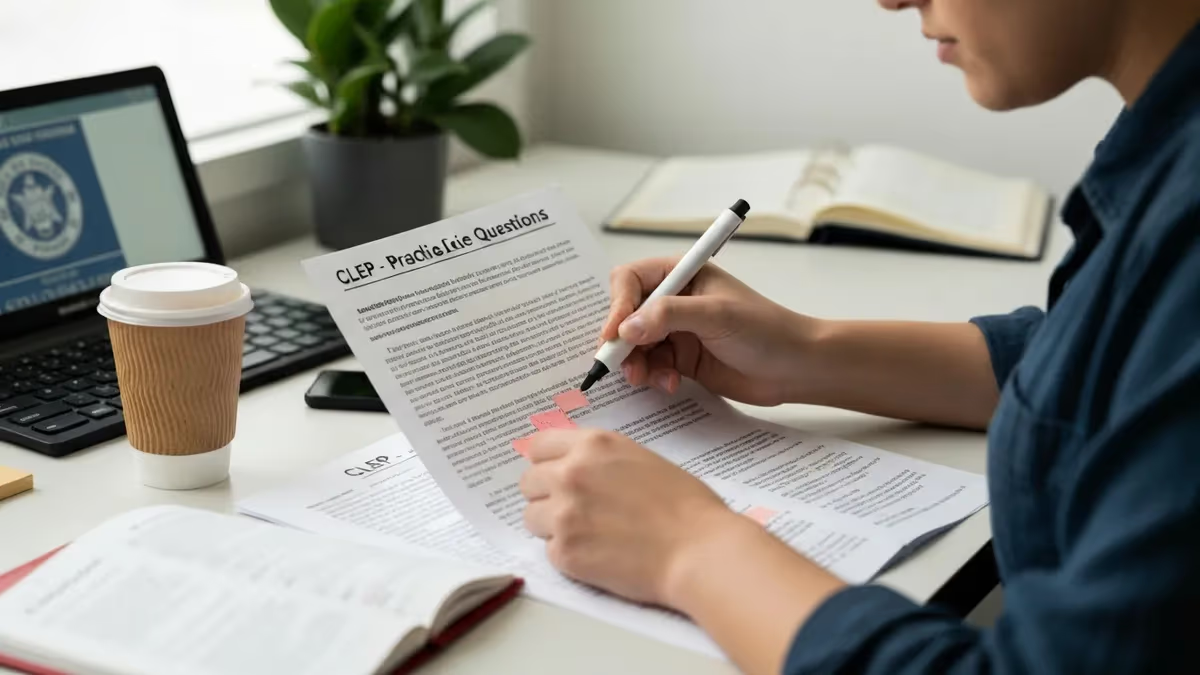
If you are preparing for the US History 2 CLEP practice test, you are already on a smart path toward earning college credit without paying for a full semester of coursework. The CLEP College Board administers this exam as part of its broader suite of 34 subject tests, and US History 2 specifically covers the period from Reconstruction (1865) through the present day. Scoring well means demonstrating deep familiarity with major political movements, wars, social transformations, and economic shifts that define modern American identity. This guide gives you everything you need to walk in confident and prepared.
The CLEP test for US History 2 is one of the most content-heavy exams in the entire program. Unlike narrow subject tests such as CLEP College Algebra or CLEP Exam Spanish, this exam demands that you synthesize over 150 years of American history into a coherent understanding of cause and effect. You will be asked to evaluate primary sources, interpret historical arguments, and connect events across decades. Students who treat it as a simple memorization exercise almost always underperform. Strategic preparation — including timed practice — is the difference between passing and retaking.
Understanding what is clep and how its scoring works is a critical first step before you begin any practice routine. CLEP exams are scored on a scale of 20 to 80, and most institutions require a score of 50 to award credit. However, some selective universities set the threshold at 60 or higher. Before you invest weeks of study time, verify your target school's policy so you know exactly what score you need to achieve. This prevents wasted effort and helps you calibrate your preparation intensity from the very start of your study plan.
The content of US History 2 is divided into several major thematic and chronological units. You will encounter questions about Reconstruction and its political aftermath, the Gilded Age and Progressive Era, both World Wars and their domestic consequences, the Cold War and Civil Rights movement, and post-1970 American politics through the early 21st century. The exam writers deliberately choose questions that test conceptual understanding rather than isolated facts. Knowing that the New Deal passed in 1933 is less valuable than understanding why it represented a fundamental shift in the relationship between the federal government and American citizens.
One of the most effective strategies for CLEP testing is to simulate real exam conditions as early as possible in your preparation. Timed practice tests reveal exactly which historical periods are weakest in your knowledge base, allowing you to reallocate study time before exam day. Students who take at least four or five full-length practice sessions consistently report higher confidence and better time management during the actual exam. This site offers free practice questions organized by topic so you can drill specific eras without committing to a full 120-question session every time.
Modern States CLEP resources have become increasingly popular among self-studiers, offering free video lectures and practice materials for dozens of CLEP subjects including US History 2. Combining Modern States content with dedicated practice tests creates a powerful preparation loop: learn the material through structured video lessons, then immediately test your retention through practice questions, review your errors, and return to the lecture content for targeted reinforcement. This active recall cycle is scientifically proven to produce stronger long-term memory retention than passive re-reading or highlighting alone.
This article walks you through the complete US History 2 CLEP exam format, shares targeted study strategies, provides a realistic study schedule, and explains how to interpret your practice test scores to maximize your final result. Whether you have six weeks or six months before your test date, the framework presented here will help you build a preparation plan that fits your schedule, targets your weaknesses, and gives you the best possible chance of earning the credit hours you need.
US History 2 CLEP by the Numbers
Key Facts at a Glance
| Item | Value | Details |
|---|---|---|
| Total Questions | 120 | Multiple choice format |
| Time Allowed | 90 min | ~45 seconds per question |
| Passing Score | 50 | On a 20–80 scale |
| Exam Fee | $93 | Plus testing center fee |
| Credit Hours Earned | 3–9 | Varies by institution |
US History 2 CLEP Exam Format
| Section | Questions | Time | Weight | Notes |
|---|---|---|---|---|
| Reconstruction & Gilded Age (1865–1900) | 24 | 18 min | 20% | Reconstruction politics, industrialization, immigration |
| Progressive Era & WWI (1900–1929) | 24 | 18 min | 20% | Reform movements, foreign policy, 1920s culture |
| Depression, WWII & Early Cold War (1929–1960) | 30 | 22 min | 25% | New Deal, WWII, Korean War, McCarthyism |
| Civil Rights & Vietnam Era (1960–1980) | 24 | 18 min | 20% | Civil Rights movement, Great Society, Vietnam, Watergate |
| Post-1980 to Present | 18 | 14 min | 15% | Reagan revolution, post-Cold War, 21st century |
| Total | 120 | 90 minutes | 100% |
Mastering the content areas of the US History 2 CLEP exam requires more than surface-level familiarity with textbook chapter titles. The exam writers at the CLEP College Board design questions to reward students who understand historical causation — the why behind events — rather than students who merely memorize dates and names. For example, a question might ask you to evaluate which of four factors most directly caused the failure of Reconstruction, requiring you to weigh political, economic, social, and constitutional variables against each other in real time.
Reconstruction (1865–1877) is arguably the most conceptually complex period on the exam because it involves competing visions of national reunion, the contested meaning of freedom for formerly enslaved people, and the limits of federal power in Southern states.
You should understand the differences between Presidential and Radical Reconstruction, the role of the Freedmen's Bureau, the 13th, 14th, and 15th Amendments, and the emergence of sharecropping and Black Codes as mechanisms of economic and social control. The Compromise of 1877 and the end of Reconstruction are frequently tested in context with the rise of Jim Crow laws and the Supreme Court's decision in Plessy v. Ferguson.
The Gilded Age and Progressive Era represent a period of dramatic economic transformation that exam questions love to connect to contemporary political debates. You must understand how industrialization concentrated wealth, how Populism and later Progressivism attempted to redistribute political and economic power, and how figures like Theodore Roosevelt, William Howard Taft, and Woodrow Wilson translated reform impulses into federal policy. The Sherman Antitrust Act, the Federal Reserve Act, and the ratification of the 16th and 17th Amendments are all key legislative touchstones. Understanding the suffrage movement and its eventual success in 1920 is equally essential for this section.
World War I and its aftermath — including the Treaty of Versailles, the Senate's rejection of the League of Nations, and the Red Scare of 1919–1920 — frequently appear in exam questions that link foreign policy decisions to domestic political consequences.
The 1920s demand particular attention because the exam often tests the cultural contradictions of the decade: mass consumerism and the rise of advertising alongside Prohibition, the Ku Klux Klan revival, and immigration restriction through the Emergency Quota Act of 1921 and the Immigration Act of 1924. The Harlem Renaissance deserves focused study as a cultural and political movement with lasting significance.
The Great Depression and New Deal represent approximately 10–12 questions on the exam, making them among the most heavily weighted subtopics within the 1929–1960 section. You need to understand not just the economic causes of the Depression but also the political philosophy behind FDR's New Deal coalition, the specific programs created (CCC, WPA, Social Security Act, FDIC), and the constitutional tensions these programs created with the Supreme Court. WWII requires attention to both the military campaigns and the home front: rationing, women in the workforce, Japanese American internment, and the Manhattan Project all fall within the exam's scope.
The Civil Rights movement of the 1950s and 1960s is one of the most thoroughly tested periods on the entire exam. You should be able to trace the movement from Brown v. Board of Education (1954) through the Montgomery Bus Boycott, sit-ins, Freedom Rides, March on Washington, Civil Rights Act of 1964, Voting Rights Act of 1965, and the Fair Housing Act of 1968.
Understanding the strategic differences between organizations like SNCC, SCLC, and CORE — and between leaders like Martin Luther King Jr., Malcolm X, and Stokely Carmichael — is essential for answering nuanced questions about movement tactics and ideology.
If you want to know clep exam spanish and other language exam strategies alongside history preparation, you will find that the disciplined reading habits you develop for CLEP US History 2 transfer directly to language-based exams that also require careful interpretation of written passages. The analytical reading skills sharpened by history exam prep — identifying argument structure, evaluating evidence, distinguishing primary from secondary interpretation — are universally valuable across all CLEP subjects and will serve you well throughout your college career and beyond.
Where to Study CLEP Management: Best Resources for US History 2
Modern States CLEP offers a completely free online course for US History 2 that includes video lectures from college professors, reading materials, and practice quizzes. The Khan Academy US History series is another excellent free option, covering the full scope of the exam with short video lessons organized by chronological period. Both platforms allow you to study at your own pace and revisit difficult concepts as many times as needed without any cost.
The College Board's official CLEP website provides a free study guide for every exam, including US History 2, which outlines the exact content areas, approximate question weights, and sample questions. REA's free CLEP practice tests available online are also widely recommended by test-takers who have passed the exam. Combining two or three of these free sources gives you a strong, zero-cost preparation system that rivals expensive commercial prep courses in effectiveness when used consistently over several weeks.

Is the US History 2 CLEP Worth Taking?
- +Earn 3–9 college credit hours for the cost of a single $93 exam fee
- +Skip a required general education course and free up your schedule for major coursework
- +No prerequisite coursework required — anyone can register and sit for the exam
- +Accepted at over 2,900 colleges and universities across the United States
- +Strong self-study resources available including free Modern States CLEP course
- +Passing score of 50 is achievable with 6–10 weeks of consistent preparation
- −Some highly selective universities do not accept any CLEP credits toward degree requirements
- −The 150-year content scope makes this one of the most reading-intensive CLEP exams
- −No partial credit — you must hit the institution's passing threshold to earn any credit
- −Test center availability may be limited depending on your geographic location
- −A retake requires waiting 3 months and paying the full exam fee again
- −Some programs restrict which CLEP exams count toward major or distribution requirements
US History 2 CLEP Practice Test Preparation Checklist
- ✓Take a full diagnostic practice test in week one to identify your weakest historical periods
- ✓Download the official CLEP US History 2 exam guide from the College Board website
- ✓Create a week-by-week study schedule that covers all five content areas before your exam date
- ✓Complete the free Modern States CLEP US History 2 video course from start to finish
- ✓Build a flashcard deck covering key legislation, Supreme Court cases, and political movements
- ✓Practice at least one timed full-length practice test every two weeks throughout your prep
- ✓Review every wrong answer and trace errors back to the specific content gap they reveal
- ✓Study primary source documents including speeches, executive orders, and legislative excerpts
- ✓Confirm your target institution's CLEP credit policy and minimum passing score before exam day
- ✓Schedule your exam appointment at least two weeks in advance to secure your preferred test center

The 50-Point Passing Score Is More Achievable Than Students Think
A score of 50 on the CLEP scale represents roughly 50% correct answers, which means you can pass the US History 2 exam while missing nearly half the questions. This does not mean you should aim for mediocrity — a higher score may be required by your specific institution — but it does mean that even students with significant content gaps can pass with focused preparation on the highest-weighted exam sections. Prioritize the 1929–1960 period (25% of the exam) and Civil Rights Era (20%) to build the fastest point gains.
Understanding how your CLEP practice test scores translate into real exam performance is one of the most important analytical skills you can develop during your preparation period. The CLEP College Board uses a formula that converts your raw score (number of correct answers) into a scaled score between 20 and 80. Because there is no penalty for wrong answers on CLEP exams, you should always answer every question — never leave a blank. Guessing strategically on questions where you can eliminate two or three answer choices improves your expected score significantly compared to leaving items blank.
Many students are surprised to discover that their practice test scores in weeks three and four of preparation are actually lower than their initial diagnostic score. This is a normal and actually healthy sign: it means you are moving into unfamiliar content territory and encountering questions about periods you have not yet reviewed.
The score inflection point typically comes in weeks five and six, when your broadened content knowledge begins integrating into a coherent historical framework that supports more accurate reasoning under time pressure. Trust the process and do not abandon your study plan based on a single discouraging practice session.
Credit policies across American institutions vary more than most CLEP candidates expect. While the American Council on Education recommends awarding credit for a score of 50, individual colleges set their own thresholds. Ivy League and other highly selective institutions frequently decline to accept CLEP credits at all, while community colleges and large state universities are generally the most generous.
Military-affiliated students should note that military branches and the GI Bill program have their own specific policies for CLEP credit recognition that may differ from civilian institutional policies. Always verify directly with your institution's registrar before assuming any credit will be awarded.
The CLEP tests are administered year-round at Prometric testing centers and at many colleges that maintain their own testing facilities. You can also take certain CLEP exams remotely through Prometric's online proctoring service, which expanded significantly during and after the COVID-19 pandemic. Remote testing offers convenience but requires a stable internet connection, a quiet private space, and a compatible computer. Some students find the in-person testing center environment less distracting and actually perform better there despite the added logistical complexity of traveling to a physical location.
One common mistake among CLEP US History 2 candidates is underestimating the post-1980 content section, which covers 15% of the exam. Many students who graduated high school in the 2000s or later have studied the New Deal and WWII extensively but received comparatively little classroom instruction on Reagan-era conservatism, the end of the Cold War, the Clinton and Bush presidencies, or the post-9/11 national security state.
If your textbook knowledge gets thin after 1975, dedicate extra study sessions to reviewing the Reagan Revolution, the Contract with America, the Clinton impeachment, and the domestic and foreign policy responses to September 11, 2001.
The exam also tests historiographical awareness — meaning it occasionally asks you to identify which historical interpretation a given passage represents, or to evaluate competing scholarly arguments about a historical event. For example, a question might present two historians' differing assessments of Reconstruction's failure and ask which factors each emphasizes. This type of question rewards students who have engaged with historical arguments in their study materials rather than just memorizing facts. Reading the introductions and chapter summaries of academic history textbooks — even without reading full chapters — can significantly improve your ability to handle these interpretation-based questions.
Students who have already passed CLEP US History 1 (which covers the colonial period through 1877) have a meaningful advantage on the Reconstruction section of US History 2, since both exams overlap in the 1865–1877 period. If you have not taken CLEP US History 1, you can still master Reconstruction for this exam by focusing on the political and social dimensions of the post-Civil War period without needing to deeply review antebellum history.
The US History 2 exam treats Reconstruction as a starting point rather than requiring deep knowledge of its Civil War context, which means targeted review of the Reconstruction Amendments and their implementation is sufficient for this specific exam.
Not all colleges accept CLEP credits, and those that do often impose minimum score requirements above the standard 50-point threshold — some require 60 or higher. A few institutions cap the total number of CLEP credit hours that can count toward a degree, and some restrict which courses the credits can replace. Contact your institution's registrar or academic advisor before paying the exam fee to confirm that a passing score will actually result in credit hours being applied to your transcript.
Developing an effective daily study routine is the single most powerful thing you can do to maximize your US History 2 CLEP practice test performance. Research on learning science consistently shows that distributed practice — studying for 45–60 minutes per day across multiple weeks — produces stronger retention than marathon cramming sessions the week before the exam.
Create a dedicated study block in your daily schedule, treat it as a non-negotiable appointment, and protect it from interruptions. Even on days when motivation is low, showing up for even 30 minutes of focused review maintains momentum and prevents the knowledge decay that happens during extended breaks from studying.
Active recall is the most effective study technique available to CLEP candidates, and it is dramatically underused by self-studiers who default to re-reading notes or highlighting textbooks.
Active recall means closing your notes and forcing yourself to retrieve information from memory — writing out what you remember about the Progressive Era without looking, explaining the causes of the Great Depression out loud to an imaginary student, or answering practice questions without checking answers until you have committed to a response. The mental effort of retrieval, even when you get the answer wrong, strengthens memory far more powerfully than passive review of material you already know.
Spaced repetition flashcard systems like Anki are particularly effective for the fact-heavy content of CLEP US History 2. You can download pre-made CLEP US History decks from the Anki community or build your own as you study, adding a card for every key term, court case, legislation, or historical figure you encounter.
The Anki algorithm automatically schedules each card for review at the optimal moment — just before you would forget it — which means you spend more time on difficult cards and less time on things you already know solidly. Using Anki for 15–20 minutes daily in addition to your primary study sessions can dramatically accelerate your content mastery without requiring significant additional time investment.
Students who want to know where to study clep management and related quantitative subjects often ask whether analytical skills from math-focused CLEP exams transfer to history exams.
While the content domains are entirely different, the test-taking discipline required for both is remarkably similar: read questions carefully before looking at answer choices, eliminate clearly wrong options before evaluating the remaining ones, manage time to avoid running out before the final questions, and flag difficult questions to revisit rather than spending excessive time on any single item. These universal test-taking habits apply across all CLEP subjects and should be practiced during every timed practice session.
Primary source analysis is a skill the CLEP US History 2 exam tests more heavily than many candidates expect. You may encounter excerpts from presidential speeches, Supreme Court opinions, reform movement pamphlets, political cartoons described in text, or newspaper editorials from various historical periods. The exam will ask you to identify the author's purpose, the historical context of the document, or the argument being made.
Practicing with primary sources from the Library of Congress's online collection, the Avalon Project at Yale Law School, or Digital History builds exactly the close-reading skills these questions demand. Devote at least one study session per week specifically to analyzing two or three primary source documents.
Group study can be highly effective for CLEP US History 2 preparation if structured correctly. Unstructured group sessions that turn into social conversations rarely produce meaningful learning gains. Effective history study groups assign each member a specific historical period to teach to the group, then quiz each other using practice questions.
Teaching a concept to someone else — even a peer who knows nothing about it — forces you to identify gaps in your own understanding with brutal clarity. If you cannot explain the causes and consequences of the Korean War in plain language without consulting your notes, you have not yet mastered that content well enough to answer exam questions about it confidently.
In the final week before your exam, shift from learning new content to reinforcing what you already know. Take one full-length timed practice test three to four days before your exam, then spend the remaining days reviewing your error log, rereading your most important flashcards, and getting adequate sleep.
Sleep is not a luxury during exam prep — it is when your brain consolidates the memories formed during study sessions. Students who sacrifice sleep for last-minute cramming reliably perform worse than students who prioritize eight hours of sleep the night before the exam. Arrive at your testing center early, bring a valid ID, and trust the preparation you have invested over the preceding weeks.
On the day of your US History 2 CLEP exam, your performance will depend on the preparation you have completed in the preceding weeks, but your mental state and physical condition in the final 24 hours also matter significantly. Avoid introducing any new study material the night before the exam — your brain needs time to consolidate existing knowledge, not process new information under stress.
Instead, spend 20–30 minutes lightly reviewing your most important flashcard categories: major legislation, Supreme Court cases, and the chronological sequence of major 20th-century events. Then close your books, eat a good meal, and get to bed at your normal time.
Time management during the exam itself is one of the most commonly cited challenges by CLEP US History 2 test-takers. With 120 questions and 90 minutes, you have an average of 45 seconds per question. In practice, some questions — particularly those involving primary source excerpts or complex historical analysis — require 60–90 seconds of careful reading and reasoning.
This means you need to move quickly through questions you know confidently in order to bank time for the more demanding analytical questions. During your practice tests, deliberately practice skipping questions you find difficult, marking them for review, and returning to them after you have answered everything you are confident about.
The structure of multiple-choice questions on CLEP exams follows predictable patterns that skilled test-takers exploit systematically. The four answer choices are typically designed so that two are clearly wrong, one is plausible but subtly incorrect, and one is clearly right. Train yourself to identify the two obviously wrong answers first, then focus your reasoning on distinguishing the plausible incorrect answer from the correct one.
Plausible but wrong answers often contain partially accurate information, conflate two different historical events, or use correct facts to support incorrect conclusions. Recognizing these patterns through extensive practice is itself a trainable skill that improves your performance independent of content knowledge.
After your exam, the CLEP College Board will typically provide unofficial score results immediately at the testing center. Official scores are sent directly to the institution or institutions you designated during registration within two to three weeks. If you did not designate an institution before the exam, you can send scores to up to four institutions free of charge.
Additional score reports beyond the four free ones require a fee. Save your official score report when you receive it, as some institutions require you to submit it directly to the registrar rather than waiting for electronic score transfers from the College Board.
If your score falls short of your institution's passing threshold on the first attempt, take the experience as data rather than defeat. Review the content area breakdown on your score report — the CLEP College Board provides performance subscores by content area for US History 2, showing whether you underperformed in specific historical periods. Use this breakdown to design a targeted remediation plan before your next attempt. The mandatory three-month waiting period between attempts gives you time to significantly strengthen your weakest areas rather than retaking the exam with the same preparation gaps that caused the initial shortfall.
Consider whether a commercial prep course or working with a history tutor might bridge any specific gaps you identify from your score report. While self-study is sufficient for most students, some learners benefit significantly from the structured accountability and personalized feedback that a tutor or organized course provides. Many tutors who specialize in CLEP preparation are available online at hourly rates that remain far below the cost of a full college course, making targeted tutoring a cost-effective option even for students who are otherwise committed to self-directed study.
Finally, remember that passing the US History 2 CLEP exam is not just about saving money — though the financial benefit is real and substantial. Every credit hour you earn through CLEP testing is a credit hour you can invest in coursework that genuinely interests you, in a lighter semester that gives you space to pursue internships or research opportunities, or in an accelerated graduation timeline that reduces your overall student loan burden.
The discipline, analytical thinking, and synthesis skills you develop while preparing for this exam are themselves valuable intellectual habits that will serve you throughout college and professional life. Approach your preparation with that broader purpose in mind, and the individual study sessions will carry more meaning and motivation than if you view the exam as merely a hurdle to clear.
CLEP Questions and Answers

CLEP Precalculus Study Guide: Everything You Need to Pass in 2026

What Is CLEP? The College-Level Examination Program Explained (2026)

Biology CLEP Practice Test: Free Questions, Format Breakdown & Study Strategy (2026)

CLEP Classes: Best Free and Paid Courses to Pass Your Exam

CLEP Calculus Practice Test: Your Complete Guide to Passing the Exam
About the Author

Educational Psychologist & Academic Test Preparation Expert
Columbia University Teachers CollegeDr. Lisa Patel holds a Doctorate in Education from Columbia University Teachers College and has spent 17 years researching standardized test design and academic assessment. She has developed preparation programs for SAT, ACT, GRE, LSAT, UCAT, and numerous professional licensing exams, helping students of all backgrounds achieve their target scores.