
FMCSA CDL Program Oversight Audit: How States Are Reviewed 2026 September
How FMCSA audits state CDL programs under 49 CFR 384 — 🎓 testing, ELDT, third-party oversight, MCSAP funding, and corrective actions.

Behind every commercial driver's license sits a quiet enforcement machine — and most drivers never see it. The Federal Motor Carrier Safety Administration runs an ongoing oversight program that audits how each state issues, tests, and tracks CDL applicants.
It's not glamorous work. But it's the reason a CDL from Maine carries the same weight as one from Arizona. And it's why an employer in Texas can hire a driver from Ohio without doing weeks of background verification just to confirm the license is real.
You might think state driver licensing is purely a state matter. Not quite. Under 49 CFR Part 384, every state that issues commercial driver's licenses agrees to follow federal minimum standards.
FMCSA — the federal agency that wrote those standards — has the authority to check the work. Regularly. Thoroughly. Sometimes uncomfortably. State officials describe these reviews in measured tones, but anyone who's sat through one will tell you they're intense.
This article walks through what an FMCSA CDL program oversight audit actually involves, why it matters to drivers, and how states respond when auditors find problems. If you're studying for a CDL, working as a third-party tester, or running a commercial driving school, this is the regulatory scaffolding holding it all up.

FMCSA CDL Oversight at a Glance
Let's set the stage. The Commercial Motor Vehicle Safety Act of 1986 created the unified CDL system we use today. Before that act, drivers could legally hold licenses in multiple states — a loophole that let unsafe drivers dodge suspensions by simply applying somewhere else. A trucker disqualified in Florida could resurface a week later in Georgia, carrying a clean new license and the same risky habits. Congress closed the door. Now there's one driver, one license, one record.
But making that system work requires every state to play by the same rules. FMCSA's State Compliance Program — sometimes called the CDL Program Compliance Review or just "the audit" — is how the federal government verifies that states actually do what they've promised. Auditors arrive with checklists. They pull files. They watch knowledge tests being administered. They sit in pickup trucks and observe skills exams. They cross-reference databases. And they write findings.
Each audit produces a paper trail that follows the state for years. Previous findings get reopened during the next review. Promises made in Corrective Action Plans get checked against actual implementation. Auditors talk to each other — and to OIG investigators — across state lines. The institutional memory is long, and that's by design.
Why the audit exists
Federal funding follows federal compliance. States receive Motor Carrier Safety Assistance Program (MCSAP) grant money each year to enforce trucking safety. Part 384 ties that funding directly to CDL program integrity — so a state that ignores ELDT, sloppily administers skills tests, or loses control of third-party testers can see millions in federal dollars withheld. The audit is the verification mechanism that makes the funding consequence real, and it's why state licensing agencies treat the review week with genuine seriousness.
So what does an auditor actually look at? More than you'd expect. The review covers seven broad areas, and within each one are dozens of sub-checks. Auditors verify that knowledge tests come from the AAMVA test pool — or an FMCSA-approved equivalent — and that the state hasn't quietly substituted easier questions to boost pass rates.
They confirm skills tests follow the standardized procedures laid out in the CDL Skills Test Examiner Manual. They check that examiners themselves are trained, certified, and recertified on schedule. They time pre-trip inspections. They watch how examiners score backing maneuvers. They count the number of road-test scoring items used against the federal minimum.
Then there's recordkeeping. Every CDL application, medical certificate, self-certification, conviction, and disqualification has to land in the state's driver record. And that record has to talk to the Commercial Driver's License Information System (CDLIS) — the national network that prevents drivers from holding licenses in multiple states. If a state's data doesn't sync with CDLIS, FMCSA notices. Auditors run sample queries during the visit, pulling random driver records and comparing the state-side data against the CDLIS-side data. Discrepancies become findings. Patterns of discrepancies become substantial findings.
What FMCSA Auditors Review
Knowledge and skills tests must follow federal protocols set out in the CDL Skills Test Examiner Manual. Auditors observe live exams, review examiner certifications, sample test results for statistical irregularities like suspiciously high pass rates, and check that test routes meet federal complexity standards.
Since February 2022, all new Class A, Class B, and certain endorsement applicants must complete Entry-Level Driver Training from a provider listed on the federal Training Provider Registry. States must verify completion electronically before issuing licenses, and auditors check those verification logs against driver records.
States that delegate skills testing to private companies must conduct annual audits of those testers — observing live tests, sampling files, and reviewing pass-rate data. FMCSA then audits the state's audit program. It's oversight of oversight, designed to catch fraud schemes that have surfaced in past decades.
Driver records, test scores, and CDLIS uploads all need secure handling. Auditors review access controls, multi-factor authentication, audit logs, fraud detection systems, and incident response plans. Legacy systems running outdated code create repeat findings that can take years to fully remediate.
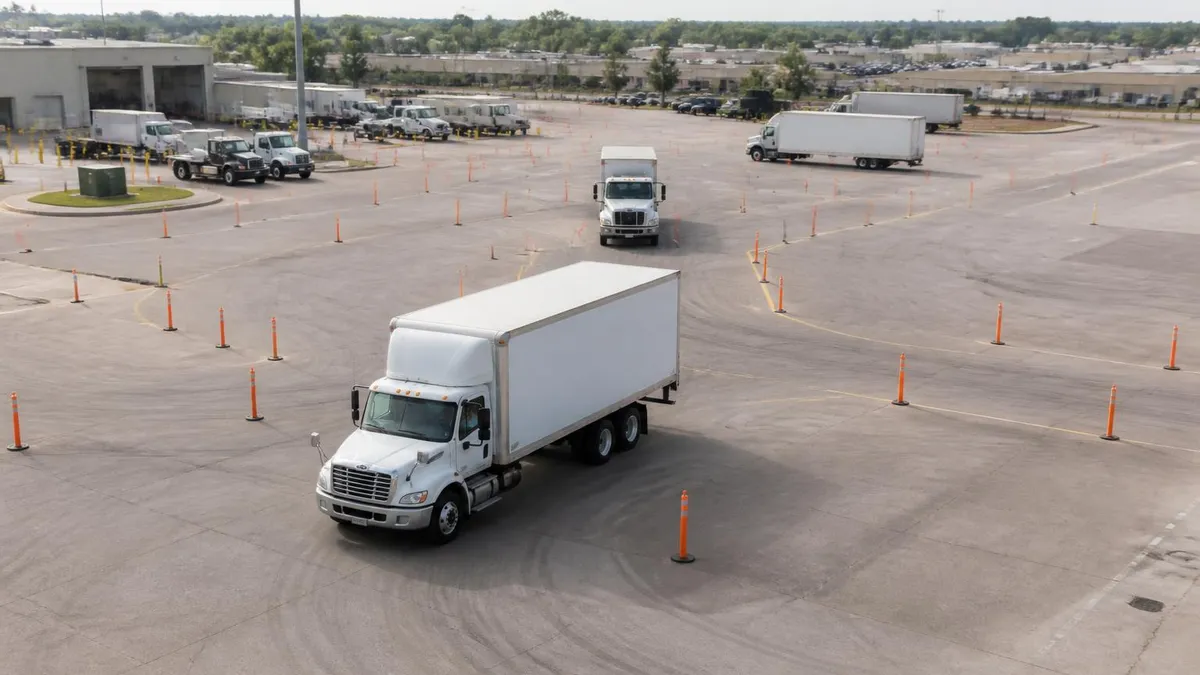
Third-party testers deserve their own paragraph because they cause a disproportionate share of audit findings. Many states don't have the staff to run every skills test in-house, so they certify private companies — usually trucking schools or owner-operated examiners — to administer tests on the state's behalf. It's a sensible arrangement. It can also go wrong fast. The economic incentive isn't aligned: a third-party tester gets paid per test, but their reputation depends on customers passing. That tension shows up in audit findings year after year.
FMCSA expects states to audit each third-party tester at least once a year, observe a sample of tests being conducted, and pull random files to confirm the paperwork matches reality. When that doesn't happen — and historically, it sometimes hasn't — you get the kind of integrity problems that make headlines. Drivers passing tests they never took.
Examiners signing off on skills they never observed. Whole cohorts of fraudulent CDLs entering the workforce. FMCSA's response has been to tighten the third-party oversight rules and audit the states' audits more aggressively. Some states have lost their authority to use third-party testers entirely after repeat failures.
How a State Compliance Audit Unfolds
The cycle runs roughly every three years, though FMCSA can — and does — schedule interim reviews when a state shows warning signs. Repeat findings. Whistleblower complaints. Fraud indictments. Statistical anomalies in pass rates. Any of those can pull a state into an off-cycle audit. And the agency doesn't hide that authority. It uses it. In years where a particular issue spikes nationally — say, ELDT compliance after the 2022 rule took effect — FMCSA may also conduct focused thematic reviews across multiple states simultaneously, comparing how each handles the same regulatory question.
For drivers, all of this happens in the background. You show up at a CDL testing center, pass your knowledge test, take your skills exam, and walk out with a license. You don't see the examiner's certification file. You don't see the third-party tester's annual audit report. You don't see the CDLIS upload confirmation. But every one of those pieces had to exist, in the right form, at the right moment, for your license to be valid under federal law. The audit is what makes that quietly true.
One small but important detail — auditors don't only review documents. They observe. They watch. A federal auditor will sit in on a live skills test, clipboard in hand, comparing what the examiner does against what the examiner is supposed to do. Did the examiner check the applicant's medical certificate before starting? Did the pre-trip inspection follow the federal sequence? Did the road test cover all the required maneuvers in the right driving environments? Those observation findings carry weight, because they capture how the program actually runs day to day — not just how it looks on paper.
When FMCSA finds substantial non-compliance, the agency can withhold up to 5% of a state's MCSAP basic and incentive grants in year one — and up to 10% in subsequent years if problems persist. For large states, that's millions of dollars annually. The threat alone tends to focus attention quickly, and most states resolve substantial findings well before the second-year withholding penalty would kick in.
Let's talk about ELDT — the Entry-Level Driver Training rule — because it's reshaped audit findings since it took effect in February 2022. Before ELDT, training requirements were a patchwork. Some states required formal classroom and behind-the-wheel hours. Others let applicants walk in and test cold. The federal rule ended that. Now every first-time Class A, Class B, and certain endorsement applicants must complete training from a provider listed on FMCSA's Training Provider Registry. The curriculum is defined federally. The instructor qualifications are defined federally. The recordkeeping format is defined federally.
The Registry isn't optional. It's a database, run by FMCSA, that tracks every approved training provider and every training completion certificate they issue. When a state issues a CDL, it has to verify — electronically — that the applicant's training record exists in the Registry. No record, no license. Auditors check this verification process closely.
Did the state's IT system actually query the Registry? Did it block applicants who lacked training? Did anyone override the block manually? Did the override get documented and justified? Those questions sit at the center of modern audits, and they generate more findings than almost any other category right now.
ELDT also created a new oversight burden on training providers themselves. Provider records are subject to federal audit. Instructor credentials must be documented. Behind-the-wheel hours must be logged accurately. Curriculum coverage must match the federal Appendix A through G specifications. When FMCSA reviews a state, it samples training provider files too — pulling random certificates, comparing them against actual training records, and verifying that nothing got fabricated to push a student through faster than the rule allows. It's a layered review, with each layer accountable to the next.
State CDL Compliance Checklist
- ✓Verify every CDL applicant against the federal Training Provider Registry before allowing the knowledge or skills test to proceed
- ✓Maintain examiner certifications and document recertification training on the defined federal schedule with retained completion certificates
- ✓Conduct annual on-site audits of every third-party skills test provider operating in the state, including live test observation and file sampling
- ✓Upload all CDL transactions — applications, conviction records, disqualifications — to CDLIS within the federally required timeframe
- ✓Retain testing records, medical certificates, self-certifications, and audit working papers per the Part 384 retention requirements
- ✓Implement automated fraud detection — covering suspicious pass rates, examiner-level anomalies, file irregularities, and improbable testing patterns
- ✓Submit Corrective Action Plans within FMCSA's deadline and follow through on every milestone with timely status updates to federal regulators
IT security plays a bigger role than you might guess. CDL records are sensitive. They include medical information, social security data, driving histories, and conviction records. A breach isn't just embarrassing — it's a federal compliance failure. Auditors review the state's access controls, audit logs, multi-factor authentication, and incident response procedures. Some states have learned the hard way that legacy mainframe systems running 1990s-era code don't meet modern federal expectations. Migrating those systems is expensive and slow. But the alternative is repeat findings — and eventually, funding consequences.
Integrity reviews go further than IT. Auditors examine pass-rate statistics by examiner — looking for outliers who pass everyone, or examiners whose results don't match what their peers see. They review complaint logs. They interview former employees when allegations surface. And in cases of suspected fraud, they coordinate with the Department of Transportation Office of Inspector General, which has criminal investigative authority. People have gone to prison over CDL fraud schemes uncovered through these reviews. Examiners. Third-party tester owners. In a few cases, mid-level state employees who took bribes to pass unqualified applicants.
FMCSA CDL Audit Pros and Cons
- +Audits create real funding consequences — states have to maintain testing integrity or lose federal MCSAP money
- +Nationwide standards mean a CDL from any state carries the same regulatory weight on every interstate highway
- +Third-party tester oversight catches fraud schemes that would otherwise produce unsafe drivers in commercial fleets
- +ELDT verification prevents untrained applicants from slipping through state-level gaps and reaching the road too early
- +Corrective Action Plans force structural improvements with documented milestones, not just temporary one-off fixes
- −Audits add administrative burden on state licensing agencies already stretched thin with day-to-day workloads
- −Compliance costs can fall on small third-party testers and training providers without significant federal offsets
- −Three-year cycles sometimes miss emerging problems that develop and grow between scheduled federal visits
- −Funding withholding hurts state enforcement budgets — which can indirectly affect highway safety in the short term
- −Documentation requirements can slow legitimate applicants when state IT systems break down or back up
What happens when a state fails badly? It's rare for FMCSA to fully decertify a CDL program — that would mean license holders from that state couldn't legally operate commercial vehicles across state lines, which is an enormous economic hit. So the agency typically uses a graduated response. First comes the written finding. Then partial funding withholding. Then larger withholding. Then formal decertification proceedings, which involve public comment periods and federal notice in the Federal Register. The process is slow on purpose — designed to give states every opportunity to correct course before consequences become catastrophic.
States that face that pressure usually move fast. They restructure their licensing divisions. They terminate problem third-party testers. They invest in new IT systems. They hire compliance officers. And they submit detailed Corrective Action Plans with month-by-month milestones — because FMCSA tracks each milestone and reports publicly on progress. Some states publish their own quarterly compliance reports, partly for transparency and partly to show federal regulators they're taking the work seriously. It's a kind of regulatory theater, but the theater has substance behind it.
There's also a feedback loop worth mentioning. Findings from one state's audit often inform the audit protocol used in the next state's review. If auditors discover a new kind of fraud scheme — say, a third-party tester gaming the GPS records used to verify skills test routes — FMCSA updates its checklist nationally. Every state then gets reviewed against the new standard during their next cycle. The system learns, slowly but steadily, from each thing it catches.
For you, the takeaway is straightforward. The CDL you're working toward sits inside a federal compliance framework that auditors check, document, and enforce. When you study the AAMVA test pool, you're studying questions vetted at the federal level. When your training provider issues an ELDT certificate, that record lands in a federal database.
When your examiner certifies your skills test, that certification can be reviewed by federal auditors years later. The system isn't perfect — no regulatory system is — but the oversight machinery is real, active, and well-funded. It deserves a moment of respect, even from people who'll never directly interact with it.
And while audit cycles run on a three-year baseline, the agency reserves the option to drop in unannounced. Some reviews start with a phone call on a Monday morning and end with auditors in the licensing office by Wednesday. States that have been through that experience tend to invest more heavily in continuous compliance — running their own internal mini-audits monthly, cleaning up findings before federal reviewers arrive, and treating MCSAP funding as something to be earned, not assumed.
A final note for anyone working inside the system — examiners, school operators, third-party testers, state licensing staff. Audits aren't traps. They're checklists. FMCSA publishes its review criteria, posts findings reports on its website, and runs training sessions for state staff. If you're operating a CDL training school or a third-party testing operation, you can read the same procedural manuals the auditors use. Compliance is achievable. It just takes attention — and a willingness to document what you do, when you did it, and who signed off.
One pattern worth noting: states that perform best on audits tend to invest in internal compliance staff. They hire dedicated examiners just to monitor their own examiners. They run shadow audits between federal reviews. They build dashboards that flag suspicious testing patterns in real time — examiner pass rates, third-party tester complaint volumes, ELDT verification failures, CDLIS sync errors. None of that's federally mandated. But the states that do it sail through audits with minor findings, while states that don't get hit with the substantial findings that trigger funding consequences.
And if you're a driver waiting on your license, knowing that this oversight exists should give you a small dose of confidence. The CDL you earn isn't just a state document. It's a federally backed credential, audited regularly, tied to a national database, and enforced through real funding consequences. That's why it works — and why it's worth taking seriously when you study. Take practice tests.
Read the manual. Understand the rules behind the rules. The system was built to mean something, and the audit program is what keeps it meaning something year after year. Whether you're behind the wheel or behind a state desk, the same federal oversight shapes the credential — and that shared standard is exactly why a CDL carries the weight it does on every interstate highway in the country.
CDL Questions and Answers
About the Author
Licensed Driving Instructor & DMV Test Specialist
Penn State UniversityRobert J. Williams graduated from Penn State University with a degree in Transportation Management and has spent 20 years as a certified driving instructor and DMV examiner consultant. He has personally coached thousands of applicants through written knowledge tests, skills assessments, and commercial driver licensing programs across more than 30 states.
Join the Discussion
Connect with other students preparing for this exam. Share tips, ask questions, and get advice from people who have been there.
View discussion (7 replies)