
CDL California: Complete Requirements and Application Guide 2026 September
CDL California guide: 🏆 classes A/B/C, age rules, DMV steps, knowledge & road tests, ELDT, medical exam, endorsements, fees, and rejection pitfalls.
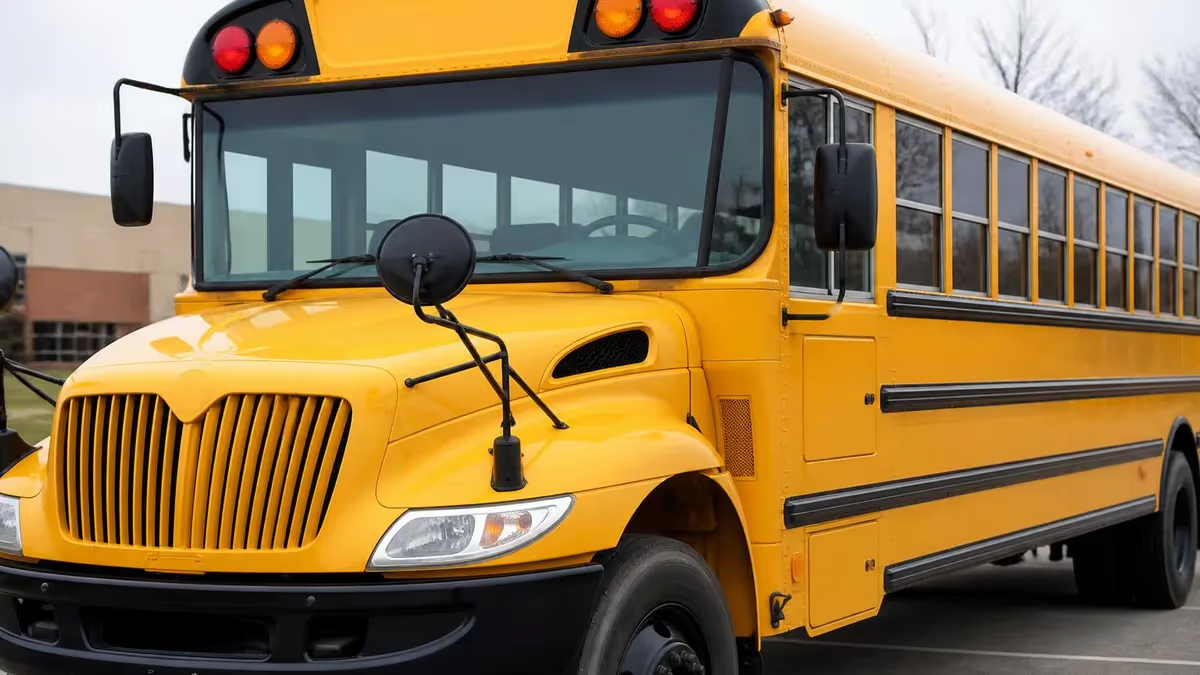
California runs the largest commercial driving operation in the United States, and the rules feel that way too. Getting a CDL California credential isn't just paperwork — it's a layered process involving the DMV, federal training providers, a medical examiner, and sometimes the California Highway Patrol. The state moves a staggering volume of freight every day across ports, distribution hubs, and interstate corridors, which means examiners have plenty of practice spotting weak applicants. You don't want to be one of them.
Here's the good news. The path is well-mapped. If you understand what each step demands before you start, you can move from applicant to licensed driver in a matter of weeks rather than months.
This guide walks you through the classes, the age limits, the eligibility checklist, the testing sequence, the medical card, the ELDT requirement, the fees, and the small details that trip up first-timers — like Self-Certification and bringing your own truck to the road test. Read it once before you start. Then keep it open as you go. The applicants who breeze through are the ones who treat the process like a project, not a series of surprises.
One more thing to set expectations. California's CDL system blends federal Department of Transportation rules with state-specific extras — emissions compliance, third-party testing options, and CHP oversight on certain endorsements. Other states are simpler. California isn't. But the upside is that a California-issued CDL is respected everywhere, and the testing is rigorous enough that employers tend to trust new hires from in-state schools more than they trust quick-mill credentials issued elsewhere. That reputation is worth something on day one of your career.
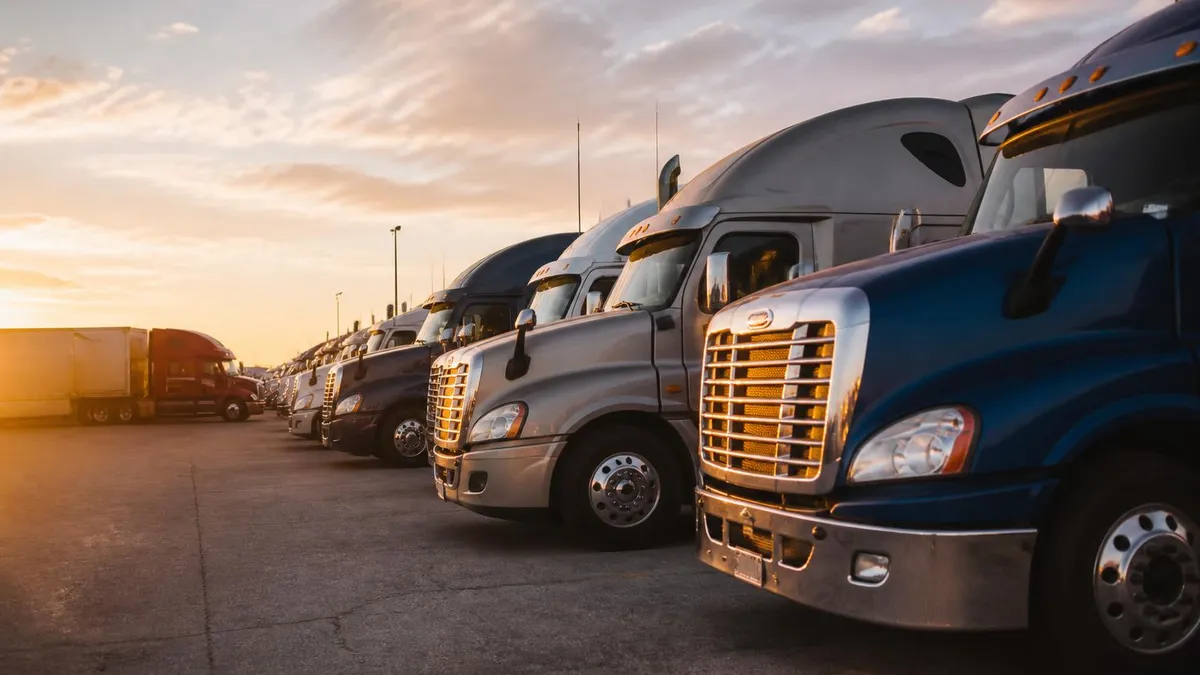
California CDL by the Numbers
California issues three commercial license classes, and the one you need depends entirely on what you plan to drive. Class A covers any combination of vehicles with a gross combination weight rating above 26,000 pounds when the towed unit is heavier than 10,000 pounds — think tractor-trailers, doubles, and triples. Class B is for single vehicles over 26,000 pounds, plus buses, dump trucks, and segmented platform haulers.
Class C, in the commercial sense, isn't your regular driver's license — it's for vehicles carrying 16 or more passengers (including the driver) or transporting hazardous materials in placardable amounts. Yes, the naming overlap is confusing. Yes, you'll explain it to friends and family more than once.
Picking the wrong class is the most common opening mistake. Drivers assume Class A is always the move because it's the broadest, but that's only true if you actually need to pull combination units. Class B holders can run buses, garbage trucks, and most straight trucks without ever touching a fifth wheel. Match the credential to the job. Don't pay for testing you'll never use.
Worth noting too — your Class affects which knowledge tests you'll take, which endorsements are available, and which type of vehicle you need to bring to the road test. Upgrading later is possible but means re-doing portions of the process. So if you're undecided between A and B, lean A. The extra cost up front beats the rework cost six months in.
Intrastate vs Interstate Age Rules
You can apply for a California CDL at 18, but you're restricted to intrastate driving — meaning everything stays inside California's borders. The moment you cross a state line for commercial purposes, federal rules kick in and you must be 21. Hazmat endorsements also require age 21 minimum. Plan your timeline around the work you actually want.
Before you even fill out a form, run yourself through the eligibility checklist. California wants four things confirmed up front: you're a state resident with a verifiable address, you've held a valid Class C (regular) driver license for at least one year, you can read and speak English well enough to understand traffic signs and communicate with officers and inspectors, and you can produce REAL ID-compliant proof of identity.
That last one matters more than people think — federal law now requires REAL ID verification for any commercial credential, and showing up with the wrong documents costs you a wasted DMV appointment.
Beyond those four, you'll need a clean enough driving record to satisfy the DMV. Recent DUIs, license suspensions in any state, or a pattern of moving violations can all kill your application. So can certain criminal convictions, especially anything involving drugs or violence, if you're chasing a hazmat endorsement. Pull your own MVR before you spend a dime. If something's there you didn't expect, deal with it first. The DMV will pull it anyway — there's no value in being surprised.
English proficiency is sometimes underestimated as well. The standard isn't fluency. It's whether you can read road signs, understand verbal instructions from an officer, and complete a logbook in English. If you're a non-native speaker, study the California Commercial Driver Handbook in English even if you've also got a translated copy. The skills test is conducted in English, full stop.
Four Steps to Your California CDL
Complete federally-required Entry-Level Driver Training through an FMCSA-listed provider. Gather REAL ID documents, proof of residency, and your current Class C license.
Visit a CDL-issuing DMV office, complete form DL 44C, pay fees, pass vision screening, and take the General Knowledge plus class/endorsement written tests.
Pass the DOT physical with a certified medical examiner, then submit your Medical Examiner's Certificate and complete Self-Certification at the DMV.
Schedule the three-part skills exam — pre-trip inspection, basic control, and on-road driving — using a vehicle that matches your target class. Pass and your CDL is issued.
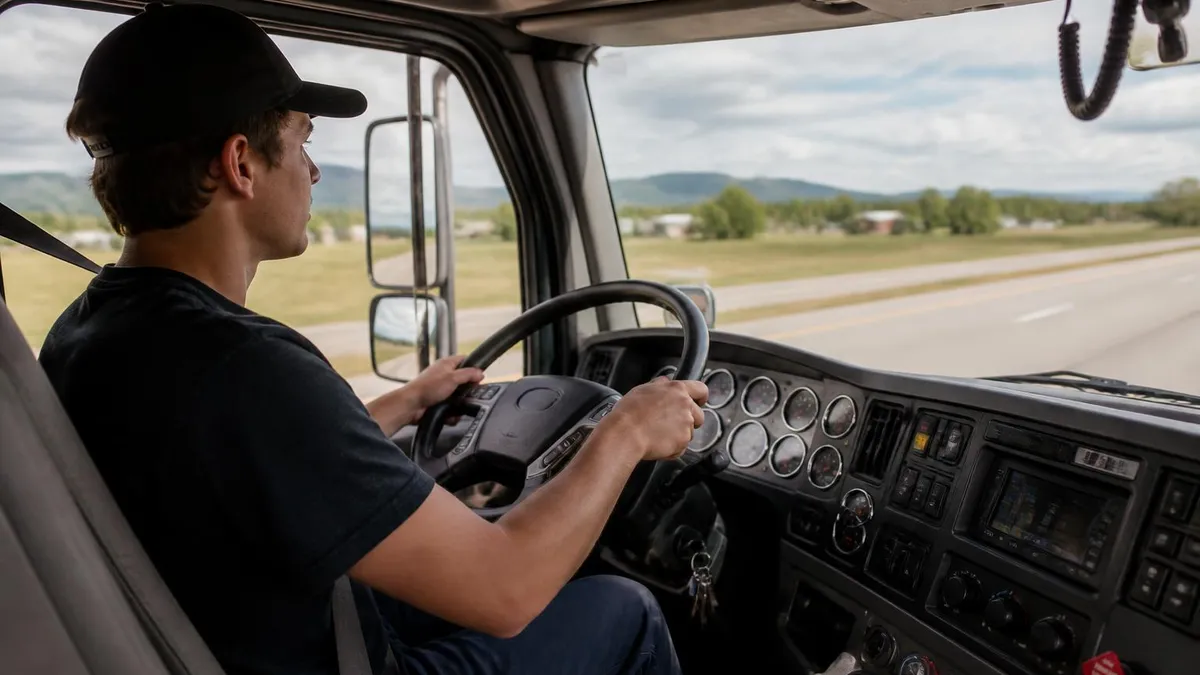
The DMV application itself is straightforward — until it isn't. You complete form DL 44C in person at a CDL-issuing office, pay the base fee (currently $66 for the application and one initial test attempt), submit your medical examiner's certificate, and choose your Self-Certification category. That last selection determines which federal medical rules apply to you, and changing it later is a hassle. Most drivers select Non-Excepted Interstate, which is the strictest category and gives you maximum flexibility. Pick wrong and you may have to redo paperwork. Read the four options carefully on the DMV's website before you walk in.
After paperwork, you'll do a vision screening and a thumb print. The clerk hands you the appropriate written tests based on your class and endorsements. California uses computer-based testing at most offices, so results are instant. Pass the General Knowledge and your class-specific tests, and you receive a Commercial Learner's Permit (CLP) on the spot. You must hold the CLP for at least 14 calendar days before you're eligible to take the skills test — that's a federal floor, not a state suggestion. Use that window to log behind-the-wheel hours with a licensed CDL holder beside you.
Inside the California CDL Skills Test
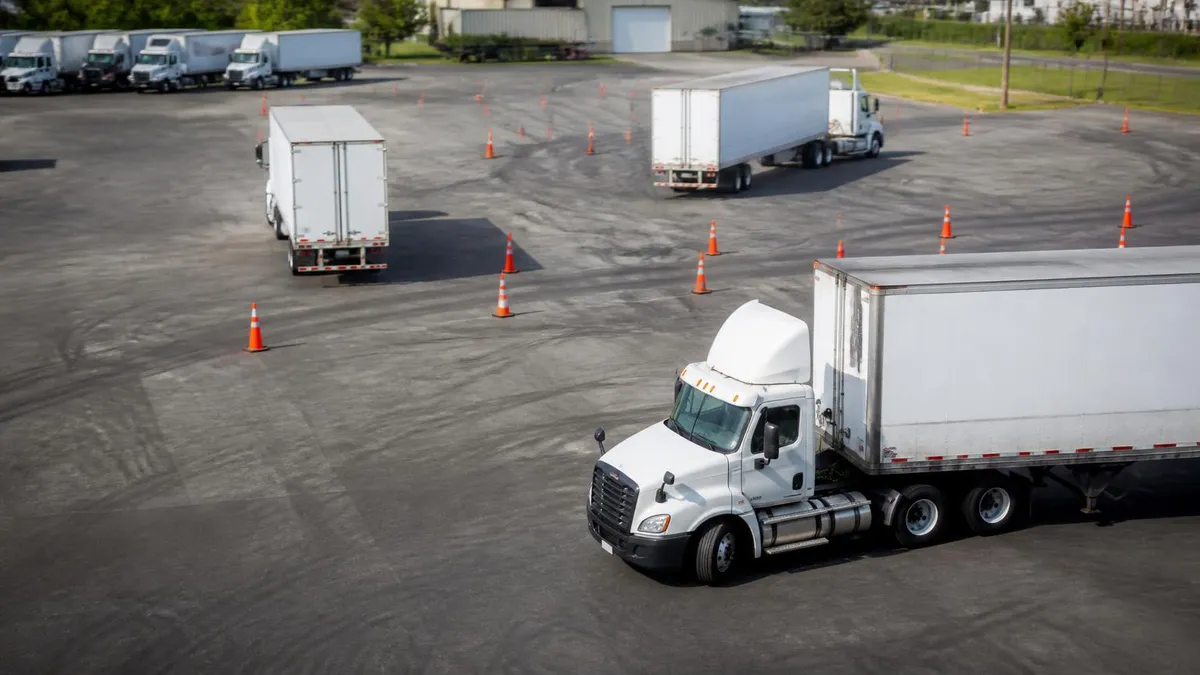
The road test is where most California applicants get tripped up, and the reason is almost always equipment. California requires you to bring your own vehicle to the skills exam, and it must match the class and configuration of the license you're seeking. Want a Class A with air brakes? Bring a combination unit with air brakes. Show up with the wrong configuration and you'll be sent home without testing. The vehicle also needs current registration, valid insurance, and a recent inspection — examiners check, and they don't bend on this.
This is why most candidates partner with a CDL school or their future employer for the road test. Schools rent out test-ready vehicles by the half-day. Employers often let new hires test in the truck they'll actually drive, which has the side benefit of letting you practice on familiar equipment. Either way, plan this part early — vehicle access is what determines your real timeline, not DMV scheduling. If you're going through a school, ask about their test pass rates before signing the contract. Schools with strong rates are worth a few hundred extra dollars.
One overlooked detail: your test vehicle must be in good mechanical order. If the examiner finds defects during the pre-trip — leaking air lines, broken lights, worn tires — they can refuse to start the test. That counts against your attempt count even though you never drove. Inspect the truck the day before your scheduled test the same way you'd inspect it for the exam itself. Fix anything questionable. Don't gamble.
Every CDL holder must pass a Department of Transportation physical performed by a certified medical examiner listed on the FMCSA National Registry. The exam covers vision, hearing, blood pressure, urinalysis, and a full health history review. Your Medical Examiner's Certificate is valid for up to 24 months — sometimes less if you have a managed condition like hypertension or sleep apnea. Lose the card and your CDL goes downgraded immediately.
Entry-Level Driver Training — ELDT for short — became federal law in February 2022, and it changed how new CDL applicants prepare. Before you can take the skills test for a Class A or B license (or add a P, S, or H endorsement), you must complete training with a provider listed in the FMCSA Training Provider Registry. The curriculum is split into theory and behind-the-wheel hours. There's no fixed minimum number of clock hours for the BTW portion, but you must demonstrate proficiency across every required topic.
Choose your ELDT school carefully. California has dozens of registered providers ranging from community colleges to private CDL schools to employer-run academies. Prices vary wildly — anywhere from a few hundred dollars for theory-only refresher courses to $7,000+ for full four-week immersion programs.
Cheaper isn't always worse, but make sure the school includes pre-trip instruction and gives you actual seat time. ELDT certificates from non-registered providers are worthless. Verify the provider's listing on the FMCSA site before you pay. Print the listing page. Keep a copy of your certificate of completion and a copy in your phone — the DMV won't issue your CDL without it.
Some employers pay for ELDT in exchange for a contract commitment, typically one to two years of service. Read those contracts carefully. They're usually fine, but quit early and you may owe a prorated repayment. Veterans should also check whether the GI Bill covers their chosen school — many registered California providers are VA-approved, which can wipe out your tuition entirely.
California CDL Document Checklist
- ✓Valid California Class C driver license held for at least one year
- ✓REAL ID documents: passport, birth certificate, or other federally accepted identity proof
- ✓Two recent proofs of California residency (utility bill, lease, bank statement)
- ✓Completed and signed ELDT certificate from an FMCSA-registered provider
- ✓Current DOT medical examiner's certificate (within last 24 months)
- ✓Social Security number verification — card or W-2
- ✓Application fee of $66 plus any endorsement or test retake fees
California offers six standard endorsements, and choosing them comes with real consequences. The P endorsement covers passenger vehicles — anything carrying 16 or more people. School bus drivers also need the S endorsement on top of P, plus a federal background check. T covers doubles and triples, common in long-haul work. N is for tank vehicles carrying liquids or gases in bulk. H is hazardous materials, which requires fingerprinting and a TSA security threat assessment. X is the combined hazmat and tank endorsement — useful if you'll haul fuel.
Each endorsement has its own written test, and most carry additional restrictions or renewals. Hazmat is the most demanding: TSA processing typically takes 4-6 weeks, costs around $87 in federal fees, and must be renewed every five years. P and S require behind-the-wheel testing in the appropriate vehicle type.
School bus drivers also need a separate CHP school bus certificate beyond the DMV credential — yes, two agencies, two processes. Plan for it. Many veteran drivers stack endorsements over the first few years of their career, since each one expands the kinds of routes you can run and tends to bump your pay rate.
If you're brand new and not sure which endorsements to chase, talk to recruiters at three or four California carriers before you commit. Some are desperate for tanker drivers. Others want hazmat-X for fuel routes. A few hour-long calls can save you from spending hundreds on the wrong combination of credentials, and recruiters will tell you exactly what pays best in your region right now.
California CDL Pros and Cons
- +Strong job market — California freight demand is consistent year-round
- +Higher pay than most non-commercial driving careers, especially with endorsements
- +Clear path to self-employment as an owner-operator once licensed and experienced
- +Transferable credential — your CDL works in every other state with minor paperwork
- +Multiple specializations available through endorsements and equipment certifications
- −Up-front costs run $3,000-$8,000 once ELDT, fees, medical, and testing are totaled
- −DOT physical disqualifies drivers with uncontrolled medical conditions
- −Long timeline — 14-day CLP holding period plus medical and scheduling delays
- −California's traffic and emissions rules make in-state work harder than other states
- −Lifestyle impact for long-haul work — extended time away from home is normal
Applications get rejected for predictable reasons. The biggest culprit? Self-Certification confusion. Drivers walk in not knowing which of the four federal categories applies to them — Non-Excepted Interstate, Excepted Interstate, Non-Excepted Intrastate, or Excepted Intrastate — and either guess wrong or fail to certify at all. No certification on file means no CDL, full stop. Pick the right one based on the work you'll actually do, and update it whenever your situation changes.
Other common rejections: expired medical cards, missing ELDT certificates, mismatched documents (your name on the DMV file doesn't match your Social Security record), and failing the vision screening without bringing corrective lenses. A small percentage of applicants also fail the road test more than three times in a single application cycle — at that point you're often required to retrain before re-testing. If you've been turned away, ask the clerk for the specific reason in writing. That document tells you exactly what to fix before your next attempt.
Third-party testers are an option many California applicants overlook. The DMV authorizes certain CDL schools and employers to administer the skills test on its behalf, which can shave weeks off your wait time when DMV appointments are backed up. The catch — third-party tests still need to be reported and verified by the DMV, and not every endorsement is available through them. Ask the school upfront whether they're DMV-certified third-party testers and what classes they cover.
The California Highway Patrol plays a role that surprises new drivers. While the DMV issues your CDL, CHP runs commercial vehicle enforcement on California roads — weigh stations, brake inspections, log audits, and the school bus certification program. CHP also conducts the Basic Inspection of Terminals (BIT) program, which means if you end up working for or owning a commercial fleet, expect periodic CHP inspections of your vehicles and paperwork.
School bus drivers go through CHP testing in addition to the DMV CDL process, and that test is famously thorough. Expect detailed questioning on passenger evacuation, railroad crossings, and student management — areas the DMV portion barely touches.
One more piece worth knowing: California is one of the strictest states for emissions, drug testing, and electronic logging device compliance. Even if you pass your CDL test on day one, staying licensed requires ongoing attention to these areas. Random drug screens, biennial medical recertification, and ELD audits all continue throughout your career.
The state's CARB regulations also affect which trucks you can legally operate intrastate, so if you're buying your own equipment as an owner-operator, research compliance before purchase. Treat your CDL like a license you have to re-earn quietly, every year. Drivers who do that have careers that last decades. Drivers who don't lose their credential the first time something gets reviewed.
Pulling all this together: the California CDL process rewards preparation. Get the documents right, pick the correct class, complete ELDT from a verified provider, pass the DOT physical, hold your CLP the full 14 days, bring the right truck to the road test, and certify yourself accurately. Do those things and the system works the way it's supposed to. Skip steps and you'll spend months going back to the DMV.
Most drivers who fail their first attempt did everything right except one thing — usually a document or a Self-Certification mistake. Slow down at the front end. The rest takes care of itself. Start studying the California Commercial Driver Handbook today, and use practice tests to confirm you actually retain the material before you spend money on the real exam.
CDL Questions and Answers
About the Author
Licensed Driving Instructor & DMV Test Specialist
Penn State UniversityRobert J. Williams graduated from Penn State University with a degree in Transportation Management and has spent 20 years as a certified driving instructor and DMV examiner consultant. He has personally coached thousands of applicants through written knowledge tests, skills assessments, and commercial driver licensing programs across more than 30 states.
Join the Discussion
Connect with other students preparing for this exam. Share tips, ask questions, and get advice from people who have been there.
View discussion (7 replies)