
What Is BSN? Bachelor of Science in Nursing Explained 2026 September
What is BSN? A 4-year nursing degree opening doors to higher pay, leadership roles, and specialty units. 💯 See requirements, career paths, and salary.
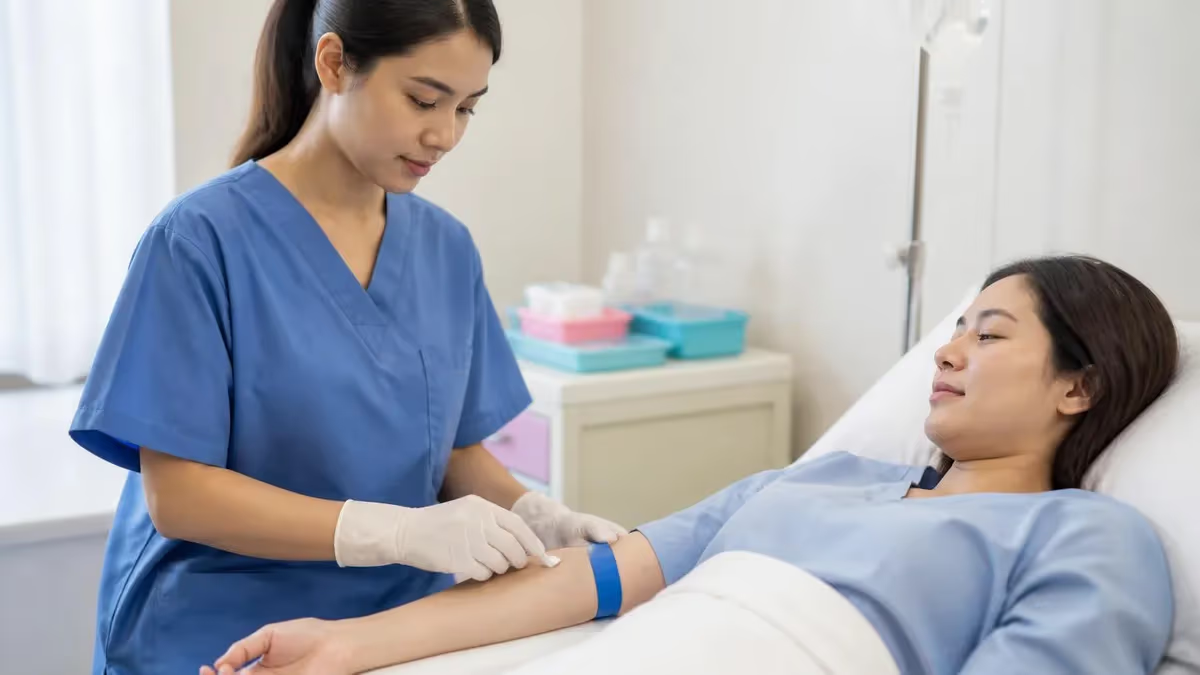
What Is BSN? The Short, Honest Answer
BSN stands for Bachelor of Science in Nursing — a four-year undergraduate degree that prepares you to practice as a registered nurse. It's the credential hospitals increasingly want stamped on every nursing badge, and it's quickly becoming the gold standard for the profession. Not just another degree on the wall, though. The BSN signals you've done the clinical hours, the science prerequisites, and the leadership coursework that hospitals lean on when they're trying to hit Magnet status.
You've probably heard the term thrown around in hospital corridors, on job listings, or maybe from a friend who's an RN talking about going back to school. So here's the plain version: a BSN is what you earn when you graduate from a four-year nursing program at a college or university. After graduation, you sit for the same NCLEX-RN exam every nursing graduate takes — whether they came from a two-year associate program or a four-year bachelor's program. Pass it, and you're a registered nurse.
The kicker? Both paths lead to RN licensure, but the BSN opens doors the ADN simply doesn't. We're talking about leadership tracks, ICU and ER positions in major academic medical centers, public health roles, military nursing, and the foundation you need if grad school is anywhere on your horizon. Want to be a nurse practitioner someday? You need a BSN to even apply to most MSN programs. Curious about what the workload looks like? Check out the BSN program structure breakdown for a full week-by-week peek.
Here's something most prospective students don't realize until orientation week — a BSN isn't just nursing theory plus extra fluff. The bachelor's-level curriculum digs into research methods, evidence-based practice, community health, healthcare policy, and nursing informatics. You'll write papers. You'll defend care plans. You'll sit in lectures on biostatistics. It's rigorous in a different way than the ADN, which is laser-focused on bedside skills.
And the timing matters. The Institute of Medicine's Future of Nursing report set a target — 80% of the nursing workforce holding a BSN. Hospitals chasing Magnet recognition need most of their nurses BSN-prepared. So even if you start as an ADN-RN, the pressure to bridge up is real. The good news? RN to BSN programs let working nurses finish the degree in 12-18 months, often online, often while still pulling shifts.
What's Inside a BSN Program?
Four years sounds like a lot — and it is, but every semester earns its keep. The first two years cover what nursing schools call prerequisites and general education: anatomy and physiology, microbiology, chemistry, statistics, psychology, English composition, and usually a sociology or ethics course. You're not in scrubs yet. You're in a lecture hall with biology majors and pre-meds, building the science foundation that everything else rests on.
Years three and four? That's where it gets real. You enter the nursing core: medical-surgical nursing, pediatrics, obstetrics, mental health, community health, gerontology, and critical care. Each rotation pairs classroom time with clinical placements — actual hospital floors, real patients, real charts. Most programs require between 700 and 1,000 clinical hours total. That's hands-on time you can't fake or shortcut.
Core Coursework You'll Tackle
- Pathophysiology — how diseases develop, progress, and respond to treatment
- Pharmacology — drug classes, mechanisms, interactions, and dosing math (you'll calculate doses in your sleep)
- Health Assessment — head-to-toe physical exams, listening to lung sounds, palpating abdomens
- Nursing Research — reading studies, applying evidence to practice, sometimes designing your own small project
- Leadership and Management — how to run a unit, delegate to LPNs and CNAs, handle conflict
- Public and Community Health — population-level care, disparities, prevention
The clinical rotations rotate you through every major nursing specialty. One semester you're holding a newborn in labor and delivery — eight weeks later you're starting IVs in the ED. By senior year, most programs throw you into a capstone preceptorship: 120 to 200 hours shadowing one nurse on one unit, basically a job audition. Many students get hired right where they did their capstone.
Tuition varies wildly. State schools run $10,000-$25,000 per year for in-state residents. Private universities can hit $40,000-$60,000 annually. Online and hybrid BSN programs sometimes come in cheaper, especially if you're pursuing the RN-to-BSN bridge. Financial aid, scholarships, and hospital tuition reimbursement programs are everywhere — ask. Hospitals are desperate enough for BSN-prepared nurses that many will pay your way if you commit to working there for two or three years post-graduation.
Entry Routes Into a BSN
Not everyone starts at 18 with a freshman backpack. The BSN has multiple on-ramps:
- Traditional 4-year BSN — straight from high school, full college experience
- Accelerated BSN (ABSN) — for people who already hold a non-nursing bachelor's degree, finishes in 12-18 months. The accelerated BSN program route is brutal but fast.
- RN-to-BSN bridge — for working ADN-RNs who want to upgrade. Mostly online, usually 12-24 months.
- LPN-to-BSN — for licensed practical nurses moving up to RN-bachelor's level
- ASN-to-BSN — Associate of Science in Nursing graduates bridging to the bachelor's
Each route ends in the same place — a BSN diploma and NCLEX-RN eligibility. The path you pick depends on where you're starting from.

What Can You Do With a BSN?
Here's where the four years pays off. A BSN qualifies you for every entry-level RN role plus a serious chunk of positions that explicitly require a bachelor's. Bedside nursing? Of course — but the degree also unlocks specialty units, leadership tracks, public health, and grad school. You're not pigeonholed.
Where BSN Nurses Actually Work
Hospitals employ the lion's share — about 60% of all RNs. Within hospitals, BSN-prepared nurses tend to land in higher-acuity units: ICU, ED, OR, labor and delivery, oncology, and cardiac. Magnet hospitals — those with the Magnet recognition for nursing excellence — often require or strongly prefer BSN credentials. If you want to work at a teaching hospital or a top-ranked academic medical center, the BSN isn't optional anymore.
Outside the hospital walls, BSN nurses run home health caseloads, manage school nursing programs, lead community health initiatives, work for insurance companies as case managers, and join the military as commissioned officers (the Army, Navy, and Air Force require a BSN for nurse corps officers — no exceptions). Public health departments hire BSNs for epidemiology support, vaccination campaigns, and disaster response. The list keeps going: corporate occupational health, clinical research, pharmaceutical sales, telephonic nurse advice lines, hospice, dialysis centers.
Specialty Roles That Often Require a BSN
- Critical Care RN — ICU, CCU, surgical ICU, neuro ICU
- Emergency Department Nurse — trauma centers, level I and II EDs
- Operating Room (Perioperative) Nurse — circulating, scrubbing, recovery
- Labor and Delivery Nurse — high-risk OB units especially
- Pediatric Nurse — children's hospitals and PICUs
- Oncology Nurse — chemo certification often requires BSN
- Public Health Nurse — county and state health departments
- School Nurse — many states now require BSN for certification
- Charge Nurse / Unit Manager — leadership track positions
- Clinical Educator — teaching new hires and students
Salary — What's the BSN Premium?
Pay varies by state, hospital, and shift, but BSN-prepared RNs typically earn $3,000-$10,000 more annually than ADN-RNs in the same roles. The Bureau of Labor Statistics pegs the median RN salary around $86,000 nationally — BSN holders cluster above that median. In high-cost states like California, Massachusetts, and New York, BSN-RNs routinely break $100,000 with a few years of experience and night-shift differentials. Travel nursing, which most agencies require a BSN for, can push earnings well past $150,000 a year.
Beyond the base salary, the BSN unlocks management ladder rungs: charge nurse, assistant nurse manager, nurse manager, director of nursing — each step adds significant pay. And if you eventually go for an MSN or DNP to become a nurse practitioner, you're looking at median salaries north of $120,000.
Grad School Is Wide Open
Want to specialize beyond bedside care? The BSN is your ticket to graduate nursing programs — the MSN (Master of Science in Nursing) and the DNP (Doctor of Nursing Practice). Without a BSN, you'd need a longer bridge program, more prerequisites, more time. With it, you walk into MSN admissions with everything they want to see.
- Nurse Practitioner (NP) — primary care, family practice, acute care, pediatrics, psych
- Certified Nurse Midwife (CNM) — full-scope midwifery care
- Certified Registered Nurse Anesthetist (CRNA) — among the highest-paid nursing roles, often $200,000+
- Clinical Nurse Specialist (CNS) — expert clinician in a specialty
- Nurse Educator — teaching at colleges and clinical sites
- Nurse Administrator — hospital and health system leadership
BSN vs. ADN — Which Should You Choose?
This is the question every prospective nurse wrestles with. The ADN (Associate Degree in Nursing) is a two-year program at community colleges. It's faster, cheaper, and gets you to RN status sooner. The BSN takes four years, costs more, but unlocks bigger career horizons. Both lead to RN licensure via the same NCLEX exam — so on paper, both produce registered nurses.
The catch is the long game. Hospitals are tightening BSN requirements every year. Magnet status, Joint Commission expectations, and the IOM's 80% target all push toward bachelor's-prepared bedside nurses. Many hospitals now require new ADN hires to commit to bridging to BSN within 3-5 years. So the question becomes: pay for two years now and bridge later, or commit to four years upfront?
If money's tight and you need to start earning fast, the ADN-then-bridge path makes sense — work as an RN, often with hospital tuition reimbursement, and finish online while pulling shifts. If you've got the time and resources for a four-year program, the BSN saves you from the second round of school later. Either way, the destination is the same: BSN-prepared RN. ASN to BSN bridges work the same way for ASN graduates.
The Licensing Step — NCLEX-RN
Whether you finish a BSN, ADN, or diploma program, you can't practice as an RN until you pass the NCLEX-RN. That's the National Council Licensure Examination for Registered Nurses, administered by the NCSBN. It's a computer-adaptive test — meaning the questions get harder or easier based on how you're answering — and it can range from 75 to 145 questions over up to 5 hours. Pass rates for first-time BSN test-takers run around 88%, slightly higher than ADN first-timers.
Studying for the NCLEX is its own beast. Most BSN students take a comprehensive review course (Kaplan, UWorld, ATI) plus do thousands of practice questions in the months before testing. Quick tip — start NCLEX-style practice questions early in your final year, not just in the cram window after graduation.
Why the BSN Matters More Every Year
The push for BSN-prepared nurses isn't going away. Patient outcomes data backs it up — studies in journals like Health Affairs and Medical Care have linked higher BSN percentages on units to lower mortality, fewer failure-to-rescue events, and better patient satisfaction scores. Hospitals see the data, accreditors see it, and policy follows.
For you, that means picking a BSN now is investing in a credential that's getting more valuable, not less. The pay premium is widening. The role options keep expanding. The grad school doors stay open. And as the profession evolves toward higher-acuity care, more autonomy, and more leadership at the bedside, the bachelor's-prepared nurse is the one positioned to grow.
Ready to test what you know? Try the BSN practice test for a feel of the question style, or browse online BSN programs if you're weighing your options. Every nursing journey starts with one decision — and choosing the BSN is one most nurses say they'd make again.
About the Author

Registered Nurse & Healthcare Educator
Johns Hopkins University School of NursingDr. Sarah Mitchell is a board-certified registered nurse with over 15 years of clinical and academic experience. She completed her PhD in Nursing Science at Johns Hopkins University and has taught NCLEX preparation and clinical skills courses for nursing students across the United States. Her research focuses on evidence-based exam preparation strategies for healthcare certification candidates.