
BSN Bridge Program: Complete Guide to Requirements, Types, and How to Enroll
BSN bridge program guide: types, admission requirements, costs, and timelines. Everything nurses need to advance their degree. 🎓
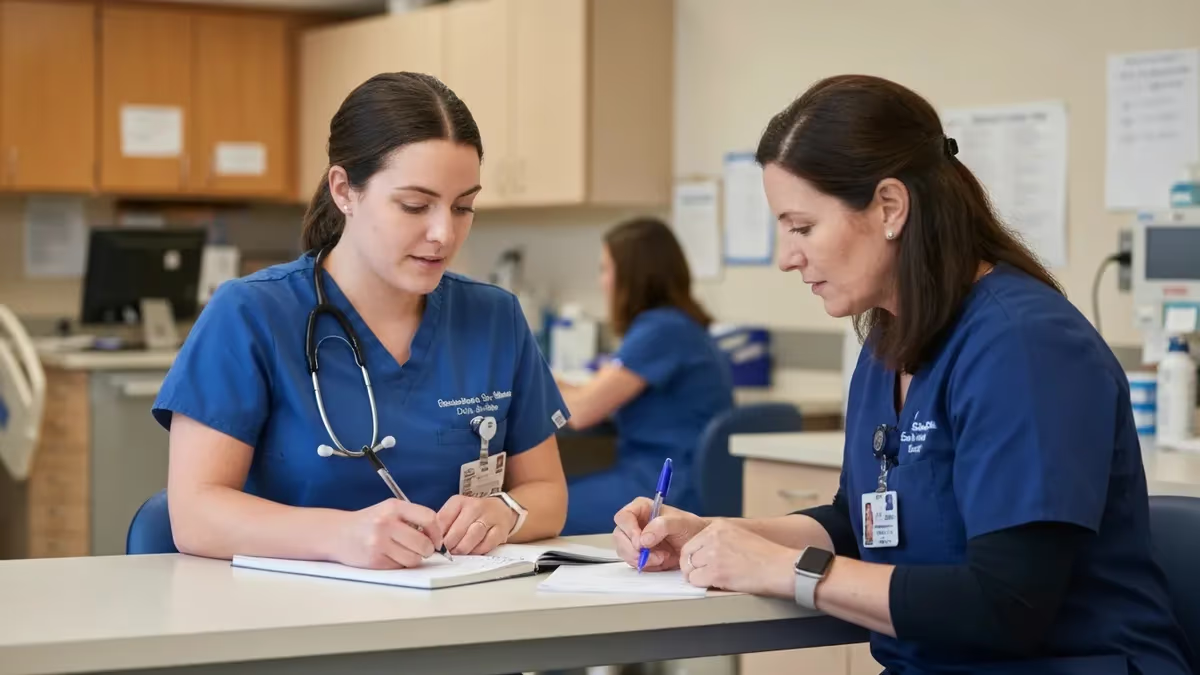
A bsn bridge program is one of the most efficient pathways available for nurses and pre-nursing students who want to earn a Bachelor of Science in Nursing without starting from scratch. These programs are designed to recognize prior academic credit and clinical experience, allowing participants to complete their BSN in significantly less time than a traditional four-year track. Whether you are an LPN, an ADN-holding registered nurse, or a college graduate from a non-nursing field, there is likely a bridge pathway structured to meet your specific starting point.
The demand for BSN-prepared nurses has grown substantially over the past decade. Major health systems including the American Nurses Association and the Institute of Medicine have championed the push toward requiring BSN-level preparation for bedside nurses, particularly in acute care settings. Hospitals seeking Magnet designation — a prestigious recognition of nursing excellence — typically require a high percentage of their nursing workforce to hold at least a BSN. This institutional pressure has driven enrollment in bridge programs to record levels across the country.
Understanding which type of bridge program aligns with your background is the critical first step. LPN-to-BSN programs are designed for licensed practical nurses who want to skip the intermediate ADN step entirely and move directly into baccalaureate-level coursework. ADN-to-BSN programs, sometimes called RN-to-BSN programs, serve registered nurses who completed an associate degree and need 30 to 60 additional credit hours to earn a bachelor's degree. Accelerated second-degree BSN programs serve college graduates with bachelor's degrees in other fields who want to enter nursing through an intensive, fast-track curriculum.
Program lengths vary widely depending on the starting credential. LPN-to-BSN programs typically run 24 to 36 months for full-time students. ADN-to-BSN bridge programs average 12 to 24 months, with many online-friendly formats allowing working nurses to complete coursework on their own schedule. Accelerated second-degree programs, which are among the most intense, compress all required nursing content into 12 to 18 months and demand full-time commitment with limited outside employment during clinical rotations.
Tuition is another major consideration when evaluating bridge options. Public university RN-to-BSN programs can run as low as $8,000 to $15,000 total for in-state students, while accelerated second-degree programs at private universities can top $60,000 to $80,000. Many employers, particularly hospital systems, offer tuition reimbursement benefits that can offset a substantial portion of these costs, especially for ADN nurses completing their BSN while employed. Scholarship programs through organizations like the American Association of Colleges of Nursing and state nursing associations also target bridge program students specifically.
Accreditation is a non-negotiable factor in selecting any bridge program. Programs accredited by the Commission on Collegiate Nursing Education (CCNE) or the Accreditation Commission for Education in Nursing (ACEN) meet rigorous national standards for curriculum quality, faculty qualifications, and student outcomes. Enrolling in an unaccredited program can jeopardize your eligibility for graduate school, federal financial aid, and some employer tuition reimbursement benefits. Always verify accreditation status directly on the CCNE or ACEN websites before submitting an application.
This guide walks through every major aspect of the BSN bridge program landscape — from admission requirements and program types to costs, study strategies, and what to expect once you graduate. Whether you are just beginning to explore your options or are ready to submit your first application, the information here will help you make a confident, well-informed decision about advancing your nursing career.
BSN Bridge Programs by the Numbers
Types of BSN Bridge Programs
Designed for licensed practical nurses, this track bypasses the ADN entirely. Students complete 24 to 36 months of full-time coursework covering RN-level clinical skills and all BSN general education requirements before earning their bachelor's degree.
The most common bridge format, this program targets registered nurses who hold an associate degree. Students complete 30 to 60 upper-division credit hours focused on leadership, public health, research, and evidence-based practice over 12 to 24 months.
Built for college graduates from non-nursing fields, this intensive program covers all required nursing content in 12 to 18 months. Students must complete prerequisites in anatomy, physiology, chemistry, and statistics before enrollment begins.
Many RN-to-BSN programs now offer fully online or hybrid delivery, allowing working nurses to complete didactic coursework remotely while arranging clinical hours through their current employer or approved local preceptors.
Select health systems partner with universities to create cohort-based bridge programs for their employed nurses. These programs frequently offer tuition subsidies, scheduled cohort start dates, and clinical placements within the sponsoring hospital.
Admission requirements for BSN bridge programs vary considerably based on program type and institution, but several core requirements appear across virtually every accredited option. For LPN-to-BSN applicants, programs universally require a current, unencumbered LPN license in the state where clinical rotations will occur. Most programs also require a minimum of 6 to 12 months of clinical practice experience following licensure, ensuring that entering students have foundational bedside skills before tackling baccalaureate-level content. A high school diploma or GED is required, and many programs require an associate's degree or significant college coursework in science prerequisites.
For ADN-to-BSN applicants, the baseline admission criteria center on holding an active, unrestricted RN license. The vast majority of programs require a minimum cumulative GPA of 2.5 to 3.0 on prior college coursework, with highly competitive programs at flagship state universities setting the bar at 3.2 or higher. Transcripts from all previously attended colleges must be submitted, and admissions committees scrutinize science course grades closely — a C or below in anatomy, physiology, or microbiology may trigger a requirement to repeat those courses before enrollment is approved.
Accelerated second-degree BSN programs carry the most selective admission standards of any bridge format. Because these programs compress an enormous volume of clinical and didactic content into 12 to 18 months, programs select candidates carefully for both academic aptitude and demonstrated resilience. Most require a completed bachelor's degree with a minimum overall GPA of 3.0, with science prerequisites averaging 3.3 or higher. Common prerequisites include two semesters of anatomy and physiology with labs, one semester of microbiology, one semester of chemistry, one semester of statistics, and often nutrition and human development or lifespan psychology.
Letters of recommendation are required by the overwhelming majority of bridge programs, with most requesting two to three letters from professional references who can speak to your clinical competence, academic potential, and character. The strongest letters come from physicians, nurse practitioners, or head nurses who have directly supervised your clinical work. Academic letters from college professors in science courses can supplement clinical references but typically carry less weight in admissions decisions for clinically oriented programs. Generic character references from community members or personal acquaintances rarely satisfy this requirement.
Personal statements and essays are another differentiating factor in competitive admissions processes. Admissions committees use these documents to assess your professional maturity, your reasons for pursuing BSN-level education, and your long-term career goals. The most effective personal statements for bridge program applications connect specific clinical experiences to particular skills or knowledge gaps that the BSN program addresses. Candidates who articulate clear post-graduation goals — whether in nursing leadership, public health, informatics, or graduate school preparation — tend to perform significantly better in competitive applicant pools.
Background checks and health screenings are non-negotiable requirements for all bridge programs with clinical components. These typically include a criminal background check, a drug screening, current CPR certification at the BLS for Healthcare Providers level, documented immunizations (MMR, hepatitis B, varicella, annual flu), TB testing, and in many programs, proof of professional liability insurance. Some programs require HIPAA training completion and an occupational health clearance before clinical placement is authorized. Gathering these documents early — ideally two to three months before your target enrollment date — prevents delays that could push your start to the next admission cycle.
English language proficiency requirements apply to applicants whose native language is not English. Most accredited programs accept TOEFL scores of 79 to 100 on the internet-based test or IELTS scores of 6.5 to 7.0 as evidence of sufficient proficiency for nursing coursework. Some programs exempt applicants who completed an undergraduate degree taught entirely in English, even if it was earned abroad. If English proficiency testing is required, scheduling early is essential because test center availability can lag several weeks behind demand in many metropolitan areas.
BSN Bridge Program Curriculum and Coursework
BSN bridge programs build on your existing clinical foundation by adding courses that develop higher-order competencies in evidence-based practice, nursing research, and population health. Core nursing courses typically include nursing theory, leadership and management in nursing, community and public health nursing, pathophysiology at the baccalaureate level, pharmacology, and a nursing research or informatics course that introduces students to reading and applying peer-reviewed evidence in clinical decision-making.
Clinical practicums in BSN bridge programs emphasize settings that ADN graduates rarely encounter, particularly community health agencies, public health departments, school health programs, occupational health settings, and home care environments. These rotations typically require 90 to 180 clinical hours and are arranged by the student through approved preceptor agreements. Students are expected to apply systems-level thinking and population-based health promotion strategies rather than the individual patient focus that dominates associate-degree clinical experiences.

BSN Bridge Program: Advantages and Disadvantages
- +Significantly shorter than a traditional four-year BSN — most formats complete in 12 to 24 months
- +Credit for prior nursing coursework and clinical experience reduces total credit hours needed
- +Online and hybrid delivery formats allow working nurses to study without leaving current employment
- +Meets hospital Magnet designation requirements and employer BSN mandates
- +Opens eligibility for graduate school admission into MSN, DNP, and CRNA programs
- +Average salary increase of $14,000 or more annually compared to ADN-prepared nurses
- −Even bridge programs require significant time commitment — typically 15 to 25 hours per week for part-time students
- −Tuition costs range from $8,000 to $80,000 depending on institution type and program format
- −Science prerequisites that are more than five to seven years old may need to be retaken at additional cost
- −Accelerated second-degree formats prohibit outside employment, making financial planning critical
- −Some programs have competitive acceptance rates below 30 percent at flagship state universities
- −Clinical hour requirements can be difficult to arrange independently, particularly in rural areas
How to Apply to a BSN Bridge Program: Step-by-Step Checklist
- ✓Verify your nursing license is active, unencumbered, and valid in the state where clinical rotations will occur.
- ✓Request official transcripts from every college or university you have attended, including dual enrollment credits.
- ✓Calculate your cumulative GPA on all prior science coursework and identify any courses that may need to be repeated.
- ✓Confirm that all required science prerequisites were completed within the last five to seven years.
- ✓Obtain two to three letters of recommendation from supervisors, clinical preceptors, or science faculty who know your work.
- ✓Schedule your criminal background check and drug screening at least eight weeks before your target application deadline.
- ✓Gather required health documentation including immunization records, CPR certification, and TB test results.
- ✓Write a personal statement that connects specific clinical experiences to your BSN goals and long-term career plans.
- ✓Research tuition costs, available scholarships, and employer tuition reimbursement benefits before selecting a program.
- ✓Submit applications to two to four programs to maximize your chances of acceptance in your preferred start term.
Employer Tuition Reimbursement Can Cover Up to 100% of Your BSN Costs
Many hospital systems offer tuition reimbursement programs that cover $5,000 to $12,000 per year toward a BSN bridge program, with some large health networks covering full tuition in exchange for a two-to-three-year employment commitment. Ask your HR department about tuition benefits before selecting a program — choosing an employer-partnered university often unlocks the highest reimbursement amounts and simplifies clinical placement arrangements.
The cost of a BSN bridge program is one of the most consequential factors in the decision to enroll, yet many prospective students significantly overestimate the out-of-pocket burden. Public university RN-to-BSN programs for in-state students are frequently the most affordable option, with total tuition ranging from $8,000 to $20,000 for the 30 to 60 credit hours required to complete the degree. Several large state university systems — including those in Texas, Florida, and Arizona — have invested heavily in online RN-to-BSN infrastructure, driving per-credit-hour costs down to $200 to $350 in some cases.
Private nonprofit universities occupy the middle tier of the cost spectrum, with total bridge program tuition typically ranging from $20,000 to $45,000. These institutions often provide stronger academic advising, smaller cohort sizes, and more robust career services, which some students find worth the additional investment. Many private nonprofit institutions also have extensive scholarship endowments that can significantly reduce net tuition costs for qualified applicants — a full-sticker-price comparison between a private and a public institution often understates the true financial difference once scholarships are applied.
Accelerated second-degree BSN programs at private universities represent the highest-cost segment of the bridge program market, with tuition commonly running from $50,000 to $80,000 for the full program. These programs also carry the highest opportunity cost, since their full-time format generally precludes outside employment during the 12 to 18 months of active enrollment.
Students who pursue this pathway typically rely on a combination of federal student loans, personal savings, and in some cases, graduate PLUS loans to cover both tuition and living expenses. Federal financial aid eligibility for these programs depends on the institution's Title IV status — all CCNE- and ACEN-accredited programs at regionally accredited institutions qualify.
Employer tuition reimbursement is the single most powerful cost-reduction tool available to working nurses pursuing a bridge program. The majority of hospital systems and large healthcare organizations offer formal tuition assistance programs, typically providing $5,000 to $12,000 per calendar year for degree-seeking employees.
Some Magnet hospitals, under pressure to increase their BSN workforce percentage, have expanded these benefits substantially — offering full tuition coverage in exchange for a two-year service commitment post-graduation. The key to maximizing this benefit is identifying which universities your employer has formal partnership agreements with, since partnered institutions sometimes offer discounted tuition rates in addition to the standard reimbursement benefit.
Scholarships and grants specifically targeting bridge program students are more numerous than many applicants realize. The American Association of Colleges of Nursing administers multiple scholarship programs for RN-to-BSN students. The Health Resources and Services Administration (HRSA) funds the Nurse Corps Scholarship Program, which covers tuition and fees plus a monthly stipend in exchange for post-graduation service at federally designated shortage-area facilities.
State nursing associations in many states administer their own scholarship funds, often with less competition than national programs because applicants must be residents of the specific state. Hospital foundations, county health departments, and community foundations also fund nursing scholarships that go unclaimed every year simply because students do not search for them.
Return on investment calculations for BSN bridge programs are generally favorable, particularly for ADN nurses completing an RN-to-BSN program. Salary data from the Bureau of Labor Statistics and national nursing compensation surveys consistently show a salary differential of $10,000 to $18,000 per year between ADN and BSN-prepared nurses at the same seniority level.
A $15,000 total tuition investment that produces $14,000 in additional annual earnings pays for itself in slightly more than one year. For nurses who plan a 20-to-30-year career, the lifetime earnings advantage of the BSN credential can exceed $250,000, even accounting for tuition costs and the time invested in completing the program.
Financial planning for a bridge program should begin at least 6 to 12 months before your anticipated enrollment date. This timeline allows you to submit a FAFSA early, research and apply for external scholarships with fall deadlines, negotiate tuition reimbursement terms with your employer, and build savings to cover any costs that fall outside reimbursement caps. Students who fail to plan financially often encounter mid-program financial stress that can compromise academic performance or force a leave of absence — an outcome that delays degree completion and erodes the return on investment the program was intended to provide.
Not every nursing bridge program advertised online is accredited by CCNE or ACEN. Enrolling in an unaccredited program can disqualify you from federal financial aid, block acceptance to graduate nursing programs, and violate employer tuition reimbursement terms. Always verify accreditation status on the official CCNE or ACEN directory websites before paying any application fees or deposits.
Career outcomes following BSN bridge program completion are consistently strong, particularly given current nursing workforce dynamics in the United States. The Bureau of Labor Statistics projects registered nursing employment to grow by 6 percent through 2032, adding approximately 177,400 new positions — a pace that exceeds the average for all occupations. Within this growth environment, BSN-prepared nurses have a significant competitive advantage for roles in acute care settings, outpatient specialty clinics, public health agencies, nursing education, and healthcare administration.
Hospital employment is the most common post-graduation destination for bridge program graduates, and the BSN credential unlocks positions and advancement pathways that are formally closed to ADN nurses in many institutions. Charge nurse roles, nurse educator positions, quality improvement specialist roles, and case management jobs all typically require a BSN or higher as a minimum educational qualification at hospitals with Magnet or Pathway to Excellence designation. Nurses who complete a bridge program while employed at one of these institutions are often immediately eligible for internal promotion opportunities that were previously out of reach.
Public health nursing represents one of the fastest-growing employment sectors for BSN graduates, and bridge program curricula are specifically designed to prepare nurses for this environment. Community health nursing practicums expose students to population-level intervention strategies, health education program design, community needs assessment methodologies, and collaboration with interdisciplinary public health teams. Graduates who develop skills in epidemiology, health policy analysis, and community coalition building are well positioned for roles with county and state health departments, federally qualified health centers, and nonprofit health organizations.
Graduate school eligibility is perhaps the most transformative long-term benefit of completing a BSN bridge program. The BSN is the minimum entry credential for all graduate nursing programs in the United States, including Master of Science in Nursing (MSN) programs, Doctor of Nursing Practice (DNP) programs, and nurse anesthesia (CRNA) programs. CRNA programs, which produce certified registered nurse anesthetists who earn average salaries exceeding $200,000 per year, require not only a BSN but also a minimum of one year of critical care experience — making the bridge program completion a foundational prerequisite for this career trajectory.
Nursing informatics has emerged as a particularly high-demand specialty for BSN-prepared nurses with interest in technology and data analysis. Healthcare organizations undergoing electronic health record implementations, population health management initiatives, and clinical analytics projects actively recruit nurses who combine clinical knowledge with the research and analytical skills emphasized in BSN bridge curricula. Informatics nurses often work in project management, system configuration, and clinical decision support roles that allow hybrid remote-office schedules and command salaries ranging from $80,000 to $110,000 annually in most markets.
International nursing opportunities also expand substantially for BSN-prepared nurses. Many countries that recruit US-trained nurses for immigration-based workforce programs require a minimum of a baccalaureate nursing degree from an accredited institution. The World Health Organization and various international health NGOs that place nurses in global health roles similarly require BSN-level preparation as a baseline credential. Bridge program graduates who are interested in global health careers often use their BSN as a launching pad for graduate study in global health, international development, or public health.
Nursing leadership and administration represent career pathways that are formally inaccessible without a BSN in most hospital systems. Unit manager roles, director of nursing positions, and chief nursing officer tracks all require at minimum a BSN and increasingly prefer candidates with a master's degree. Bridge program graduates who demonstrate leadership potential in their BSN capstone projects and community practicums often fast-track into management development programs at their employing institutions, shortening the typical timeline to a first leadership role by two to four years compared to ADN nurses without a bachelor's degree.
Succeeding in a BSN bridge program requires a different study approach than most nurses used to pass their NCLEX or complete an associate degree program. The emphasis shifts from mastering clinical protocols and pharmacological facts to engaging critically with nursing research, synthesizing evidence across multiple studies, and applying population-level thinking to practice problems. Nurses who approach their bridge coursework expecting it to feel like traditional nursing school often experience early frustration — those who approach it as professional development and intellectual growth tend to thrive.
Time management is the most commonly cited challenge by working nurses in RN-to-BSN programs. Part-time enrollment typically requires 15 to 20 hours of dedicated study time per week in addition to full-time clinical employment. Creating a structured weekly study schedule — treating coursework hours like shifts that cannot be traded away — is the most effective strategy for maintaining academic progress without burnout. Many successful bridge students block specific mornings or evenings for coursework three to four days per week and protect those blocks from social and family obligations as diligently as they protect their work schedule.
Writing proficiency is an area where many bridge program students discover an unexpected skills gap. BSN-level courses require formal academic writing including literature reviews, research critiques, evidence-based practice papers, and policy analysis essays. If your undergraduate science writing experience was limited to lab reports, investing early in your program — taking a professional writing workshop, working with your university's writing center, or completing an online academic writing refresher — pays dividends throughout every subsequent course. Strong writing skills are also essential for the capstone project, which is typically the most heavily weighted single assignment in the program.
Engagement with faculty and academic advisors is dramatically more important in bridge programs than many students anticipate. Bridge program faculty are typically practicing nurse scholars who can connect you with clinical mentors, research opportunities, and professional networks that extend well beyond the classroom. Students who attend virtual office hours, participate actively in discussion boards, and seek out informal mentorship relationships with faculty consistently outperform their peers who treat coursework as a purely transactional process. The relationships you build during your bridge program can generate recommendation letters, job referrals, and collaborative research opportunities for years after graduation.
Building a peer learning community with fellow bridge students significantly improves both academic outcomes and program completion rates. Online bridge programs in particular can feel isolating when students do not make deliberate efforts to connect with cohort peers. Creating or joining a study group that meets virtually each week — to discuss readings, workshop essays, and debrief clinical experiences — provides both academic support and the professional community that sustains motivation through challenging coursework periods. Many bridge program graduates credit their study group relationships as among the most professionally valuable outcomes of their entire BSN experience.
Leveraging your clinical workplace as a learning laboratory accelerates your understanding of bridge program content in ways that purely academic study cannot replicate. When your coursework covers quality improvement methodology, identify a real quality metric on your unit that you can analyze through the lens of the course framework. When nursing leadership content addresses conflict resolution or staff scheduling strategies, pay close attention to how your nurse manager approaches these challenges in real time. This integration of academic content with lived clinical experience is exactly what distinguishes competent BSN graduates from those who simply completed the credit hours.
Finally, keeping your long-term career goals visible throughout the program provides the motivational resilience needed to persist through demanding coursework periods. Write your post-graduation goals on a card at your study space. Track your progress toward each requirement using your program's degree audit tool. Celebrate milestones — finishing your first research paper, completing your community health clinical rotation, submitting your capstone — as meaningful achievements. Bridge programs are designed to be completed, and the nurses who finish are overwhelmingly those who maintain clarity about why they started.
BSN Questions and Answers

Accelerated BSN Programs: Requirements, Cost, and Timeline
ADN to BSN Online: Bridge Programs and Costs Complete Guide

Accelerated BSN Programs by Location: Complete US Guide With Canada Comparison for 2026

Accredited BSN Programs: Complete Guide to CCNE and ACEN Nursing Degrees in 2026

BSN RN: What It Is, Salary, and Why It Matters in 2026
About the Author

Registered Nurse & Healthcare Educator
Johns Hopkins University School of NursingDr. Sarah Mitchell is a board-certified registered nurse with over 15 years of clinical and academic experience. She completed her PhD in Nursing Science at Johns Hopkins University and has taught NCLEX preparation and clinical skills courses for nursing students across the United States. Her research focuses on evidence-based exam preparation strategies for healthcare certification candidates.