
How Many Questions Are on the Permit Test in PA? Complete DMV Written Test Guide
How many questions are on the permit test in PA? Learn the exact DMV written test format, passing score, topics covered, and best study tips. 🧠
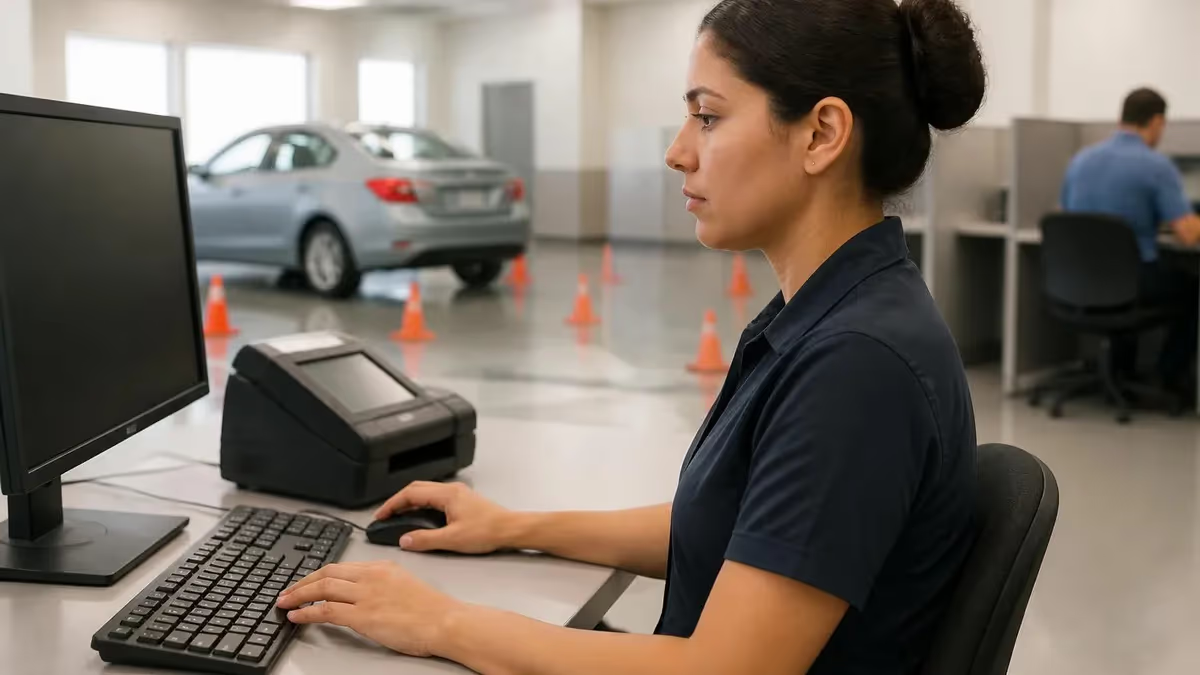
The dmv written test is one of the most important milestones on the path to earning your driver's license, and knowing exactly what to expect makes a tremendous difference in your preparation. If you're wondering how many questions are on the permit test in PA, the answer is 18 questions drawn from Pennsylvania's official driver's manual.
You need to answer at least 15 correctly — an 83% passing threshold — making it essential to study road signs, traffic laws, and safe driving practices before you sit down at the testing terminal. Understanding the format removes anxiety and helps you focus your energy on genuine learning.
Pennsylvania's knowledge exam tests your understanding of real-world driving scenarios, not just your ability to memorize isolated facts. The Bureau of Motor Vehicles designs each question to reflect situations you will actually encounter behind the wheel: interpreting road signs and markings, applying speed limit rules, navigating intersections, and understanding right-of-way protocols. Many first-time test-takers underestimate this exam because they assume common sense alone is enough. In reality, Pennsylvania traffic laws contain dozens of specific rules — such as exact following distances on wet roads or blood-alcohol thresholds — that require deliberate study.
The dmv knowledge test is administered on a computer terminal at any PennDOT Driver License Center. The exam is not timed in a strict per-question sense, but the entire session has a reasonable completion window. Questions are drawn randomly from a large bank, which means no two test sessions are identical. This randomization is intentional: it ensures that every applicant demonstrates genuine understanding of the full scope of driving knowledge rather than memorizing a fixed list of answers. Taking multiple permit test practice sessions with varied question pools is therefore the single most effective preparation strategy.
Applicants who fail the written exam may retake it, but Pennsylvania imposes a waiting period and limits the number of attempts before additional requirements kick in. On a third failure, you must wait 90 days before retesting, and some applicants are required to complete a remedial driver education program. These consequences underscore why thorough preparation matters so much. A focused study plan of even one to two weeks — covering the full driver's manual, practicing with realistic online dmv permit test simulations, and reviewing your mistakes — dramatically increases your odds of passing on the first attempt.
The permit test is also your entry point into Pennsylvania's Graduated Driver Licensing (GDL) program. Once you pass, you receive a learner's permit that allows supervised driving under specific restrictions: a licensed adult 21 or older must be in the front passenger seat at all times, nighttime driving is restricted, and cell phone use is prohibited even hands-free for junior drivers. These restrictions are designed to build skill progressively before you face the full independence of an unrestricted license. Failing to comply during the permit stage can result in delays to your full licensure timeline.
Many applicants treat the dmv test online resources as supplementary tools, but modern practice platforms are so comprehensive that they can serve as your primary study method when used correctly. The most effective approach combines reading the official Pennsylvania Driver's Manual with completing hundreds of practice questions across multiple sessions. Platforms that simulate the real exam interface — showing 18 questions, flagging incorrect answers with explanations, and varying the question pool each session — build both knowledge and test-taking confidence simultaneously. Reviewing why a wrong answer is wrong is at least as valuable as getting the right answer.
Whether you are a teenager applying for your first learner's permit or an adult driver new to Pennsylvania who needs to convert an out-of-state license, this guide covers everything you need to know about the dmv written test structure, the topics it tests, and the most efficient ways to prepare. You will find a detailed breakdown of the exam format, a study checklist, common pitfalls to avoid, and links to free practice quizzes aligned specifically with Pennsylvania BMV content. Let's walk through every step so you can walk into your testing appointment with genuine confidence.
Pennsylvania Permit Test by the Numbers

PA Permit Test Format & Structure
| Section | Questions | Time | Weight | Notes |
|---|---|---|---|---|
| Road Signs & Markings | 4 | Untimed | 22% | Must recognize shape, color, and meaning |
| Traffic Laws & Regulations | 7 | Untimed | 39% | Speed limits, right-of-way, passing rules |
| Safe Driving Practices | 4 | Untimed | 22% | Weather, following distance, impaired driving |
| Licensing & Vehicle Requirements | 3 | Untimed | 17% | GDL rules, registration, insurance |
| Total | 18 | No strict time limit | 100% |
Understanding what the dmv knowledge test actually covers is the foundation of any effective study plan. Pennsylvania's exam is built directly from the official Pennsylvania Driver's Manual, which PennDOT updates periodically to reflect changes in state law and best practices. The manual is divided into chapters covering vehicle controls, traffic laws, road signs and markings, sharing the road with pedestrians and cyclists, and special driving conditions. Every question on the 18-item test is traceable to a specific section of this document, which is why reading it cover to cover — not just skimming — remains the gold standard preparation method.
Road signs and markings represent roughly 22% of the exam, meaning you can expect approximately four questions dedicated to sign recognition and interpretation. Pennsylvania follows the national standard for sign shapes and colors: octagonal red signs mean stop, triangular signs mean yield, diamond-shaped yellow signs indicate warnings, and rectangular signs convey regulatory or informational content. However, knowing shapes alone is not enough. You must also understand specific signs such as the "No U-Turn" symbol, the meaning of different pavement markings (solid yellow versus dashed white), and what flashing yellow versus flashing red signals require of drivers.
Traffic laws and regulations form the largest single content category, accounting for roughly 39% of the exam — about seven questions. This section covers a wide range of rules: legal passing procedures, school zone speed limits (always 15 mph when children are present unless posted otherwise), the proper response to emergency vehicles (pull right and stop), and Pennsylvania's specific rules about turning at red lights. You must also know blood-alcohol concentration (BAC) thresholds: 0.08% for adults, 0.02% for drivers under 21, and special DUI provisions for commercial vehicle operators.
Safe driving practices, which account for about 22% of the test, go beyond knowing the rules to understanding how to apply them in dynamic real-world situations. Questions in this category address following distance (the three-second rule under normal conditions, extended to four or more seconds in wet or foggy weather), proper braking technique on ice, how to handle a tire blowout at highway speed, and what to do when a vehicle's headlights fail.
Many test-takers know these rules in principle but get tripped up by specific numbers — for instance, the precise distance at which you must turn on headlights after sunset (sunset to sunrise, or anytime visibility drops below 1,000 feet).
The licensing and vehicle requirements section covers Pennsylvania's Graduated Driver Licensing (GDL) system in detail. Junior drivers (those under 18) face specific restrictions during the learner's permit phase and the junior driver's license phase. During the permit stage, you must complete 65 hours of supervised driving, including 10 hours at night and 5 hours in adverse weather conditions. These hours must be logged in a practice log signed by the supervising driver. Understanding these requirements is not just exam knowledge — it directly affects how you plan your practice driving months before your road test.
A driving knowledge test question that surprises many applicants involves sharing the road with vulnerable users. Pennsylvania law requires drivers to give cyclists at least four feet of clearance when passing — more than many people assume. Similarly, at crosswalks, vehicles must stop for pedestrians in the crosswalk and remain stopped until the pedestrian has completely cleared the lane the vehicle will travel through. Questions about these rules appear regularly and are commonly missed by applicants who drive past cyclists and pedestrians daily without consciously knowing the legal requirements.
Special driving conditions — including fog, snow, rain, and nighttime driving — are woven throughout the exam rather than isolated in a single section. In heavy fog, Pennsylvania law requires you to use low-beam headlights rather than high beams, because high beams reflect off fog particles and reduce visibility further.
On snow and ice, you should reduce speed to match road conditions regardless of posted speed limits, and stopping distances can increase by 10 times compared to dry pavement. Understanding these principles not only helps you pass the exam but makes you genuinely safer once you are behind the wheel with your permit.
BMV Practice Test Questions
Prepare for the BMV - Test exam with our free practice test modules. Each quiz covers key topics to help you pass on your first try.
BMV Basic BMV Practice
BMV Exam Questions covering Basic BMV Practice. Master BMV Test concepts for certification prep.
BMV Alcohol, Drugs, and Impaired Driving Laws
Free BMV Practice Test featuring Alcohol, Drugs, and Impaired Driving Laws. Improve your BMV Exam score with mock test prep.
BMV Licensing Requirements
BMV Mock Exam on BMV Licensing Requirements. BMV Study Guide questions to pass on your first try.
BMV Traffic Laws
BMV Test Prep for BMV Traffic Laws. Practice BMV Quiz questions and boost your score.
BMV Vehicle Operations
BMV Questions and Answers on BMV Vehicle Operations. Free BMV practice for exam readiness.
BMV Parking, Right-of-Way, and Intersections
BMV Mock Test covering Parking, Right-of-Way, and Intersections. Online BMV Test practice with instant feedback.
BMV Road Signs and Markings
Free BMV Quiz on Road Signs and Markings. BMV Exam prep questions with detailed explanations.
BMV Safe Driving and Hazard Awareness
BMV Practice Questions for Safe Driving and Hazard Awareness. Build confidence for your BMV certification exam.
Road Signs, Traffic Laws, and Safe Driving Practices
Pennsylvania uses the federally standardized system of road signs and markings, where shape and color convey meaning even before you read the text. Warning signs are yellow diamonds alerting drivers to curves, school zones, or merging traffic ahead. Regulatory signs — white rectangles — tell you what you must or must not do, such as speed limits or no-passing zones. Blue signs indicate services like fuel and hospitals, while green signs provide directional and distance information on highway routes.
Pavement markings add a critical second layer of communication. A solid yellow center line means passing is prohibited in both directions. A dashed yellow line on your side means you may pass when safe. White edge lines define the boundary of the travel lane, and crosswalk lines signal where pedestrians have legal right-of-way. Double solid white lines separate traffic moving in the same direction and should not be crossed. Memorizing these distinctions is essential because the permit test regularly includes questions that require identifying the correct meaning of a specific marking pattern rather than a simple sign shape.

Online DMV Practice Tests vs. Reading the Manual Alone
- +Simulates the real exam interface so the testing environment feels familiar on test day
- +Randomized question pools expose you to the full breadth of tested material across multiple sessions
- +Immediate feedback on wrong answers with explanations accelerates learning more than passive reading
- +Tracks your weak areas so you can focus extra study time where it matters most
- +Available 24/7 on any device, making it easy to fit practice into a busy schedule
- +Builds test-taking confidence by letting you experience passing scores before the real exam
- −Some free platforms use outdated question banks that don't reflect current Pennsylvania law
- −Over-relying on practice tests without reading the manual can leave conceptual gaps
- −Repetition of the same platform's questions can create false confidence if the bank is small
- −Screen fatigue from extended online sessions can reduce retention compared to manual reading
- −No substitute for actual supervised driving practice, which is also required for licensure
- −Free platforms may lack explanations for wrong answers, reducing their educational value
Study Checklist Before Your DMV Written Test
- ✓Download or pick up the current Pennsylvania Driver's Manual from PennDOT's website and read every chapter.
- ✓Highlight all specific numbers in the manual: speed limits, following distances, BAC thresholds, and waiting periods.
- ✓Complete at least three full 18-question practice tests, aiming for 100% rather than stopping at 83%.
- ✓Review every incorrect practice answer and locate the corresponding section in the driver's manual.
- ✓Memorize all standard road sign shapes, colors, and their specific meanings including pavement marking patterns.
- ✓Study Pennsylvania's GDL restrictions thoroughly, including supervised driving hour requirements for junior drivers.
- ✓Practice identifying and interpreting traffic control signals including flashing lights and hand signals from officers.
- ✓Review right-of-way rules for every intersection type: four-way stops, T-intersections, roundabouts, and yield signs.
- ✓Confirm your appointment, required documents (proof of identity, Social Security number, proof of residency), and testing location the day before.
- ✓Get a full night of sleep before test day and arrive at the Driver License Center at least 15 minutes early.

The 83% Rule Means Zero Room for Guessing
With only 18 questions on the Pennsylvania permit test, a single wrong answer still lets you pass — but two wrong answers is the maximum you can afford. This tight margin means you cannot afford to guess on unfamiliar topics. Every question you are unsure about represents a real risk of failure, which is why targeted study of your weak areas in the final days before your exam matters more than general review of content you already know well.
One of the most common reasons applicants fail the Pennsylvania permit test is overconfidence in their intuitive understanding of driving rules. Experienced passengers and young adults who have ridden in vehicles for years often assume that observation has taught them everything they need to know.
In reality, observing driving and understanding the legal framework that governs it are entirely different skills. A driver who has merged onto a highway a thousand times as a passenger may not know the specific rule about when you must yield to traffic already on the highway versus when merging traffic has the right of way.
Another frequent mistake is memorizing answer patterns from a single practice test platform and then being surprised by different phrasing on the real exam. The Pennsylvania DMV's question bank is large and contains multiple questions that test the same underlying concept using entirely different scenarios and wording.
For example, the rule about following distance might be tested as "what is the minimum following distance in dry conditions," "when should you increase your following distance beyond three seconds," or "which scenario demonstrates proper following distance on a wet road." All three test the same knowledge but require you to actually understand the concept rather than memorize a specific answer.
Impaired driving questions deserve special attention because they appear frequently and involve specific numbers that many applicants misremember. Pennsylvania's legal BAC limit for regular drivers over 21 is 0.08%. For drivers under 21, any BAC of 0.02% or higher triggers DUI penalties under the state's zero-tolerance law.
Commercial drivers face the stricter federal threshold of 0.04%. Beyond alcohol, Pennsylvania law addresses prescription medications, marijuana (legal under state medical law but still illegal for driving impaired), and any substance that affects your ability to operate a vehicle safely. The exam will test these distinctions, and confusing the thresholds is a common source of lost points.
Right-of-way questions at intersections are another area where test-takers frequently lose points because they apply a logical but legally incorrect reasoning. At a four-way stop, the vehicle that arrives first proceeds first — simple enough. But when two vehicles arrive simultaneously from perpendicular directions, the rule is that the driver on the left yields to the driver on the right.
Many applicants assume it should be the opposite (yield to the left, as in roundabouts), leading to a wrong answer. Similarly, at an uncontrolled intersection where two vehicles approach simultaneously from opposite directions, both turning left must yield to the straight-through traffic and to each other.
Questions about emergency situations are often missed because applicants know the general concept but get specific details wrong. When a school bus with flashing red lights is stopped on a two-lane road, all traffic in both directions must stop. However, on a divided highway with a median barrier, only traffic on the same side as the bus must stop — traffic on the opposite side of the barrier may proceed with caution.
This exception trips up many applicants who apply the same-direction rule universally. Similarly, when an emergency vehicle approaches with lights and siren active, you must pull to the right edge of the road and stop — not just slow down or move to the right lane while continuing to drive.
Nighttime driving questions require knowing specific visibility and headlight rules. Pennsylvania law requires headlights from half an hour after sunset to half an hour before sunrise, and any time visibility falls below 1,000 feet — not just after dark. You must dim your high beams within 500 feet of an oncoming vehicle and within 300 feet when following another vehicle.
Forgetting to switch to low beams in fog is both a legal violation and a safety hazard, since high beams reflect off moisture particles and create glare that reduces rather than improves visibility. These specific distances appear regularly on the permit exam.
Finally, many applicants neglect the sections of the driver's manual covering vehicle safety and mechanical requirements. Pennsylvania law requires functioning brakes, steering, lights, horn, mirrors, and wipers. Tires must meet minimum tread depth requirements (2/32 of an inch). Windshields must be free of cracks that obstruct the driver's view. These equipment questions are less common on the exam than traffic laws but do appear, and preparing thoroughly means covering the entire manual — not just the chapters that seem most obviously relevant to everyday driving decisions.
If you fail the Pennsylvania permit test three times, you must wait 90 days before you can attempt the exam again, and PennDOT may require completion of a remedial driver education course before allowing you to retest. This waiting period can delay your entire timeline for getting a license by months. Thorough preparation before your first attempt is far less costly — in time, fees, and frustration — than the consequences of multiple failures.
Test day preparation is as important as the weeks of study that precede it. Arriving at the Pennsylvania Driver License Center without the correct documentation will result in being turned away regardless of how well you know the material.
Pennsylvania requires proof of identity (a birth certificate or valid passport), your Social Security card or a document showing your full Social Security number, and two proofs of Pennsylvania residency (utility bills, bank statements, or similar documents dated within 90 days). Junior applicants also need a parent or guardian's signature on the application. Missing any one of these documents means a wasted trip and rescheduled appointment.
The physical testing environment at Pennsylvania Driver License Centers is standardized: you sit at a computer terminal and answer questions using a touch screen or mouse. The interface displays one question at a time with multiple-choice answers, and in most locations you can flag questions to revisit before submitting. Use this feature strategically — if you are uncertain about a question, flag it, continue through the rest of the exam, and return to it with fresh eyes after completing the others. Sometimes context from later questions triggers recall of information relevant to an earlier flagged item.
Managing test anxiety is a practical skill that significantly affects performance. Research on test-taking performance consistently shows that moderate anxiety improves focus, but high anxiety impairs working memory and leads to second-guessing correct initial answers. The most effective anxiety management strategy for a knowledge test is thorough preparation combined with controlled breathing. If you have consistently scored 90% or above on practice tests, remind yourself of that fact as you sit down at the terminal. Your performance on practice exams is a reliable predictor of performance on the real exam when the practice material closely matches the actual content.
When reading each question on the real exam, take the time to parse the wording carefully before selecting an answer. The DMV written test is designed by professionals who use precise legal language, and a single word like "must," "should," or "may" can completely change the correct answer. "You must stop" indicates a legal requirement with no exceptions, while "you should stop" indicates a best practice.
Answer the question that is actually being asked, not a slightly different version that you studied. If the question asks what you should do when a traffic signal is not working, the answer is to treat the intersection as a four-way stop — even if you think the question might be testing knowledge of flashing red lights specifically.
It is also worth knowing what happens immediately after you pass. The testing terminal will print a result sheet showing your score, and the center staff will process your learner's permit on the same visit if you have all required documents. Your permit is typically printed on the spot.
With permit in hand, you can begin supervised driving immediately — but remember that a licensed driver 21 or older (18 or older for adult applicants) must occupy the front passenger seat at all times. The permit is valid for 12 months, giving you a full year to complete your required practice hours and schedule your road test.
If you need to locate the nearest testing center or understand the full process for converting an out-of-state license, the official PennDOT website maintains an updated list of Driver License Centers with hours, services offered, and appointment booking links. Some locations offer walk-in testing while others require advance appointments, and wait times vary significantly by location and time of day. Booking early morning appointments on weekdays consistently results in shorter wait times than afternoon or weekend slots at busy urban centers.
For applicants who want to maximize their chances of passing on the first attempt, the combination of reading the full Pennsylvania Driver's Manual, completing a minimum of five full-length practice exams across different platforms, and reviewing every incorrect answer with the manual open is consistently the most effective preparation approach.
Spread your study over at least one to two weeks rather than cramming the night before, since distributed practice produces substantially better long-term retention than massed practice. With the right preparation and a clear understanding of what to expect, passing the Pennsylvania permit test on your first attempt is a realistic and achievable goal.
Practical tips from applicants who have recently passed the Pennsylvania permit test reveal several patterns that separate successful first-time passers from those who need multiple attempts. The most universally cited tip is to never skip the road signs chapter of the driver's manual.
Signs that seem obvious in real life — stop signs, yield signs, railroad crossing signs — are often accompanied by exam questions that focus on their specific legal requirements rather than their general meaning. For example, a stop sign legally requires you to come to a complete stop at the marked stop line, not at the edge of the intersection, and then yield to all traffic and pedestrians before proceeding.
Second, experienced test-takers recommend creating a personal cheat sheet of specific numbers from the manual during your study sessions. This is not a sheet you bring to the exam — it is a study tool you create and review repeatedly in the days before your test.
Write down the BAC thresholds (0.08%, 0.02%, 0.04%), the following distance rules (3 seconds dry, 4-5 seconds wet), headlight distance rules (high beams off within 500 feet of oncoming, 300 feet when following), school bus stop rules, and the GDL hour requirements. Reviewing these numbers daily for the week before your test moves them from short-term memory into the reliable recall you need under exam conditions.
Third, pay particular attention to questions about what to do in situations you hope you will never encounter: brake failure, tire blowout at speed, driving through floodwater, and vehicle fire. The exam tests these scenarios specifically because many drivers have never faced them and therefore have no automatic response.
For brake failure, the correct procedure is to pump the brakes (if non-ABS), shift to a lower gear to use engine braking, apply the parking brake gradually, and steer toward a safe stopping area. For a tire blowout, hold the steering wheel firmly, ease off the gas (do not brake suddenly), and steer smoothly to maintain direction before gradually decelerating.
Fourth, understand Pennsylvania's specific rules about cell phone use while driving, because these rules have evolved significantly and the exam reflects current law. Under Pennsylvania law, all drivers are prohibited from using a handheld mobile device while driving. Texting while driving carries specific fines. For junior drivers under the GDL program, all mobile phone use — including hands-free — is prohibited. These distinctions between adult and junior driver rules appear on the exam, and confusing them leads to wrong answers. Know not just the general rule but who it applies to and what exceptions exist.
Fifth, review the rules for driving in school zones and construction zones specifically. In active construction zones, speed limit fines are doubled when workers are present, and some zones have lower speed limits that apply 24 hours a day even when no workers are visible.
School zones reduce to 15 mph when children are present, but the definition of "present" is important: it means when children are outside the school building in a school zone, not just during school hours. An after-school activity that puts children near the road activates school zone protections even at 6 PM. This nuance is tested because many drivers incorrectly assume school zone rules only apply during morning and afternoon school sessions.
Sixth, do not overlook the chapter on sharing the road with trucks and buses. Large commercial vehicles have blind spots — called "no-zones" — in which passenger vehicles are invisible to the truck driver: directly behind the trailer, directly in front of the cab, and along both sides of the vehicle. The exam tests whether you know to avoid lingering in these zones.
The rule of thumb is simple: if you cannot see the truck driver's mirrors, the truck driver cannot see you. Additionally, large trucks need significantly more stopping distance than passenger vehicles — up to two football fields at highway speeds — which is why cutting in front of a truck and then braking is one of the most dangerous maneuvers a passenger car driver can make.
Finally, on the day of your exam, use every available minute productively. If you arrive early and are waiting to be called to a terminal, mentally quiz yourself on the specific numbers and rules you identified as weak areas during your practice sessions. When you sit down at the terminal, read each question twice before selecting an answer.
Trust your preparation — if you have studied thoroughly and consistently scored above 90% on practice exams, you have everything you need to pass. The Pennsylvania permit test is designed to be passable by any motivated, well-prepared applicant, and with the right study approach, that describes you on test day.
BMV Questions and Answers
Driver Test Car Rental in Gastonia, NC: Complete BMV Road Test Vehicle Guide
Gahanna BMV: Complete Guide to Ohio BMV Office Locations, Services, and Appointments
Ohio BMV Locations: Types, Services, and How to Find One Near You
Failed DMV Test for Cheating: What Really Happens, Consequences, and How to Recover
Florida Permit Test Online Practice: Your Complete 2026 Study Guide to Pass on the First Try
About the Author

Licensed Driving Instructor & DMV Test Specialist
Penn State UniversityRobert J. Williams graduated from Penn State University with a degree in Transportation Management and has spent 20 years as a certified driving instructor and DMV examiner consultant. He has personally coached thousands of applicants through written knowledge tests, skills assessments, and commercial driver licensing programs across more than 30 states.
Join the Discussion
Connect with other students preparing for this exam. Share tips, ask questions, and get advice from people who have been there.
View discussion (9 replies)