
Indiana BMV Learners Permit Study Guide: Master the DMV Written Test in 2026
Ace the Indiana BMV learners permit book topics with our study guide. Master traffic laws, road signs & safe driving. 📚 Pass your DMV written test in 2026.
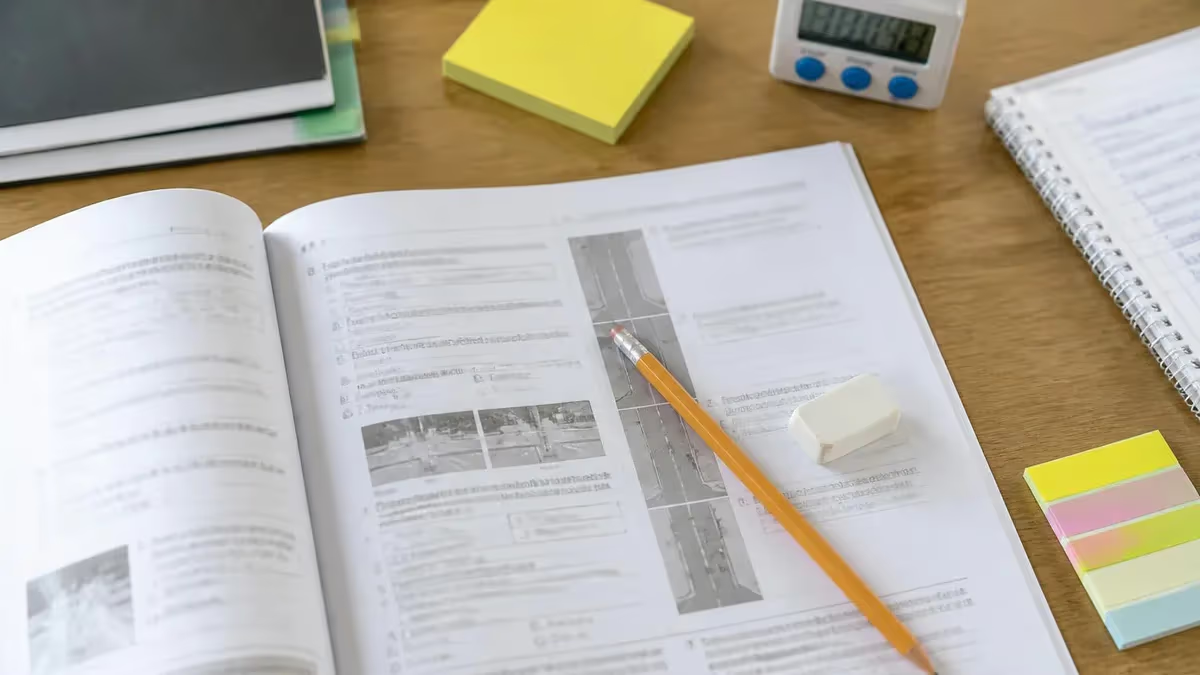
The indiana bmv learners permit book is the foundation of every successful DMV written test attempt in Indiana. Whether you are a first-time teen driver or an adult returning to the road after years away, understanding what the Indiana Bureau of Motor Vehicles expects you to know before handing over your learners permit is the single most important step you can take. This comprehensive study guide walks you through every major topic — from traffic laws and road signs to safe driving practices and alcohol awareness — so you walk into the exam room fully prepared.
Indiana's BMV knowledge exam covers a broad range of material drawn directly from the official Indiana Driver's Manual. The test consists of 34 questions, and you must answer at least 28 correctly — an 82 percent passing threshold — to earn your learner's permit. Many test-takers underestimate the detail required, especially around road signs and markings, speed limit rules in school and construction zones, and right-of-way regulations. A structured study plan that mirrors the exam's actual topics dramatically improves your odds of passing on the first attempt.
One of the most effective ways to reinforce what you read in the manual is to take practice tests that simulate the real exam environment. The indiana bmv learners permit study guide resources available on PracticeTestGeeks.com use question banks modeled after the format and difficulty level of the official Indiana BMV exam, giving you immediate feedback on which areas need more attention before test day arrives.
Road signs and markings are among the highest-frequency topics on the Indiana knowledge test. You will be expected to recognize regulatory signs such as STOP, YIELD, and speed limit placards, as well as warning signs, guide signs, and pavement markings. Many test-takers lose points by confusing similar-looking signs or misremembering color codes. For example, orange signs always indicate construction or maintenance zones, while yellow signs warn of hazards ahead. Drilling these distinctions through repeated practice is far more effective than reading the manual a single time.
Traffic laws in Indiana are nuanced, and the BMV exam tests both general rules and state-specific regulations. Topics include following distances, passing laws on two-lane roads, intersection right-of-way rules, pedestrian crosswalk obligations, and the specific conditions under which a learner's permit holder may drive. Indiana uses a graduated driver licensing system, which means permit holders face restrictions on driving hours, passenger counts, and cell phone use that differ from standard license holders. Knowing these restrictions cold is essential because several exam questions focus specifically on GDL rules.
Safe driving practices extend beyond simple rules into defensive driving philosophy. The Indiana BMV wants to ensure new drivers understand concepts like scanning ahead, maintaining adequate following distance using the three-second rule, adjusting speed for weather conditions, and identifying blind spots before changing lanes. These topics appear in scenario-based questions on the written test, where you must select the safest course of action from several plausible options. Scenario questions are often where underprepared test-takers stumble because they require applied judgment, not just memorized facts.
This guide is organized to cover every exam topic systematically, provide study schedules for different timelines, and point you toward the best practice quizzes to confirm your readiness. By the time you finish, you will have a clear picture of Indiana's learners permit requirements, the exam format, high-yield study topics, and the day-of strategies that consistently help drivers pass the DMV knowledge test on their very first attempt.
Indiana BMV Learners Permit by the Numbers
Key Facts at a Glance
| Item | Value | Details |
|---|---|---|
| Total Exam Questions | 34 | Official Indiana knowledge test length |
| Passing Score | 82% | 28 correct answers required |
| Minimum Age | 16 | To apply for Indiana learners permit |
| Permit Validity | 180 days | Before upgrade to full license |
| Test Attempts | 3 | Allowed before mandatory wait period |

Indiana Learners Permit Study Schedule
- ▸Read Chapters 1-3 of the Indiana Driver's Manual cover to cover
- ▸Memorize all regulatory and warning sign shapes and colors
- ▸Take one baseline practice quiz to identify weak areas
- ▸Create flashcards for speed limits in school and construction zones
- ▸Study Indiana's Graduated Driver Licensing restrictions in detail
- ▸Review right-of-way rules at intersections, roundabouts, and railroad crossings
- ▸Practice 50+ traffic law questions on PracticeTestGeeks.com
- ▸Review alcohol and impaired driving laws — high-frequency exam topic
- ▸Study safe driving practices: following distance, lane changes, merging
- ▸Work through all scenario-based practice questions available
- ▸Take two full 34-question timed practice exams
- ▸Review every question you answered incorrectly and re-read the manual section
- ▸Take three complete timed practice exams targeting 90%+ scores
- ▸Re-study any topic where you score below 85%
- ▸Review permit application documents and BMV office hours
- ▸Get adequate sleep the night before your scheduled test
The official Indiana Driver's Manual is the single authoritative source for every question that appears on the BMV knowledge test. The manual is published by the Indiana Bureau of Motor Vehicles and covers everything from basic vehicle operation and traffic laws to special driving conditions, alcohol impairment, and the state's graduated driver licensing program.
Before diving into practice questions, spending meaningful time with the manual builds the conceptual foundation that makes practice tests far more productive. Reading the manual once through without taking notes, however, is rarely sufficient — active reading with highlights, margin notes, or digital flashcards is significantly more effective.
The manual is divided into chapters, each addressing a distinct category of driving knowledge. Early chapters introduce Indiana traffic laws and the rights and responsibilities of drivers. Middle chapters cover road signs and markings in exhaustive detail, including regulatory signs, warning signs, construction signs, guide signs, and pavement markings. Later chapters address special situations like driving in bad weather, sharing the road with pedestrians and cyclists, and the specific rules governing learner's permit holders under Indiana's GDL system. The exam draws from all of these chapters, so skipping any section creates predictable gaps in your knowledge.
Road signs and markings deserve special emphasis because they represent a disproportionate share of the questions on most state knowledge exams, including Indiana's. The BMV tests your ability to identify signs by shape, color, and symbol — not just by text. A red octagon always means STOP. A yellow diamond warns of a hazard ahead. A white rectangle contains regulatory information like speed limits or lane restrictions. Orange signs mark active construction zones. Knowing these color-shape combinations cold, without hesitation, is one of the most reliable ways to add correct answers on test day.
Indiana traffic laws cover dozens of specific scenarios that new drivers encounter in the real world. The exam tests knowledge of following distance rules (the three-second rule in normal conditions, extended to four or more seconds in wet or icy conditions), passing laws on two-lane highways, the correct procedure for approaching a school bus with flashing red lights, and rules for turning at intersections with and without traffic signals.
Each of these topics has appeared on the Indiana knowledge exam repeatedly and is worth dedicating focused study time to, particularly since the questions are often worded to test precision rather than general awareness.
Indiana's Graduated Driver Licensing system imposes specific restrictions on permit holders that differ meaningfully from the rules for licensed adult drivers. During the learner's permit phase, the permit holder must always be accompanied by a licensed driver who is at least 25 years old and seated in the front passenger seat.
Driving is prohibited between 10 p.m. and 5 a.m. unless the trip is for work, school, or religious activities. Cell phone use, including hands-free devices, is prohibited for permit holders in Indiana — a restriction more stringent than the rules for adult licensed drivers. The BMV knowledge test typically includes two to four questions specifically on GDL restrictions.
Alcohol and drug impairment laws are another high-frequency topic on the Indiana DMV written test. Indiana's legal blood alcohol concentration limit for drivers over 21 is 0.08 percent, but for drivers under 21, any detectable alcohol — effectively a 0.02 percent limit — constitutes a violation under the state's zero-tolerance law. The exam may also ask about Indiana's implied consent law, which states that any driver operating a vehicle on Indiana roads implicitly consents to chemical testing if lawfully stopped on suspicion of impaired driving. Refusing the test triggers an automatic license suspension independent of any criminal conviction.
The driving knowledge test also covers vehicle operation basics that are easy to overlook: how to adjust mirrors correctly, when to use headlights (required from 30 minutes after sunset to 30 minutes before sunrise, and any time visibility is less than 500 feet), proper hand positioning on the steering wheel, and the correct sequence for executing a three-point turn or parallel park.
While these topics may seem elementary, they appear on the exam precisely because many new drivers lack formal instruction on them. Reviewing the manual's vehicle operation sections ensures you do not lose points on questions that are straightforward once you know the specific Indiana rule.
Road Signs and Markings, Traffic Laws & Safe Driving Practices
Indiana's BMV knowledge test devotes significant attention to road signs and markings because correctly reading signage is a foundational safety skill. Regulatory signs — white rectangles with black or red text — tell drivers what they must or must not do: speed limit signs, one-way signs, no-turn signs, and STOP and YIELD signs all fall into this category. Warning signs use yellow diamonds to alert drivers to upcoming hazards such as sharp curves, pedestrian crossings, or merging traffic. Guide signs, typically green or blue, provide directional and distance information to help drivers navigate.
Pavement markings are equally important and frequently tested. A solid yellow center line prohibits passing in either direction, while a broken yellow line permits passing when safe. A solid white line on the right edge of the road marks the road boundary, and white lane lines separate traffic moving in the same direction. Double solid white lines indicate that lane changes are prohibited — a marking commonly found near intersections and toll plazas. Orange pavement markings in construction zones have the same regulatory force as standard markings and must be obeyed even when they conflict with permanent markings.

Online DMV Permit Test Prep vs. Manual-Only Study: Which Approach Wins?
- +Immediate feedback on wrong answers helps you correct misconceptions before they solidify into bad habits
- +Timed practice exams replicate the real pressure of the DMV knowledge test environment
- +Question variety across multiple practice sets ensures you encounter edge-case rules, not just the most common topics
- +Progress tracking shows exactly which categories need more study time, making review sessions efficient
- +Mobile-friendly practice tools let you study during commutes, lunch breaks, or any spare moment throughout the day
- +Repeated exposure to question phrasing trains you to parse tricky wording on the actual exam without second-guessing
- −Practice questions alone without reading the manual can leave conceptual gaps that cause failures on unfamiliar question wording
- −Free practice sites vary in question quality — some use outdated or inaccurate content that does not match current Indiana law
- −Over-relying on memorized answers to specific questions does not build the flexible knowledge needed for scenario-based questions
- −Online-only study can create false confidence if you are scoring high on easy question sets rather than realistic exam-difficulty material
- −Screen fatigue from extended online study sessions can reduce retention compared to varied study methods including physical flashcards
- −Without a structured schedule, online practice tends to focus on already-mastered topics rather than weak areas that need the most work
DMV Written Test Preparation Checklist
- ✓Download or obtain the current Indiana Driver's Manual from the official BMV website before starting your study plan
- ✓Read the entire manual at least once, highlighting key rules, speed limits, and sign descriptions as you go
- ✓Create flashcards for every road sign shape, color, and meaning covered in the manual's signage chapter
- ✓Memorize Indiana's specific GDL restrictions: driving hours, passenger limits, and the cell phone prohibition for permit holders
- ✓Study Indiana's implied consent law and the BAC thresholds for drivers over and under 21 years old
- ✓Take at least five full-length 34-question timed practice exams and aim for 90%+ before scheduling your real test
- ✓Review every incorrect practice answer and re-read the relevant manual section — do not just note the right answer
- ✓Study right-of-way rules for intersections, roundabouts, railroad crossings, and emergency vehicle encounters
- ✓Confirm your test appointment, required documents (proof of identity, residency, Social Security number), and the $9.50 permit fee
- ✓Get a full night of sleep before your exam day and arrive at the BMV office at least 15 minutes early

The 82% Threshold Means You Can Miss Only 6 Questions
Indiana requires 28 correct answers out of 34 questions, leaving no room for careless errors. Test-takers who score between 70% and 80% on practice exams pass practice but fail the real test — close is not enough. Target consistent 90%+ scores on full-length practice exams before scheduling your appointment, and specifically drill road signs, GDL restrictions, and impaired driving laws, which together account for roughly half of all exam questions.
High-yield study topics are those that appear most frequently on the Indiana BMV knowledge exam and carry the highest risk of costing you a passing score if you have not mastered them. Based on the structure of the Indiana Driver's Manual and the exam's question distribution, five categories consistently generate the most questions: road signs and markings, right-of-way rules, speed limits and following distance, Indiana's GDL restrictions, and alcohol and impaired driving laws. Dedicating disproportionate study time to these five areas while maintaining a solid baseline across all others is the most efficient exam preparation strategy available.
Speed limits in Indiana are not one-size-fits-all, and the exam exploits this complexity. The default speed limit in a residential district is 30 mph unless posted otherwise. In school zones during active school hours, the limit drops to 20 mph. On interstate highways, the standard limit is 70 mph for passenger vehicles, though construction zones impose a reduced limit that carries doubled fines for violations.
The exam also tests your knowledge of Indiana's basic speed law, which requires drivers to travel at a speed that is safe for current road conditions regardless of what the posted limit says — meaning a driver traveling 45 mph in a 55 mph zone during a blizzard may still be cited if that speed is deemed unsafe.
Right-of-way rules at various intersection types are tested extensively. At a four-way stop, vehicles must stop completely and proceed in the order they arrived. When two vehicles arrive simultaneously, the driver on the left yields to the driver on the right. At a T-intersection, the vehicle on the dead-end road yields to traffic on the through road.
At a roundabout, vehicles inside the roundabout have the right of way over entering vehicles. When turning left at a green light, you must yield to oncoming traffic and pedestrians crossing the intersection. When entering a road from a private driveway, alley, or parking lot, you must yield to all road traffic and pedestrians on the sidewalk.
The driving knowledge test also covers railroad crossing safety in detail. Drivers must stop no closer than 15 feet and no farther than 50 feet from railroad tracks when a signal is active or when a train is approaching. You may not proceed until the train has completely cleared the crossing and the signals have stopped.
At passive crossings — those without active signals or gates — drivers must reduce speed, look in both directions, and yield to any approaching train. Some exam questions present scenarios involving stopped school buses and large trucks at railroad crossings, where additional rules require these vehicles to stop even when no signal is present.
Pedestrian and bicycle rules appear on the Indiana knowledge exam as well, reflecting the state's commitment to multi-modal road safety. Drivers must yield to pedestrians in marked crosswalks and at intersections where pedestrians have a walk signal. When turning at an intersection, you must yield to pedestrians crossing the road you are turning onto, even if your light is green.
Bicyclists have the same rights and responsibilities as vehicle drivers on Indiana roads, meaning they are entitled to use the full lane when necessary for safety. Passing a cyclist requires leaving at least three feet of clearance — a specific measurement the exam has tested directly.
Emergency vehicle response rules are straightforward but frequently missed by unprepared test-takers. When an authorized emergency vehicle approaches with lights and sirens active, you must pull to the right edge of the road and stop — not slow down, not move to a center turn lane, but stop completely and remain stopped until the emergency vehicle has passed.
Indiana's Move Over law additionally requires drivers to move to a non-adjacent lane when passing a stopped emergency vehicle, tow truck, or highway maintenance vehicle on a multi-lane road. If changing lanes is not safely possible, the law requires you to reduce speed to at least 10 mph below the posted speed limit.
Weather-related driving knowledge rounds out the high-yield topic list. The exam tests your understanding of how to handle hydroplaning (ease off the accelerator, steer straight, do not brake hard), what to do when headlights fail to penetrate fog (use low beams, reduce speed, pull off the road if visibility is too poor to continue), and how to respond to black ice (gentle braking, no sudden steering inputs, maximum following distance). These scenario-based questions require you to select the safest action from multiple plausible options, rewarding test-takers who have internalized the underlying principles rather than simply memorizing rules in isolation.
Indiana requires applicants under 18 to complete an approved driver education course before applying for a learner's permit. The course must include at least 30 hours of classroom instruction and six hours of behind-the-wheel training with a certified instructor. Without proof of driver education enrollment or completion, the BMV will not issue a learner's permit to applicants under 18, regardless of knowledge test scores. Check with your school or a licensed private driving school to enroll before scheduling your BMV appointment.
Passing strategies for the Indiana BMV knowledge test begin well before you walk through the BMV office door. The most impactful strategy is consistent, spaced practice over two to four weeks rather than a last-minute cram session the night before. Research on memory retention consistently shows that spreading study sessions across multiple days with review intervals leads to dramatically better long-term recall than massed practice. For a 34-question exam with a high pass threshold, retaining nuanced rule details under test-day pressure requires this kind of deep encoding, not surface-level familiarity.
Active recall is more effective than passive re-reading. Instead of reading the manual again to review road signs, cover the sign descriptions and test yourself on each shape and color before looking at the answer. Instead of reading through practice question explanations, try to generate the correct rule from memory before confirming it. This forces your brain to retrieve information rather than simply recognize it, which is exactly what the exam demands. Flashcards, self-quizzing, and the practice tests on PracticeTestGeeks.com all use this principle effectively.
Simulate the actual test conditions during your final preparation week. Set a timer for the time allowed on the Indiana exam, use a clean interface without pausing or looking things up, and score yourself honestly. If you are scoring below 90 percent consistently in simulated conditions, reschedule your BMV appointment and continue studying rather than attempting the test prematurely. The BMV allows three attempts before requiring a mandatory waiting period, but each failed attempt creates delays and fees that are easily avoided with adequate preparation time.
On the day of the test, arrive at the BMV office with all required documents assembled: acceptable proof of identity (a birth certificate or valid passport), proof of Indiana residency (a utility bill, bank statement, or school record bearing your name and Indiana address), your Social Security card or a document showing your full Social Security number, and the $9.50 permit application fee. Missing any document means you cannot test that day, creating unnecessary delays. Confirm the complete document requirements on the official Indiana BMV website the day before your appointment since requirements can change.
During the actual exam, read every question carefully before selecting an answer. Indiana BMV questions often include qualifiers like "always," "never," "except," and "unless" that fundamentally change the correct answer. Questions about road signs frequently include distractor answers that are plausible-looking but incorrect in a specific detail — a slightly wrong color, the wrong shape, or an incorrect distance. Take your time, trust your preparation, and resist the urge to change answers unless you have a specific, well-founded reason to do so. First-instinct answers are correct more often than second-guessed revisions for test-takers who have studied properly.
After earning your learner's permit, the real learning accelerates through behind-the-wheel practice with your required supervising driver. Indiana requires permit holders to complete at least 50 hours of supervised driving practice, including at least 10 hours at night, before becoming eligible to upgrade to a probationary license. Keep a driving log to track these hours, as the BMV may require documentation. Use your supervised driving time to practice the skills most heavily tested on the road skills exam: smooth braking and acceleration, precise lane keeping, confident intersection navigation, and parallel parking within defined boundaries.
The transition from permit holder to full license holder in Indiana follows a structured timeline under the GDL system. After holding a learner's permit for at least 180 days and completing the required supervised driving hours, eligible drivers may apply for a probationary license.
The probationary phase imposes its own restrictions — no driving between 10 p.m. and 5 a.m. except for work, school, or religious activities, and no more than one non-family passenger under 25 in the vehicle for the first 180 days. Understanding the full GDL pathway from the start helps you plan your driving practice strategically and avoid violations that could reset your timeline.
Practical test-day tips can make the difference between a passing score and an unnecessary retest for well-prepared candidates. Start your exam morning with a normal breakfast — low blood sugar impairs concentration and slows information retrieval. Avoid caffeine overload, which can increase anxiety and make it harder to read questions carefully. If you use glasses or contacts for vision, wear them to the exam; the BMV requires corrected vision if your uncorrected vision does not meet the state's minimum standard, and you will be tested at the office. Arriving calm, rested, and organized is itself a performance advantage.
During the exam, manage your time without rushing. The Indiana knowledge test does not impose a strict per-question time limit, so you have the flexibility to pause and think through scenario-based questions. If you encounter a question you are uncertain about, make your best-informed guess, note the question number mentally, and continue. There is no penalty for guessing on the Indiana exam, so leaving questions blank is never the right strategy. Return to uncertain questions at the end if time permits and you have a genuine second thought based on specific knowledge, not anxiety.
Process of elimination is a reliable strategy for questions where you are not completely certain. Even if you cannot immediately identify the correct answer, you can often identify one or two options that are clearly wrong based on your manual reading.
Eliminating obviously incorrect distractors increases your probability of selecting the right answer significantly — from 25 percent with a random guess among four options to 50 percent after eliminating two wrong answers. This technique works especially well on road sign identification questions and on questions about specific distances or time intervals where you remember the general rule but not the precise number.
If you fail the knowledge test, Indiana allows you to retake it on a subsequent visit without a waiting period for the first two attempts. The third failure triggers a mandatory waiting period before you can retest.
Rather than retaking the exam as quickly as possible after a failure, use the time to identify which categories caused the most errors — the BMV score report typically indicates missed topic areas — and focus your additional study specifically on those weaknesses. A targeted one-week review of problem areas is almost always more productive than a rushed retake the next day without additional preparation.
Parents and supervising drivers play a crucial role in learner's permit preparation beyond the knowledge test itself. The most effective supervising drivers provide structured, progressive practice starting in low-traffic environments and gradually increasing complexity. Beginning in an empty parking lot to practice basic vehicle control before moving to quiet neighborhood streets and eventually to highways mirrors how professional driving instructors build skills. Each supervised session should include deliberate practice of specific skills — backing into a parking space, executing a three-point turn, merging onto a highway — rather than just accumulating driving time without structured goals.
The driving knowledge test is ultimately a proxy for real-world safety judgment. The Indiana BMV designed the exam to ensure that every new permit holder has a minimum baseline of traffic law knowledge before taking the wheel with a supervisor. Approaching your study with this purpose in mind — not just to pass a test but to genuinely understand why the rules exist — produces both better exam scores and safer drivers.
When you understand that the three-second following distance exists because reaction time plus braking distance at highway speeds requires at least that much space, the rule becomes logical and memorable rather than an arbitrary fact to memorize.
Finally, use every resource available to you. The official Indiana BMV website provides access to the current Driver's Manual, sample knowledge test questions, and complete information about permit requirements and fees. PracticeTestGeeks.com offers targeted practice quizzes covering every major exam topic, including dedicated sets for alcohol and impaired driving laws, basic road rules, and advanced scenario questions. Combining official manual study with targeted online practice testing is the preparation approach that most consistently produces first-attempt passes, regardless of whether you have two weeks or two months before your scheduled exam.
Sample BMV Practice Questions
Try these questions from our free BMV practice tests. The correct answer and an explanation follow each question.
What is the minimum age to apply for a learner's permit in Ohio?
- A. 14 years
- B. 15 years and 6 months
- C. 16 years
- D. 18 years
Answer: B. 15 years and 6 months
Ohio allows teens to apply for a temporary permit at 15 years and 6 months.
At night, you must dim your high-beam headlights when within how many feet of an oncoming vehicle in Indiana?
- A. 150 feet
- B. 300 feet
- C. 500 feet
- D. 1,000 feet
Answer: C. 500 feet
Indiana law requires drivers to dim high beams within 500 feet of an oncoming vehicle to avoid blinding the other driver.
What is the legal blood alcohol concentration (BAC) limit for drivers aged 21 and older in Indiana?
- A. 0.05%
- B. 0.06%
- C. 0.08%
- D. 0.10%
Answer: C. 0.08%
The legal BAC limit for drivers 21 and older in Indiana (and all US states) is 0.08%, above which a driver is presumed impaired.
What is the typical penalty for a first-offense OWI in Indiana?
- A. Warning only
- B. A Class C misdemeanor with up to 60 days in jail and a fine up to $500
- C. A Class A misdemeanor with up to one year in jail and a fine up to $5,000
- D. Automatic 10-year license revocation
Answer: B. A Class C misdemeanor with up to 60 days in jail and a fine up to $500
A first OWI offense in Indiana is a Class C misdemeanor, punishable by up to 60 days in jail and a fine up to $500, plus license suspension.
BMV Questions and Answers

DMV Driver's License Written Test Questions: Complete Study Guide and Practice Strategy for 2026

BMV Hours of Operation: Everything You Need to Know Before Your DMV Written Test
Ohio BMV Hours: Office Schedules, Online Services, and What to Know

Indiana BMV License Renewal Cost: Fees, Requirements, and How to Prepare for the DMV Written Test

BMV Driving Test Schedule: Everything You Need to Know About the DMV Written Test
About the Author

Licensed Driving Instructor & DMV Test Specialist
Penn State UniversityRobert J. Williams graduated from Penn State University with a degree in Transportation Management and has spent 20 years as a certified driving instructor and DMV examiner consultant. He has personally coached thousands of applicants through written knowledge tests, skills assessments, and commercial driver licensing programs across more than 30 states.
Join the Discussion
Connect with other students preparing for this exam. Share tips, ask questions, and get advice from people who have been there.
View discussion (9 replies)