
Failed DMV Test for Cheating: What Really Happens, Consequences, and How to Recover
Failed DMV test for cheating? Learn the real consequences, 🟢 retest waiting periods, state penalties, and how to legitimately pass on your next attempt.
Being told you failed DMV test for cheating is one of the most stressful outcomes a new driver can face at the licensing office. Unlike a normal failure where you simply missed too many questions, a cheating disqualification carries administrative penalties, mandatory waiting periods, and sometimes a permanent note on your driving record. This guide walks through exactly what happens when an examiner suspects cheating, how different state DMVs handle the situation, and the concrete steps you can take to recover quickly and pass the test legitimately on your next visit.
Cheating accusations at the DMV usually fall into a handful of categories: using a phone during the written knowledge exam, glancing at a neighbor's screen, hiding notes in clothing or under the testing table, or signaling answers to another test taker. Modern DMV offices use overhead cameras, partitioned cubicles, and proctored testing stations specifically to detect these behaviors. Even an honest mistake like checking the time on a smartwatch can be interpreted as a violation, which is why understanding the rules matters before you ever sit down at the terminal.
The consequences are not just losing the test attempt. Most states impose a waiting period of 30 days to 6 months before you can retest, charge an additional fee on top of the standard retake price, and may require you to start over with a learner's permit if you held one. In some states, your application is denied entirely for a year, and the incident is documented in a way that future employers running a Motor Vehicle Record check could potentially see. The stakes are higher than most people realize.
This article covers the most common cheating scenarios, what evidence examiners actually need to disqualify you, your appeal rights, and the difference between a void test and a fraud finding. We also cover what to do in the days immediately following the incident, how to prepare for a clean retake, and how to use legitimate study tools effectively so you never need to consider shortcuts again. Whether your situation involves an actual violation or a misunderstanding you want to resolve, the information here will help you move forward with confidence.
It is worth noting up front that most DMV examiners are not looking to trap you. They follow strict protocols, document what they see, and report it through standardized channels. If you genuinely did not cheat, you have a path to challenge the determination, but it requires acting quickly and following the appeals process specific to your state. If you did cheat, the fastest way out is honesty, completing the waiting period, and demonstrating you have legitimately learned the material before your next attempt.
Throughout this guide we reference DMV procedures across multiple states because rules vary widely. California, Texas, Florida, Ohio, and New York all handle cheating allegations differently in terms of waiting periods, documentation, and reinstatement requirements. We will highlight these differences so you can identify what applies to your situation. For helpful procedural context on related licensing visits, see our BMV Appointment Guide: How to Schedule, Prepare, and Pass Your Visit on the First Try for tips that apply equally to retake appointments.
DMV Cheating Disqualifications by the Numbers

What Counts as Cheating at the DMV
Any glance at a phone, smartwatch, earbud, or connected device during the written exam is treated as cheating. Examiners require devices to be stowed completely. Even reading a text counts.
Bringing study notes, cheat sheets, written formulas on hands, or sign images printed inside clothing all qualify. Testing stations are searched visually before you begin.
Glancing at the test taker next to you, even briefly or accidentally, is treated as a violation. DMV cubicles are positioned and proctored specifically to catch this behavior.
Signaling, mouthing answers, or accepting hand gestures from another person in the lobby or waiting area is grounds for immediate disqualification of both parties involved.
Having another person take the test for you, using fake identification, or submitting forged documents elevates the case from a simple violation to potential criminal fraud charges.
The immediate consequences of being caught cheating at the DMV begin the moment the examiner approaches your station. You will typically be asked to step away from the terminal, your test will be voided on the spot, and you will be escorted to a separate area where a supervisor documents the incident. In most cases your application paperwork is marked, your photo is captured if it was not already, and you are given a written notice explaining the reason for the disqualification and the date you may reapply.
Beyond losing the test attempt, the financial impact adds up quickly. The fees you already paid for the application and the test are usually forfeited, meaning when you return you pay them again. Some states charge an additional administrative fee of $25 to $75 specifically for processing a violation. If you held a learner's permit, the time spent under that permit may not count toward graduated licensing requirements, effectively resetting your supervised driving clock from zero.
The waiting period before you can retest is the most significant practical penalty for most people. In California, a confirmed cheating incident triggers a 12-month wait before reapplication. In Texas, the wait is typically 90 days for a first offense. Ohio imposes a 6-month delay and requires the applicant to retake any vision and driving portions even if those were completed. The exact length depends on whether the examiner classified the incident as a simple violation or as fraud, with fraud carrying the heavier penalty.
Documentation is another consideration people often overlook. The incident is logged in your DMV file and remains visible to examiners during any future visit. If you apply for a commercial driver's license later, the CDL examiner can see prior fraud findings. Some employers conducting Motor Vehicle Record checks for driving positions request a full history rather than a basic abstract, and a fraud notation can appear in that fuller report. The administrative record matters even if no criminal charge is filed.
If the cheating involved impersonation, fake identification, or a forged document, the matter often moves beyond DMV administrative action into criminal territory. Identity-related offenses can be charged as misdemeanors or felonies depending on the state and the specifics of what was presented. Local law enforcement may be called to the DMV office during processing, and the applicant could be cited or arrested rather than simply sent home. These cases are rare but they do happen, particularly when commercial endorsements or hazmat credentials are involved.
If you are uncertain about what to bring to your next visit and what is allowed at the testing terminal, our DMV Testing Area No Cell Phones Allowed: Complete Rules Guide for Your Driving Exam walks through the exact items prohibited inside the testing area. Reviewing it carefully before your retake helps you avoid any second incident that could compound the original penalty and extend your wait time even further.
The emotional impact of being accused, particularly when the accusation was a misunderstanding, can be significant. Many people leave the DMV in tears or in shock and make rushed decisions about whether to argue, sign forms, or walk away. The single most important thing to do in that moment is to stay calm, request a written copy of the violation notice, ask the supervisor how to file an appeal, and leave without making statements you have not thought through. You can always return to challenge the finding once you have your documentation in hand.
BMV Practice Test Questions
Prepare for the BMV - Test exam with our free practice test modules. Each quiz covers key topics to help you pass on your first try.
BMV Basic BMV Practice
BMV Exam Questions covering Basic BMV Practice. Master BMV Test concepts for certification prep.
BMV Alcohol, Drugs, and Impaired Driving Laws
Free BMV Practice Test featuring Alcohol, Drugs, and Impaired Driving Laws. Improve your BMV Exam score with mock test prep.
BMV Licensing Requirements
BMV Mock Exam on BMV Licensing Requirements. BMV Study Guide questions to pass on your first try.
BMV Traffic Laws
BMV Test Prep for BMV Traffic Laws. Practice BMV Quiz questions and boost your score.
BMV Vehicle Operations
BMV Questions and Answers on BMV Vehicle Operations. Free BMV practice for exam readiness.
BMV Parking, Right-of-Way, and Intersections
BMV Mock Test covering Parking, Right-of-Way, and Intersections. Online BMV Test practice with instant feedback.
BMV Road Signs and Markings
Free BMV Quiz on Road Signs and Markings. BMV Exam prep questions with detailed explanations.
BMV Safe Driving and Hazard Awareness
BMV Practice Questions for Safe Driving and Hazard Awareness. Build confidence for your BMV certification exam.
Failed DMV Test for Cheating: State-by-State Rules
California treats DMV cheating as a serious administrative offense under Vehicle Code section 1808. A confirmed first-time cheating incident typically results in a 12-month waiting period before the applicant can reapply for a license. The DMV will retain all fees paid for the violated test and require a complete new application with full fees at reapplication time.
If the case involves fraudulent documentation or impersonation, California can refer the matter to the California Highway Patrol or local district attorney for misdemeanor or felony prosecution. Applicants have 10 days to request an administrative hearing if they wish to contest the finding, and they must submit the request in writing using DMV form DS 699 or its current equivalent.
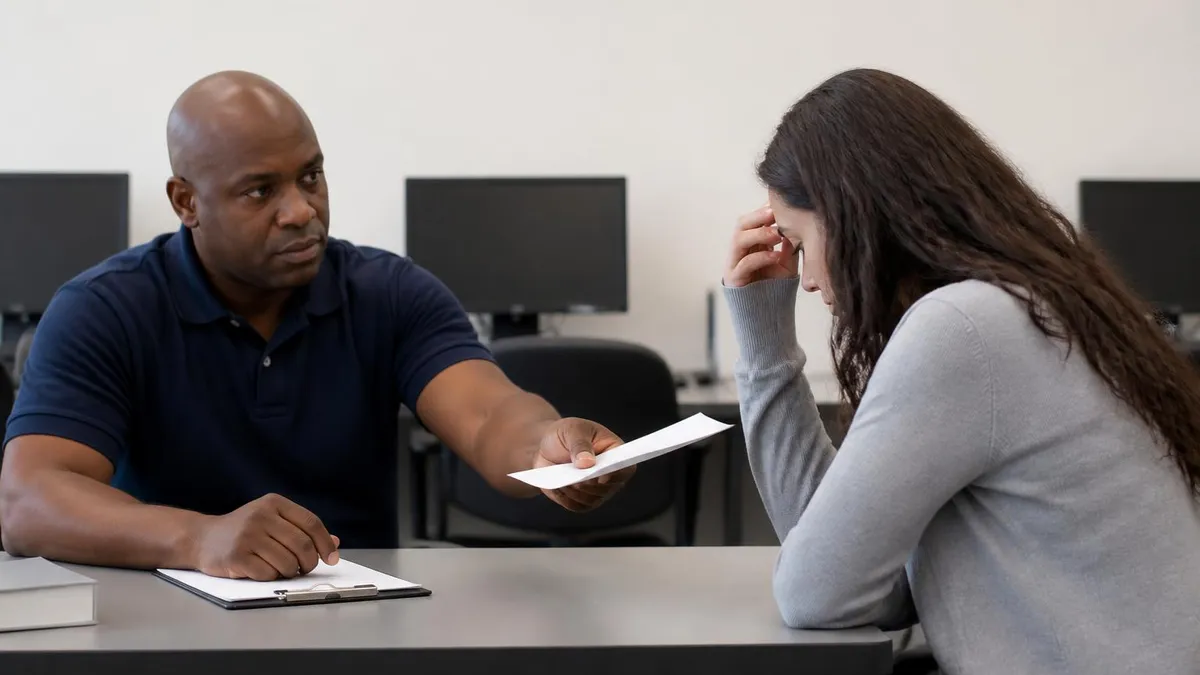
Accepting the Penalty vs. Filing an Appeal
- +Filing an appeal preserves your right to challenge an unfair determination
- +Successful appeals can erase the violation from your driving record entirely
- +The appeal process forces the DMV to produce written evidence of the alleged behavior
- +Even an unsuccessful appeal often reduces the waiting period or removes the fraud notation
- +You gain valuable time to study and prepare for the retake during the appeal window
- +Documented appeals create a paper trail useful if a future employer questions the incident
- +Accepting quickly avoids prolonging the stressful experience and lets you focus forward
- −Appeals require time off work to attend an administrative hearing in person
- −Hearings can take 60 to 120 days to be scheduled in busy DMV districts
- −Legal representation is recommended for fraud cases and adds cost
- −If the appeal fails, the original penalty stands and the waiting clock restarted
- −Some states extend the waiting period if the appeal is found frivolous
- −Documentation submitted during the appeal becomes part of your permanent file
- −Emotional stress of reliving the incident at a formal hearing can be significant
Pros and Cons at a Glance
| Pros | Cons |
|---|---|
| Filing an appeal preserves your right to challenge an unfair determination | Appeals require time off work to attend an administrative hearing in person |
| Successful appeals can erase the violation from your driving record entirely | Legal representation is recommended for fraud cases and adds cost |
| The appeal process forces the DMV to produce written evidence of the alleged behavior | If the appeal fails, the original penalty stands and the waiting clock restarted |
| Even an unsuccessful appeal often reduces the waiting period or removes the fraud notation | Some states extend the waiting period if the appeal is found frivolous |
| You gain valuable time to study and prepare for the retake during the appeal window | Documentation submitted during the appeal becomes part of your permanent file |
| Documented appeals create a paper trail useful if a future employer questions the incident | Emotional stress of reliving the incident at a formal hearing can be significant |
Retake Preparation Checklist After a Cheating Disqualification
- ✓Request and save a written copy of the violation notice from the supervisor
- ✓Confirm the exact retest eligibility date in writing before leaving the DMV office
- ✓Calculate any application fees you will need to pay again at reapplication
- ✓Read your state's driver handbook from cover to cover at least twice
- ✓Take at least five full-length practice tests scoring 90% or higher before scheduling
- ✓Leave your phone, smartwatch, and earbuds in your vehicle on test day
- ✓Arrive 30 minutes early and complete check-in calmly without rushing
- ✓Bring two forms of identification and any required residency documents
- ✓Listen carefully to the examiner's pre-test instructions and ask questions if unclear
- ✓Sit upright, keep eyes on your own screen, and avoid any ambiguous movements
Examiners watch the retake closer than the original
Once you have been flagged for cheating, your file is marked and the examiner conducting your retake is alerted. Every gesture, glance, and pause is scrutinized more carefully. This is not paranoia — it is documented DMV protocol. Keep your hands visible, eyes on your screen, and avoid any behavior that could be misinterpreted.
The appeals process exists specifically for applicants who believe they were wrongly accused of cheating. Every state DMV is required by administrative law to provide a hearing mechanism, though the procedural specifics vary. The first step in any appeal is to request a written copy of the violation report — not just the notice you received at the counter, but the detailed examiner's report that describes what behavior was observed, when, and by whom. This document is the foundation of any successful challenge.
In most states you have between 10 and 30 days to file a formal appeal after receiving the violation notice. Miss this window and the determination becomes final, with no further administrative recourse available. Filing usually requires a written letter or completed form, payment of a small filing fee in some states, and a brief statement of the grounds for your challenge. Common successful grounds include factual inaccuracy in the examiner's report, lack of corroborating video evidence, and procedural errors in how the violation was processed.
Video evidence is often the deciding factor in cheating appeals. Most modern DMV offices have overhead cameras covering the testing terminals, and that footage is typically retained for 30 to 90 days. If your appeal includes a request for video review, the hearing officer can compare the footage against the examiner's written description of what occurred. In cases where the video does not clearly show the alleged behavior, hearings frequently result in the violation being reduced or dismissed entirely.
Bringing a witness can strengthen your case if someone was with you in the testing area or lobby. Family members, friends who drove you to the appointment, or other test takers seated nearby can sometimes provide testimony about what they observed. Witness statements should be submitted in writing before the hearing and include the person's contact information so the hearing officer can verify if needed. Even informal witness accounts can shift the outcome when video evidence is inconclusive.
Legal representation is worth considering if the violation has been classified as fraud rather than a simple infraction. Fraud findings carry potential criminal exposure, and the standard of evidence at a fraud-related hearing is different from a routine administrative dispute. A traffic attorney or administrative law attorney familiar with your state's DMV procedures can review the report, identify weaknesses in the examiner's documentation, and represent you at the hearing. Many offer free initial consultations specifically for DMV matters.
The hearing itself is usually informal, held at a regional DMV office or by video conference, and presided over by an administrative hearing officer rather than a judge. You will have the opportunity to present your evidence, the DMV will present its report, and the officer will issue a written decision within 30 to 60 days. If the appeal succeeds, the violation is removed from your record and any waiting period is lifted. If it fails, you have the option to file a further appeal in state superior court, though this is rare and costly.
Documentation matters at every stage. Keep copies of every notice, receipt, letter, email, and form involved in your case. Maintain a written timeline noting the date of the original incident, the date you received the violation notice, the date you filed the appeal, and any hearing dates. This paper trail protects you if there are administrative errors and serves as evidence of your good-faith effort to resolve the matter properly.

DMV supervisors sometimes ask applicants to sign an acknowledgment of the violation before leaving the office. Read it carefully. Signing an admission can waive your appeal rights and lock in the longer penalty. You are not required to sign anything to leave — request a copy to review at home first.
Passing the DMV test legitimately on your retake is entirely achievable with focused preparation, and the waiting period imposed by the cheating disqualification actually gives you more than enough time to master the material. Most state knowledge tests cover the same core topics: road signs, right-of-way rules, speed limits, parking regulations, alcohol and drug impairment laws, and safe driving practices. None of these topics requires memorizing obscure trivia — they reward consistent study and repeated exposure to question formats.
Start with your state's official driver handbook. Every state publishes a free PDF version, and the questions on the actual test are drawn directly from this document. Read it twice end to end, taking notes on sections that confuse you or contain numerical thresholds like BAC limits, following distances, and minimum insurance amounts. The handbook is the authoritative source — third-party study guides can contradict it, and on test day the handbook wins.
Practice tests are the second pillar of effective preparation. Free practice tests like those available throughout PTGquiz are designed to mirror the format, difficulty, and topic distribution of the real DMV exam. Take a baseline test before you start serious studying to identify your weak areas, then take targeted practice tests on those specific topics until you consistently score 90% or higher. Take at least two full-length mixed practice tests in the final week before your appointment.
Time management on test day is often overlooked. Most DMV knowledge tests give you 30 to 45 minutes for 25 to 50 questions, which is generous if you have studied but tight if you are second-guessing every answer. Read each question fully, eliminate obviously wrong options first, then choose between the remaining two based on what the handbook says. Do not change answers unless you have a clear reason — first-instinct answers are correct more often than revised ones.
Sleep and nutrition matter more than people expect. The night before your retake, get a full eight hours of sleep, eat a balanced breakfast on the day of, and avoid excessive caffeine that can make you jittery during the test. Arrive at the DMV at least 30 minutes early so you have time to check in calmly, use the restroom, and settle your nerves before being called to the testing terminal. Rushing in stressed is one of the most common preventable causes of avoidable mistakes.
Once you are seated at the terminal, follow the examiner's instructions exactly. Place your phone in the designated tray or your bag, keep your hands on the keyboard or touchscreen, and avoid looking around the room. If you genuinely need to stretch or adjust your posture, do so slowly and obviously rather than in a way that could be misinterpreted. The goal is to complete the test with zero ambiguous behavior that could trigger another examiner concern.
If your retake involves the road test in addition to the written exam, our Ohio BMV Driving Test: Maneuverability, Road and Pass Tips walks through what examiners look for during the practical evaluation. The same general principles apply nationwide: smooth controlled movements, full stops at every stop sign, proper mirror checks before lane changes, and complete shoulder checks for blind spots. Most road test failures come from missing these fundamentals rather than from advanced driving errors.
Final preparation tips can make the difference between a confident retake and a second stressful experience. In the week before your retest, build a daily routine: 30 minutes of handbook review in the morning, one practice test in the evening, and a brief review of incorrect answers before bed. This spaced repetition pattern is far more effective than cramming the night before, and it embeds the material in long-term memory rather than short-term recall.
Pay particular attention to the topic areas where most people lose points. Alcohol and drug impairment questions are heavily represented on every state test and often contain numerical thresholds that test takers confuse — for example, the standard BAC limit of 0.08% for adults, the 0.02% limit for drivers under 21, and the 0.04% limit for commercial drivers. Memorize these specific numbers cold. Right-of-way scenarios at four-way stops, uncontrolled intersections, and roundabouts are another high-frequency topic worth extra attention.
Road sign recognition is the easiest section to master and the most embarrassing to miss. Learn the meaning of every regulatory sign (red and white), every warning sign (yellow diamond), every construction sign (orange), and every guide sign (green or blue) shown in your handbook. Many state tests now include image-based sign questions where you identify a sign by its shape and color even when the words are obscured. Repeated visual exposure during practice tests is the most efficient way to build this recognition.
Mental preparation on test day is just as important as the academic preparation. Acknowledge that you may feel nervous, particularly given the prior incident, and plan for that. Take three deep breaths before you start the test. Read the first question carefully and answer it confidently to build momentum. If you encounter a question you cannot answer, flag it and return to it after completing the rest — most testing systems allow you to skip and revisit.
After the test, regardless of the outcome, take a moment to reflect on what went well. If you passed, congratulations — request your interim license document immediately and confirm when your permanent card will arrive in the mail. If you did not pass on the knowledge portion, ask for a printed score report showing which topic areas you missed and use it to focus your next study cycle. The DMV is required to provide this information on request in most states.
Maintaining a clean record going forward is the final piece. Once you have passed and obtained your license, drive defensively, avoid traffic violations, and keep your insurance current. A cheating incident on your application record is one thing — a clean driving history afterward demonstrates that the incident was a one-time event and not a pattern. Within a few years, that clean record becomes the dominant entry, and the original violation fades into administrative background noise that rarely surfaces in practical contexts.
Finally, remember that thousands of people retake DMV tests every year for many reasons including cheating disqualifications, and the vast majority pass legitimately on their next attempt. The waiting period is frustrating but finite. Use it productively, prepare thoroughly, and approach the retake with the calm confidence that comes from genuine knowledge. The license at the end of the process is the same license everyone else holds, and once you have it, you are on equal footing with every other driver on the road.
Sample BMV Practice Questions
Try these questions from our free BMV practice tests. The correct answer and an explanation follow each question.
What is the consequence of refusing a chemical test (breath, blood, or urine) in Indiana?
- A. No penalty unless convicted of OWI
- B. Automatic license suspension for at least one year
- C. A small fine but no license action
- D. You may refuse without any consequence
Answer: B. Automatic license suspension for at least one year
Under Indiana's implied consent law, refusing a chemical test results in automatic license suspension of at least one year, regardless of OWI conviction.
What is the legal blood alcohol concentration (BAC) limit for drivers 21 and over?
- A. 0.08%
- B. 0.10%
- C. 0.05%
- D. 0.02%
Answer: A. 0.08%
The legal BAC limit for drivers 21 and over is 0.08% in all US states. Driving at or above this level constitutes DUI/DWI.
What does a flashing yellow traffic signal mean?
- A. Stop completely
- B. Proceed with caution
- C. The signal is broken
- D. Turn only
Answer: B. Proceed with caution
A flashing yellow light means slow down and proceed with caution.
What is required to prove Ohio residency at the BMV?
- A. Two documents showing your name and address
- B. A passport only
- C. A birth certificate
- D. A single utility bill from any state
Answer: A. Two documents showing your name and address
The BMV requires two proofs of Ohio residency showing name and current address.
BMV Questions and Answers
Driver Test Car Rental in Gastonia, NC: Complete BMV Road Test Vehicle Guide

Ohio BMV Driving Test: Maneuverability, Road and Pass Tips
DMV Testing Area No Cell Phones Allowed: Complete Rules Guide for Your Driving Exam
Hours of Ohio BMV: Complete Guide to Office Hours, Locations, and Visit Planning

BMV Appointment Guide: How to Schedule, Prepare, and Pass Your Visit on the First Try
About the Author
Licensed Driving Instructor & DMV Test Specialist
Penn State UniversityRobert J. Williams graduated from Penn State University with a degree in Transportation Management and has spent 20 years as a certified driving instructor and DMV examiner consultant. He has personally coached thousands of applicants through written knowledge tests, skills assessments, and commercial driver licensing programs across more than 30 states.
Join the Discussion
Connect with other students preparing for this exam. Share tips, ask questions, and get advice from people who have been there.
View discussion (9 replies)