
DMV Written Test Study Guide: What Indiana Drivers Need to Know About Road Signs, Traffic Laws, and Safe Driving
🆕 Ace your DMV written test with this complete guide to road signs, traffic laws, and safe driving practices. Free BMV practice tests included.

The DMV written test is the first major milestone on every new driver's journey, and understanding exactly what it covers — from road signs and markings to traffic laws and safe driving practices — can make the difference between passing on your first attempt and returning to the BMV a second or third time.
Many test-takers search for answers to questions like "is genetic testing covered by insurance" when they really mean they want to know whether their preparation resources are comprehensive enough to guarantee a passing score. The good news is that Indiana's BMV knowledge test follows a predictable format, and with the right study approach, most applicants can pass confidently after just two to three weeks of focused preparation.
The DMV knowledge test evaluates your understanding of Indiana traffic laws, your ability to recognize road signs and markings in real-world conditions, and your grasp of safe driving practices that protect both you and other road users. The test consists of 50 multiple-choice questions drawn from the Indiana Driver's Manual, and you must answer at least 42 correctly — an 84 percent score — to receive a passing grade.
First-time test-takers who underestimate the depth of the material often find themselves tripped up by nuanced questions about right-of-way rules, speed limit exceptions, and the precise meanings of less common warning signs. Thorough study is not optional if you want a first-attempt pass.
Indiana's BMV administers the driver license test in both standard and online formats, giving applicants flexibility in how and where they complete the examination. The online DMV permit test option has expanded significantly in recent years, allowing qualified applicants to take the knowledge assessment from a computer at home or at a public kiosk.
Whether you choose an in-person or online format, the content remains identical: questions about traffic laws, road signs and markings, speed limits, driving knowledge related to emergency situations, and the safe driving practices outlined in the state's official driver manual. Knowing this lets you focus your energy on the right material.
One of the most efficient ways to prepare for the DMV written test is through structured practice using questions that mirror the real exam's difficulty and phrasing. Studies on driver education consistently show that test-takers who complete at least three to five full-length practice tests score significantly higher on their official knowledge exam than those who only read the manual once.
Practice tests train your brain to recall specific facts quickly under mild pressure, build familiarity with the multiple-choice format, and highlight the individual topics — like right-of-way at uncontrolled intersections or the rules for passing on two-lane roads — where your understanding still has gaps.
Road signs and markings form a substantial portion of the BMV knowledge test, often accounting for 20 to 25 percent of all questions. Indiana test-takers must be able to identify signs by shape and color alone, without relying on the text printed on them. An octagon is always a stop sign, a triangle pointing downward always signals yield, and a diamond shape always indicates a warning.
Regulatory signs appear in red and white, guide signs in green or blue, and warning signs in yellow or fluorescent yellow-green. Mastering this visual vocabulary before test day ensures you won't second-guess yourself on any sign-recognition question.
Traffic laws governing speed limits, following distances, lane changes, and right-of-way account for another large chunk of the driving knowledge test. Indiana law sets default speed limits of 30 mph in urban districts, 55 mph on rural two-lane roads, and 70 mph on interstate highways unless otherwise posted. The three-second following distance rule applies under ideal conditions, and that gap should extend to six or more seconds in rain, fog, or construction zones. Understanding these precise figures — rather than vague approximations — is what separates well-prepared applicants from those who answer "close enough" and still get the question wrong.
Safe driving practices covered on the DMV test extend beyond mechanical rules to include judgment calls: when to use your horn, how to handle a tire blowout at highway speed, what to do when an emergency vehicle approaches from behind, and how to navigate school zones safely.
You can explore additional guidance on test preparation logistics and vehicle requirements through resources like genetic testing insurance coverage comparisons, which help prospective drivers understand exactly what documentation and vehicle standards the BMV expects. Building a complete picture of the entire licensure process — not just the written test — sets you up for success at every stage.
Indiana BMV Written Test by the Numbers
Key Facts at a Glance
| Item | Value | Details |
|---|---|---|
| Total Test Questions | 50 | Multiple choice format |
| Minimum Passing Score | 84% | 42 correct answers required |
| Time Allowed | 60 min | Most finish in 30-40 minutes |
| Retake Attempts Allowed | 3x | Before additional wait period |

What the Indiana BMV Knowledge Test Covers
Approximately 20-25% of questions test your ability to identify sign shapes, colors, and meanings — including warning, regulatory, guide, and construction signs. You must recognize signs by shape even when the text is obscured.
Questions on speed limits, right-of-way rules, passing laws, lane discipline, and turning regulations make up roughly 35% of the exam. Exact legal numbers — not approximations — are required for full credit.
This section addresses defensive driving techniques, following distances, emergency vehicle protocols, school zone behavior, and hazard recognition. Expect 15-20 questions focused on judgment in realistic scenarios.
Indiana law is explicit about BAC limits (0.08% for adults, 0.02% for drivers under 21), penalties for OWI, and the chemical test refusal consequences. These questions carry heavy point value and demand precise answers.
Questions about seat belt laws, child restraint requirements, headlight use, and vehicle inspection expectations round out the exam. Indiana's primary seat belt law means officers can stop drivers solely for non-compliance.
Understanding road signs and markings at a deep level — not just memorizing their shapes — is the foundation of performing well on the Indiana DMV written test. Road signs communicate critical information in fractions of a second, and the entire sign system is engineered around redundancy: shape conveys the category of message, color confirms it, and text or symbols specify the detail.
When you understand this layered logic, even an unfamiliar sign becomes decipherable. For example, any diamond-shaped yellow sign warns of a potential hazard ahead, whether that hazard is a sharp curve, a school crossing, a low clearance, or an animal crossing zone.
Regulatory signs — the ones that give you legally binding instructions — are almost always white with red or black text. The stop sign's octagonal shape is internationally recognized, but many test-takers overlook the significance of the yield sign's downward-pointing triangle, the do-not-enter sign's square with a horizontal red bar, or the wrong-way sign that uses the same color vocabulary to reinforce a life-critical message.
Pavement markings add another layer: solid white lines separate same-direction traffic and prohibit lane changes, dashed white lines permit lane changes, and double solid yellow lines mark a no-passing zone for traffic in both directions. Knowing these distinctions cold will let you answer marking questions in seconds.
Traffic laws are where many test-takers lose points because Indiana's rules are specific about numbers. The state mandates a minimum following distance of three seconds under dry, clear conditions — calculated by picking a fixed roadside object and counting the time between when the vehicle ahead passes it and when your front bumper reaches the same point.
In rain or low visibility, the recommended following distance doubles to at least six seconds. In school zones during posted hours, the maximum speed is 20 mph in Indiana unless a different speed is posted, and violations in school zones carry doubled fines. These specific figures appear frequently on the DMV knowledge test.
Right-of-way rules generate some of the most challenging questions on the driving knowledge test because they require you to apply logic to a described scenario rather than recall a simple fact. At a four-way stop, the first vehicle to arrive goes first; when two vehicles arrive simultaneously, the vehicle on the right has the right-of-way; when three or four vehicles arrive at once, the vehicle facing the fewest potential conflict points proceeds.
At uncontrolled intersections where no signs are present, yield to vehicles already in the intersection and to vehicles approaching from your right. Practicing these scenarios with real exam questions is far more effective than reading the rules passively.
Indiana's safe driving practices requirements include specific guidance on how to handle a vehicle during emergency situations that catch many new drivers off guard. If a front tire blows out at highway speed, the correct response is to grip the steering wheel firmly, ease off the accelerator without braking hard, and steer gradually to the shoulder — braking aggressively during a blowout can cause loss of control.
If a rear tire blows out, the vehicle will pull toward the damaged tire; steer in the opposite direction with gentle corrections. The BMV tests on these scenarios because they represent real life-or-death decisions that new drivers must make without time to think.
The rules surrounding school buses are another area that the Indiana DMV written test covers with notable frequency. When a school bus displays its red flashing lights and extends its stop arm on an undivided two-lane road, all traffic in both directions must stop at least 10 feet from the bus and remain stopped until the arm retracts and the lights stop flashing.
On a divided highway with a physical median barrier, only traffic behind the bus must stop; traffic on the opposing side of the median may continue. Violations of the school bus stopping law in Indiana carry fines beginning at $500 for a first offense and can include license suspension.
Alcohol and impaired driving laws are tested heavily on the BMV knowledge exam because Indiana, like all U.S. states, uses the written test as a primary educational tool for communicating the legal and safety consequences of impaired operation. The legal blood alcohol concentration limit is 0.08 percent for drivers aged 21 and older, 0.04 percent for commercial vehicle operators, and 0.02 percent for drivers under 21.
Indiana operates under implied consent law, meaning that by accepting a driver's license you have already legally consented to chemical testing if an officer has probable cause to suspect impairment. Refusing a test results in automatic license suspension of at least one year, separate from any criminal OWI charges.
BMV Practice Test Questions
Prepare for the BMV - Test exam with our free practice test modules. Each quiz covers key topics to help you pass on your first try.
BMV Basic BMV Practice
BMV Exam Questions covering Basic BMV Practice. Master BMV Test concepts for certification prep.
BMV Alcohol, Drugs, and Impaired Driving Laws
Free BMV Practice Test featuring Alcohol, Drugs, and Impaired Driving Laws. Improve your BMV Exam score with mock test prep.
BMV Licensing Requirements
BMV Mock Exam on BMV Licensing Requirements. BMV Study Guide questions to pass on your first try.
BMV Traffic Laws
BMV Test Prep for BMV Traffic Laws. Practice BMV Quiz questions and boost your score.
BMV Vehicle Operations
BMV Questions and Answers on BMV Vehicle Operations. Free BMV practice for exam readiness.
BMV Parking, Right-of-Way, and Intersections
BMV Mock Test covering Parking, Right-of-Way, and Intersections. Online BMV Test practice with instant feedback.
BMV Road Signs and Markings
Free BMV Quiz on Road Signs and Markings. BMV Exam prep questions with detailed explanations.
BMV Safe Driving and Hazard Awareness
BMV Practice Questions for Safe Driving and Hazard Awareness. Build confidence for your BMV certification exam.
Driving Test Online vs. In-Person: What to Expect
Indiana's online DMV permit test option allows eligible applicants to complete the knowledge examination through a secure digital platform without visiting a BMV branch. The online version uses the same question bank and passing threshold as the in-person test — 42 out of 50 correct answers. Applicants must verify their identity before starting, and the system uses randomized question ordering to prevent memorization shortcuts.
The online format is especially useful for applicants with transportation challenges or those who live far from a BMV branch. However, not all applicants are eligible; Indiana's online testing system typically restricts access to first-time permit applicants who have not previously failed the knowledge test at a branch. If you have already failed in-person, you will likely need to return to a physical BMV location for subsequent attempts. Confirm your eligibility before scheduling an online session.

Practice Tests vs. Reading the Manual Only: Which Approach Wins?
- +Practice tests expose the exact question formats and phrasing you'll encounter on test day, eliminating surprises
- +Instant feedback after each question builds accurate understanding faster than passive reading
- +Timed practice sessions train you to answer within the pace the real test requires
- +Topic-specific quizzes let you concentrate study time on your weakest areas instead of re-reading everything
- +Repeated exposure to right-of-way and sign-recognition scenarios builds reflexive recall under pressure
- +Completing multiple full-length practice exams builds the mental stamina to stay focused through all 50 questions
- −Practice tests alone won't explain the reasoning behind rules — the manual provides context that prevents misapplication
- −Some practice test providers use outdated or inaccurate questions that don't reflect current Indiana law
- −Over-reliance on memorizing specific practice questions can leave gaps when the real test phrases a question differently
- −Practice tests without explanations can reinforce wrong answers if you guess correctly for the wrong reason
- −Skipping the manual means you may miss newly updated laws not yet reflected in third-party question banks
- −Test-only preparation tends to underperform on the road — understanding why laws exist makes you a safer real-world driver
Safe Driving Practices Checklist: What the BMV Tests On
- ✓Learn every road sign shape and its associated meaning category before drilling individual signs
- ✓Memorize Indiana's exact speed limits for residential zones (30 mph), rural roads (55 mph), and interstates (70 mph)
- ✓Practice right-of-way scenarios at four-way stops, uncontrolled intersections, and merging situations
- ✓Study the three-second following distance rule and know when to extend it to six seconds or more
- ✓Review the rules for stopping for school buses on divided versus undivided highways
- ✓Understand implied consent law and the consequences of refusing a chemical sobriety test
- ✓Study the BAC thresholds for standard drivers (0.08%), commercial drivers (0.04%), and drivers under 21 (0.02%)
- ✓Practice identifying pavement markings — solid white, dashed white, solid yellow, and dashed yellow — and their meanings
- ✓Review the rules for yielding to pedestrians in crosswalks, especially at uncontrolled pedestrian crossings
- ✓Complete at least three full-length 50-question practice tests before scheduling your official BMV knowledge exam
Most BMV Test Failures Come from Road Sign and Right-of-Way Questions
Internal data from state driver education programs consistently shows that road sign identification and right-of-way scenario questions account for over 60 percent of wrong answers on first-attempt BMV knowledge tests. Spending at least 40 percent of your total study time on these two specific topic areas — rather than distributing time evenly across all chapters — will have the greatest impact on your final score.
Passing the Indiana driving knowledge test on your first attempt requires more than just reading the driver's manual from cover to cover — it demands active engagement with the material through practice, self-testing, and targeted review of weak areas. Research in cognitive science consistently demonstrates that retrieval practice, the act of recalling information from memory rather than re-reading it, produces dramatically stronger long-term retention than passive study.
Every time you answer a practice question, struggle to recall the right answer, and then confirm whether you were correct, your brain consolidates that information more deeply than any amount of rereading could achieve. This is why structured practice test sessions are so much more effective than highlighting the manual.
The driving test online and in-person formats both require the same level of content mastery, but online test-takers sometimes underestimate preparation requirements because the at-home environment feels less formal. Resist this tendency. The passing threshold is identical, the question pool is the same, and the consequences of failing — a mandatory waiting period and potential additional fees — apply equally in both formats.
Treat an online DMV permit test session with the same seriousness you would bring to an in-person appointment. Set up in a quiet space, eliminate distractions, and allocate the full 60 minutes rather than trying to rush through.
One of the most underutilized preparation strategies is the targeted review session. After completing a full-length practice test, do not simply note your total score and move on. Instead, go through every question you answered incorrectly and look up the relevant section in the Indiana Driver's Manual. Read the surrounding paragraphs, not just the sentence that contains the answer.
Context is what turns a memorized fact into a durable understanding. A test-taker who knows that the following distance is three seconds understands nothing about why; a test-taker who knows the three-second rule exists because it provides enough reaction time and stopping distance at typical urban speeds can extrapolate correctly to related questions they haven't seen before.
Indiana's BMV knowledge test includes a meaningful number of questions about vehicle equipment and the legal obligations that come with it. Headlights must be turned on not only at night but also during rain, fog, or any condition that reduces visibility to fewer than 500 feet — a requirement that surprises many first-time test-takers who assume headlights are only for darkness.
Windshield wipers must be fully functional, and if your vehicle's wipers are activated, your headlights must be on as well under Indiana law. Seat belts are mandatory for all occupants in all seating positions, and children under 8 years old who are under 4 feet 9 inches tall must be secured in an appropriate child safety seat or booster seat.
The rules governing passing on two-lane roads are another topic that generates a disproportionate share of wrong answers on the driving knowledge test. Passing on a two-lane road is legal only when the centerline is dashed on your side, visibility ahead is clear for a sufficient distance to complete the maneuver safely, and no signs or markings prohibit passing.
You must not pass within 100 feet of an intersection, railroad crossing, bridge, or tunnel. When passing, signal your intention, check mirrors and blind spots, accelerate smoothly to a speed sufficient to complete the pass quickly, then signal again before returning to your lane with adequate clearance ahead of the passed vehicle.
Motorcycle-specific rules appear on the Indiana BMV test more frequently than many car-only applicants expect, because Indiana law requires all driver's license applicants to demonstrate awareness of motorcycle safety. When sharing the road with motorcycles, drivers must maintain the same following distance they would with any other vehicle — three seconds minimum — because motorcycles can stop significantly faster than cars.
Drivers must also check mirrors and blind spots specifically for motorcycles before changing lanes, because a motorcycle's smaller profile makes it easy to miss. Indiana law prohibits sharing a lane with a motorcycle even partially, a practice known as lane splitting, which is illegal in Indiana.
Intersection management deserves special attention during your preparation for the BMV knowledge test because intersections are statistically the most dangerous locations on any road network. When approaching a yellow light, Indiana law requires you to stop if you can do so safely before reaching the stop line — a yellow light is not a signal to accelerate.
A steady red arrow prohibits turning in the indicated direction until the arrow turns green. A flashing yellow arrow permits a turn but requires you to yield to oncoming traffic and pedestrians. A flashing red light must be treated as a stop sign: come to a full stop, yield to cross traffic, and proceed when safe. These distinctions frequently appear as trick questions on the actual exam.

Indiana updates its official Driver's Manual periodically to reflect changes in state traffic law. Using an outdated manual or third-party study guide based on an older version can result in learning rules that are no longer accurate — and answering exam questions incorrectly as a result. Always download the current edition directly from the Indiana BMV website before you begin studying, and verify the publication date to ensure you are working from the most recent version available.
The online DMV permit test and in-person driving knowledge test both draw from the same question bank that the BMV updates in alignment with each new edition of the Indiana Driver's Manual. This means that test-takers who study the current manual and practice with up-to-date question sets are working from the most accurate preparation material available.
One of the most common mistakes applicants make is relying on word-of-mouth advice from friends or family about "what's on the test" — this anecdotal guidance is unreliable and often reflects older test versions that no longer match the current exam format or content priorities.
Time management during the actual DMV written test is rarely a concern for well-prepared applicants, since the 60-minute window is generous for 50 questions. However, test anxiety can cause some applicants to second-guess correct answers and change them to incorrect ones — a pattern well documented in educational research. If you have studied thoroughly and your first instinct tells you a particular answer is correct, trust that instinct unless you can identify a specific reason your initial choice was wrong. Changing answers based on vague uncertainty almost always reduces scores rather than improving them.
For applicants who struggle with test anxiety, structured preparation is the most effective antidote. The more often you have experienced the format, timing, and difficulty level of practice questions before test day, the less threatening the actual exam will feel. Completing five to ten full-length practice tests in the two weeks leading up to your BMV appointment effectively desensitizes your stress response to the testing environment. By the time you sit down at the actual terminal, the experience will feel familiar rather than frightening, and your retrieval of studied information will flow smoothly instead of being blocked by cortisol-driven anxiety.
The road signs and markings section of the Indiana BMV knowledge test is one area where visual practice tools — flashcard apps, sign identification drills, and image-based quizzes — outperform text-based study. Because actual driving requires you to identify signs visually and instantly, your brain stores sign knowledge most effectively when it has been encoded through visual exposure rather than word descriptions.
Spend at least one dedicated study session reviewing sign images specifically, covering the text on each sign and testing yourself on the sign's meaning based on shape and color alone. This replicates the exact cognitive challenge the test presents.
Indiana requires a BMV-approved driver education course for applicants under 18, and this requirement exists because structured classroom and behind-the-wheel instruction dramatically reduces crash risk among new teen drivers. The driver education curriculum covers all the material that appears on the knowledge test, giving teen applicants an advantage if they pay close attention during instruction rather than treating the classroom sessions as a formality.
Adults who take driver education voluntarily — though it is not required for applicants over 18 — similarly show measurably better first-attempt pass rates on the knowledge test compared to self-study-only applicants, according to data from the Indiana BMV's own licensure records.
Special driving situations deserve extra study attention because the BMV tests on them specifically and new drivers encounter them infrequently during supervised practice. Railroad crossings require a full stop within 15 to 50 feet of the nearest track whenever the warning lights are flashing or the crossing gate is lowered — never attempt to beat a train.
Emergency vehicles displaying flashing lights require you to pull to the right edge of the road and stop until the emergency vehicle has passed. Funeral processions must not be interrupted by cross traffic when the lead vehicle has entered an intersection on a green light. Each of these scenarios appears on the Indiana knowledge test with statistical regularity.
Roundabouts have become increasingly common on Indiana roads, and the BMV knowledge test has added more questions about roundabout navigation in recent exam updates. When approaching a roundabout, yield to vehicles already circulating inside the roundabout, enter when a safe gap appears, travel counterclockwise, and exit at your desired street without stopping unless pedestrians are crossing.
Lane selection in multi-lane roundabouts follows the same logic as any multi-lane turn: use the right lane to exit at the first or second exit, and the left lane for exits past the halfway point of the circle. You can find additional context about test logistics and vehicle requirements at resources covering genetic testing insurance and related BMV topics.
Your final week of preparation before the Indiana BMV knowledge test should shift from broad learning to targeted consolidation. By this point you should have read the entire Indiana Driver's Manual at least once and completed multiple practice tests. The final week is the time to review only the topics where practice tests revealed consistent weaknesses — not to reread material you already know well. Create a short personal review list of five to ten specific rules, numbers, or sign meanings that you have answered incorrectly more than once, and drill those specific items daily until they become automatic.
Sleep quality in the nights leading up to your test matters more than most applicants realize. Cognitive research consistently shows that information consolidated during sleep is retained with higher accuracy than information reviewed in a sleep-deprived state.
Pulling an all-night study session the night before your BMV appointment is counterproductive: you will arrive fatigued, your processing speed will be slower, and your ability to recall studied material under mild pressure will be meaningfully impaired. Instead, finish your last practice session at least two hours before bedtime, get seven to nine hours of sleep, and arrive at the BMV branch or sit down at your online testing station rested and alert.
On the day of your DMV written test, gather all required documents the night before so that morning logistics don't add unnecessary stress. For applicants under 18, this means your birth certificate, Social Security card, proof of Indiana residency, and proof of driver education enrollment. For adult first-time applicants, the documentation requirements are similar but may vary based on your citizenship or immigration status — the Indiana BMV website provides a complete REAL ID compliance checklist that you should review before your appointment. Arriving without a required document will result in your appointment being rescheduled, wasting your preparation momentum.
During the test itself, read every question completely before selecting an answer. Many BMV questions use qualifiers like "always," "never," "must," and "except" that fundamentally change what the correct answer is. A question that asks which of four actions a driver "must never" do requires a different analysis than one asking which action is "recommended." Regulatory requirements carry the word "must" or "shall" in the Driver's Manual; advisory guidance uses "should" or "recommended." Training yourself to notice these distinctions during practice will make you a more precise reader during the actual exam.
After passing the knowledge test, new permit holders in Indiana enter the graduated driver licensing program, which imposes supervised driving hours, nighttime driving restrictions, and passenger limitations that phase out as young drivers gain experience and demonstrate safe driving practices over time. Teen permit holders must accumulate at least 50 supervised driving hours, including 10 at night, before qualifying for the probationary license.
During the probationary phase, no more than one non-family passenger under 25 may ride in the vehicle during the first six months. These restrictions are enforced and violations can delay full licensure — understanding them as part of your overall preparation is worthwhile even before you pass the written test.
The driver license test that follows the knowledge exam — the behind-the-wheel road test — is a separate evaluation that tests the practical application of everything you've learned. Examiners look for proper mirror checking at every intersection, smooth and controlled braking, accurate use of turn signals at least 200 feet before turns, correct lane positioning, and demonstrated awareness of pedestrians and other road users.
The skills that help you pass the written test — deep knowledge of traffic laws, road signs, and safe driving practices — translate directly into the habits that examiners score on the road test. There is no shortcut between the two assessments; genuine mastery of both is the path to a full Indiana driver's license.
Consistent, structured preparation remains the clearest predictor of first-attempt success on both the Indiana BMV knowledge test and the eventual road test. Applicants who combine thorough manual study, targeted practice testing, and honest review of their weak areas consistently outperform those who rely on shortcuts.
The DMV written test is not designed to trick prepared applicants — its questions are direct, its answer choices are distinguishable, and its content is fully disclosed in the official Indiana Driver's Manual that every applicant can access for free. Your score on test day will be a direct reflection of how seriously you engaged with the preparation process in the days and weeks leading up to your appointment.
Sample BMV Practice Questions
Try these questions from our free BMV practice tests. The correct answer and an explanation follow each question.
What is the BAC limit for drivers under 21 years of age in Indiana?
- A. 0.08%
- B. 0.04%
- C. 0.02%
- D. 0.00% — any detectable amount
Answer: C. 0.02%
Indiana enforces a 0.02% BAC limit for drivers under 21, making it virtually zero-tolerance for underage drinking and driving.
What is the legal blood alcohol concentration (BAC) limit for drivers aged 21 and older in Indiana?
- A. 0.05%
- B. 0.06%
- C. 0.08%
- D. 0.10%
Answer: C. 0.08%
The legal BAC limit for drivers 21 and older in Indiana (and all US states) is 0.08%, above which a driver is presumed impaired.
What does a flashing red traffic light require drivers to do?
- A. Slow down and proceed with caution
- B. Stop, then proceed when safe
- C. Wait for the light to turn green
- D. Yield to traffic from the left only
Answer: B. Stop, then proceed when safe
A flashing red light must be treated like a stop sign — come to a complete stop and proceed only when it is safe.
When driving on a city road without posted speed limit signs, you should not go faster than ___.
- A. 30 mph
- B. 25 mph
- C. 35 mph
- D. 20 mph
Answer: B. 25 mph
In Ohio, if there are no posted speed limit signs on a city road, the default statutory speed limit is 25 mph. This general rule applies to urban districts and helps ensure safety in areas with higher pedestrian traffic and potential intersections. Drivers should always be aware of the default limits when specific signs are absent.
BMV Questions and Answers
Driver Test Car Rental in Gastonia, NC: Complete BMV Road Test Vehicle Guide
Gahanna BMV: Complete Guide to Ohio BMV Office Locations, Services, and Appointments
Ohio BMV Locations: Types, Services, and How to Find One Near You
Failed DMV Test for Cheating: What Really Happens, Consequences, and How to Recover
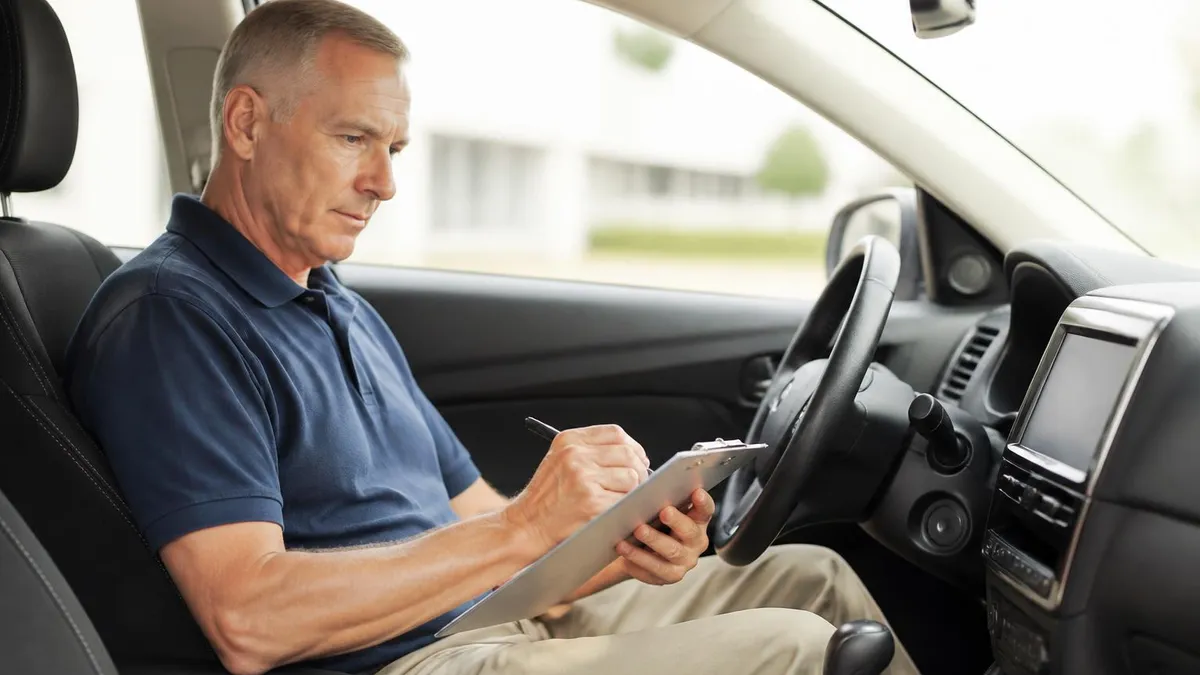
Florida Permit Test Online Practice: Your Complete 2026 Study Guide to Pass on the First Try
About the Author

Licensed Driving Instructor & DMV Test Specialist
Penn State UniversityRobert J. Williams graduated from Penn State University with a degree in Transportation Management and has spent 20 years as a certified driving instructor and DMV examiner consultant. He has personally coached thousands of applicants through written knowledge tests, skills assessments, and commercial driver licensing programs across more than 30 states.
Join the Discussion
Connect with other students preparing for this exam. Share tips, ask questions, and get advice from people who have been there.
View discussion (9 replies)