
Indiana BMV CDL Manual: Complete Study Guide for the DMV Written Test
Master the Indiana BMV CDL manual & dmv written test. Study traffic laws, road signs, and safe driving practices. Start your free practice test today! ✅

The indiana bmv cdl manual is your single most important resource when preparing for the DMV written test in Indiana. Whether you are pursuing a standard Class C license or working toward a Commercial Driver's License, the manual covers every rule, regulation, and road sign you will encounter on the official knowledge exam. Thousands of Indiana drivers sit down at a BMV terminal each week, and those who study the manual thoroughly consistently outperform those who guess their way through. Understanding the manual is not optional — it is the foundation of safe, legal driving in the Hoosier State.
Many first-time applicants underestimate the scope of the DMV knowledge test. The exam does not simply quiz you on common sense; it asks precise questions about following distances, blood-alcohol thresholds, right-of-way rules at uncontrolled intersections, and the exact meaning of dozens of road signs and markings. The Indiana BMV designs the test specifically from the manual's content, so every chapter you skip is a direct risk to your passing score. Candidates who treat the manual as optional reading fail at significantly higher rates than those who study systematically over one to two weeks.
The commercial driver's license portion of the Indiana BMV manual adds substantial complexity. CDL applicants must master general knowledge sections that all drivers share, plus specialized endorsement content covering hazardous materials, passenger transport, school buses, tank vehicles, and combination units. Each endorsement carries its own written knowledge test, meaning a single CDL candidate may need to pass five or six separate exams before even scheduling a skills test. Approaching this process without a structured study plan leads to repeated failures, wasted fees, and delayed career starts.
Traffic laws form the backbone of both the standard and CDL written exams. Indiana follows a graduated licensing system for new drivers under 18, imposes strict hours-of-service rules for commercial operators, and enforces zero-tolerance blood-alcohol limits for CDL holders operating commercial vehicles. Knowing these distinctions matters enormously on the test. An answer that is correct for a standard passenger vehicle may be completely wrong when the question involves a commercial motor vehicle, and the exam frequently tests exactly that kind of situational awareness.
Road signs and markings represent roughly 20 to 30 percent of the questions most test-takers encounter on the Indiana BMV knowledge exam. The manual categorizes signs by shape, color, and function: regulatory signs (red and white) tell you what you must or must not do; warning signs (yellow diamond) alert you to hazards ahead; guide signs (green) provide navigation information.
Pavement markings add another layer — solid yellow lines, broken white lines, and crosshatch patterns all carry specific legal meanings that drivers must recognize at a glance. Missing a handful of sign questions can push a borderline score below the 70 percent passing threshold.
Safe driving practices covered in the manual go well beyond basic rules. The BMV manual dedicates entire chapters to defensive driving techniques, proper lane changing, merging on highways, driving in adverse weather conditions, and how to handle mechanical failures like brake fade or tire blowouts at highway speed. These sections are not merely theoretical; they reflect the real-world scenarios that Indiana crash data shows cause the most fatalities. Studying them carefully does not just help you pass — it literally makes you a safer driver the moment you leave the testing center.
This guide will walk you through every major section of the Indiana BMV CDL manual, explain what to expect on the DMV written test, and give you practical study strategies to maximize your score on the first attempt. By the end, you will understand the exam format, the highest-priority topics, and how to use free online practice tests to reinforce your knowledge before test day. Let's get started so you can pass with confidence.
Indiana CDL and BMV Written Test by the Numbers
Key Facts at a Glance
| Item | Value | Details |
|---|---|---|
| Minimum Passing Score | 70% | Required on Indiana BMV knowledge test |
| Questions on General Knowledge CDL Test | 50 | Must answer 40 correctly to pass |
| CDL Knowledge Test Fee Range | $36–$58 | Varies by endorsements attempted |
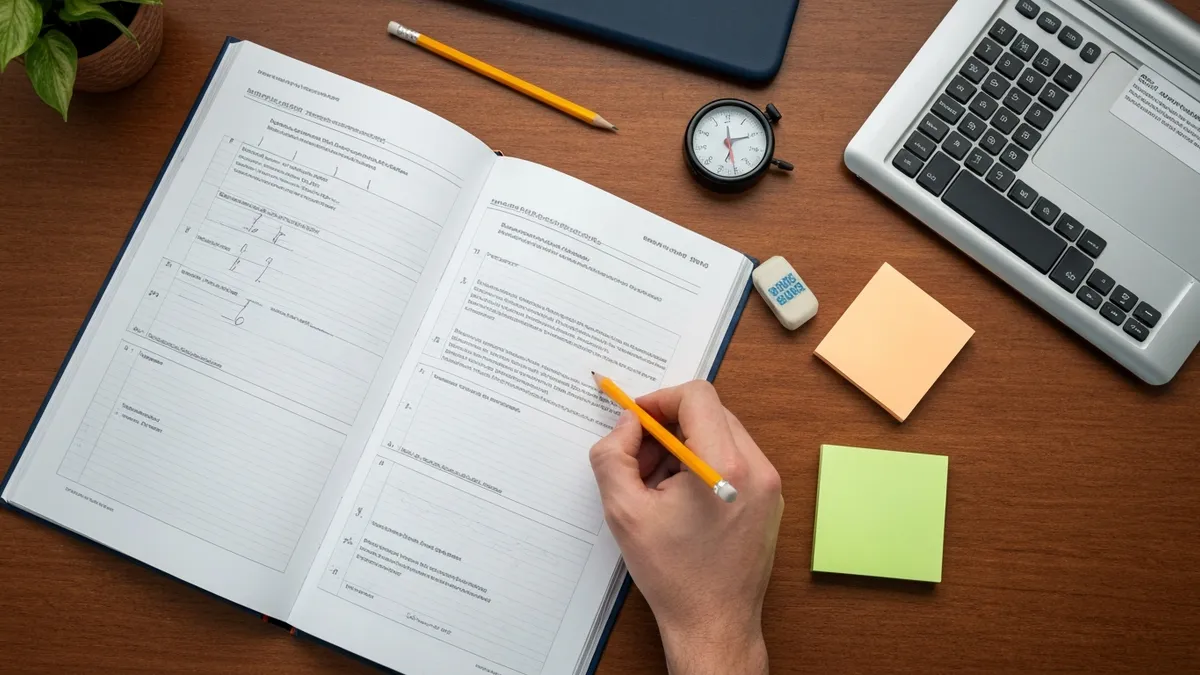
Indiana BMV CDL Manual: Key Sections at a Glance
Covers vehicle inspection, basic controls, shifting, backing, and coupling/uncoupling. All CDL applicants must pass the general knowledge test regardless of which vehicle class or endorsements they pursue. This is the foundational exam.
Required for any CDL holder operating vehicles with air brake systems. Covers dual air brake systems, low-air warning devices, and proper brake adjustment. Failing this section restricts your license with an air brake limitation.
Addresses the unique challenges of operating tractor-trailers and other combination units, including off-tracking, rearward amplification, and proper coupling procedures. Required for Class A CDL applicants seeking full driving privileges.
The most complex endorsement section. Covers placarding rules, shipping papers, emergency response, and federal HazMat regulations. Requires a TSA security threat assessment and background check before the endorsement is issued.
Covers safe passenger transport, emergency exits, railroad crossing procedures, and school bus loading/unloading zones. Each section carries a separate written test and demands precise knowledge of student safety protocols.
The Indiana BMV written test — often called the DMV knowledge test or driving knowledge test — is a computer-administered exam taken at any full-service BMV branch. For a standard Class C license, applicants answer 34 questions drawn from the Indiana Driver's Manual and must score at least 70 percent, meaning no more than 10 missed answers.
The test is untimed for most applicants, though CDL knowledge tests are longer and some endorsement exams do carry informal time guidance. You can retake a failed test after one full business day, and there is no limit on retakes, though each attempt requires paying the applicable fee again.
CDL knowledge exams follow a different structure than the standard license test. The general knowledge test alone contains 50 questions, requiring 40 correct answers to pass. If you are pursuing a Class A CDL, you will also take the combination vehicles test. Air brakes carries 25 questions with a 20-question passing threshold.
Each endorsement — hazardous materials, passenger, tank vehicles, school bus, and doubles/triples — adds its own separate exam with its own question bank and passing requirement. A driver seeking a full Class A CDL with HazMat and Passenger endorsements might complete six distinct written tests before ever scheduling a skills evaluation.
The online DMV permit test preparation tools available through PracticeTestGeeks mirror the real exam's format closely. Questions appear one at a time, with four answer choices and immediate feedback after each selection. This instant-feedback model accelerates learning dramatically compared to passive reading, because it forces you to commit to an answer and then immediately confront whether your reasoning was correct. Research on spaced repetition consistently shows that active recall practice produces better long-term retention than re-reading the same material multiple times.
One frequently misunderstood aspect of the Indiana knowledge exam is that it adapts its question selection from a large bank. You will not see the exact same 34 or 50 questions that a friend saw last week. This means memorizing a specific question list is a losing strategy. The reliable approach is understanding the underlying concepts well enough to answer any question about a topic, not just the particular phrasing you practiced. That depth of understanding comes from reading the BMV manual carefully and then reinforcing comprehension through varied practice questions that test the same concepts differently.
Test centers across Indiana — from Indianapolis to Fort Wayne, Evansville to South Bend — all administer the same standardized exam content. However, appointment availability varies significantly by location. Urban centers like Indianapolis often have two-week wait times for CDL skills tests, while rural locations may have more immediate openings for knowledge testing. Planning your study timeline with the appointment backlog in mind helps you avoid rushing your preparation or waiting idly after you feel ready. The BMV's online scheduling portal allows you to check real-time availability across all locations in the state.
Federal regulations require that CDL applicants pass all required knowledge tests before scheduling a skills test. This sequencing is non-negotiable. You cannot show up with a partially completed knowledge test record and request a skills evaluation. Building your study schedule backward from your target skills test date, factoring in knowledge test scheduling windows and the one-day waiting period for retakes, gives you a realistic timeline. Most successful CDL candidates block two to four weeks of deliberate daily study — roughly 90 minutes per day — and take a full mock exam every three to four days to measure their progress.
The driving test online practice resources available through PracticeTestGeeks are specifically built around the Indiana BMV manual's actual content. Rather than generic national questions, the practice tests reflect Indiana-specific rules like the state's graduated licensing curfew provisions, the 0.04 percent BAC limit for CDL holders, and Indiana's specific rules about school bus loading zones and railroad crossings. Using Indiana-focused practice rather than generic national tests ensures you are reinforcing the exact knowledge that will appear on your official BMV exam.
Traffic Laws, Road Signs and Markings: The Core Knowledge Areas
Indiana traffic laws tested on the BMV knowledge exam cover right-of-way rules, speed limits in school and construction zones, passing regulations on two-lane roads, and turning procedures at intersections. CDL holders face additional federal regulations including hours-of-service limits, weight restrictions, and mandatory pre-trip inspection requirements. Understanding which laws apply to standard vehicles versus commercial vehicles is critical, as many exam questions are specifically designed to test this distinction and will trip up candidates who do not study both sets of rules thoroughly.
Speed limit rules deserve particular attention because Indiana uses several context-dependent limits. The default rural highway speed is 70 mph, urban interstates allow 65 mph, and residential streets carry a 30 mph default limit unless posted otherwise. School zones reduce limits to 20 mph when children are present, and construction zones impose fines doubled for violations. CDL candidates must also know that federal regulations set maximum driving time at 11 hours after 10 consecutive hours off duty for property-carrying drivers, a rule that overrides any more permissive state standard.

Studying the Indiana BMV CDL Manual vs. Skipping Straight to Practice Tests
- +Builds deep conceptual understanding that survives any question phrasing variation on the real exam
- +Covers Indiana-specific rules that differ from other states, like the 0.04% CDL BAC limit and graduated licensing curfews
- +Prepares you for endorsement exams with specialized content not covered in generic study guides
- +Provides authoritative definitions for terms like 'controlled intersection' and 'no-passing zone' that are quoted verbatim on the test
- +Includes diagrams of road signs, pavement markings, and vehicle systems that reinforce visual recognition
- +Establishes safe driving habits that reduce your lifetime crash risk — not just your test score
- −The full Indiana CDL manual exceeds 200 pages and takes 6–10 hours to read thoroughly
- −Dense regulatory language can be difficult to absorb without active study techniques like note-taking or flashcards
- −Some sections — particularly HazMat regulations — use federal regulatory language that requires careful re-reading
- −No built-in self-assessment: reading the manual does not reveal which concepts you have not retained
- −Content updates when federal or state regulations change, requiring you to confirm you have the current edition
- −Reading alone without practice tests leaves gaps in your ability to apply knowledge under timed, multiple-choice conditions
CDL Knowledge Test Prep Checklist: 10 Steps to Passing
- ✓Download the current Indiana CDL Driver's Manual from the official BMV website and confirm the publication date is 2025 or later.
- ✓Read the general knowledge sections (Chapters 1–4) in full before attempting any practice questions.
- ✓Study the air brakes chapter completely, even if you plan to request the restriction — understanding it helps on general knowledge questions.
- ✓Identify every endorsement you need and locate the corresponding manual sections before scheduling any knowledge tests.
- ✓Take a baseline practice test with no preparation to identify your weakest topic areas first.
- ✓Review road signs and pavement markings from the sign chart in the manual appendix until you can name each sign's meaning without hesitation.
- ✓Complete at least three full-length timed mock exams matching the real test's question count for your specific exam type.
- ✓Score 85 percent or higher on two consecutive mock exams before booking your official BMV test appointment.
- ✓Review Indiana-specific rules: graduated licensing curfews, CDL BAC limits, and school bus railroad crossing procedures.
- ✓Arrive at the BMV branch 15 minutes early with required identification documents and your scheduling confirmation number.
The 70% Rule Has a Hidden Margin of Error
Indiana's 70 percent passing score sounds achievable, but on a 50-question CDL general knowledge test it means you can miss only 10 questions. If you score 68 percent (34 correct out of 50), you fail and must pay to retake. Candidates who target 85 percent or higher during practice consistently pass on the first attempt with a comfortable buffer — never aim for the bare minimum when studying because real-test nerves reliably cost you 5 to 8 percentage points compared to relaxed practice conditions.
CDL endorsements represent the career-expanding extras that separate a basic commercial license from a fully marketable credential. Indiana issues endorsements for Hazardous Materials (H), Passenger (P), School Bus (S), Tank Vehicles (N), Doubles and Triples (T), and the combination Tanker-HazMat (X). Each endorsement requires passing a separate written knowledge test, and each has a dedicated section in the Indiana CDL manual. Drivers who hold all applicable endorsements command significantly higher wages than those with bare Class A or Class B licenses, making endorsement study an investment with measurable financial returns over a trucking career.
The HazMat endorsement is the most administratively complex because federal law mandates a Transportation Security Administration background check before the state can issue it. Indiana CDL applicants must submit fingerprints to TSA, pay a separate federal fee of approximately $86 as of 2025, and wait for clearance — a process that can take four to six weeks.
Smart candidates initiate the TSA application process before they even begin studying for the knowledge test, so the background check clears around the same time they are ready to test. Failing to account for this timeline is one of the most common reasons CDL candidates miss their intended employment start dates.
The passenger endorsement test covers rules unique to carrying multiple occupants for compensation or as part of a commercial operation. Questions focus on passenger loading and discharge procedures, emergency exit locations, prohibition of standees forward of the rear axle, and the requirement to secure carry-on baggage so it cannot block the aisle or emergency exits during a sudden stop or rollover. Drivers operating charter buses, transit buses, or shuttle vehicles need this endorsement, and the knowledge exam reflects the serious consequences of errors when dozens of passengers are aboard.
School bus endorsement testing builds on the passenger endorsement foundation and adds requirements specific to child safety. The exam tests knowledge of loading and unloading zones, the use of warning lights and stop arms, procedures at railroad grade crossings (mandatory stop, window open, listen for trains), and how to handle a bus evacuation.
Indiana law imposes especially strict rules at railroad crossings: school bus drivers must stop between 15 and 50 feet from the nearest track, open the door or window, look and listen, and then proceed only when it is safe — a procedure tested repeatedly in the endorsement exam's question bank.
Tank vehicle endorsement knowledge testing covers the unique handling characteristics of liquid cargo. Liquid in a partially filled tank creates surge, a front-to-back sloshing motion that pushes the vehicle forward when braking. Transverse surge pushes the vehicle sideways through turns. Understanding these dynamics and knowing how baffled tanks differ from unbaffled smooth-bore tanks is core exam content. Candidates who have driven tankers know these forces intuitively, but the exam requires you to explain them precisely using the manual's terminology, not just recognize them from experience.
Doubles and triples endorsement testing requires mastery of the unique physics governing multi-trailer combination vehicles. The crack-the-whip effect amplifies sway through each connected trailer, making the last trailer in a triple combination subject to forces that can cause rollover at speeds well below what would be dangerous for a standard tractor-trailer.
The exam tests coupling and uncoupling sequences for multi-trailer combinations, how to inspect converter dollies and pintle hooks, and the specific pre-trip inspection points unique to multi-trailer rigs. Many carriers that operate doubles and triples provide their own orientation training, but that training assumes you already have the endorsement — passing the test comes first.
After completing all required knowledge tests, CDL candidates must pass a skills test administered either by the Indiana BMV or by a state-approved third-party tester. The skills test has three components: a pre-trip vehicle inspection conducted from memory without the manual, a basic vehicle control exercise in a closed course, and an on-road driving evaluation in real traffic. The knowledge exams prepare you for the written component only; skills testing requires hands-on practice in an actual commercial vehicle. Reputable CDL training schools provide this experience, and many coordinate directly with third-party testers to streamline the scheduling process.

Federal law prohibits Indiana from issuing a HazMat endorsement until TSA completes a security threat assessment on the applicant. This background check requires fingerprinting and a separate federal fee of approximately $86, and processing takes four to six weeks on average. Apply for TSA clearance before you start studying so the approval arrives around the time you are ready to test — waiting until after you pass the knowledge exam can delay your CDL issuance by six weeks or more.
Test day preparation begins the evening before your appointment. Lay out your required identification documents: your current Indiana driver's license or state ID, your Social Security card or an acceptable substitute, and any scheduling confirmation provided by the BMV. CDL applicants who have a Commercial Learner's Permit (CLP) that is expiring should confirm their test date falls within the permit's validity period — a CLP is valid for 180 days, and testing after expiration requires restarting the entire application and knowledge testing process from scratch.
Arrive at the BMV branch at least 15 minutes before your scheduled appointment. Check in at the service counter, pay any applicable fees, and wait to be called to a testing terminal. The computerized testing stations at Indiana BMV branches present questions on a touchscreen with four answer options.
Read each question completely before selecting an answer — exam writers frequently include answer choices that are partially correct but miss a specific qualifier like "when towing a trailer" or "in a construction zone." Those qualifiers change the correct answer entirely, and rushing past them is one of the most preventable causes of failed exams.
Managing test anxiety is a real skill that practice tests build indirectly. Repeated exposure to exam-format questions normalizes the testing experience and reduces the physiological stress response that impairs recall under pressure. Candidates who have taken 10 or more full-length practice tests before the official exam report significantly lower anxiety levels than those attempting the real test cold. This is why PracticeTestGeeks recommends completing at least three timed, full-length mock exams in the final week of study, not as a score benchmark, but as anxiety inoculation for the real test environment.
If you do not pass on your first attempt, use the required one-business-day waiting period productively. Review which topic categories generated the most incorrect answers. The BMV testing terminal does not show you which specific questions you missed, but it typically indicates performance by major category — signs, traffic laws, alcohol and drugs, and so on.
Use that categorical feedback to focus your re-study on the weakest areas rather than re-reading the entire manual. Return to the practice test bank and drill the specific topics where you underperformed until your mock exam scores in those categories are consistently above 85 percent.
CDL candidates who are also studying for the driving test online should structure their final week of preparation around simulation rather than new content intake. By the last five days before your test, you should not be learning new material — you should be rehearsing known material under test conditions.
This means full-length practice exams at the same time of day as your scheduled BMV appointment, in a quiet environment without music or distractions, timed to match the real exam's constraints. Mental rehearsal of successful performance is a technique used in competitive athletics and high-stakes licensing exams alike, and it genuinely works.
After passing the knowledge tests and obtaining your Indiana Commercial Learner's Permit, you must hold the CLP for a minimum of 14 days before the BMV will schedule a CDL skills test. Federal regulation mandates this holding period regardless of how experienced you are as a driver. Use those 14 days for behind-the-wheel practice in the vehicle class you will test in.
If you are testing in a tractor-trailer for a Class A license, practice pre-trip inspections until you can complete the inspection from memory in under 30 minutes and backing maneuvers until you can execute a straight-line back, offset back, and alley dock with consistent accuracy.
The BMV's driver license test is a milestone, but it is also a beginning. Earning your Indiana CDL opens career pathways in long-haul trucking, regional delivery, passenger transport, and specialized hauling that pay well above the national median wage for all occupations. The Bureau of Labor Statistics reports median annual pay for heavy and tractor-trailer truck drivers exceeded $54,000 in 2024, with experienced operators at major carriers often earning $80,000 or more.
The weeks of study required to pass your knowledge exams are a small investment relative to the career they unlock — and doing that study thoroughly, using resources like PracticeTestGeeks' Indiana-focused practice tests, is the surest path to getting it right on the first try.
Building an effective study schedule for the Indiana BMV CDL manual requires understanding the scope of what you need to learn and working backward from your target test date. Most successful candidates follow a two-week intensive schedule for the general knowledge test alone, then add one week per endorsement they are pursuing.
Week one focuses on reading: cover Chapters 1 through 4 of the CDL manual completely, taking handwritten notes on numbers, thresholds, and rules that appear in list form. Written notes engage a different form of memory than passive reading and dramatically improve retention for the kind of numerical detail — following distances, BAC limits, inspection item counts — that the BMV exam tests precisely.
Week two shifts to active recall. Begin each study session with a practice test rather than more reading. When you miss a question, return immediately to the manual section that covers the topic and re-read it carefully. This targeted remediation — studying from your errors rather than from a predetermined chapter list — focuses your limited study time on the gaps that actually exist in your knowledge rather than the sections you already understand. By the end of week two, most candidates have addressed their weakest areas sufficiently to score above 80 percent on practice exams consistently.
Group study is an underrated preparation strategy for CDL candidates. Studying with coworkers who are also pursuing CDLs, or with friends who have recently earned theirs, creates opportunities for verbal explanation that reinforce understanding at a deeper level than silent reading.
Explaining the difference between baffled and unbaffled tank vehicles to another person forces you to organize your knowledge clearly enough to communicate it — a process that almost always reveals gaps you did not know existed. If you cannot explain a concept clearly to someone else, you have not learned it well enough to answer a test question about it reliably.
Flashcards — either physical index cards or a digital app like Anki — work exceptionally well for the sign recognition and numerical threshold components of the exam. Create one card for each road sign in the manual's appendix: the sign image or description on the front, its name and legal meaning on the back.
Create separate cards for key thresholds: 0.04 percent BAC for CDL holders, 0.08 percent for standard license holders, 70 percent passing score, 50 questions on the general knowledge test, 14-day CLP holding period. Review these cards daily using spaced repetition, which schedules each card for review just before you would naturally forget it, producing maximum retention with minimum time investment.
The driving knowledge test component that surprises most first-time CDL candidates is the pre-trip inspection section that appears in some endorsement-specific knowledge tests. Even though the official skills test pre-trip inspection is performed live on an actual vehicle, the knowledge tests include questions about which items must be inspected, what constitutes a defect that puts a vehicle out of service, and the correct sequence for a systematic inspection.
Study the seven-step inspection method outlined in the CDL manual: approach and overview, engine compartment, cab interior, lights, walkaround, signal lights, and brakes. Memorizing this sequence helps you answer knowledge test questions and prepares you for the live skills test simultaneously.
Candidates with previous military or emergency vehicle driving experience sometimes qualify for waived skills testing under Indiana's CDL reciprocity provisions for military drivers. However, the knowledge testing requirement is not waived — every CDL applicant must pass the written exams regardless of prior experience.
Veterans transitioning to civilian trucking careers sometimes underestimate the knowledge tests because their operational skills are strong, then fail due to insufficient study of regulatory content that differs from military standards. The BMV's written exam tests civilian federal and state regulations exclusively, not military vehicle operation procedures, so prior driving experience — while valuable — is not a substitute for manual study.
Your final preparation step before the official test should be a complete review of the Indiana BMV manual's table of contents. Run through each chapter heading and ask yourself to summarize the key rules covered in that section from memory. If you can produce a coherent summary of each chapter without opening the manual, you are ready to test.
If specific chapters produce hesitation or blank spots, revisit those sections that day and take a targeted practice quiz on the topic before sleeping. Walking into the BMV test center the next morning with that level of comprehensive recall gives you a significant advantage over candidates who studied sporadically or relied on memorized question lists that may not appear on their specific test version.
BMV Questions and Answers

Indianapolis BMV: Locations, Services, and What to Expect
DMV Driver's License Written Test Questions: Complete Study Guide and Practice Strategy for 2026

BMV Hours of Operation: Everything You Need to Know Before Your DMV Written Test

Ohio BMV License Renewal: Online, In-Person, and Cost Guide

Crown Point BMV Appointment: Complete Guide to Scheduling, Testing, and Getting Your Indiana License
About the Author

Licensed Driving Instructor & DMV Test Specialist
Penn State UniversityRobert J. Williams graduated from Penn State University with a degree in Transportation Management and has spent 20 years as a certified driving instructor and DMV examiner consultant. He has personally coached thousands of applicants through written knowledge tests, skills assessments, and commercial driver licensing programs across more than 30 states.
Join the Discussion
Connect with other students preparing for this exam. Share tips, ask questions, and get advice from people who have been there.
View discussion (9 replies)