
ASVAB Guide: Army, Air Force, Navy, Marines Branch Compare 2026 September
ASVAB army air force military navy marines — compare branches, recruiter tips, fitness tests, AFQT scores, and free practice prep for every service. ⏳
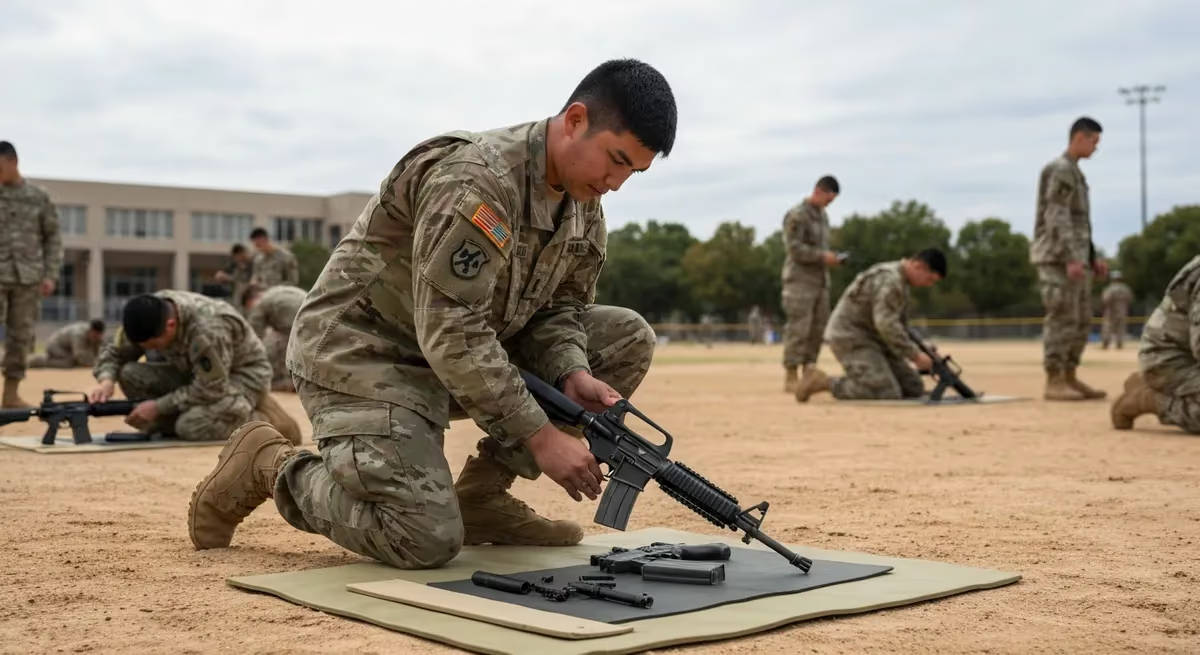
If you're researching asvab army air force military navy marines options, you're at the most important decision point in any military career — choosing a branch. Each service has different missions, lifestyles, deployment tempos, training pipelines, and post-service career paths.
Your ASVAB score qualifies you for jobs within whichever branch you choose, but choosing the right branch first matters more than maxing out your score in the wrong service. A focused asvab practice test routine pays off across every branch, but the branch fit shapes your daily work, base assignments, and 4-20 year career trajectory more than any single test result.
The U.S. military has six active branches: Army (largest, ground combat focus), Navy (sea power, aircraft carriers, submarines), Air Force (air superiority, space ops, cyber), Marines (rapid response amphibious infantry), Space Force (space domain operations, smallest branch), and Coast Guard (maritime security, search and rescue, DHS rather than DoD). Reserve and National Guard components add part-time service options across most branches. Choose the branch that matches your goals first; choose the MOS or rating second.
This guide compares all six branches across mission, lifestyle, ASVAB requirements, pay, training, and career advancement. We'll also cover what to expect from your first recruiter conversation, the differences between the Army Combat Fitness Test and the Air Force PT test, and how to use ASVAB scores strategically when negotiating your enlistment contract at MEPS.
U.S. Military Branches by the Numbers
A solid asvab score qualifies you for service across every branch, but the AFQT minimum varies: Army 31, Marines 32, Navy 35, Air Force and Space Force 36, Coast Guard 40. Each branch sets its own line score requirements for specific MOS or ratings on top of the AFQT floor. Higher scores unlock more jobs, signing bonuses, and elite training pipelines across all branches. The asvab test itself is identical regardless of which branch you take it for — same 10 subtests, same scoring, same MEPS administration. The difference is which scores qualify you for which jobs at which branch.
Branch choice is shaped by mission preference, lifestyle, and post-service career goals. Army recruits handle ground combat, mechanized warfare, and large-scale ground operations. Navy recruits work on ships and submarines with global deployment cycles. Air Force focuses on air, space, and cyber operations with stable base assignments. Marines emphasize rapid response amphibious operations with intense combat focus. Space Force handles satellite and space-based operations. Coast Guard does maritime law enforcement, search and rescue, and port security under DHS authority.
Match the branch's daily work to your personality and lifestyle goals before signing a contract that locks you in for 4-8 years.
Many recruits split prep across academic mornings and physical evenings to maximize energy in each domain. Splitting cognitive and physical training across the day prevents burnout in either area.
An air force recruiter conversation starts the same way at every branch — they want to understand your education, work history, fitness, and goals. The recruiter's job is to get you enlisted in their branch in jobs they need to fill. Your job as the recruit is to clarify which branch and which job actually fit your goals.
Don't accept the first MOS or rating offered; bring a list of target jobs and line score requirements to MEPS for the contract negotiation. The asvab test matters across all branches, but the army combat fitness test is specific to Army recruits — it's mandatory for all soldiers and replaces the legacy APFT in 2022.
Active Army recruits face the ACFT during basic combat training. Six events scored 0-100 each (600 total): three-rep max deadlift, standing power throw, hand-release push-ups, sprint-drag-carry, plank, two-mile run. Combat MOS slots require ACFT 420+ (70 per event); special operations require 540+. Strength training matters more than pure cardio for ACFT. Other branches have different fitness tests: Navy PRT (push-ups, sit-ups or planks, 1.5-mile run or alternative), Air Force PT (similar to Navy), Marine PFT (pull-ups, plank, 3-mile run), Coast Guard PFT (similar Navy format). Each branch has its own standards.
If you can't run reasonably and do basic strength work today, start training before talking to recruiters — fitness shapes which branches and jobs welcome you.
Recruiters often work toward branch-specific quotas — knowing which jobs they need to fill at any given time helps you negotiate from a position of strength when offered alternatives to your top choices.
ASVAB Practice Test Questions
Prepare for the ASVAB - Armed Services Vocational Aptitude Battery exam with our free practice test modules. Each quiz covers key topics to help you pass on your first try.
ASVAB Arithmetic Reasoning Test
ASVAB Exam Questions covering Arithmetic Reasoning Test. Master ASVAB Test concepts for certification prep.
ASVAB Arithmetic Reasoning Word Problems
Free ASVAB Practice Test featuring Arithmetic Reasoning Word Problems. Improve your ASVAB Exam score with mock test prep.
ASVAB Assembling Objects Test
ASVAB Mock Exam on Assembling Objects Test. ASVAB Study Guide questions to pass on your first try.
ASVAB Automotive Information Test
ASVAB Test Prep for Automotive Information Test. Practice ASVAB Quiz questions and boost your score.
ASVAB Electronics Fundamentals and Circuits
ASVAB Questions and Answers on Electronics Fundamentals and Circuits. Free ASVAB practice for exam readiness.
ASVAB Electronics Practice Test
ASVAB Mock Test covering Electronics Practice Test. Online ASVAB Test practice with instant feedback.
ASVAB Electronics Practice Test 1
Free ASVAB Quiz on Electronics Practice Test 1. ASVAB Exam prep questions with detailed explanations.
ASVAB General Science Biology and Ecology
ASVAB Practice Questions for General Science Biology and Ecology. Build confidence for your ASVAB certification exam.
ASVAB General Science Practice Test
ASVAB Test Online for General Science Practice Test. Free practice with instant results and feedback.
ASVAB General Science Practice Test 1
ASVAB Study Material on General Science Practice Test 1. Prepare effectively with real exam-style questions.
ASVAB Mathematics Knowledge Test
Free ASVAB Test covering Mathematics Knowledge Test. Practice and track your ASVAB exam readiness.
ASVAB Mechanical Comprehension Principles
ASVAB Exam Questions covering Mechanical Comprehension Principles. Master ASVAB Test concepts for certification prep.
ASVAB Mechanical Comprehension Test
Free ASVAB Practice Test featuring Mechanical Comprehension Test. Improve your ASVAB Exam score with mock test prep.
ASVAB Paragraph Comprehension and Inference
ASVAB Mock Exam on Paragraph Comprehension and Inference. ASVAB Study Guide questions to pass on your first try.
ASVAB Paragraph Comprehension Test
ASVAB Test Prep for Paragraph Comprehension Test. Practice ASVAB Quiz questions and boost your score.
U.S. Military Branch Comparison
Army (~452K active) is the largest branch with the broadest mission scope: armor, artillery, infantry, aviation, intelligence, cyber, special forces, medical, and dozens of technical specialties. Lower AFQT minimum (31) and the most diverse career paths. Marines (~172K active) are smaller and more selective with intense focus on amphibious infantry operations and rapid response. AFQT minimum 32. Marine training emphasizes physical and mental toughness above other branches. Army offers more career variety; Marines offer tighter culture and combat focus.
A focused asvab scores evaluation should match your target branch and MOS specifically. Army needs broad recruits across infantry, technical, medical, and specialty roles. Navy emphasizes technical aptitude (nuclear, aviation, cryptologic). Air Force values electronic and mechanical aptitude (avionics, maintenance, cyber). Marines focus combat readiness with sufficient AFQT for desired MOS.
Space Force requires technical and STEM aptitude across the smallest active branch. Test asvab practice test rotation prepares you for whichever branch you target — but knowing your branch's job catalog and line score requirements lets you focus prep time on the subtests that matter most for your career path.
Coast Guard's higher AFQT minimum (40) reflects its size and selectivity. Many Coast Guard ratings effectively require AFQT 50+ in practice, even though 40 is the published floor. Coast Guard ratings cover Aviation Survival Technician (rescue swimmer), Aviation Maintenance Technician, Marine Science Technician, Operations Specialist, Boatswain's Mate, and Information Systems Technician among others. Coast Guard service has more domestic homeports than Navy, making it appealing to recruits who want maritime service without long deployments overseas.
Don't take the ASVAB cold then look for a branch that fits — research branches first and use ASVAB strategically.
Visit base photo galleries and YouTube tours of facilities at potential first duty stations before signing. Quality of life at your first base shapes your initial impression of military service significantly.
4 Branch Selection Strategies
Don't pick a branch based on TV recruiting ads. Research what daily work looks like — Army deployments to forward operating bases, Navy 6-9 month sea duty cycles, Air Force base-to-base rotations, Marine combat training intensity. Match the day-to-day work to your personality and lifestyle goals before signing a contract.
Talk to recruiters from at least three branches before committing. Each recruiter pitches their branch's strengths and may not mention drawbacks. Multiple conversations reveal trade-offs that single-recruiter conversations hide. Don't sign with the first recruiter you meet just because they're convenient or charismatic.
Each branch publishes its job catalog online. Army has MOS lists, Navy has rating descriptions, Air Force has AFSC catalogs, Marines have MOS catalogs. Read job descriptions for 5-10 roles you'd consider before MEPS. Knowing line score requirements and training pipelines protects you against high-pressure contract negotiations.
Recruiters can quote signing bonuses verbally without binding the military to specific dollar amounts. Always verify bonus terms in writing on your enlistment contract before signing. Some bonuses pay out across enlistment milestones rather than upfront. Failing to complete training can void remaining payments and trigger recoupment of already-paid amounts.
A solid asvab scores result combined with strong physical readiness positions you for nearly any branch. Books like asvab study guide options from Kaplan, Barron's, Princeton Review, and the ASVAB for Dummies series cover all 10 subtests with practice questions and content review. Pair a quality study guide with weekly practice tests for the most reliable score gains. Asvab for dummies works as an introductory content review for recruits without strong academic backgrounds; pair it with a tougher prep book like Kaplan's ASVAB Prep Plus for higher-difficulty practice questions to round out your prep.
Enlistment timelines also vary by branch. Army contracts run 2-6 years for active duty; Marines typically 4 years; Navy 4-6 years for most ratings (6 years for Nuclear Field, Naval Special Warfare); Air Force 4-6 years; Space Force 4 years; Coast Guard 4 years. Reserve and National Guard contracts are typically 6-8 years total commitment with 1 year of active drilling and the remainder in IRR (Inactive Ready Reserve). Each branch has its own variations and bonus structures tied to enlistment length.
Longer enlistments (6 years) typically come with larger signing bonuses and access to higher-tier training pipelines.
Build a list of 5-10 target jobs with line score requirements before MEPS. Knowing exactly which subtests drive your target jobs lets you prep specifically for those subtests rather than studying all 10 generically.
Active Duty vs Reserve Service: Pros and Cons
- +Active duty provides full-time pay, benefits, housing, and healthcare
- +Reserve and Guard offer civilian career flexibility with part-time service
- +GI Bill education benefits accrue across both active and reserve service
- +Active duty unlocks faster promotion and full benefit access
- +Reserve drill weekends typically run 1 weekend per month + 2 weeks summer
- +Both pathways count toward retirement after 20 years of qualifying service
- −Active duty requires permanent change of duty station every 2-4 years
- −Reserve service can activate during contingencies — civilian job protection but disruption
- −Active duty involves longer separations from family and civilian community
- −Reserve drill commitment competes with civilian job and family time
- −Active duty contracts run longer (4-6 years) than most reserve initial tours
- −Reserve benefits package is reduced compared to active duty equivalent
Pros and Cons at a Glance
| Pros | Cons |
|---|---|
| Active duty provides full-time pay, benefits, housing, and healthcare | Reserve service can activate during contingencies — civilian job protection but disruption |
| Reserve and Guard offer civilian career flexibility with part-time service | Active duty involves longer separations from family and civilian community |
| GI Bill education benefits accrue across both active and reserve service | Reserve drill commitment competes with civilian job and family time |
| Active duty unlocks faster promotion and full benefit access | Reserve benefits package is reduced compared to active duty equivalent |
The army fitness test (ACFT) is mandatory for all Army recruits during basic combat training. Failing the ACFT delays graduation; passing it on first attempt streamlines your training timeline. The air force careers spectrum is broad — aircraft maintenance, avionics, security forces, intelligence, cyber operations, special tactics (Combat Controller, Pararescue), space operations, and cryptologic linguist. Air Force prides itself on technical career fields that translate to civilian employment after service. Pilot career paths require commissioning through the Air Force Academy, ROTC, or Officer Training School — not enlisted accession.
Air Force base assignments tend to be more stable than Army or Navy with longer rotations between PCS moves. Air Force facilities and quality of life consistently rate highest among branches in surveys, though the workload at deployed locations and during exercises can be intense. Quality of life is a real factor when comparing branches — the same enlisted pay grade brings different lifestyles depending on which branch you wear the uniform of.
If quality of life and post-service career skills matter more to you than combat experience, Air Force or Space Force generally lead the comparison.
Don't underestimate Coast Guard rating selectivity even though many AFQT 50+ recruits qualify. Coast Guard ratings often have additional medical, citizenship, and clearance requirements beyond the standard branch minimums.
Branch Selection & Enlistment Checklist
- ✓Research mission, lifestyle, and daily work across all 6 active branches
- ✓Talk to recruiters from at least 3 branches before committing
- ✓Read job catalogs (MOS, rating, AFSC) for branches you're considering
- ✓Look up line score requirements for 3-5 target jobs in each branch
- ✓Take an ASVAB practice test to gauge baseline AFQT and subtest performance
- ✓Begin physical training 8-12 weeks before basic combat training
- ✓Pass MEPS medical screening and qualify for desired MOS or rating
- ✓Negotiate enlistment contract terms — MOS, bonus, length — at MEPS
- ✓Verify all bonus and training terms in writing before signing
- ✓Prepare mentally for basic training intensity unique to your chosen branch
The army pt test (ACFT) and the test asvab practice test both matter for Army recruits — academic qualification and physical readiness work together at MEPS and basic combat training. The Air Force PT test (push-ups, sit-ups or planks, 1.5-mile run) follows similar logic but with branch-specific standards. The Marine PFT (pull-ups, plank, 3-mile run) is the most physically demanding of the standard fitness tests and reflects Marine emphasis on combat fitness.
Coast Guard PFT mirrors Navy standards. Each branch's fitness test should shape your physical training program — train specifically for the events you'll face. A focused practice asvab test routine over 6-8 weeks combined with structured physical training puts you in qualified territory across multiple branches simultaneously.
Recruits often ask which branch is hardest to enlist in — the answer depends on your AFQT score and physical condition. Coast Guard has the highest AFQT minimum and tightest selection. Marines have the most demanding initial training. Air Force and Space Force compete on technical aptitude. Army has the broadest mission and most accessible enlistment for recruits with average ASVAB scores.
Choose based on fit, not difficulty — every branch is hard in its own way during initial training.
Quick Reference: Floor Scores by Branch
Army: 31 (lowest, broadest mission). Marines: 32. Navy: 35. Air Force: 36. Space Force: 36. Coast Guard: 40 (highest, smallest force). These are floor scores — competitive specialties typically demand AFQT 50+ alongside specific line scores. Recruits with high school diplomas face the standard minimums; GED-holders often face AFQT 50+ requirements regardless of branch. Score 20+ points above your branch minimum to maximize MOS or rating options and signing bonuses.
The asvab score range spans 1-99 (percentile-based AFQT). Most recruits cluster between 30-60. AFQT below 31 is below floor for any branch; 31-49 qualifies for entry-level Army or Marines roles; 50-65 opens most general jobs; 65-85 unlocks technical and skilled specialties; 85-99 qualifies for elite programs and the highest signing bonuses available. A weekly practice asvab session reveals where your score trajectory is heading — flat scores mean change your approach; rising scores mean stay the course. Most recruits gain 10-15 AFQT points across 4-6 weeks with targeted weak-area drilling and consistent weekly practice testing.
Branch competitiveness varies by ASVAB tier. AFQT 31-40 candidates have realistic Army and Marine options but limited Navy/Air Force/Coast Guard options. AFQT 50-65 candidates have broad access across all branches with most general MOS and rating slots available. AFQT 65+ unlocks technical, intelligence, cyber, and aviation specialties across all branches. AFQT 85+ qualifies for elite programs (Special Forces, Nuclear Field, Combat Controller) with the largest signing bonuses available across the Department of Defense.
Aim for AFQT 65+ to keep every branch and every job category open during your contract negotiation at MEPS.
The Military Entrance Processing Station (MEPS) is where you take the official ASVAB, complete medical screening, and sign your enlistment contract. Bring printed line score requirements for your target jobs and your driver's license. Don't sign anything you haven't read carefully. Verify MOS or rating, signing bonus, enlistment length, and training pipeline timeline in writing on the contract. Verbal recruiter promises don't bind the military once you've signed. Take your time during contract negotiation — you can request a 24-hour delay to think before signing.
The army aft — colloquial shorthand for the Army Combat Fitness Test (ACFT) — applies to all Army recruits including National Guard and Reserve. Failing the ACFT during basic combat training can delay graduation; failing as an active-duty soldier triggers a remediation plan with a 90-day window to retake.
Civilian recruits who train for ACFT before basic give themselves a major advantage — soldiers who arrive at basic already meeting ACFT standards adjust to demanding training pace much faster than those still building baseline fitness. An asvab test sample online session is one of the easiest first steps for any prospective recruit. Free practice tests cover all 10 subtests at no cost — use one as a diagnostic before opening any prep books.
Match your physical training to your target branch. Army recruits should train for the ACFT events specifically. Marine recruits should focus on pull-ups, planks, and a 3-mile run. Air Force and Space Force recruits should train for push-ups, sit-ups or planks, and 1.5-mile run. Navy and Coast Guard recruits follow similar standards to Air Force. Generic 'general fitness' training works less well than event-specific training when your assessment is event-specific.
The branch you choose dictates what you train; don't waste 8 weeks training for the wrong test format.
If you're wondering what is the asvab test, it's the Armed Services Vocational Aptitude Battery — a multiple-choice exam developed by the Department of Defense and used since 1968 to determine military enlistment eligibility and job placement.
The test has been refined repeatedly over the decades but the core structure remains: 10 subtests covering general science, arithmetic reasoning, word knowledge, paragraph comprehension, mathematics knowledge, electronics information, auto and shop information, mechanical comprehension, assembling objects, and verbal expression (a composite of word knowledge and paragraph comprehension). Your AFQT score is calculated from four core subtests: AR, MK, WK, and PC. An asvab practice test air force routine is similar to other branches but adds emphasis on Mechanical and Electronic composites for maintenance and avionics AFSCs.
The Air Force MAGE composites (Mechanical, Administrative, General, Electronic) determine which AFSCs you qualify for within Air Force. Each AFSC has minimum scores in one or more areas, with technical and avionics careers needing 60+ in Mechanical or Electronic. Knowing your target AFSCs and their composite requirements lets you prep specifically for the subtests that matter for your career path. Generic AFQT-only prep leaves Air Force technical roles inaccessible.
Whatever branch you target, treat ASVAB and physical readiness as parallel tracks throughout your prep window — both matter for the contract you sign at MEPS.
ASVAB Questions and Answers
About the Author
Retired Military Officer & Armed Forces Test Preparation Specialist
United States Army War CollegeColonel Steven Harris (Ret.) served 28 years in the US Army, earning a Master of Arts in Military Science from the Army War College and a Bachelor of Science in Criminal Justice. He has coached thousands of military enlistment and officer candidate program applicants through the ASVAB, AFQT, AFCT, OAR, and officer selection assessment processes across all military branches.
Join the Discussion
Connect with other students preparing for this exam. Share tips, ask questions, and get advice from people who have been there.
View discussion (5 replies)