
ALCPT Vocabulary Section — Word Knowledge Guide 2026 September
Prepare for the ALCPT Vocabulary Section certification. 🎓 Practice questions with answer explanations covering all exam domains.
What the ALCPT Vocabulary Section Tests
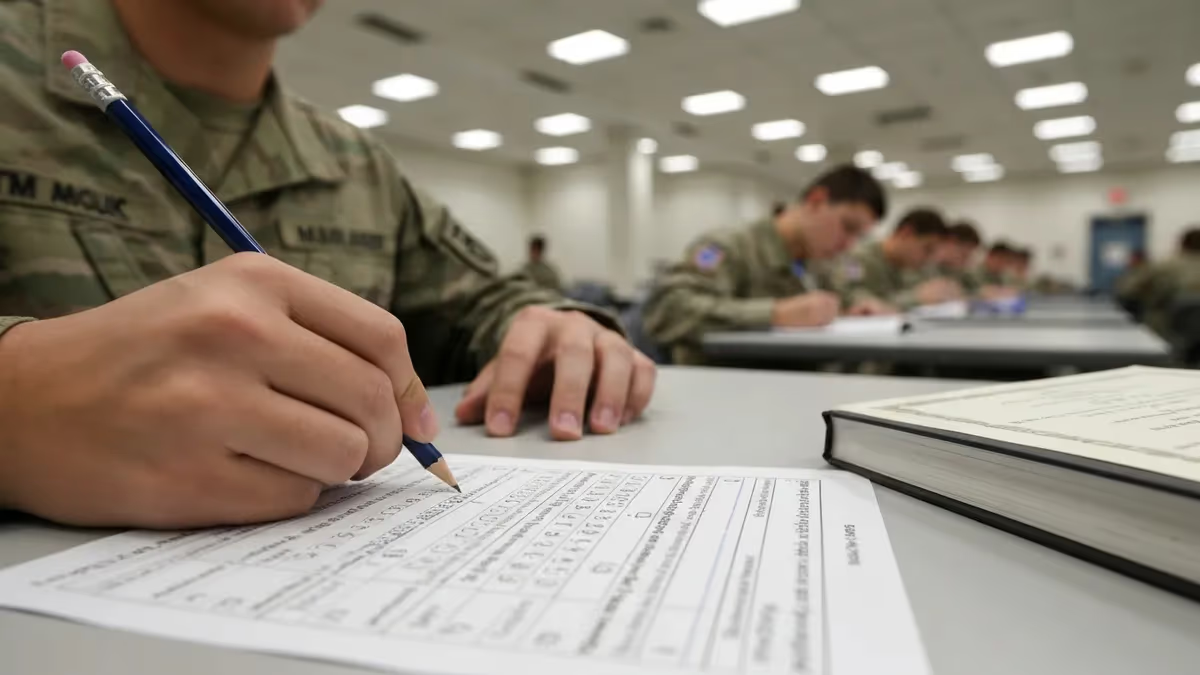
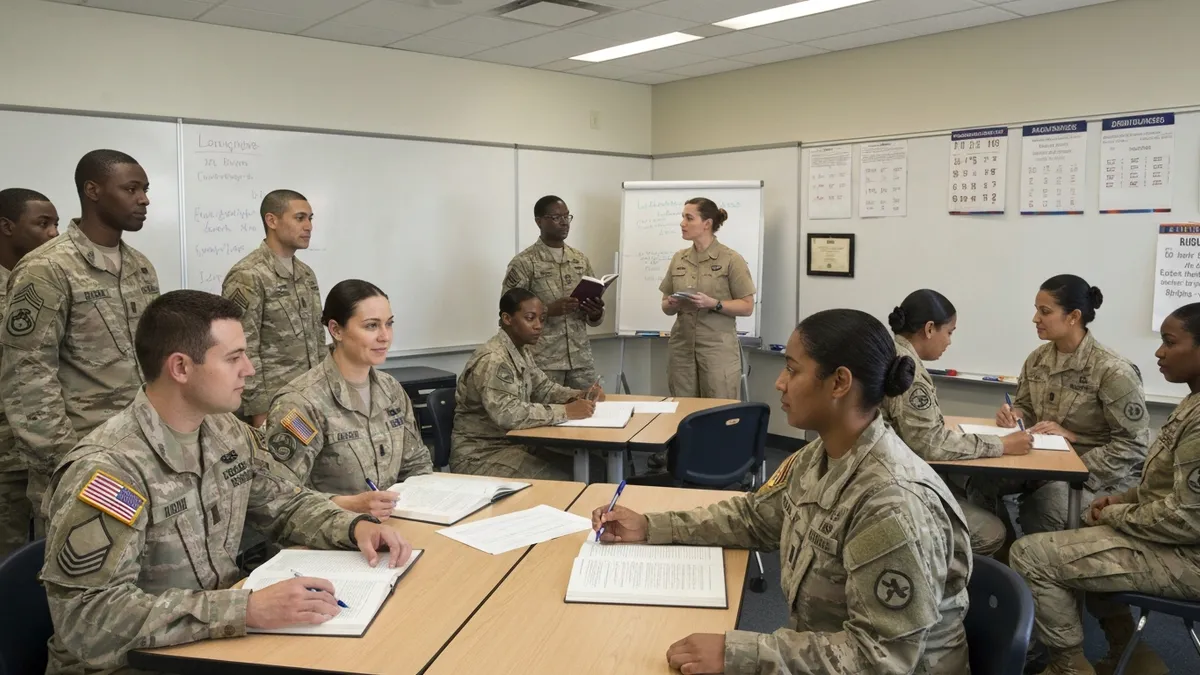
The American Language Course Placement Test (ALCPT) evaluates English language proficiency for military personnel in allied nations. The vocabulary section — often called the Word Knowledge portion — measures your ability to recognize and understand English words in context, a core skill required for military training and communication.
Unlike general English vocabulary tests, the ALCPT focuses on practical military and professional language. Examinees encounter words drawn from:
- Military instructions and commands — terms used in daily operations, briefings, and orders
- Technical English — vocabulary related to equipment, procedures, and reports
- Formal professional English — language used in official correspondence and documentation
- Common American English idioms — expressions frequently used in training environments
The vocabulary section is directly linked to your overall ALCPT score. A strong word knowledge score can raise your total band score and determine eligibility for advanced English Language Training (ELT) courses. Most allied military programs require a minimum ALCPT score of 70–85 to qualify for intermediate or advanced English instruction.
Vocabulary questions appear throughout the test and are not isolated to a single section — they integrate with the listening comprehension portion as well, since understanding spoken vocabulary is essential for answering audio-based questions correctly.
Explore the ALCPT Complete Guide for a full breakdown of all test sections and how they contribute to your final score.
Vocabulary Question Format and Number of Questions
ALCPT vocabulary questions are presented in multiple-choice format, with four answer options (A, B, C, D). Each question presents a target word — either in isolation or within a sentence — and asks you to identify its meaning or the best synonym.
Two main question types appear:
- Word definition questions — A single word is shown, and you select the closest meaning from four options. Example: "What does DEPART mean?" with options such as (A) arrive, (B) leave, (C) remain, (D) return.
- Sentence completion / contextual vocabulary — A sentence contains a blank or an underlined word, and you select the word that fits best or matches the underlined word. Example: "The soldier was ordered to ______ the area immediately." — testing whether you know words like evacuate, occupy, inspect, or secure.
The ALCPT contains 100 questions total across listening and reading/vocabulary sections. Vocabulary items typically account for a significant portion of the reading section, which contains roughly 50 questions. Time allowed is approximately 35–40 minutes for the reading portion, giving you about 40–45 seconds per question on average.
Because questions move quickly, you need instant word recognition — not slow recall. This is why active vocabulary study (not passive reading) produces better test results.
See the ALCPT Score Guide to understand how vocabulary performance maps to your final band and what scores qualify for each training level.
Study Strategies: How to Build Military Vocabulary Efficiently
Building test-ready vocabulary for the ALCPT requires a focused strategy — not random English study. The following methods are proven to accelerate word retention for military English learners.
1. Use Frequency-Based Word Lists
Start with the 500–1,000 most common military English words. Focus on words that appear repeatedly in military training materials, field manuals, and official orders. Prioritize verbs and adjectives — they appear most often in ALCPT questions. Avoid studying rare or highly specialized technical jargon that is unlikely to appear on the test.
2. Learn Words in Context
Studying isolated word lists is less effective than seeing words in sentences. Read short passages from military training guides, American English textbooks (such as the DLI American Language Course books), and official military correspondence. When you encounter an unfamiliar word, write it down in a sentence and review the full phrase — not just the definition.
3. Use Spaced Repetition Flashcards
Flashcard apps using spaced repetition (such as Anki) are extremely effective for vocabulary retention. Create one card per word with: the word on the front, and on the back: definition, example sentence, and one synonym. Study 20–30 new words per day and review previous cards daily. At this rate, you can build a 600-word active vocabulary in one month.
4. Practice With ALCPT-Style Questions
After learning a set of words, test yourself with multiple-choice questions that mirror the ALCPT format. This trains your brain to recognize synonyms quickly — the exact skill tested on the exam. Use our ALCPT practice tests to drill vocabulary in a realistic test environment.
5. Focus on Synonyms and Antonyms
ALCPT vocabulary questions frequently ask for synonyms (words with similar meaning). For every word you study, learn at least one synonym and one antonym. Example: DEPART — synonyms: leave, exit, evacuate; antonyms: arrive, enter, return. This approach also helps with context-based questions where a synonym fits the sentence.
6. Build on Your Listening Vocabulary
Vocabulary tested in the listening section overlaps significantly with the reading section. Watch American English military briefings, training videos, and news reports. Pay attention to how words are used in context — this builds natural recall rather than mechanical memorization. See the ALCPT Listening Guide for specific audio study strategies that reinforce vocabulary learning.
For a fuller set of questions on this topic, see our alcpt test resource.
ALCPT Checklist
- ✓Download or obtain the DLI American Language Course books (especially volumes 1-5 for core vocabulary)
- ✓Create a personal word list of 500 high-frequency military English words
- ✓Set up Anki or another spaced repetition app and study 20-30 new words per day
- ✓Learn one synonym and one antonym for every vocabulary word you study
- ✓Practice 10-15 ALCPT-style multiple-choice vocabulary questions daily
- ✓Read one short military or professional English passage per day to build contextual vocabulary
- ✓Review idioms and fixed expressions weekly (at least 50 before test day)
- ✓Take a full ALCPT practice test every week to track vocabulary improvement and identify weak areas
- ✓Listen to American English audio daily to build passive-to-active vocabulary transfer
- ✓On test day: eliminate obviously wrong answers first, then choose the best remaining synonym
ALCPT Pros and Cons
- +ALCPT has a defined, publicly available content blueprint — candidates know exactly what to prepare for
- +Multiple preparation pathways (self-study, courses, coaching) accommodate different learning styles and schedules
- +A growing ecosystem of study resources means candidates at any budget level can access quality preparation materials
- +Clear score reporting allows candidates to identify specific strengths and weaknesses for targeted remediation
- +Professional recognition associated with strong performance provides tangible career and academic benefits
- −The scope of tested content requires substantial preparation time that competes with existing professional or academic commitments
- −No single resource covers the full content scope — candidates typically need multiple study tools for comprehensive preparation
- −Test anxiety and exam-day performance variability mean preparation effort does not always translate linearly to scores
- −Registration, preparation, and potential retake costs accumulate into a significant financial investment
- −Content and format can change between exam versions, making older preparation materials less reliable
ALCPT Vocabulary Questions and Answers
About the Author

Educational Psychologist & Academic Test Preparation Expert
Columbia University Teachers CollegeDr. Lisa Patel holds a Doctorate in Education from Columbia University Teachers College and has spent 17 years researching standardized test design and academic assessment. She has developed preparation programs for SAT, ACT, GRE, LSAT, UCAT, and numerous professional licensing exams, helping students of all backgrounds achieve their target scores.
Join the Discussion
Connect with other students preparing for this exam. Share tips, ask questions, and get advice from people who have been there.
View discussion (8 replies)