
ALCPT Listening Section Guide: Ace the Hardest Part 2026
Get ready for your ALCPT Listening Section Guide: Ace the certification. Practice questions with step-by-step answer explanations and instant scoring. 📚
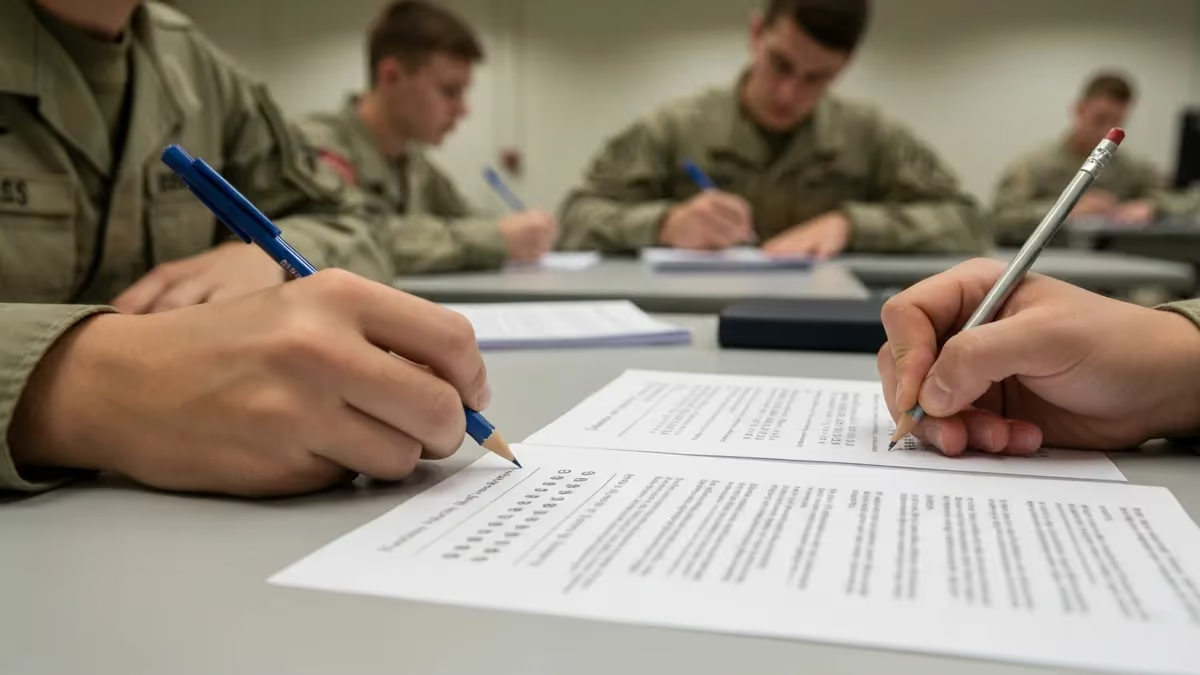
What the ALCPT Listening Section Tests
The American Language Course Placement Test evaluates spoken English comprehension in the format used by the U.S. military's Defense Language Institute. The Listening section specifically tests your ability to understand American English as it is naturally spoken — not textbook-perfect speech — including contractions, reduced vowels, linked words, and speaker-specific rhythm patterns. Practice with the free ALCPT - American Language Course Placement practice test on PracticeTestGeeks (800+ questions with answer explanations).
Test-takers hear a recording of a sentence, short dialogue, or conversational exchange spoken at a natural pace. They must then select the answer that best matches the meaning or implication of what was said. The recordings feature multiple American English accents from different regional backgrounds, reflecting the diversity of DLI instructors and military personnel. Topics range from everyday situations (directions, schedules, workplace instructions) to academic and military context passages.
Your score on this section directly determines your English proficiency level for placement in the American Language Course (ALC) at DLI. A strong Listening score opens the door to higher ALC levels, accelerating your path to operational military language training. You can review full scoring criteria in the ALCPT score guide and understand how each section contributes to your overall placement.
- The ALCPT contains 100 multiple-choice questions. (Defense Language Institute English Language Center)
- ALCPT forms 1–150 contain 66 listening questions. (Defense Language Institute English Language Center)
- ALCPT forms 1–150 take approximately 75 minutes including directions and materials handling. (Defense Language Institute English Language Center)
- ALCPT forms 151 and higher take approximately 70 minutes including directions and materials handling. (Defense Language Institute English Language Center)
- Students may take only one end-of-level ALCPT for each completed level. (Defense Language Institute English Language Center)
- The ALCPT is administered in a testing room using an answer sheet, pencils, and a test booklet. (Defense Language Institute English Language Center)
- The ALCPT is intended for approved military and government English language training programs worldwide. (Defense Language Institute English Language Center)
Facts verified Oct 16, 2026 against Defense Language Institute English Language Center. Dates that have passed are removed automatically.
ALCPT Exam at a Glance
| Item | Detail | Official source |
|---|---|---|
| Number of questions | 100 multiple-choice questions | Defense Language Institute English Language Center |
| Number of questions (Forms 1–150 — Listening) | 66 listening questions | Defense Language Institute English Language Center |
| Number of questions (Forms 1–150 — Reading) | 34 reading questions | Defense Language Institute English Language Center |
| Number of questions (Forms 151 and higher — Listening) | 50 listening questions | Defense Language Institute English Language Center |
| Number of questions (Forms 151 and higher — Reading) | 50 reading questions | Defense Language Institute English Language Center |
| Time limit (Forms 1–150) | Approximately 75 minutes including administration | Defense Language Institute English Language Center |
| Time limit (Forms 151 and higher) | Approximately 70 minutes including administration | Defense Language Institute English Language Center |
| Time limit (Forms 151 and higher — Reading) | 35 minutes | Defense Language Institute English Language Center |
| Retake policy | One end-of-level test per completed level | Defense Language Institute English Language Center |
| Delivery | Paper test administered in a testing room | Defense Language Institute English Language Center |
| Eligibility | Approved military and government English language programs | Defense Language Institute English Language Center |
Facts verified Oct 16, 2026 against Defense Language Institute English Language Center. Dates that have passed are removed automatically.
Free ALCPT - American Language Course Placement Test Study Tools
Interactive ALCPT - American Language Course Placement Test resources on PracticeTestGeeks, free to start:
- ALCPT - American Language Course Placement Test practice test — 800+ questions with instant scoring and answer explanations
- ALCPT - American Language Course Placement Test flashcards — review key terms and concepts card by card
- ALCPT - American Language Course Placement Test study guide — topic-by-topic overview of what the exam covers
- ALCPT - American Language Course Placement Test cheat sheet — one-page printable summary for last-minute review
Why the Listening Section Is the Hardest Part
Most English learners have trained primarily on reading and writing — skills developed through textbooks where every word is visible and permanent. Listening breaks all of those safety nets. When the audio ends, the moment is gone. You cannot re-read the sentence or look up an unfamiliar word. This creates pressure that reading and grammar sections simply do not impose.
Native speakers also speak with reductions and blends that written English never shows. "Did you eat yet?" becomes "Jeet yet?" in fast speech. "I am going to go" becomes "I'm gonna go." If you have not specifically trained your ear to decode these patterns, critical information disappears before you can process it. The ALCPT tests exactly this real-world listening skill — not whether you know the grammar rule, but whether you can hear it in motion.
Additionally, each item uses similar distractor answer choices. One wrong option often contains a word from the audio that leads you to a wrong interpretation. Another distractor restates what the speaker said but reverses the meaning. Without a clear strategy for managing these distractors, guessing alone yields poor results. The ALCPT complete guide covers the full exam structure so you can see how the Listening section fits into your total score picture.
Daily Training Schedule for ALCPT Listening
Building strong listening comprehension for the ALCPT requires consistent daily exposure to authentic American English — not just occasional study sessions. The goal is to train your ear to process speech at native speed automatically, so that on test day, comprehension is instinctive rather than effortful. The schedule below is designed around free and low-cost resources accessible to any DLI student or military English learner.
Morning (15 minutes) — Dictation Training: Use ALCPT 30-day study plan audio materials or VOA Learning English broadcast segments at the 'learning' level (about 120 words per minute — close to ALCPT speed). Play a sentence once, write exactly what you heard, then check the transcript. Focus on the words you missed. This builds the phoneme-to-word recognition that ALCPT rewards.
Midday (10 minutes) — Accent Variety Exposure: The ALCPT uses multiple American English accents. Rotate between different VOA Learning English reporters each session, or use the English Learning section of NPR's website where regional accents differ by host. Do not just listen passively — repeat sentences aloud immediately after hearing them ("shadowing") to cement the accent patterns in your auditory memory.
Evening (20 minutes) — ALCPT-Format Practice: Take timed practice tests using the ALCPT Listening for Main Ideas practice test and the ALCPT Listening for Specific Details practice test. Do not pause the audio. After completing the set, review every wrong answer and identify whether you missed a keyword, misheard a word, or fell for a distractor. Log your error patterns weekly.
Weekend Review (30 minutes): Listen to a complete podcast episode at normal conversational speed — TED Talks in English or American military history podcasts work well. Do not use transcripts during listening. Afterward, summarize what you understood. This tests whether your listening comprehension is holding at extended durations, which mirrors the fatigue factor in the real exam.
Many readers pair this guide with the alcpt test to check their readiness before exam day.
ALCPT Listening Training Checklist
- ✓Complete daily 15-minute dictation with VOA Learning English transcripts
- ✓Practice ALCPT Listening for Main Ideas questions under timed conditions
- ✓Practice ALCPT Listening for Specific Details questions under timed conditions
- ✓Log all missed keywords and review audio for those segments
- ✓Shadow at least one American English speaker for 10 minutes per session
- ✓Review the ALCPT exam format and score requirements
- ✓Take a full-length ALCPT practice test without pausing audio
- ✓Review the ALCPT 30-day study plan and adjust your weak areas
- +Validates your knowledge and skills objectively
- +Increases job market competitiveness
- +Provides structured learning goals
- +Networking opportunities with other certified professionals
- −Study materials can be expensive
- −Exam anxiety can affect performance
- −Requires dedicated preparation time
- −Retake fees apply if you don't pass
Pros and Cons at a Glance
| Pros | Cons |
|---|---|
| Validates your knowledge and skills objectively | Study materials can be expensive |
| Increases job market competitiveness | Exam anxiety can affect performance |
| Provides structured learning goals | Requires dedicated preparation time |
| Networking opportunities with other certified professionals | Retake fees apply if you don't pass |
Sample ALCPT - American Language Course Placement Test Practice Questions
Try these questions from our free ALCPT - American Language Course Placement Test practice tests. The correct answer and an explanation follow each question.
You hear: 'You will need to score at least seventy percent to pass this section.' What is the minimum passing score?
- A. Sixty percent
- B. Sixty-five percent
- C. Seventy percent
- D. Seventy-five percent
Answer: C. Seventy percent
The speaker states that at least seventy percent is required to pass.
Man: 'I feel like my English is improving, but I still make mistakes when people talk fast.' Woman: 'That gets easier the more you practice listening.' What does the woman suggest?
- A. Regular listening practice will help him improve over time.
- B. He should ask native speakers to talk more slowly.
- C. He will never fully understand fast speech without a translator.
- D. He should focus on reading instead of listening.
Answer: A. Regular listening practice will help him improve over time.
The woman assures the man that consistent listening practice will make understanding fast speech easier.
Select the correct comparative structure: 'The ALCPT is ___ the TOEFL.'
- A. not as difficult than
- B. not as difficult as
- C. less difficult than more
- D. lesser difficult as
Answer: B. not as difficult as
The structure 'not as [adjective] as' correctly expresses that two things are unequal.
An officer's report describes a suspect's actions: 'The suspect was observed checking his watch, looking around nervously, and to run when he saw the patrol car.' Which part of this sentence violates the rules of parallel structure?
- A. checking his watch
- B. looking around nervously
- C. to run when he saw
- D. was observed
Answer: C. to run when he saw
To maintain parallel structure in a list, all items should be in the same grammatical form. The first two items are gerunds ('checking', 'looking'). The third item should also be a gerund ('running') to match the others. The infinitive 'to run' breaks the parallel pattern.
Take the full ALCPT - American Language Course Placement Test practice test
🎧 What does ALCPT stand for?
ALCPT stands for the American Language Course Placement Test. It is an English-proficiency test produced by the Defense Language Institute English Language Center (DLIELC) and used by the U.S. military and partner nations to place students into the correct level of the American Language Course (ALC).
START ALCPT PRACTICE TEST🔢 How many questions are on the ALCPT Listening section?
The ALCPT Listening section has 66 (forms 1–150) or 50 (forms 151 and higher) multiple-choice questions. Each item plays an audio recording one time only, and you pick the best answer from four options. There is no replay, so training your ear to catch meaning on the first hearing is essential.
START ALCPT PRACTICE TEST🔁 Does ALCPT listening audio ever replay?
No. Each ALCPT listening recording plays only once, with no transcript and no pause. This is the single biggest reason the Listening section feels harder than Reading. The fix is daily dictation practice at natural speed so first-time comprehension becomes automatic.
START LISTENING PRACTICE TEST🗣️ What accents are used in ALCPT listening?
The ALCPT uses standard American English from several regional varieties rather than one single accent. Speakers pronounce words naturally with contractions and reductions. Because of this, your practice should include multiple American voices, such as VOA Learning English and NPR hosts, not just one speaker.
START LISTENING PRACTICE TEST✍️ Can I take notes during the ALCPT listening test?
Yes. DLI instructors recommend jotting down 2-3 keywords as you listen, such as the main noun, main verb, a time expression, or any negation. Do not try to write full sentences. Quick keyword notes help you choose the right answer and resist distractor options.
START ALCPT PRACTICE TEST🏅 What is a passing score on the ALCPT?
The ALCPT has no single section pass mark. Your listening result combines with the Structure and Vocabulary scores to set your American Language Course placement level. A higher total places you in a more advanced ALC level and shortens your English-training timeline at DLI.
START ALCPT PRACTICE TEST🏫 Who makes and administers the ALCPT?
The ALCPT is developed by the Defense Language Institute English Language Center (DLIELC) at Lackland Air Force Base, Texas. It is administered by sponsoring military units and DLIELC enrollment offices to measure English readiness for the American Language Course.
START ALCPT PRACTICE TEST⚡ How can I improve ALCPT listening speed fast?
Improvement comes from automatic word recognition. The fastest method is 15 minutes of daily dictation at about 120-150 words per minute, close to ALCPT speed. Play a sentence once, write what you heard, then check it. Most learners notice faster comprehension after 3-4 weeks.
START LISTENING PRACTICE TEST🪤 Why are ALCPT answer choices so tricky?
Each listening item uses close distractors. One wrong option repeats a word from the audio but points to the wrong meaning, and another restates the sentence with the meaning reversed. Listening for the full idea, not a single familiar word, is how you avoid these traps.
START LISTENING PRACTICE TEST🎯 What is the best free way to practice ALCPT listening?
Combine timed, no-pause practice tests with authentic listening. Use VOA Learning English and NPR for accent variety, then shadow the speaker by repeating each sentence aloud. Finish with a full-length ALCPT practice set and review every missed keyword to target your weak spots.
START ALCPT PRACTICE TESTALCPT Listening Questions and Answers
Official Resources
- Defense Language Institute English Language Center (DLIELC) — the U.S. Department of Defense organization that develops and administers the ALCPT and the American Language Course.
- Defense Language Institute Foreign Language Center (DLIFLC) — the related DoD language institute in Monterey, California, providing official information on military language training and proficiency standards.
More ALCPT Resources
How this page was made: written with AI tools and published by Nathan Beja, founder of Practice Test Geeks, who is responsible for its content. Exam facts are checked against the official sources listed below. Not reviewed by a subject-matter expert. Editorial policy
Sources & references
Exam facts on this page (fees, format, dates, passing scores) are checked against these official sources; the date is our last check. Editorial policy
- dlielc.edu — Test delivery, exam format, retake policy, time limit, eligibility · verified Oct 2026