
ALCPT Practice Tips 2026 — How to Prepare and Score Higher
Free ALCPT Practice Tips 2026 practice test with questions and answer explanations. Prepare for the 2026 exam with instant scoring. 🗨️
What Is the ALCPT and What Does Preparation Look Like?
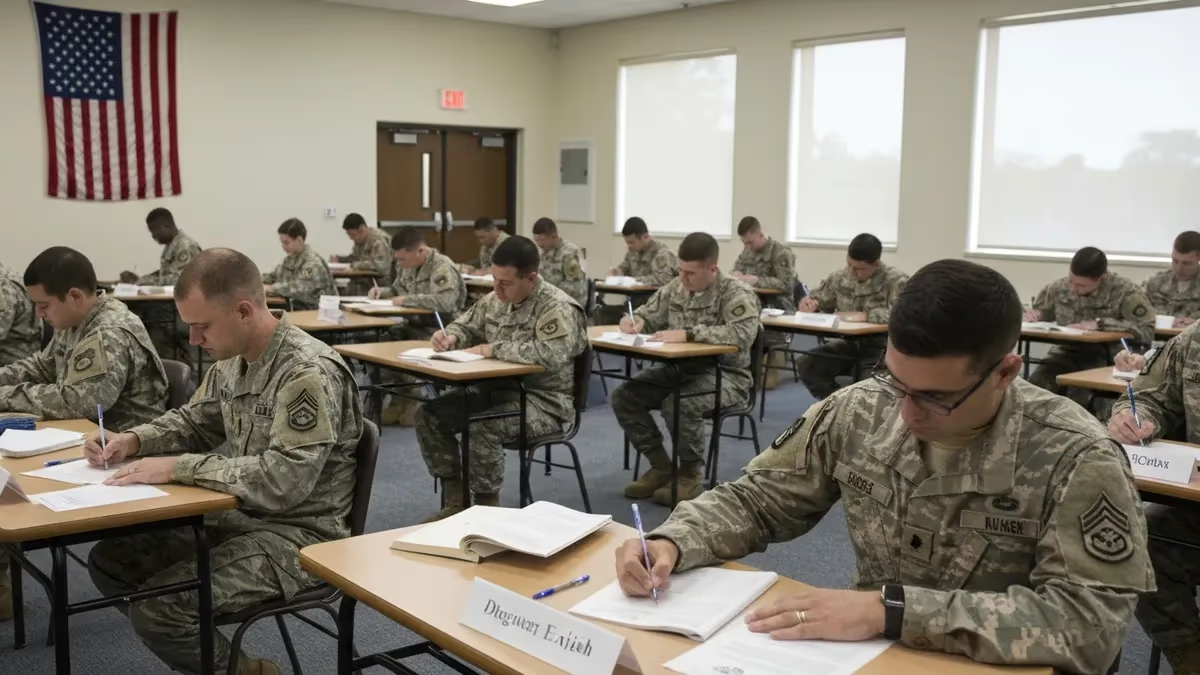
The American Language Course Placement Test (ALCPT) is an English proficiency exam administered by the Defense Language Institute (DLI) to measure listening and reading ability in non-native English speakers serving in the US military and allied armed forces. Scores range from 0 to 100, and a passing score typically falls between 70 and 85 depending on the program or duty assignment. Practice with the free ALCPT - American Language Course Placement practice test on PracticeTestGeeks (800+ questions with answer explanations).
The test is divided into two sections:
- Listening Comprehension — Audio clips of English sentences, short conversations, and questions answered from what you heard.
- Reading (Grammar & Vocabulary) — Written sentences testing grammar rules, word usage, and vocabulary in military and everyday contexts.
Effective ALCPT preparation is built around two pillars: daily exposure to spoken English and systematic grammar review. Most test-takers need 3–6 weeks of focused study to move up a scoring tier. If you are starting from below 50, plan for 6–8 weeks. Review the ALCPT Complete Guide 2026 to understand score benchmarks and which form you will face before you begin studying.
The single most effective thing you can do is take timed ALCPT practice tests every few days to track your progress and identify weak areas. Passive studying — reading notes or watching English TV without active practice — rarely moves scores significantly.
- The ALCPT contains 100 multiple-choice questions. (Defense Language Institute English Language Center)
- ALCPT forms 1–150 contain 66 listening questions. (Defense Language Institute English Language Center)
- ALCPT forms 1–150 take approximately 75 minutes including directions and materials handling. (Defense Language Institute English Language Center)
- ALCPT forms 151 and higher take approximately 70 minutes including directions and materials handling. (Defense Language Institute English Language Center)
- Students may take only one end-of-level ALCPT for each completed level. (Defense Language Institute English Language Center)
- The ALCPT is administered in a testing room using an answer sheet, pencils, and a test booklet. (Defense Language Institute English Language Center)
- The ALCPT is intended for approved military and government English language training programs worldwide. (Defense Language Institute English Language Center)
Facts verified Oct 16, 2026 against Defense Language Institute English Language Center. Dates that have passed are removed automatically.
ALCPT Exam at a Glance
| Item | Detail | Official source |
|---|---|---|
| Number of questions | 100 multiple-choice questions | Defense Language Institute English Language Center |
| Number of questions (Forms 1–150 — Listening) | 66 listening questions | Defense Language Institute English Language Center |
| Number of questions (Forms 1–150 — Reading) | 34 reading questions | Defense Language Institute English Language Center |
| Number of questions (Forms 151 and higher — Listening) | 50 listening questions | Defense Language Institute English Language Center |
| Number of questions (Forms 151 and higher — Reading) | 50 reading questions | Defense Language Institute English Language Center |
| Time limit (Forms 1–150) | Approximately 75 minutes including administration | Defense Language Institute English Language Center |
| Time limit (Forms 151 and higher) | Approximately 70 minutes including administration | Defense Language Institute English Language Center |
| Time limit (Forms 151 and higher — Reading) | 35 minutes | Defense Language Institute English Language Center |
| Retake policy | One end-of-level test per completed level | Defense Language Institute English Language Center |
| Delivery | Paper test administered in a testing room | Defense Language Institute English Language Center |
| Eligibility | Approved military and government English language programs | Defense Language Institute English Language Center |
Facts verified Oct 16, 2026 against Defense Language Institute English Language Center. Dates that have passed are removed automatically.
Free ALCPT - American Language Course Placement Test Study Tools
Interactive ALCPT - American Language Course Placement Test resources on PracticeTestGeeks, free to start:
- ALCPT - American Language Course Placement Test practice test — 800+ questions with instant scoring and answer explanations
- ALCPT - American Language Course Placement Test flashcards — review key terms and concepts card by card
- ALCPT - American Language Course Placement Test study guide — topic-by-topic overview of what the exam covers
- ALCPT - American Language Course Placement Test cheat sheet — one-page printable summary for last-minute review
Mastering the ALCPT Listening Section — the Hardest Part
The listening section is what separates average scorers from high scorers on the ALCPT. Unlike reading, you cannot re-read a question — once the audio plays, it is gone. This means your listening skills must be automatic, not labored.
1. Train With Native-Speed Audio Every Day
Use podcasts, military briefings, or American news radio at full native speed. Resist the urge to slow audio down. Your goal is to build processing speed, not just comprehension at half speed. Start with 10 minutes per day and increase to 30 minutes by week three.
2. Practice Dictation
Dictation is the single highest-yield listening exercise for ALCPT. Listen to a short clip (15–20 seconds), pause, write what you heard word for word, then compare. This forces full attention and highlights the specific word patterns and reductions you miss. Do 10 minutes of dictation daily.
3. Focus on Question Types
The ALCPT listening section uses three main item types: sentence completion (fill in what you heard), short dialogue (answer a question about a brief exchange), and statement questions (choose what the speaker means). Practice each type separately before mixing them. Review the ALCPT Exam guide for exact item formats and sample audio scripts.
4. Build Your Ear for Contractions and Reductions
American English spoken at natural speed is full of reductions: "gonna," "wanna," "kinda," "shoulda," "didja." These are not mistakes — they are standard. If you have only studied formal written English, reductions will trip you up on the listening section. Dedicate a week specifically to reduced speech practice.
5. Simulate Test Conditions
At least twice per week, sit at a desk with no distractions, play ALCPT-style audio at test volume, and answer questions under time pressure. Familiarity with the test environment reduces anxiety and improves concentration on test day. Take full-length ALCPT practice sessions to build stamina and pacing.
6. Review Every Wrong Answer
After each practice session, play back every item you got wrong. Do not just note the correct answer — understand why you missed it. Was it a vocabulary gap? A reduction you did not recognize? A grammar structure you misread? Targeted review beats general re-study every time.
Many readers pair this guide with the alcpt test online to check their readiness before exam day.
- ✓Listen to 15–20 minutes of American English audio (podcast, news, or ALCPT-style clips)
- ✓Complete 10 minutes of dictation — write what you hear, then compare and analyze errors
- ✓Review 10–15 vocabulary flashcards with spaced repetition (Anki or Quizlet)
- ✓Answer 20 grammar questions focusing on your current weak area
- ✓Take a 10-item listening mini-drill under timed conditions (45 sec/item)
- ✓Read one short English passage and answer comprehension questions
- ✓Log your score and any recurring error patterns in a study journal
- ✓Rest — avoid cramming more than 90 minutes of active study per day
- +Validates your knowledge and skills objectively
- +Increases job market competitiveness
- +Provides structured learning goals
- +Networking opportunities with other certified professionals
- −Study materials can be expensive
- −Exam anxiety can affect performance
- −Requires dedicated preparation time
- −Retake fees apply if you don't pass
Pros and Cons at a Glance
| Pros | Cons |
|---|---|
| Validates your knowledge and skills objectively | Study materials can be expensive |
| Increases job market competitiveness | Exam anxiety can affect performance |
| Provides structured learning goals | Requires dedicated preparation time |
| Networking opportunities with other certified professionals | Retake fees apply if you don't pass |
Sample ALCPT - American Language Course Placement Test Practice Questions
Try these questions from our free ALCPT - American Language Course Placement Test practice tests. The correct answer and an explanation follow each question.
He answered every question on the test _______ and received a perfect score.
- A. correct
- B. correctly
- C. correction
- D. more correct
Answer: B. correctly
'Correctly' is the adverb form that modifies the verb 'answered'.
Select the best word: 'The training exercise was _______ to prepare soldiers for real combat conditions.'
- A. irrelevant
- B. designed
- C. ignored
- D. forbidden
Answer: B. designed
'Designed' means planned or created with a specific purpose, making it the correct fit since the exercise had the deliberate goal of preparation. The other options suggest the exercise lacked purpose or was disregarded.
We don't know _______ ALCPT scores yet.
- A. ours
- B. our
- C. us
- D. ourselves
Answer: B. our
Explanation: In this sentence, "our" is the correct possessive pronoun indicating that the ALCPT scores belong to "we" (the subject of the sentence). So, the sentence should read, "We don't know our ALCPT scores yet."
Choose the correct completion: 'The _____ you practice, the _____ your English will become.'
- A. more / better
- B. most / best
- C. much / good
- D. harder / more
Answer: A. more / better
The structure 'the + comparative ... the + comparative' is used to show that two things change in proportion. 'The more you practice, the better your English will become' correctly uses comparative forms in both clauses. 'Most/best' are superlatives and do not fit this structure.
Take the full ALCPT - American Language Course Placement Test practice test
How this page was made: written with AI tools and published by Nathan Beja, founder of Practice Test Geeks, who is responsible for its content. Exam facts are checked against the official sources listed below. Not reviewed by a subject-matter expert. Editorial policy
Sources & references
Exam facts on this page (fees, format, dates, passing scores) are checked against these official sources; the date is our last check. Editorial policy
- dlielc.edu — Test delivery, exam format, retake policy, time limit, eligibility · verified Oct 2026