
KPA Reading Section Guide 2026 September — Language Arts Prep
Free KPA Reading Section Guide 2026 September practice test with questions and answer explanations. 🟢 Prepare for the 2026 September exam with instant scoring.
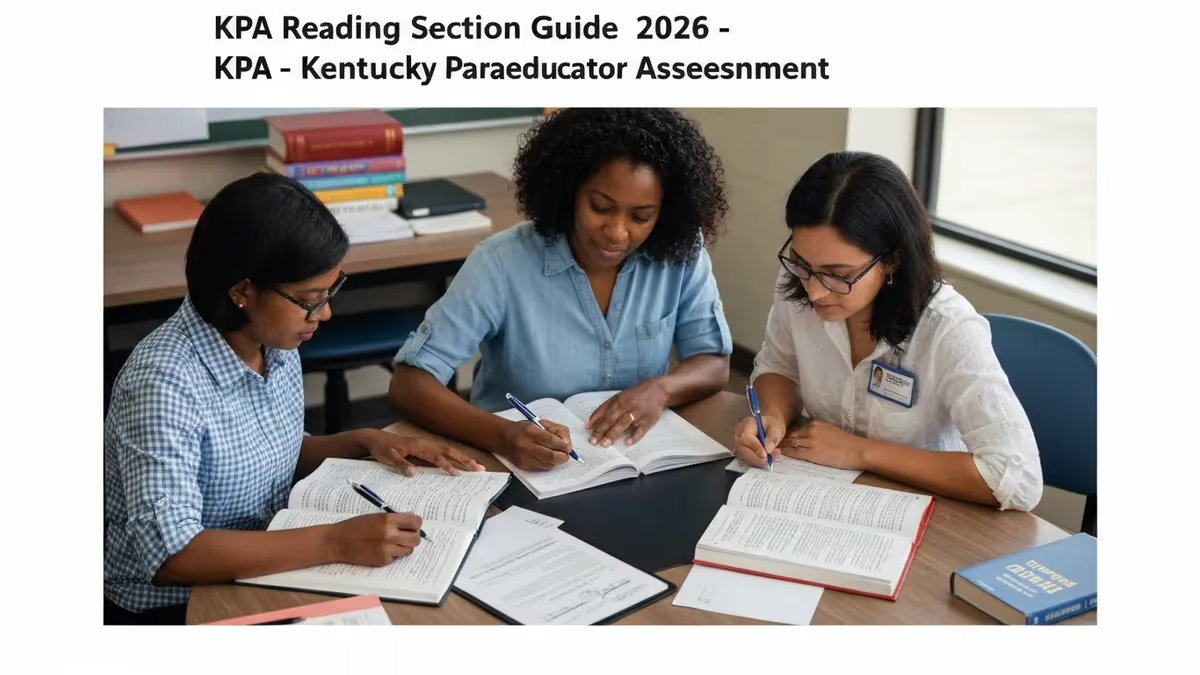
What the KPA Reading & Language Arts Section Covers
The Reading/Language Arts section is the first of three content areas on the Kentucky Paraeducator Assessment (KPA). It evaluates whether you have the foundational literacy skills required to support certified teachers in Kentucky classrooms under ESSA (Every Student Succeeds Act) guidelines.
As a paraeducator, you won't be teaching reading independently — but you will work in small groups, pull struggling readers aside for targeted practice, and help students decode words, build fluency, and understand what they read. The KPA Reading section tests exactly those competencies: the knowledge you need to reinforce what the teacher has already taught.
The section draws from five core skill areas: phonics and phonemic awareness, reading comprehension strategies, vocabulary development, grammar fundamentals, and basic writing mechanics. Questions are written at a level appropriate for someone assisting K–12 classroom instruction, so the focus is on practical application rather than advanced literary theory.
Before diving into sub-topics, make sure you understand the full KPA structure. Our KPA Complete Guide covers scoring, timing, and registration details. You can also begin testing your current level with our KPA Practice Test.
Phonics & Phonemic Awareness
Phonemic awareness is the ability to hear and manipulate individual sounds (phonemes) in spoken words — before any print is involved. Phonics connects those sounds to written letters and letter combinations. The KPA tests both because paraeducators frequently support early readers who are still cracking the code of print.
Key concepts to know:
- Blending — combining sounds to form a word (/k/ /æ/ /t/ → "cat")
- Segmenting — breaking a word into its individual phonemes ("ship" → /ʃ/ /ɪ/ /p/)
- Phoneme substitution — changing one sound to make a new word ("bat" → "bad")
- Consonant blends and digraphs — bl, cr, sh, th, ch, wh
- Short vs. long vowel patterns — CVC (hop) vs. CVCe (hope)
- R-controlled vowels — ar, er, ir, or, ur
- Syllable types — closed, open, silent-e, vowel team, r-controlled, consonant-le
Study strategy: Practice by looking up decodable readers used in Kentucky K–2 classrooms. If you can explain why a word is pronounced the way it is, you're ready for this portion. Many KPA questions ask you to identify what a student is doing wrong or how to best help — so think like a teacher's aide, not a linguist.
Reading Comprehension Strategies
This sub-topic tests whether you understand the strategies skilled readers use — and more importantly, whether you can help a student who is struggling to use them.
Key concepts to know:
- Main idea vs. supporting details — distinguishing the central point from evidence
- Making inferences — drawing conclusions not directly stated in the text
- Text structures — cause/effect, compare/contrast, problem/solution, sequence, description
- Author's purpose — to inform, persuade, or entertain
- Context clues — using surrounding text to determine word meaning
- Summarization — retelling key ideas in your own words
- Monitoring comprehension — recognizing when understanding breaks down and rereading
Study strategy: Read short non-fiction passages (300–500 words) and practice identifying the main idea in one sentence. Then ask: what would a student find confusing here, and how would I explain it? This is the exact thinking the KPA requires.
Vocabulary & Grammar
Vocabulary and grammar questions on the KPA focus on practical knowledge — the kind you'd use when helping a student revise a paragraph or decode an unfamiliar word in a text.
Vocabulary concepts:
- Using context clues (definition, example, contrast, restatement)
- Synonyms and antonyms
- Word roots, prefixes, and suffixes (un-, re-, pre-, -tion, -ment, -ful)
- Multiple-meaning words (homonyms, homophones)
- Tier 2 academic vocabulary (analyze, contrast, justify, sequence)
Grammar concepts:
- Parts of speech: noun, verb, adjective, adverb, pronoun, preposition, conjunction
- Subject-verb agreement
- Correct pronoun use (him/her/they)
- Comma rules: items in a series, compound sentences, introductory phrases
- Capitalization rules
- Sentence types: simple, compound, complex
- Run-on sentences and sentence fragments
Study strategy: Pull a paragraph from a 4th–6th grade textbook and identify every grammar element listed above. Try rewriting it with intentional errors, then catch them. This mirrors exactly what you'll do on the job.
Writing Basics
The KPA does not ask you to write an essay — instead, it tests your knowledge of the writing process so you can guide students through it. Questions may show a student's rough draft and ask how you'd help improve it.
Key concepts:
- The writing process — prewriting, drafting, revising, editing, publishing
- Paragraph structure — topic sentence → supporting details → concluding sentence
- Transitional words — first, however, in addition, therefore, finally
- Revision vs. editing — revision changes content/structure; editing fixes mechanics
- Audience and purpose — adjusting tone and content for the intended reader
- Feedback strategies — asking guiding questions rather than rewriting for the student
Study strategy: Review a sample student paragraph at the 3rd–5th grade level. Ask: Does it have a clear topic sentence? Are the details relevant? Does it need transitions? What feedback would help the student improve it without you writing it for them? Our KPA Practice Guide includes scenario-based exercises that mirror this format.
For broader test preparation across all three KPA sections, see our KPA Kentucky Paraeducator Assessment overview. You can also review the full format on the KPA Test page.

- ✓Review the six syllable types and practice identifying them in grade-level words
- ✓Practice segmenting and blending with words from decodable reader lists
- ✓Read 5 non-fiction passages and write a one-sentence main idea for each
- ✓Study the five text structure patterns and learn signal words for each (e.g., "because", "unlike", "first")
- ✓Complete vocabulary exercises using context clues — no dictionary allowed
- ✓Review the comma rules: series, compound sentences, and introductory phrases
- ✓Analyze 3 student writing samples: identify topic sentence, details, and missing transitions
- ✓Take at least one timed KPA practice test to simulate real exam pacing

- +Validates your knowledge and skills objectively
- +Increases job market competitiveness
- +Provides structured learning goals
- +Networking opportunities with other certified professionals
- −Study materials can be expensive
- −Exam anxiety can affect performance
- −Requires dedicated preparation time
- −Retake fees apply if you don't pass
About the Author

Educational Psychologist & Academic Test Preparation Expert
Columbia University Teachers CollegeDr. Lisa Patel holds a Doctorate in Education from Columbia University Teachers College and has spent 17 years researching standardized test design and academic assessment. She has developed preparation programs for SAT, ACT, GRE, LSAT, UCAT, and numerous professional licensing exams, helping students of all backgrounds achieve their target scores.
Join the Discussion
Connect with other students preparing for this exam. Share tips, ask questions, and get advice from people who have been there.
View discussion (8 replies)