
KPA Practice Guide 2026 September — How to Prepare Effectively
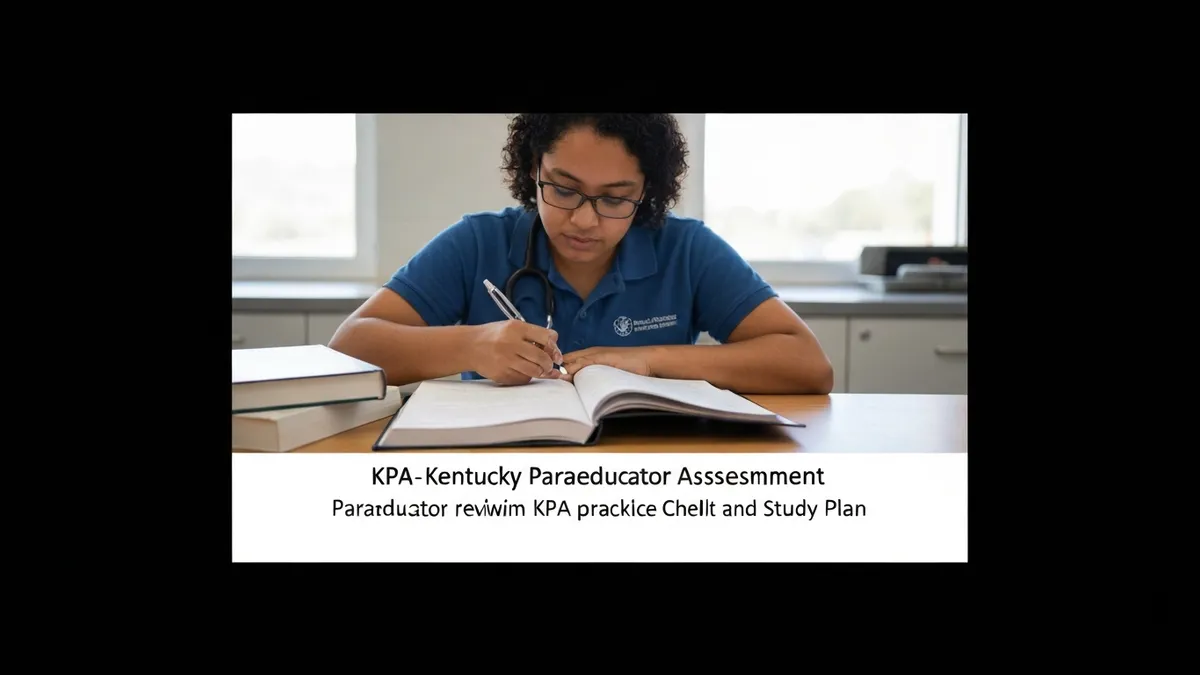
🏆 Get ready for your KPA Practice Guide 2026 September certification. Practice questions with step-by-step answer explanations and instant scoring.

Why Practice Matters for the KPA
The Kentucky Paraeducator Assessment (KPA) is a state-mandated exam required under the Every Student Succeeds Act (ESSA). Kentucky public school districts must verify that instructional aides and paraprofessionals who work in Title I programs demonstrate subject-matter knowledge and teaching skills — and passing the KPA is the primary pathway to meet that requirement.
Unlike general knowledge tests, the KPA is designed around real classroom support scenarios. That means raw content knowledge alone is not enough. You need to practice how questions are framed, how instructional support tasks are described, and how to manage your time across three distinct content areas.
Studies on high-stakes paraprofessional exams consistently show that candidates who complete structured practice sessions score 15–20% higher than those who only review study guides. Practice testing builds retrieval fluency, reduces test anxiety, and exposes knowledge gaps early — giving you time to fix them before exam day.
If you have not already reviewed the full exam structure, start with the KPA Complete Guide 2026 before working through the strategies below. For a quick overview of the assessment itself, see the KPA Test Guide.
Section-by-Section Study Strategies
Reading / Language Arts
The reading section presents short passages followed by comprehension questions. The single most effective practice habit here is active reading: before answering, identify the main idea in one sentence, note the author's purpose, and highlight any signal words (however, therefore, in contrast). Timed passage drills — where you allow yourself no more than 90 seconds per passage — are highly effective.
For language conventions, drill subject-verb agreement, pronoun reference, and comma rules in short daily bursts of 10 questions. Spaced repetition works better than one long session: 10 questions every morning for two weeks outperforms 140 questions in a single sitting.
Use our KPA Practice Test to simulate the real reading experience, then review every wrong answer immediately — don't move on until you can explain why the correct choice is right.
Mathematics
Start by diagnosing your weakest sub-topics. Take a 20-question diagnostic covering all math areas, then rank your error rate by topic. Focus the first two weeks of practice entirely on your bottom three topics before returning to full mixed-topic sets.
Calculator use rules for the KPA should be confirmed with Kentucky's official testing program. Regardless, practice both with and without a calculator so you can move efficiently on simpler arithmetic questions. For word problems, underline the question being asked before doing any calculation — this alone eliminates the most common error (solving for the wrong value).
Fractions and ratios are consistently the most-missed math topics on paraeducator assessments. Dedicate at least three focused practice sessions to fraction operations and ratio/proportion problems before exam week.
Instructional Support
This section has no real equivalent in standard academic tests, which is why it trips up otherwise well-prepared candidates. Questions describe a specific classroom situation — a student refusing work, a disagreement between the paraeducator and teacher, a student with an IEP accommodation — and ask what the paraeducator should do.
The golden rule for this section: when in doubt, defer to the supervising teacher. Paraeducator standards under ESSA make clear that paras operate under teacher supervision. Any answer choice that has you acting independently or making instructional decisions on your own is almost always wrong.
Practice by reading short scenario vignettes and categorizing the answer choices: (1) Appropriate para role, (2) Outside para authority, (3) Harmful to student. This classification habit speeds up question-answering significantly. Visit the KPA Kentucky Paraeducator Assessment category page for scenario-based practice sets.

- ✓Take a full-length diagnostic practice test before beginning focused study
- ✓Review the official KPA content areas and weighting from Kentucky's testing program
- ✓Complete at least 3 timed Reading practice sessions with 90-second-per-passage limits
- ✓Run a math diagnostic and target your three lowest-scoring sub-topics first
- ✓Practice at least 20 Instructional Support scenario questions with scenario-classification technique
- ✓Complete two full timed practice exams in Week 4 under realistic conditions (quiet room, no phone)
- ✓Review every wrong answer immediately — explain the correct answer in your own words
- ✓Rest the night before the exam and arrive early to the testing center
- +Validates your knowledge and skills objectively
- +Increases job market competitiveness
- +Provides structured learning goals
- +Networking opportunities with other certified professionals
- −Study materials can be expensive
- −Exam anxiety can affect performance
- −Requires dedicated preparation time
- −Retake fees apply if you don't pass
About the Author

Educational Psychologist & Academic Test Preparation Expert
Columbia University Teachers CollegeDr. Lisa Patel holds a Doctorate in Education from Columbia University Teachers College and has spent 17 years researching standardized test design and academic assessment. She has developed preparation programs for SAT, ACT, GRE, LSAT, UCAT, and numerous professional licensing exams, helping students of all backgrounds achieve their target scores.
Join the Discussion
Connect with other students preparing for this exam. Share tips, ask questions, and get advice from people who have been there.
View discussion (8 replies)