
ALCPT English Usage Section Guide 2026
Pass your ALCPT English Usage Section Guide 2026 exam on the first attempt. Practice questions with detailed answer explanations, hints, and instant ✏️
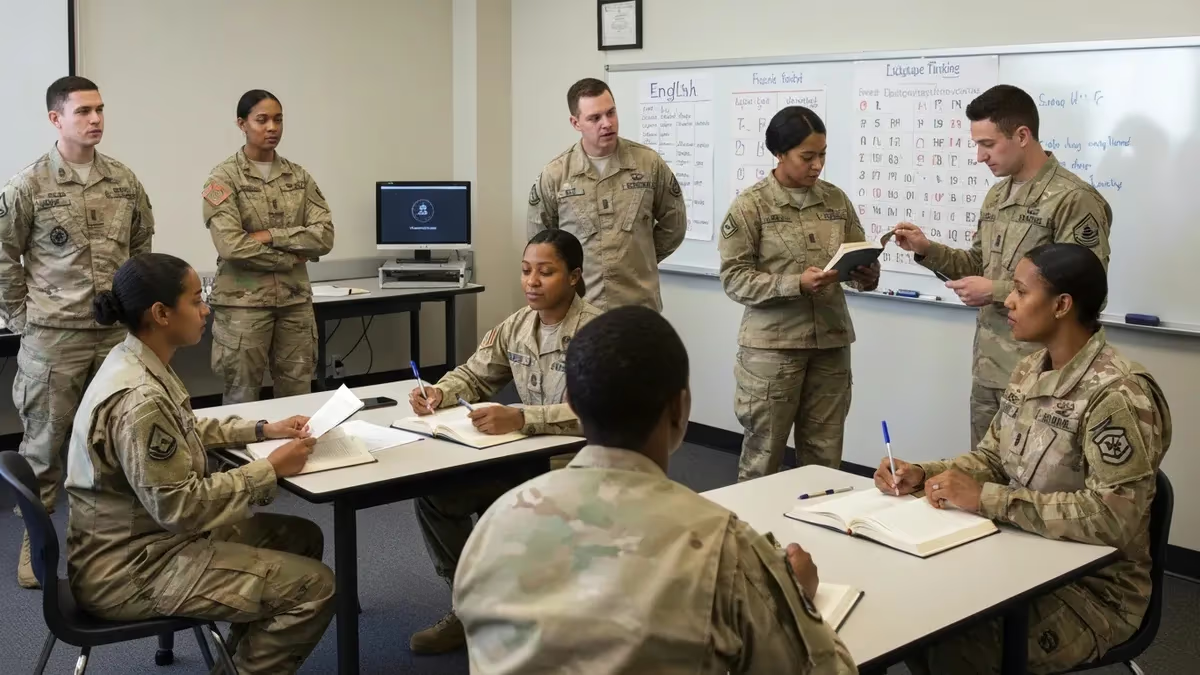
What the ALCPT English Usage Section Tests
The English Usage section of the ALCPT evaluates your ability to identify and apply correct grammatical structures in written English. Questions present a sentence with one or more blanks — you select the word or phrase that makes the sentence grammatically correct. The section typically contains 30–40 questions within the 100-question ALCPT format, weighted alongside the listening and vocabulary sections toward your final ECL (English Comprehension Level) score.
Unlike vocabulary questions that test word meaning, English usage questions test how words function in sentences — their form, agreement, and relationship to other words. The sentences often appear in military or professional communication contexts: briefings, status reports, duty assignments, and official correspondence. For full context on how this fits the overall test, read our ALCPT Complete Guide.
Common Mistakes Non-Native Speakers Make on Military English Tests
Understanding where other test-takers go wrong helps you avoid the same traps. The most frequently missed English usage questions fall into predictable patterns:
Verb Tense Confusion
Many non-native speakers default to the simple past when the present perfect is required. Example: "The sergeant submitted the report already" should be "The sergeant has submitted the report already." The word "already" signals present perfect, not simple past. Similarly, mixing "will" and "would" in reported speech is a common error in military written communications. For broader ALCPT listening context — where verb tense in audio matters — see our ALCPT Listening Guide.
Preposition Selection Errors
Prepositions do not translate directly between languages. Speakers of Arabic, Korean, and Spanish frequently confuse at/in/on for locations and time expressions. Example: "The briefing is in Monday" is wrong — it should be "on Monday." The rule: use on for days and dates, at for specific times, in for months, years, and parts of the day.
Article Usage Errors
Languages without articles (Arabic, Russian, Korean, Japanese) produce speakers who omit the or a/an where they are required, or insert them where they are wrong. Example: "I received the training yesterday" (first mention — should be a training) versus "The training I received yesterday was effective" (second mention, referencing specific training — the is correct). This distinction trips up even advanced speakers.
Subject-Verb Agreement Breaks
Long sentences with intervening clauses cause agreement errors: "The list of requirements are updated" should be "The list of requirements is updated" — the subject is "list," singular. Collective nouns (team, unit, squad) take singular verbs in American English: "The team is ready."
Targeted Study Strategies for the English Usage Section
Rote memorization of grammar rules rarely produces ALCPT results. Research on second-language acquisition shows that pattern recognition through massive input outperforms rule study alone. These strategies reflect that evidence:
Daily Grammar Drills (20 Minutes)
Practice 15–20 ALCPT-style fill-in-the-blank questions every day. Focus on one grammar category per week — spend a week only on verb tenses, then a week on prepositions, then articles, then agreement. Targeted weekly focus beats random mixed practice early in your prep. Use our ALCPT practice tests to simulate real question difficulty.
Military English Reading (30 Minutes)
Read authentic military communication texts: U.S. Army field manuals, official statements from military.com, NATO reports, and daily news from Stars and Stripes. These sources model the sentence structures and vocabulary that appear on the ALCPT. Pay attention to how sentences are constructed — notice verb tense patterns, preposition choices, and article use as you read, not just the content meaning.
Short Writing Practice (15 Minutes)
Write five to seven sentences daily in military communication style. Describe what happened in training, what will happen tomorrow, or summarize a passage you just read. Then review your own writing for the four target error types: verb tense, articles, prepositions, agreement. Writing forces conscious grammar application — passive reading does not. This transfers directly to selecting correct answers under test pressure.
Error Log System
Keep a running log of every question you miss. Note the grammar rule violated and the correct form. Review your error log weekly. Within three weeks of consistent practice, most test-takers see their most frequent error type shrink significantly because they have finally internalized the pattern. For context on how scores are evaluated, see our ALCPT Score Guide.
If you want more targeted practice, the alcpt test page covers the same material with additional questions and explanations.
How English Usage Affects Your Overall ALCPT Score
The ALCPT produces an ECL (English Comprehension Level) score from 0 to 100, used by the U.S. military and allied nations to assign English-language duty positions and language school placements. The English Usage section directly feeds into this score. A strong English usage performance can compensate for weaker listening scores and vice versa — but severe weakness in any one section pulls the overall ECL down significantly.
ECL thresholds matter practically: an ECL of 70 is typically required for advanced military language school programs, while ECL 50 is a common minimum for English-medium duty assignments. Even a 5-point improvement in ECL — achievable through targeted grammar work over four to six weeks — can mean eligibility for different assignments. For a complete breakdown of what ECL scores mean, see our ALCPT Score Guide. For the full picture of all test sections, visit the ALCPT Complete Guide and the ALCPT Vocabulary Guide.
ALCPT English Usage Study Checklist
- ✓Review the 12 English verb tenses and when each is used in military communication
- ✓Memorize the time preposition rule: on (days), at (times), in (periods/months/years)
- ✓Practice 20 article usage exercises targeting the first-mention vs reference distinction
- ✓Create a list of 50 common verb-preposition collocations (rely on, report to, comply with)
- ✓Complete 15 ALCPT-style fill-in-the-blank grammar questions daily for 4 weeks
- ✓Read one military communication text per day and annotate grammar patterns observed
- ✓Write 5 sentences daily in military style and self-correct for grammar errors
- ✓Build and review an error log — track every missed question and the rule behind it
- ✓Spend one dedicated week on each: verb tenses, prepositions, articles, then agreement
- ✓Take a full-length ALCPT practice test every two weeks to measure ECL progress
ALCPT Pros and Cons
- +ALCPT has a defined, publicly available content blueprint — candidates know exactly what to prepare for
- +Multiple preparation pathways (self-study, courses, coaching) accommodate different learning styles and schedules
- +A growing ecosystem of study resources means candidates at any budget level can access quality preparation materials
- +Clear score reporting allows candidates to identify specific strengths and weaknesses for targeted remediation
- +Professional recognition associated with strong performance provides tangible career and academic benefits
- −The scope of tested content requires substantial preparation time that competes with existing professional or academic commitments
- −No single resource covers the full content scope — candidates typically need multiple study tools for comprehensive preparation
- −Test anxiety and exam-day performance variability mean preparation effort does not always translate linearly to scores
- −Registration, preparation, and potential retake costs accumulate into a significant financial investment
- −Content and format can change between exam versions, making older preparation materials less reliable
ALCPT English Usage Questions and Answers
How this page was made: written with AI tools and published by Nathan Beja, founder of Practice Test Geeks, who is responsible for its content. Exam facts are checked against the official sources listed below. Not reviewed by a subject-matter expert. Editorial policy
Sources & references
Exam facts on this page (fees, format, dates, passing scores) are checked against these official sources; the date is our last check. Editorial policy
- dlielc.edu — Test delivery, exam format, retake policy, time limit, eligibility · verified Oct 2026