
Alcohol Based Hand Sanitizer WHMIS: Symbols, Labels, and Workplace Duties 2026
🎓 Alcohol based hand sanitizer WHMIS guide: flame symbol, label elements, SDS basics, worker duties, and AIX Safety WHMIS 2015 study tips for US readers.

Searching for alcohol based hand sanitizer whmis usually means one of two things: you are a worker who just noticed a flame symbol on a pump bottle, or you are preparing for a safety course and want to know how everyday products are classified. Either way, the answer starts with one fact. WHMIS, Canada's Workplace Hazardous Materials Information System, treats many sanitizers as flammable liquids. This guide explains the symbols, the labels, and the duties that follow.
If you live in the United States, you may wonder why a Canadian system matters to you. Many American employers run cross-border facilities, ship products north, or train staff who later work in Canada. Others study WHMIS because it mirrors OSHA's Hazard Communication Standard, and both follow the Globally Harmonized System. Learning one makes the other easier. Online providers teach the WHMIS 2015 course, and many learners search for aix safety whmis 2015 materials before they sit it.
So what does the acronym actually mean? Readers who ask what does whmis stand for will find the full answer is Workplace Hazardous Materials Information System. It is a national framework, introduced in 1988 and modernized in 2015, that gives workers three things: labels on containers, safety data sheets, and education. Federal law governs suppliers, while provincial and territorial law governs employers. The whmis meaning is less about one sticker and more about a shared chain of communication.
Alcohol based hand sanitizer is a useful teaching example because nearly everyone has used it. Most gels and liquids contain 60 to 95 percent ethanol or isopropanol, which is exactly the concentration range that makes a liquid ignite easily. The same ingredient that removes germs from your hands can also feed a fire near a spark, a heater, or a hot work area. WHMIS exists so that nobody has to guess about that risk.
Not every bottle on a shelf is handled the same way. Products authorized as drugs or natural health products fall under different legislation than industrial chemicals, so the supplier label may look different from a standard WHMIS label. Even so, bulk refills, decanted containers, and industrial-strength formulas used in workplaces often trigger WHMIS duties. Always read the label, request the safety data sheet when one exists, and confirm with your supervisor or regulator which rules apply to your specific product.
This article takes a career-and-duties angle. Instead of listing symbols in isolation, it shows who does what: the supplier who prepares the label, the employer who trains and supervises, the health and safety representative who audits storage, and the worker who reads and follows the information. You will also see how those duties connect to the questions asked in certification courses, so your study time pays off twice, once on the job and once on the exam.
By the end, you should be able to recognize the flame pictogram, read a label in under a minute, and find the right section of a safety data sheet when a question comes up. You will also know where to practice. Use the free quizzes linked below to test yourself on hazard classes, labels, and training, then return to the sections that gave you trouble. Small, repeated practice beats cramming every time.
WHMIS Symbols and Labels by the Numbers

Who Handles What: Hand Sanitizer Duties Under WHMIS
Suppliers classify the product, apply a compliant label with the flame pictogram when warranted, and provide a safety data sheet to buyers. They must keep both documents accurate and update them when new hazard information becomes available.
Employers make sure containers stay labeled, safety data sheets are accessible, and workers receive education and training specific to the products they use. They also review training regularly and keep records of who was trained and when.
Supervisors watch daily practice. They check that refill bottles carry workplace labels, sanitizer is stored away from ignition sources, and new hires know where the data sheets are kept. They also report any spills or near misses promptly.
Workers take part in training, read labels before use, follow the stated precautions, and report damaged containers or missing labels. They also have the right to ask questions and refuse unsafe work without fear of reprisal.
The pictogram most associated with hand sanitizer is the flame. Under WHMIS 2015 it appears on flammable liquids, among other classes, and it is drawn as a black flame inside a red diamond border. When you see it on a sanitizer label, the message is clear: keep the product away from heat, sparks, and open flames. The symbol does not mean the product is unsafe to use correctly. It means the hazard is real and manageable.
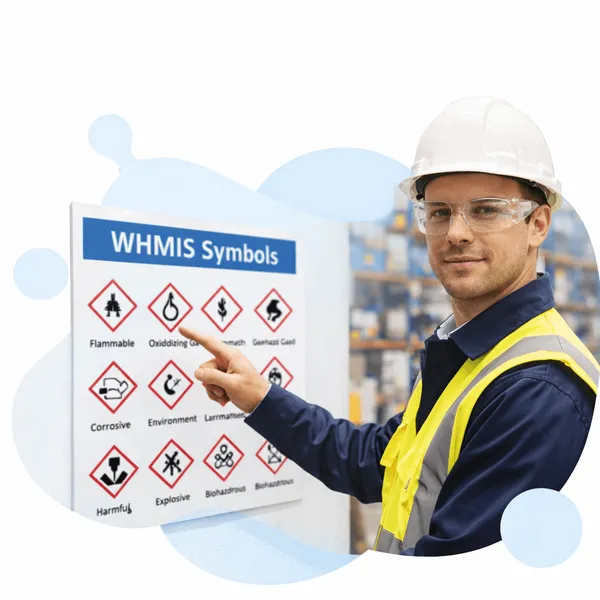
WHMIS 2015 uses ten pictograms in total. Nine are borrowed from the Globally Harmonized System, including the flame, flame over circle, gas cylinder, corrosion, exploding bomb, skull and crossbones, exclamation mark, health hazard, and environment symbol. The tenth, the biohazardous infectious materials symbol, is a Canadian addition. Learning to recognize all ten is the core skill tested in most whmis symbols questions, and it takes less time than most people expect.
Each pictogram sits inside a red diamond border and communicates a class of hazard at a glance. The definition of whmis labeling requirements adds more detail to the picture. A compliant supplier label carries six core elements: the product identifier, the initial supplier identifier, pictograms, a signal word, hazard statements, and precautionary statements. Some labels also include supplemental information, such as first aid advice or storage instructions, and may be printed in English and French.
The signal word on a flammable sanitizer is usually Danger or Warning, depending on how easily the liquid ignites. Ethanol at high concentration typically has a low flash point, meaning it gives off enough vapor to ignite at room temperature. Hazard statements then spell out the risk in plain language, such as highly flammable liquid and vapor. Precautionary statements tell you what to do about it, including keeping the container tightly closed and grounded.
Workplace labels follow a different rule. If an employee pours sanitizer from a large drum into a smaller pump bottle, the new container needs a workplace label unless it is used immediately and entirely by the person who filled it. That label must include the product identifier, safe handling information, and a reference to the safety data sheet. Skipping this step is one of the most common violations found during inspections.
Safety data sheets support the label with deeper detail. They follow a sixteen-section format covering identification, hazards, composition, first aid, fire-fighting measures, accidental release, handling and storage, exposure controls, physical properties, stability, toxicology, ecology, disposal, transport, regulatory information, and other details. For sanitizer, Sections 2, 7, and 9 are the ones you will consult most often when judging fire risk and storage needs.
Comparing systems helps American readers. OSHA's HazCom standard uses nearly identical pictograms and the same sixteen-section data sheets, so a worker who knows one can read the other. The main differences are legal: the agencies, the penalties, and the Canadian biohazard symbol. If you move between countries, expect to retrain on local rules, but you will not need to relearn what a flame, a skull, or a corrosion symbol means.
WHMIS 2015 AIX Safety Course: Symbols, Labels, and SDS Explained
The symbols module of the WHMIS 2015 AIX Safety course asks you to match each pictogram with its hazard class. Expect questions such as which symbol appears on a flammable liquid, which one warns of corrosion, and which one covers serious long-term health effects. Alcohol based hand sanitizer is a favorite example because the flame pictogram is easy to picture and the product is familiar.
A reliable way to memorize the set is to group pictograms by hazard type. Physical hazards include the flame, flame over circle, exploding bomb, gas cylinder, and corrosion to metals. Health hazards include the skull and crossbones, health hazard, exclamation mark, and corrosion to skin. The environment symbol and the biohazard symbol stand apart. Sorting them this way turns ten random images into three small, manageable groups.

Is the WHMIS Certificate Worth Getting?
- +A whmis certificate shows employers you understand hazard symbols, labels, and safety data sheets.
- +Many Canadian job sites require proof of WHMIS training before you can start work.
- +The course is short and can usually be completed online in a few hours.
- +The skills transfer easily to OSHA HazCom, since both systems use the same pictograms.
- +Knowing labels reduces accidents with common products like sanitizers, cleaners, and solvents.
- +Certificates can strengthen résumés in healthcare, cleaning, retail, warehousing, and trades.
- −Certificates are not a substitute for site-specific training from your own employer.
- −Many employers treat training as expiring after a year or three, so renewal is needed.
- −US employers cannot use WHMIS in place of required OSHA hazard communication training.
- −Course quality varies, and some providers charge more than the content justifies.
- −Passing a quiz does not prove you can apply knowledge during an actual spill.
- −Rules differ by province, so a certificate may not fully match every jurisdiction.
Daily Alcohol Based Hand Sanitizer WHMIS Checklist
- ✓Confirm every sanitizer container has a readable supplier or workplace label.
- ✓Check that the flame pictogram and signal word are visible on bulk containers.
- ✓Store sanitizer away from heat, sparks, and open flames.
- ✓Keep bulk containers tightly closed and upright when not in use.
- ✓Label any decanted bottle with product name, precautions, and SDS reference.
- ✓Make sure the current safety data sheet is easy to reach on every shift.
- ✓Clean up spills immediately and ventilate the area.
- ✓Never refill a bottle with a different product without relabeling it.
- ✓Report leaking, damaged, or unlabeled containers to your supervisor.
- ✓Review training records so new staff are instructed before they handle product.
The label is the first line of defense
Most hand sanitizer incidents trace back to a missing label, a decanted bottle with no warning, or storage near heat. If you remember one habit from this guide, make it this: read the label before you use, move, or refill any container.
Storage is where hand sanitizer duties become physical. A flammable liquid should sit in a cool, ventilated location away from ignition sources such as heaters, electrical panels, and hot work. Bulk quantities belong in approved cabinets or storage rooms, not on warm windowsills or beside kitchen equipment. Many workplaces also set limits on how much product may be kept in corridors or open areas, so ask your safety lead about local fire code rules.
Training is the second duty. WHMIS requires employers to provide education on hazard information and training on site-specific procedures. Education covers general topics such as labels, symbols, and data sheets. Training covers how to store, handle, and dispose of the exact products used at your location. A worker who completes an online course has finished only half of the requirement, and the employer must supply the rest.
Records matter more than many managers realize. An inspector who visits a site will often ask to see training logs, current safety data sheets, and examples of workplace labels. If the sanitizer on the shelf has an expired data sheet or the staff cannot explain the flame symbol, the employer may be cited. Keeping a simple spreadsheet with names, dates, and topics covered is a low-cost way to prove compliance and spot gaps.
Health and safety committees play a supporting role. Joint committees in many Canadian provinces review hazard communication programs, walk through work areas, and make recommendations to management. A committee member might notice that a pump bottle in the break room has no label, or that the sanitizer stored near the loading dock sits too close to forklift charging stations. These small catches prevent larger incidents and show why participation matters.
Disposal and spills require planning as well. Small spills of sanitizer can usually be wiped with absorbent material and ventilated, but larger releases create vapor that can ignite. Workers should know where spill kits are kept, who to call, and when to evacuate. Used wipes and absorbents should be placed in approved containers, not left in open bins. Section 6 and Section 13 of the data sheet explain what is appropriate.
Different roles carry different responsibilities, and understanding the difference helps with career planning. Health and safety coordinators, janitorial leads, warehouse supervisors, and nurse managers all handle sanitizer duties in different ways. Each role benefits from knowing the symbols, labels, and data sheet sections. Employers value staff who can explain hazards clearly, because that skill reduces incidents, speeds up audits, and builds a culture where people speak up.
Finally, remember that hazard communication is a conversation, not a poster. New products arrive, formulas change, and workers rotate. The label you learned last year may be replaced by a new one next year. Make a habit of checking, asking, and updating your knowledge whenever something changes, and encourage coworkers to do the same. That habit is what turns a certificate into genuine workplace safety.
WHMIS applies in Canada, while US workplaces follow OSHA's Hazard Communication Standard. Sanitizers authorized as drugs may be treated differently from industrial chemicals, so confirm your obligations with your regulator or safety officer before relying on this guide.
Many learners arrive at this topic because they need to pass the WHMIS 2015 course delivered through AIX Safety. Searches such as whmis 2015 aix safety v3 quiz answers are common, yet copying answers teaches nothing and does not prepare you for real workplace decisions. A better approach is to understand why each answer is correct. When you can explain the reasoning, you can handle any version of the question, including ones you have never seen.
If you want a clear starting point, define whmis in your own words first, then move to the symbols. The course usually opens with background on why hazard communication exists, followed by modules on classification, labels, safety data sheets, and worker responsibilities. Each module ends with short questions, and a final assessment pulls from all of them. A passing score is commonly 80 percent, though you should confirm this with your provider.
The final quiz typically contains between 20 and 30 multiple-choice questions. Some ask you to identify a pictogram from an image, while others describe a situation and ask what the worker should do. Expect at least a few items about labels on decanted containers and the sections of a safety data sheet. Because the course is short, there is little room to guess, so deliberate practice beforehand is especially valuable.
The aix safety whmis answers you find online may be outdated or tied to an older course version. WHMIS 2015 replaced the earlier 1988 system, and the terms changed: material safety data sheets became safety data sheets, and hazard symbols became pictograms. If an answer key refers to controlled products or the old WHMIS symbols, it is not aligned with the current course. Always match your study material to the 2015 content.
After you pass, you will usually receive a downloadable whmis certificate. This document confirms that you completed general education on hazard communication, but it does not replace workplace-specific training from your employer. Keep a copy for your records and give another to your supervisor. Many sites ask for proof at orientation, and some require refreshers every year or three years, depending on provincial rules and company policy.
Cost and time are modest. Most online WHMIS courses take two to four hours and cost somewhere between a few dollars and around thirty dollars, though prices vary by provider and bundle. Some employers cover the fee, so ask before paying out of pocket. If you are taking the course for a US job, check whether your employer expects OSHA HazCom training instead, since WHMIS alone may not satisfy American requirements.
Use the quizzes on this site as a rehearsal. Start with the hazard classes and symbols set, which builds recognition, then move to labels and data sheets, which test reading skills. Finish with the education and training questions, which cover rights and responsibilities. Track your score each time and write down the topics you missed. By the time you open the real course, the material should feel familiar rather than intimidating.
Start your preparation by building a one-page cheat sheet. Draw or print all ten pictograms, write the hazard class beside each, and add one everyday example. Put the flame next to hand sanitizer, the corrosion symbol next to drain cleaner, and the exclamation mark next to mild irritants. Seeing familiar products beside abstract symbols makes recall faster, because your brain connects the image to a real memory rather than a definition.
Next, memorize the six core label elements with a simple phrase. Product, supplier, pictogram, signal word, hazard statement, precaution: say it aloud until it feels automatic. Then pick up a real container and check each element in order. This ten-second routine mirrors what workers do on the job, and it is the exact skill that label questions on exams measure. Repetition with physical objects beats rereading notes.
Treat the sixteen data sheet sections as a table of contents rather than a list to memorize word for word. Group them: sections 1 to 3 describe the product, 4 to 8 explain what to do, 9 to 11 give technical properties, 12 to 15 cover environment, disposal, transport, and regulations, and 16 holds other information. When a question describes a scenario, ask which group it belongs to, and the right section usually becomes obvious.
Schedule short sessions instead of one long marathon. Three twenty-minute blocks across a week outperform a single hour the night before, because spacing helps memory. Use the first block for pictograms, the second for labels, and the third for data sheets and worker rights. Finish each block with a quiz, record your result, and review every wrong answer until you can explain it aloud to someone else.
Watch for tricky wording. Exam writers like words such as always, never, only, and must, which can turn a nearly correct statement into a wrong one. For example, a workplace label is not required for a container filled and used immediately by the same person, so a question claiming every container always needs one may be false. Read each option carefully and eliminate answers that overreach before you choose.
On the job, apply the same discipline. Before using any sanitizer or chemical you have not handled before, read the label, find the data sheet, and ask your supervisor if anything is unclear. The whmis what does it stand for question may appear in the first minute of a course, but the real test comes later, when a leaking bottle or a missing label demands a quick, correct decision.
Lastly, stay curious about updates. Regulations evolve, products are reformulated, and courses are refreshed. Revisit this guide, retake the quizzes every few months, and talk with coworkers about close calls and lessons learned. People who treat safety as an ongoing habit remember more, make fewer mistakes, and often become the trusted voice on the team that others turn to when a question arises.
WHMIS Questions and Answers

WHMIS 2015 Symbols Quiz: Complete Study Guide & AIX Safety Certification Prep

Free Printable WHMIS Labels: Requirements, Symbols, and Training Guide
Take the WHMIS (Workplace Hazardous Materials Information System) Test

WHMIS Quiz Answers: Complete WHMIS 2015 AIX Safety V3 Practice Guide

Flammable Products WHMIS: Hazard Classes, Symbols, and Study Guide for the AIX Safety WHMIS 2015 Course
How this page was made: written with AI tools and published by Nathan Beja, founder of Practice Test Geeks, who is responsible for its content. We have not yet matched this exam's facts to an official source, so confirm fees, dates and rules with the exam body. Not reviewed by a subject-matter expert. Editorial policy