
WHMIS Symbols and Pictograms — Complete Guide (2026)
WHMIS symbols and pictograms explained: all 9 GHS hazards, biohazardous infectious materials, label rules, SDS links, and worker training requirements. ⏳

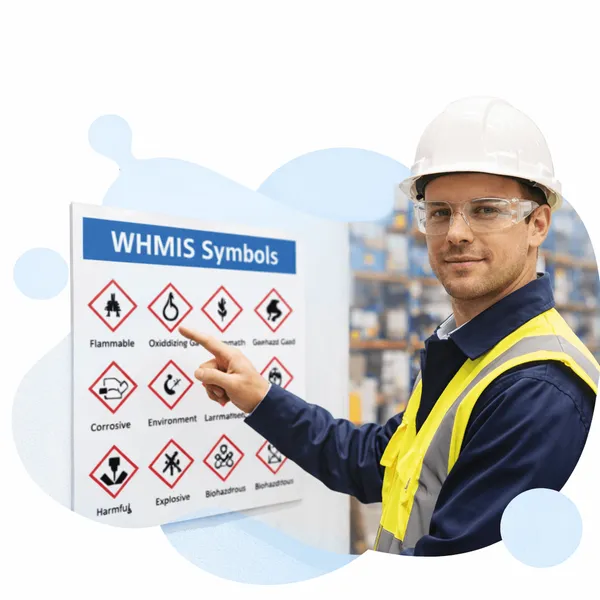
WHMIS Pictograms at a Glance

WHMIS Symbols and Pictograms — What They Mean and Why They Matter
Pop quiz. You walk into a storage room and see a red-bordered diamond with a flame inside. What do you grab — or what do you stay away from? If you can't answer in two seconds, you're not ready for the floor. That's exactly what WHMIS pictograms exist to fix.
WHMIS — Canada's Workplace Hazardous Materials Information System — uses standardized graphic symbols so any worker, on any site, in any province, can spot a hazard before they touch it. Since 2015, WHMIS has been aligned with the United Nations Globally Harmonized System (GHS), which means the whmis symbols you see on a Canadian drum match the ones on a shipment from Germany or a barrel from Mexico. Same hazard, same picture. Different language, same warning.
Here's the short version. There are nine GHS hazard pictograms shared internationally, plus one extra that WHMIS keeps from the old 1988 system: biohazardous infectious materials. That tenth symbol is the part that throws people off because GHS doesn't include it. Canada does. So on a Canadian workplace label, you can see all ten.
Every pictogram is a red square frame, set on its point so it looks like a diamond, with a white background and a black hazard symbol inside. The red border is not decoration. Under the federal Hazardous Products Regulations, that exact frame is required on supplier labels for hazardous products entering Canadian workplaces. No red border, not a valid WHMIS pictogram.
Why does this matter on test day and on the job? Because labels alone don't always survive the workplace. Bottles get rinsed. Drums get repainted. A pictogram tells you what's inside even when the words are gone — which is exactly why the whmis 2015 aix safety v3 quiz answers hammer pictogram recognition harder than almost any other topic. Pictograms are the visual shorthand that holds the whole system together.
Why Pictograms Beat Words for Hazard Communication
Hazard warnings used to be words on a label. That works fine in a single-language workplace. It falls apart fast when your warehouse staff speaks four languages, your contractors rotate through every week, and a chemical drum arrives from a supplier in Quebec with French-only fine print. Pictograms cut through all of that — a flame symbol means flammable whether the worker reads English, French, Tagalog, Spanish, or no language at all.
That's why the United Nations built GHS around pictograms in the first place. Visual hazard recognition is faster than reading and works across literacy levels. Studies on workplace safety repeatedly show pictogram-based labels outperform text-only labels for hazard identification speed — especially in high-stress moments where reading comprehension drops sharply.
Memorize this: A WHMIS pictogram is a black hazard symbol inside a red-bordered square set on its point (diamond shape) on a white background. The red border is mandatory under the federal Hazardous Products Regulations. If a supplier label shows a hazard symbol without the red diamond border, it does not meet WHMIS 2015 requirements — and that's a question that shows up on almost every certification exam.
The 9 GHS Hazard Pictograms
Flammables, self-reactives, pyrophorics, self-heating substances, emitters of flammable gas, organic peroxides. Anything that burns on its own or ignites easily.
- Example: Acetone, gasoline, propane
Oxidizers — substances that supply oxygen and intensify a fire. They don't burn themselves, but they make everything else burn hotter and faster.
- Example: Hydrogen peroxide, sodium nitrate
Gases under pressure — compressed, liquefied, refrigerated liquefied, or dissolved gases. Cylinder explosion risk if heated or punctured.
- Example: Oxygen, nitrogen, CO2 tanks
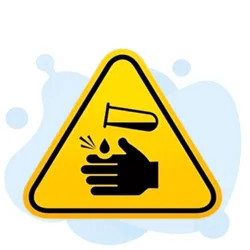
Corrosive to metals and to skin and eyes. Eats through containers, scars skin on contact, and can blind on splash.
- Example: Sulfuric acid, sodium hydroxide
Acute toxicity at fatal or near-fatal doses by mouth, skin, or inhalation. Small amounts cause serious harm.
- Example: Cyanide, methanol concentrated
Less severe acute toxicity, skin or eye irritation, skin sensitization, respiratory irritation, or harmful to ozone layer. The 'caution' bucket.
- Example: Bleach (dilute), many cleaners
Carcinogens, mutagens, reproductive toxins, respiratory sensitizers, target-organ toxicity, aspiration hazard. Long-term or systemic damage.
- Example: Asbestos, benzene, formaldehyde
Explosives, self-reactives (Type A and B), and organic peroxides (Type A and B). Detonation or rapid energy release risk.
- Example: TNT, certain peroxides
Aquatic toxicity — acute and chronic harm to aquatic organisms. Optional under Canadian WHMIS (mandatory under GHS in many other countries).
- Example: Certain pesticides, heavy metal salts
Biohazardous Infectious Materials — The Tenth Pictogram
Here's where WHMIS breaks from pure GHS alignment. Canada kept one extra pictogram from the original WHMIS 1988 system: the biohazardous infectious materials whmis symbol. It's the same three-blade biohazard mark you see on medical waste bins worldwide — except in WHMIS it lives inside a red-bordered diamond instead of an orange circle.
What It Covers
This pictogram applies to organisms (or toxins produced by organisms) that cause disease in people or animals. Think blood, body fluids, tissue cultures, certain microorganisms used in research labs, and biological waste from hospitals or veterinary clinics. If a substance can cause infection on exposure, this symbol shows up. It also covers prions (which cause diseases like CJD), parasites, and some recombinant DNA work where modified organisms might pose infection risk.
Why GHS Doesn't Have It
The Globally Harmonized System was built around chemical hazards. Infectious agents are biological, not chemical, so they fell outside the GHS scope when the UN drafted it. Canada decided that healthcare workers, lab techs, and waste handlers still needed a clear pictogram for these materials, so it stayed in WHMIS as a Class D Division 3 carryover. The EU handles biological agents under a separate Biological Agents Directive instead. Canada bundled it in — one system, one set of pictograms.
Where You'll See It
Mostly in healthcare, research labs, vet clinics, biotech facilities, and waste management. If you work in those settings, this pictogram is more relevant to your daily routine than half the chemical ones. If you work in construction or a warehouse, you'll rarely see it — but you still need to recognize it for the whmis pictograms portion of your certification test. It also surfaces in funeral services, public health, food production, and any workplace handling clinical waste streams.
How to Handle It
Standard biosafety precautions apply. That means engineering controls (biosafety cabinets, sealed centrifuges, contained autoclaves), administrative controls (restricted access, training records, posted procedures), and PPE (gloves, gowns, eye protection, sometimes respirators). Sharps go into rigid puncture-proof containers — never loose into regular waste. Spill protocols include flooding the area with appropriate disinfectant for a posted contact time (often 10–30 minutes) before any cleanup. Exposure incidents — needlestick, splash to mucous membrane, bite — go to occupational health immediately for risk assessment and possible post-exposure prophylaxis.
How Pictograms Travel — From Supplier to Worker
Step 1 — Hazard Classification
Step 2 — Supplier Label Created
Step 3 — SDS Prepared
Step 4 — Product Shipped to Workplace
Step 5 — Employer Posts SDS Access
Step 6 — Workplace Labels Applied
Step 7 — Worker Recognizes and Acts

Where Pictograms Show Up — Labels and Safety Data Sheets
Pictograms appear in two main places under WHMIS 2015: on container labels, and inside Safety Data Sheets. Both must match. If a supplier label shows the corrosion pictogram, Section 2 of the SDS must list corrosive hazard categories and Section 15 must reference the underlying regulation. They are tied together by law.
Supplier Labels
A supplier label is what arrives on the original container from the manufacturer or importer. It must show product identifier, supplier identifier, pictograms, signal word ('Danger' or 'Warning'), hazard statements, precautionary statements, and supplemental information. The pictograms have to be visible, legible, and in the legally required red diamond format. You can't just print them in black-and-white to save toner. The label has to be in both English and French if the product is sold across Canada, though provincial language laws sometimes allow English-only or French-only in specific markets.
Workplace Labels
A workplace label is what you create internally — for example, when you decant a chemical from a big drum into a spray bottle. It's allowed to be simpler than a supplier label. It needs a product identifier, safe handling info, and a reference to the SDS.
Workplace labels don't legally require the full pictogram set (workers should already be trained on the parent product), but most safety programs include them anyway for clarity. They can be handwritten, printed, or applied as preprinted forms — what matters is that the information is durable, legible, and stays attached to the container as long as the chemical is in use.
Safety Data Sheets — Sections 2 and 15
The SDS is a 16-section document that travels with hazardous products. For pictograms, two sections matter most: Section 2 (Hazard Identification) lists every pictogram, signal word, and hazard statement that applies to the product; Section 15 (Regulatory Information) references the underlying Canadian regulations including the Hazardous Products Act and the Hazardous Products Regulations.
When you study whmis sds requirements, Sections 2 and 15 are the heaviest hitters for pictogram-related exam questions. Section 8 (Exposure Controls/Personal Protection) and Section 7 (Handling and Storage) are the next two you'll lean on day-to-day — they translate the pictograms into actual workplace controls and behaviors.
What Happens When They Don't Match
Discrepancies between the label and the SDS are a compliance problem and a worker safety risk. If a label shows the corrosion pictogram but the SDS Section 2 doesn't list any corrosive categories, the product can't legally be supplied to a Canadian workplace until the discrepancy is fixed. Joint health and safety committees, supervisors, and individual workers all have the right to refuse work involving a non-compliant product. Federal inspectors under Health Canada and provincial OHS officers both have authority to seize non-compliant inventory and issue orders.
Pictogram Look-Up — What Each One Warns About
What it warns about: Anything that burns easily, ignites in air, or reacts with itself. Includes flammable liquids, gases, solids, aerosols, self-reactive substances, pyrophorics, self-heating substances, substances that emit flammable gas when wet, and organic peroxides.
On the SDS: Section 2 will list categories like 'Flammable liquid Category 2' or 'Self-reactive substance Type C'. Signal word is usually 'Danger' for higher categories.
Workplace example: A drum of acetone in a paint shop. Keep it away from sparks, hot work, and direct sunlight. Use only with ventilation and bonding/grounding when transferring.
Pictogram Recognition Checklist for the Job
- ✓Check for the red-bordered diamond — no border, not a valid WHMIS 2015 pictogram
- ✓Identify the symbol inside (flame, gas cylinder, corrosion, etc.) and recall the hazard family it represents
- ✓Read the signal word — 'Danger' is the more severe tier, 'Warning' is the less severe one
- ✓Cross-reference Section 2 of the SDS to confirm pictograms and read full hazard statements
- ✓Check Section 8 of the SDS for required PPE and engineering controls before opening the container
- ✓If the container is decanted or unlabeled, find the parent product's label and apply a workplace label before use
- ✓Never rely on memory alone for chronic-hazard pictograms (Health Hazard, Skull) — always re-check the SDS
Worker Training — What WHMIS Requires
Recognizing pictograms is only half the system. The other half is workers actually understanding what each symbol means for their specific job — and that's not optional under WHMIS. Federally, the Hazardous Products Act and Hazardous Products Regulations cover supplier responsibilities (labels and SDSs). Provincially, occupational health and safety regulations cover employer responsibilities — and the biggest one is whmis training. The two regulatory streams interlock. Suppliers have to give you accurate labels and SDSs. Employers have to make sure you can read them, understand them, and act on them.
Generic vs. Workplace-Specific
Generic WHMIS training (sometimes called 'WHMIS 2015 awareness') covers the system itself — pictograms, signal words, label types, SDS structure. Every worker who could be exposed to a hazardous product needs this baseline. But it's not enough on its own. Employers must add workplace-specific training that covers the actual products in use at that site: their hazards, controls, emergency procedures, and handling rules.
Generic training alone won't pass a regulatory audit. A regulator who shows up after an incident will ask one specific question: 'Could the worker name the pictograms on the chemicals in their work area, and could they describe the controls on the matching SDS?' If the answer is no, the employer is on the hook.
How Often
WHMIS training is not a one-and-done. Workers need refresher training when there's a change in product, work conditions, or when their knowledge gets rusty. Many provincial regulators recommend at least annual refresher courses, and several major employers run them every twelve months as standard practice. If a new chemical comes onto site, that triggers additional training — not just an email. Same goes when an SDS gets updated, when a process changes, or when a near-miss exposes a knowledge gap. Refreshers also have to be documented just like initial training.
What Records Employers Must Keep
Employers have to document who got trained, what they were trained on, when, and by whom. Records are typically kept for the duration of employment plus a defined retention period set provincially. In an audit or after an incident, those records are the first thing requested. Verification of understanding is part of the documentation — typically a quiz, a sign-off, or a supervisor observation. 'I sat through the slides' is not sufficient evidence of competency under most provincial OHS Acts.
Joint Health and Safety Committee Involvement
In most provinces, workplaces above a certain size must have a Joint Health and Safety Committee with both worker and management representatives. The JHSC has a role in WHMIS — they review training programs, inspect labels and SDS availability during workplace inspections, and investigate WHMIS-related concerns. Workers can bring pictogram-recognition issues, missing labels, or unavailable SDSs to their committee rep instead of going straight to a supervisor. The committee is supposed to push back when employer compliance lags.
Worker Rights Under WHMIS
Workers in Canada have three core WHMIS rights: the right to know, the right to participate, and the right to refuse unsafe work. The right to know means access to current labels and SDSs. The right to participate means involvement in joint committees and training programs. The right to refuse means you can stop work if a hazardous product is unlabeled or missing an SDS — and your employer cannot retaliate. These rights are written into provincial OHS legislation, not just into WHMIS itself.

WHMIS Training — What It Costs and Covers
Pictogram Quick Reference — Memorize This Table
The fastest way to lock pictograms into long-term memory is to associate each one with one example product you have actually seen. Don't memorize the abstract category name first — memorize a real container. Flame? That's the gas can in your garage. Corrosion? That's the drain cleaner under the sink. Gas cylinder? That's the propane tank on the BBQ. Skull and crossbones? Old rat poison from the shed. The visual anchor makes recall almost automatic, and your brain is wired to remember objects better than abstract categories.
And here's the thing about exam questions: they almost never ask 'what is the flame pictogram for?' in the abstract. They ask 'a worker spills a clear liquid that has the flame pictogram on the drum — what's the first hazard concern?' That's a workplace scenario, not a definition.
You need the visual memory, the hazard family, AND the practical control to answer it well — exactly what the whmis worker training assessments are designed to test. The good news is that scenario questions reward genuine understanding — if you actually know how the system works, you'll outperform people who memorized definitions cold.
Use the table below for last-minute review the night before a certification exam. Cover the right column. Look at the pictogram name. Force yourself to say the example out loud. Then check. Repeat until you hit ten of ten without a miss. After that, switch to mixed-mode: shuffle the order, mix in scenario phrasing, and time yourself. Two seconds per pictogram is a realistic target for fluent recognition. If you're slower than that on test day, the time pressure will compound any uncertainty.
One more study habit that pays off: walk through your real workplace (or any workplace you have access to) and read the labels on five random containers. Cleaning supplies under the sink. Aerosol cans in the garage. Solvent bottles in the basement. Match each pictogram to a hazard family out loud. This is the bridge between exam knowledge and on-the-floor competency, and it's the part most online courses skip entirely.
GHS Alignment — What Canada Gained and Kept
WHMIS 2015 aligned Canada with GHS but kept one important national addition. Here's the tradeoff in plain terms.
- +Standardized pictograms — same symbol means the same thing in Canada, the EU, the US, Japan
- +16-section Safety Data Sheet format — predictable structure across every supplier
- +Two signal words ('Danger' / 'Warning') replace the old class/division shorthand
- +Suppliers can ship a single label design internationally instead of relabelling per country
- +Hazard categories are numbered (Category 1 worst, higher numbers less severe) — clearer than letter codes
- −Biohazardous Infectious Materials pictogram kept — GHS has no equivalent, so it sits outside international harmonization
- −Environment pictogram remains optional in Canada — mandatory in GHS countries like the EU
- −Some old WHMIS 1988 labels are still in circulation on legacy stockpiles — workers need both old and new training
- −Workplace label rules are still set provincially in Canada — there is variation between Ontario, Alberta, BC, and federal sites
- −Transition period created confusion between 2015 and 2018 — many SDSs needed full rewrites to match the new format
Pros and Cons at a Glance
| Pros | Cons |
|---|---|
| Standardized pictograms — same symbol means the same thing in Canada, the EU, the US, Japan | Biohazardous Infectious Materials pictogram kept — GHS has no equivalent, so it sits outside international harmonization |
| Two signal words ('Danger' / 'Warning') replace the old class/division shorthand | Environment pictogram remains optional in Canada — mandatory in GHS countries like the EU |
| Suppliers can ship a single label design internationally instead of relabelling per country | Workplace label rules are still set provincially in Canada — there is variation between Ontario, Alberta, BC, and federal sites |
Sample Workplace Hazardous Materials Information System Practice Questions
Try these questions from our free Workplace Hazardous Materials Information System practice tests. The correct answer and an explanation follow each question.
What does WHMIS stand for?
- A. Workplace Healthy Materials Information System
- B. Workplace Hazardous Materials Information System
- C. Workplace Hazardous Maintenance Information System
- D. Workplace Health Materials Information System
Answer: B. Workplace Hazardous Materials Information System
Explanation: WHMIS stands for Workplace Hazardous Materials Information System. This system is designed to provide information about hazardous materials in the workplace, including their potential health effects, safe handling procedures, and necessary precautions. It is important for employees to be aware of and understand WHMIS in order to work safely with hazardous materials and protect their health.
During a chemical splash emergency, a WHMIS-trained worker should FIRST:
- A. Flush the affected area with large amounts of water for at least 15-20 minutes
- B. Apply a neutralizing agent immediately
- C. Put on additional PPE before flushing
- D. Consult the SDS before taking any action
Answer: A. Flush the affected area with large amounts of water for at least 15-20 minutes
Immediate flushing with water for 15-20 minutes is the primary first aid response for chemical splashes to skin or eyes.
Which of the following is a common method of communicating WHMIS information in the workplace?
- A. Verbally informing workers without written records
- B. Using visual aids like signs and labels, as well as Safety Data Sheets (SDS)
- C. Relying solely on oral safety talks
- D. Giving workers a written guide to WHMIS and allowing them to interpret it themselves
Answer: B. Using visual aids like signs and labels, as well as Safety Data Sheets (SDS)
WHMIS information is primarily communicated through a combination of visual aids and detailed documentation. This includes clear, standardized labels on hazardous product containers, prominent safety signs, and comprehensive Safety Data Sheets (SDS). These methods ensure that critical hazard information is readily accessible and easily understood by workers, promoting immediate recognition and appropriate action.
Regarding labels, what must WHMIS training teach workers?
- A. How to legally remove labels from containers after opening
- B. How to interpret pictograms, signal words, and hazard and precautionary statements on labels
- C. How to design custom workplace labels from scratch
- D. That labels are optional for products used only indoors
Answer: B. How to interpret pictograms, signal words, and hazard and precautionary statements on labels
Workers must be able to read and understand all elements on a WHMIS label, including GHS-aligned pictograms and signal words, to use products safely.
Take the full Workplace Hazardous Materials Information System practice test
WHMIS Questions and Answers
About the Author

Educational Psychologist & Academic Test Preparation Expert
Columbia University Teachers CollegeDr. Lisa Patel holds a Doctorate in Education from Columbia University Teachers College and has spent 17 years researching standardized test design and academic assessment. She has developed preparation programs for SAT, ACT, GRE, LSAT, UCAT, and numerous professional licensing exams, helping students of all backgrounds achieve their target scores.