
WHMIS Symbols: Complete Training Guide for WHMIS 2015 2026 September
Master WHMIS symbols and pass your WHMIS 2015 training. 💡 Covers all GHS pictograms, aix safety WHMIS answers, hazard classes, and quiz prep.

Understanding WHMIS symbols is the foundation of workplace safety in Canada, and if you are preparing for your WHMIS 2015 aix safety v3 quiz answers, this guide covers everything you need to know. WHMIS — which stands for Workplace Hazardous Materials Information System — was updated in 2015 to align with the Globally Harmonized System (GHS) of classification and labelling of chemicals.
The revised system replaced the old WHMIS 1988 symbols with internationally recognized pictograms, changing how millions of Canadian workers identify hazards on the job. Whether you work in manufacturing, healthcare, construction, or a laboratory setting, recognizing these symbols correctly can prevent serious injury or death.
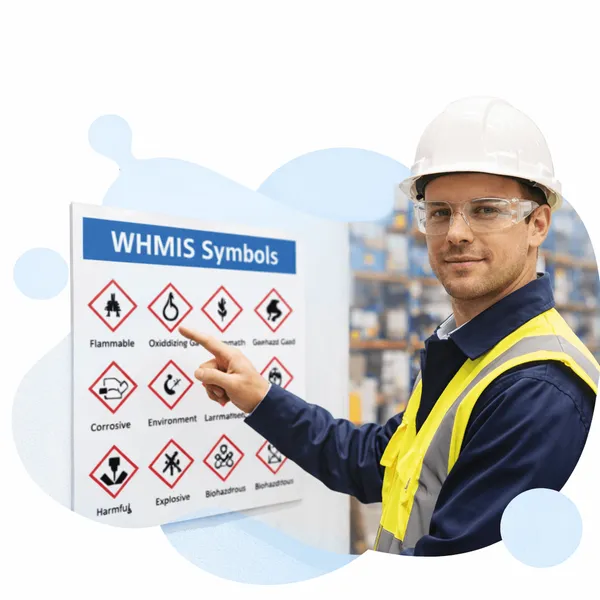
The nine GHS-based WHMIS symbols each appear inside a distinctive red diamond border, making them immediately recognizable on product labels and Safety Data Sheets (SDS). Each symbol conveys a specific category of hazard — from flammable gases and oxidizing liquids to acute toxicity and environmental hazards. Knowing what each pictogram represents is not optional trivia; it is a legal requirement under the Hazardous Products Act and the Hazardous Products Regulations. Employers across Canada must ensure workers receive adequate training before they handle, store, or dispose of any controlled product covered by the system.
Many workers search for whmis 2015 aix safety v3 quiz answers because online training platforms like AIX Safety deliver mandatory WHMIS 2015 certification that employers accept coast to coast. These assessments test your ability to match symbols to their hazard class, read SDS sections correctly, and apply safe handling procedures in realistic scenarios. Getting familiar with all nine pictograms before you sit the exam dramatically improves your score and, more importantly, builds the practical awareness that keeps you safe every shift.
What does WHMIS stand for in plain terms? It is a national communication system that ensures every hazardous product used in a Canadian workplace carries consistent labelling and documentation. The 2015 update did not change the core mission — it strengthened it by harmonizing Canadian requirements with the international GHS standard, making it easier for companies that import or export chemicals to comply with multiple regulatory frameworks simultaneously. The result is a cleaner, more visual system that workers can learn faster and apply more reliably.
This training guide walks you through every WHMIS symbol in detail, explains the hazard classes behind each pictogram, outlines what your employer is legally required to provide, and gives you a structured approach to passing your certification quiz on the first attempt. You will also find a breakdown of how the AIX Safety platform structures its WHMIS 2015 module and what types of questions appear most frequently in assessments. Each section builds on the last, so reading from start to finish gives you the most complete preparation possible.
Even if you have completed WHMIS training before, the 2015 revision introduced enough changes — new symbols, revised hazard categories, and updated SDS format — that a full review is worthwhile. Some hazard classes that existed under WHMIS 1988, like biohazardous infectious materials, carried over into the new system with modified symbols, while entirely new categories like respiratory or skin sensitizers were added. Staying current is not just about compliance; it reflects a genuine commitment to protecting yourself and your coworkers from preventable harm.
By the end of this guide, you will be able to identify all nine WHMIS 2015 pictograms on sight, explain the hazard each one represents, describe the key information found in each SDS section, and confidently answer the types of questions that appear on employer-administered and third-party WHMIS assessments including the popular AIX Safety platform used by hundreds of Canadian employers.
WHMIS 2015 by the Numbers

All 9 WHMIS 2015 Symbols Explained
Covers flammable gases, aerosols, liquids, solids, self-reactive substances, pyrophoric liquids and solids, self-heating substances, and substances that emit flammable gas on contact with water. Always store away from ignition sources and heat.
Oxidizing gases, liquids, and solids can intensify fires or cause ignition of nearby combustible materials. Keep segregated from flammables in storage. This symbol warns that the product itself may not burn but dramatically accelerates combustion.
Applies to unstable explosives, self-reactive substances of types A and B, and organic peroxides of types A and B. Products bearing this symbol require special storage permits, blast-resistant containers, and strictly controlled temperature environments.
Reserved for substances with high acute toxicity via oral, dermal, or inhalation routes. A single or short-term exposure can cause death or severe injury. This symbol requires immediate first-aid protocols and emergency response planning.
A broader warning symbol covering skin irritants, eye irritants, respiratory irritants, narcotic effects, and skin sensitizers (Category 1B). Less severe than the skull symbol, but still signals meaningful health risk requiring PPE and ventilation controls.
WHMIS training requirements in Canada are governed by both federal and provincial legislation, meaning workers must complete two distinct layers of instruction before they can legally work with controlled products. The federal Hazardous Products Regulations set the standard for how products must be classified and labelled, while provincial occupational health and safety (OHS) legislation determines how employers must train workers in those workplaces.
Understanding this two-tier structure helps explain why WHMIS certification from one platform — such as the online modules where you find aix safety whmis 2015 answers — satisfies some requirements but must be supplemented with workplace-specific training delivered by your direct employer.
Generic WHMIS training, often called Part 1 training, covers the conceptual knowledge of the system: the nine pictograms, the 16 SDS sections, label reading, and the general rights and responsibilities of workers and employers. This is typically delivered online through platforms like AIX Safety, which issues a certificate upon successful completion of a multiple-choice assessment.
The certificate is widely accepted as proof of foundational WHMIS knowledge and is often required before a new hire's first shift. Scores of 80 percent or higher are the standard threshold set by most Canadian employers, though some safety-sensitive industries require 100 percent on retakes until mastery is demonstrated.
Workplace-specific training, sometimes called Part 2 or employer-specific training, must be conducted by the employer or a designated safety officer on-site. This component covers the specific hazardous products actually present in that workplace, the correct procedures for handling them under site-specific conditions, emergency response protocols unique to the facility, and the location of SDS binders or digital SDS management systems. No online certificate, regardless of how thorough the generic content, can substitute for this hands-on, site-specific instruction. Both parts together constitute complete WHMIS compliance for any individual worker.
Refresher training is another critical obligation that employers frequently overlook until an inspection or incident forces the issue. WHMIS regulations do not specify a universal renewal interval — instead, they require retraining whenever a worker's knowledge is inadequate, when new hazardous products are introduced, or when work procedures change in ways that affect hazard exposure. In practice, many employers adopt an annual renewal cycle to ensure consistent compliance across large workforces. Workers who switch employers or move between facilities within the same organization often need site-specific retraining even if their generic certificate is current.
Supervisors and managers carry additional training obligations under most provincial OHS frameworks. Beyond understanding the symbol system themselves, supervisory personnel must be able to verify that workers under their direction have received adequate WHMIS training, ensure SDS documents are accessible during every work shift, investigate incidents involving hazardous product exposure, and document all training activities with dates and signatures. Failure to maintain accurate training records is one of the most common compliance gaps found during Ministry of Labour inspections, and the penalties can be substantial.
Workers also have explicit rights under WHMIS legislation. The right to know about hazardous products in the workplace is the cornerstone of the entire system. Workers may refuse to work with a hazardous product if they have not received adequate training, and they cannot be penalized for exercising this right. They may also request access to the SDS for any controlled product at any time, without restriction from supervisors or management. These rights exist regardless of employment status — full-time, part-time, temporary, and contract workers are all protected equally under the legislation.
Staying current on regulatory updates is part of ongoing WHMIS compliance. Health Canada periodically revises the Hazardous Products Regulations to align with new GHS revision cycles, and employers must update their training programs and SDS libraries to reflect those changes. The transition from WHMIS 1988 to WHMIS 2015 was the largest single update in the system's history, but smaller amendments continue to occur. Workers who understand the structure of WHMIS — not just the current symbols — are better positioned to adapt as the system evolves.
AIX Safety WHMIS 2015 Quiz — What to Expect
The AIX Safety WHMIS 2015 online module typically consists of 20 to 30 multiple-choice questions drawn from randomized question banks, covering pictogram identification, SDS navigation, label reading, and worker rights. Most versions of the quiz require a score of 80 percent or higher to receive a certificate, and workers are generally permitted two or three attempts before being locked out and required to retake the full training module. Questions are timed, and the platform tracks completion to generate tamper-evident records for employer compliance files.
Scoring on the AIX Safety platform rewards precise knowledge rather than general awareness. A question might display a pictogram image and ask you to select the correct hazard class from four options, or describe a workplace scenario and ask which SDS section contains the relevant emergency response information. Partial credit is not awarded on multiple-choice formats, so memorizing the exact name and definition of each hazard class — not just a vague sense of its meaning — is essential for achieving a passing score on the first attempt.

Online WHMIS Training vs. In-Person Classroom Training
- +Complete at your own pace from any device, fitting around shift schedules
- +Instant certificate delivery upon passing the assessment
- +Consistent content delivery eliminates instructor variability
- +Question banks randomize each attempt, discouraging answer memorization
- +Digital records integrate directly with employer HR and compliance systems
- +Lower cost per learner at scale compared to classroom instruction
- −Cannot replace mandatory workplace-specific training delivered on-site
- −No opportunity to handle actual products, labels, or SDS binders in real time
- −Technical issues with the platform can disrupt completion and certificate delivery
- −Workers with limited digital literacy may struggle without in-person support
- −Engagement and retention are typically lower without live instructor interaction
- −Some provincial regulators scrutinize online-only training for high-hazard sectors
WHMIS Exam Prep Checklist
- ✓Memorize all nine WHMIS 2015 pictogram names and the hazard class each represents.
- ✓Learn the exact number and title of all 16 SDS sections in order.
- ✓Distinguish between supplier labels and workplace labels and know what each must contain.
- ✓Understand the difference between physical hazards, health hazards, and environmental hazards.
- ✓Know which symbol applies to acute toxicity (skull) versus lower-severity irritants (exclamation mark).
- ✓Study the health hazard symbol categories: carcinogens, reproductive toxins, respiratory sensitizers.
- ✓Review the conditions under which an employer may create a workplace label instead of using the supplier label.
- ✓Practice identifying the correct SDS section for first aid, PPE, transport, and toxicological data.
- ✓Understand worker rights: right to know, right to refuse unsafe work, right to participate.
- ✓Complete at least one full practice quiz under timed conditions before your certification attempt.
The Health Hazard Symbol Is the Most Commonly Missed Pictogram
The health hazard symbol — a silhouette of a person with a starburst on the chest — covers serious but non-acute effects including carcinogenicity, reproductive toxicity, respiratory sensitization, and target organ toxicity. Many test-takers confuse it with the exclamation mark (which covers milder irritation effects) or the skull and crossbones (which covers acute lethality). On most WHMIS assessment platforms, questions about this symbol account for a disproportionate share of wrong answers. Spend extra review time here.
WHMIS labels and Safety Data Sheets form the two pillars of the hazard communication system, and understanding how they work together is essential for both workplace safety and passing your certification exam. Every controlled product sold in Canada must arrive from the supplier with a compliant label affixed to the container.
That label must include the product name, the supplier's name and address, a hazard statement, precautionary statements, the applicable pictograms, and signal words — either DANGER for more severe hazards or WARNING for less severe ones. These elements are not optional decorative features; they are the primary means by which a worker quickly identifies risk before handling any product.
Workplace labels come into play whenever a product is decanted from its original supplier container into a smaller container for use within the facility. Unlike supplier labels, workplace labels do not need to replicate every element of the original — they must include the product name, safe handling instructions, and a reference to the SDS.
Employers are also required to create a workplace label when they produce a hazardous product on-site rather than receiving it from an outside supplier. This distinction between supplier and workplace labels is tested heavily on WHMIS assessments because workers frequently misunderstand what information is required and under what circumstances each label type applies.
The 16-section SDS is the most information-rich document in the WHMIS system and functions as the technical reference guide for every controlled product. Section 1 provides product identification and emergency contact information. Section 2 gives a complete hazard identification summary. Section 3 covers composition and ingredient information, which is critical for toxicological assessments and mixture calculations. Section 4 through 6 cover first-aid measures, fire-fighting measures, and accidental release measures respectively — the three most operationally critical sections during an emergency. Section 7 and 8 address handling, storage, and exposure controls including specific PPE requirements and occupational exposure limits.
Sections 9 through 13 shift toward technical and scientific detail: physical and chemical properties, stability and reactivity, toxicological information, ecological information, and disposal considerations. These sections are used most heavily by industrial hygienists, safety officers, and medical personnel rather than frontline workers, but WHMIS training still requires all workers to know where this information lives so they can direct inquiries appropriately. Section 14 covers transport information and aligns with regulations from Transport Canada and international conventions for road, rail, air, and marine shipment — important for workers in distribution, logistics, and receiving roles.
Sections 15 and 16 round out the SDS with regulatory information and any other relevant data the supplier chooses to include. Section 15 lists the national and international regulations that apply to the product, including Canadian Environmental Protection Act (CEPA) designations, EPA regulations if the product is also sold in the United States, and any restricted or prohibited substance lists. Section 16 is a catch-all for revision dates, abbreviations, disclaimer language, and supplementary safety guidance. Knowing that Section 16 contains the SDS revision date helps workers and safety officers verify they are consulting the most current version of the document.
Accessing SDS documents in the workplace is a legally protected worker right, and employers must maintain them in a form that is readily accessible to all workers on every shift. This does not mean the SDS must be physically posted at every workstation, but it does mean workers must be able to retrieve the relevant document quickly — ideally within minutes — during normal work and in an emergency.
Many modern workplaces use cloud-based SDS management software that allows mobile access from any device, which satisfies accessibility requirements while also making version control easier to manage as suppliers issue updated documents.
For workers preparing to take the whmis 2015 aix safety certification assessment, the label and SDS components of the exam are some of the most reliably scored sections when approached with a systematic study method. Memorizing the 16 section numbers and their assigned content areas in sequence — rather than trying to recall them thematically — is the most efficient preparation strategy. A simple mnemonic or repeated self-testing using flash cards or online practice questions significantly improves both speed and accuracy on the timed exam format used by most certification platforms.

Canadian legislation does not mandate a specific WHMIS certificate renewal date, but most employers require annual retraining as a standard practice. More importantly, retraining is legally required whenever a worker's knowledge is found to be inadequate, when new hazardous products are introduced to the workplace, or when procedures change. Never assume a certificate earned years ago is sufficient if your workplace or role has changed — confirm your employer's specific renewal policy before it becomes a compliance issue.
Passing your WHMIS certification on the first attempt requires a strategic approach to studying rather than simply reading through material and hoping for the best. The most effective preparation combines visual memorization of the nine pictograms, systematic study of the 16 SDS sections, and repeated practice with realistic multiple-choice questions that mirror the format and difficulty level of the actual assessment. Workers who attempt the exam after only a brief skim of the training content frequently find themselves uncertain on the pictogram identification questions — particularly the three health-related symbols that are easily confused with one another.
Start your preparation by printing or drawing all nine WHMIS 2015 pictograms alongside their official names and hazard class descriptions. The nine symbols are: flame (flammables), flame over circle (oxidizers), exploding bomb (explosives and reactive substances), gas cylinder (gases under pressure), skull and crossbones (acute toxicity), health hazard (serious health effects), exclamation mark (caution/irritants), corrosion (skin and eye corrosion/metals), and environmental hazard (aquatic toxicity). Write out the hazard classes covered by each symbol without looking, then check your answers. Repeat this exercise until you can accurately name every symbol and its associated hazards in under 60 seconds.
The three most commonly confused symbols — health hazard, exclamation mark, and corrosion — deserve extra attention because they all relate to biological effects on the human body. The key distinction is severity and mechanism: corrosion means the product causes visible physical destruction of skin or metal surfaces on contact; health hazard means the product causes serious but often delayed systemic effects like cancer or reproductive harm; exclamation mark covers relatively mild and reversible effects like skin redness or temporary irritation.
On the AIX Safety quiz, a question describing a product that causes permanent lung damage would point to the health hazard symbol, not the exclamation mark, and making that distinction reliably is worth several correct answers.
Practice questions are indispensable for building test-readiness. Free resources like the quizzes on PracticeTestGeeks let you work through scenario-based questions that require applying symbol knowledge to realistic workplace situations rather than simply recalling definitions. Scenario questions are harder than straight recall because they require you to integrate multiple pieces of information — for example, identifying that a product with both a flame symbol and a skull symbol requires both fire-prevention controls and toxicological emergency response protocols, not just one or the other. This applied reasoning is exactly what employers and regulators want WHMIS training to produce.
Time management during the actual exam matters more than many candidates expect. The AIX Safety platform and similar providers set time limits per question or for the entire quiz, and running out of time is a surprisingly common reason for failing an otherwise manageable assessment. Practice answering questions in 60 to 90 seconds each — roughly the time budget you have on most timed WHMIS platforms. If a question is genuinely unclear, mark it for review and move on rather than spending three minutes deliberating and creating time pressure on later questions that you could answer confidently.
If you are looking for aix safety whmis answers to cross-reference your practice results, remember that the best use of answer keys is not to memorize the specific questions that appeared in one version of the quiz — question banks rotate — but to understand why each correct answer is correct.
When you miss a practice question, trace the logic back: which hazard class does this symbol represent, which SDS section contains this type of information, what distinguishes this label requirement from the alternative? Understanding the reasoning behind correct answers is far more valuable than memorizing a list of answers that may not match the question set you actually receive.
After you pass your online generic training, take the workplace-specific component seriously rather than treating it as a formality. The on-site training is where you connect abstract symbol knowledge to the actual products you encounter on your shift. Ask your safety officer to walk you through the SDS binder or system for the specific chemicals in your work area.
Locate the emergency eyewash stations, spill kits, and fire suppression equipment relevant to the hazards you work with. This practical grounding makes the knowledge stick and prepares you to act correctly under the time pressure of a real incident, which is ultimately what the entire WHMIS system is designed to achieve.
Practical mastery of WHMIS symbols goes beyond passing an exam — it means developing the habit of reading every label before you touch any product, locating the SDS before you begin a new task involving an unfamiliar chemical, and briefing coworkers on hazards when you are the first person to introduce a new product into a shared workspace.
These behaviors seem straightforward in training materials, but they require deliberate reinforcement in the pressure of a busy shift where shortcuts feel tempting. The workers with the best safety records are those who have internalized the WHMIS system so thoroughly that label reading becomes automatic rather than effortful.
One practical exercise that strengthens WHMIS symbol recognition is conducting informal walk-throughs of your own workplace to audit the hazardous products present. For each product, identify the pictograms on the label, verify that an SDS is accessible, and check that the label has not been damaged or obscured. This kind of active engagement with the system solidifies the connection between the symbols you studied in training and the real products you work with daily. Many experienced safety officers recommend this exercise to new workers within the first week of employment as a complement to formal training.
Understanding the WHMIS symbols for physical hazards — particularly the gas cylinder symbol — is important for workers in trades, laboratories, and industrial settings where compressed gas cylinders are common. The gas cylinder symbol covers compressed gases, liquefied gases, refrigerated liquefied gases, and dissolved gases.
The hazards associated with pressurized cylinders are both physical (explosion risk if heated or dropped) and, depending on the gas, chemical (toxicity, flammability, asphyxiation). A cylinder of oxygen carries the gas cylinder symbol; if it were an oxidizing gas, it would also carry the flame-over-circle symbol. Learning to read the combination of symbols on a single label gives you a complete picture of all relevant hazards.
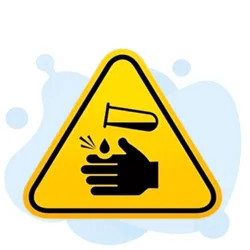
The corrosion symbol — depicting liquid dripping onto a hand and a flat surface — covers two distinct types of damage: biological corrosion to skin and eyes, and material corrosion to metals. A product classified as corrosive to metals but not to skin will still carry the corrosion symbol, which is a source of confusion on assessment questions.
The key is recognizing that the symbol signals the corrosion hazard category broadly, and the specific type of corrosion is clarified in the SDS hazard identification section (Section 2) and the first-aid section (Section 4). When in doubt about what a label symbol means for your specific handling task, always consult the SDS before proceeding.
Workers who handle oxidizing substances — chemicals like hydrogen peroxide at high concentrations, chlorine gas, or potassium permanganate — should pay particular attention to the flame-over-circle symbol because the hazards it signals require fundamentally different emergency responses than flammable materials. Oxidizers don't burn themselves, but they dramatically accelerate the combustion of other materials in the vicinity.
A fire involving an oxidizer should never be fought with techniques appropriate for a standard hydrocarbon fire. Understanding this distinction from the symbol alone — before you ever read the SDS — demonstrates exactly the kind of rapid hazard awareness that WHMIS 2015 was designed to build in every Canadian worker.
Cross-contamination between different hazard classes is a real risk in workplaces where multiple types of chemicals are stored. Storing a flammable liquid next to an oxidizer, for example, creates conditions that can transform a minor spill into a catastrophic fire or explosion. WHMIS training teaches workers to use pictograms not just to understand individual products but to think about compatibility and separation.
An employee who can look at two products on adjacent shelves, recognize conflicting pictograms — a flame on one and a flame-over-circle on the other — and flag the storage arrangement for correction is demonstrating applied WHMIS competence that goes well beyond quiz-level knowledge.
The environmental hazard symbol, depicting a dead tree and a dead fish, is worth understanding even if it is not always required on Canadian workplace labels. Products bearing this symbol are acutely or chronically toxic to aquatic organisms and may persist in the environment for extended periods.
Workers in facilities near waterways, drainage systems, or stormwater infrastructure need to understand the environmental consequences of improper disposal or accidental spills. Proper spill containment, disposal through licensed waste management services, and notification of environmental authorities in the event of a release are all informed by recognizing this symbol and consulting the ecological information in SDS Section 12.
WHMIS Questions and Answers


About the Author

Educational Psychologist & Academic Test Preparation Expert
Columbia University Teachers CollegeDr. Lisa Patel holds a Doctorate in Education from Columbia University Teachers College and has spent 17 years researching standardized test design and academic assessment. She has developed preparation programs for SAT, ACT, GRE, LSAT, UCAT, and numerous professional licensing exams, helping students of all backgrounds achieve their target scores.