
How to Get WHMIS Certification: Complete Study Guide & Training Prep 2026
How do I get WHMIS certification? Step-by-step training guide with AIX Safety answers, symbols, and free practice tests. ✅ Get certified fast.

If you have been asking yourself how do I get WHMIS certification, you are not alone. Every year hundreds of thousands of workers across Canada — and increasingly in US-based companies with Canadian operations — need to complete Workplace Hazardous Materials Information System training before they can legally handle or work near controlled products. WHMIS 2015 updated the original 1988 standard to align with the Globally Harmonized System of Classification and Labelling of Chemicals, making modern certification more comprehensive than ever. Understanding the path from enrollment to certificate is the first step to staying safe and compliant.
WHMIS stands for Workplace Hazardous Materials Information System, and it is the Canadian framework that governs how hazardous substances are classified, labeled, and communicated to workers. The standard covers everything from corrosive liquids to flammable gases, oxidizers, and acute toxins. If you work in construction, manufacturing, healthcare, oil and gas, or virtually any industrial sector, your employer is required by law to ensure you are trained before you encounter hazardous materials on the job. Certification shows you understand those hazards and can protect yourself and your coworkers.
The modern WHMIS 2015 system replaced the old WHMIS 1988 framework by introducing internationally recognized pictograms, standardized Safety Data Sheets with 16 required sections, and a new supplier-labeling format. If you studied under the old system, you will need to retrain because the hazard classes, symbols, and SDS format changed substantially. Workers who completed WHMIS 1988 training can usually transition through a bridging course that focuses on what is new rather than repeating everything from scratch, saving both time and money.
There are two general pathways to WHMIS 2015 certification: online self-paced training and in-person classroom instruction. Online courses through providers such as AIX Safety have become extremely popular because they let you complete the training on your own schedule. The whmis 2015 aix safety v3 quiz answers section of AIX Safety's platform includes scored module quizzes and a final assessment that you must pass before your certificate is issued. Most online courses take two to four hours to complete, making them accessible to busy workers and shift employees who cannot attend weekday classes.
Employer-led workplace training is the second major route. Under Canadian legislation, employers must provide site-specific WHMIS education that goes beyond the general hazard knowledge covered in generic online courses. This means even if you complete an AIX Safety online course or another accredited online program, your employer still needs to deliver hands-on training that covers the actual chemicals, safety data sheets, and emergency procedures relevant to your specific workplace. Both components together — generic and site-specific — constitute a complete WHMIS certification.
Practice testing is one of the most effective ways to prepare for your WHMIS final assessment. Reviewing past quiz questions helps you identify knowledge gaps, reinforces the nine hazard classes and their pictograms, and familiarizes you with the terminology used in SDS sections such as first-aid measures, storage requirements, and exposure controls. Free resources like the practice tests on PracticeTestGeeks.com let you simulate the assessment environment before you sit the real thing, dramatically improving your pass rate on the first attempt.
This guide walks you through every stage of the WHMIS certification process — from understanding what the credential covers and choosing a training provider, to studying the WHMIS symbols, memorizing SDS sections, and finally passing your assessment with confidence. Whether you are a first-time worker entering a trade, a supervisor updating your credentials, or an HR professional building a compliance program for your team, the information here will put you on the fastest, most reliable path to earning your WHMIS 2015 certificate.
WHMIS Certification by the Numbers

How to Get WHMIS Certification: Step-by-Step Process
Step 1 — Confirm Requirements with Your Employer
Step 2 — Enroll in an Accredited WHMIS 2015 Course
Step 3 — Complete All Training Modules
Step 4 — Pass the Final Assessment
Step 5 — Complete Employer-Specific Site Training
Step 6 — Save Your Certificate & Schedule Renewal
Choosing the right WHMIS training provider is one of the most consequential decisions in your certification journey. Not all courses are created equal, and a certificate from an unrecognized provider could be rejected by your employer or fail to meet provincial regulatory standards. The two most widely used platforms in Canada are AIX Safety and the Canadian Centre for Occupational Health and Safety eLearning portal. Both offer WHMIS 2015 compliant courses, but they differ in price, format, interface, and the depth of their quiz content. Understanding these differences helps you invest your time and money wisely.
AIX Safety is particularly popular among construction, oil and gas, and industrial workers because its platform is purpose-built for field trades. The AIX Safety WHMIS 2015 v3 course is among the most frequently searched WHMIS training programs online, with workers specifically seeking aix safety whmis 2015 answers to prepare for or review their assessments.
AIX Safety courses are mobile-friendly, bilingual in English and French, and generate a tamper-evident certificate with a QR code that employers can verify online. The platform typically charges between $20 and $45 CAD per seat for individual enrollment, with volume discounts available for employers purchasing multiple licenses.
CCOHS eLearning is another highly respected option, particularly for office-based environments and healthcare settings. CCOHS is the government body responsible for occupational health and safety information in Canada, which gives their certificates strong credibility across all sectors. Their WHMIS 2015 course takes approximately three hours to complete and includes detailed module content on all 16 SDS sections. Prices are comparable to AIX Safety. Many workers choose CCOHS specifically when applying to federal government jobs or regulated industries where the government stamp of approval carries extra weight.
Employer-licensed platforms are a third option worth considering. Many large companies — particularly in mining, utilities, and pharmaceuticals — purchase enterprise licenses from WHMIS training providers and deliver the course through their internal learning management systems. If your employer provides this option at no cost to you, it is almost always the most convenient choice because the certificate is pre-approved, completion is automatically recorded in HR systems, and the site-specific component often follows the generic training immediately in the same session.
Regardless of which provider you select, verify that the course explicitly covers WHMIS 2015, not WHMIS 1988. A legitimate course will clearly state that it aligns with the Hazardous Products Act and the Hazardous Products Regulations, which are the two federal laws that brought WHMIS 2015 into force. Courses that only mention WHMIS without specifying 2015, or that reference the older Controlled Products Regulations, may not meet current compliance standards and could leave you without a recognized credential.
Budget and timeline are also important factors when choosing a provider. If you need certification quickly — for example, to start a new job on Monday — an online course is almost always the fastest option. You can enroll, complete the training, pass the assessment, and download your certificate all in a single afternoon. In-person classroom courses offer a richer learning experience with the chance to ask an instructor questions in real time, but they typically require advance booking and may run only weekly or monthly in smaller communities.
One often-overlooked consideration is whether you need a bilingual certificate. If you work in Quebec or in a federally regulated workplace, your WHMIS training must comply with French-language requirements. Most major online providers offer bilingual or French-only versions of their WHMIS courses. Check this before enrolling if language of work is a factor in your province or territory, because failing to train in the correct language can be a compliance violation for your employer even if you personally understand the English-only material.
WHMIS Symbols, Meanings & AIX Safety Training Content
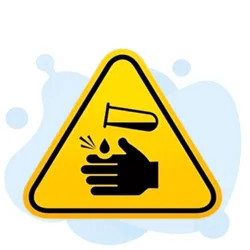
WHMIS 2015 uses nine standardized pictograms adopted from the Globally Harmonized System. Each symbol appears inside a red diamond border and represents a specific category of hazard: flammable materials show a flame icon, oxidizers show a flame over a circle, corrosives show liquid damaging a surface and a hand, and acute toxins show a skull and crossbones. The exclamation mark symbol covers irritants, sensitizers, and less severe health effects. The health hazard symbol — a silhouette with a starburst on the chest — covers carcinogens, reproductive toxins, and respiratory sensitizers. Memorizing these nine pictograms is essential for passing any WHMIS assessment.
In practice, WHMIS symbols appear on two types of labels: supplier labels on products sold to workplaces, and workplace labels created by employers when they transfer a product into a different container. Supplier labels must include the product identifier, hazard pictograms, signal word (either Danger or Warning), hazard statements, precautionary statements, and supplier contact information. Workplace labels require at minimum the product name, safe handling instructions, and a reference to the SDS. Workers who can quickly read and interpret both label types reduce the risk of accidental exposure during daily tasks.

Online vs. In-Person WHMIS Training: Which Is Right for You?
- +Complete the course on your own schedule — any time, any device
- +Typically costs less than in-person classroom training
- +Certificate is available to download immediately after passing
- +Self-paced format lets you re-read and review difficult sections
- +Mobile-friendly platforms work on phones at remote job sites
- +AIX Safety and CCOHS certificates are accepted across Canada
- −No live instructor to answer questions in real time
- −Requires internet access, which can be limited at remote work camps
- −Self-discipline needed to focus without a classroom structure
- −Employer may not accept all online providers — verify first
- −Generic online course does not replace mandatory site-specific training
- −Technology issues or browser incompatibility can delay completion
Pros and Cons at a Glance
| Pros | Cons |
|---|---|
| Complete the course on your own schedule — any time, any device | No live instructor to answer questions in real time |
| Typically costs less than in-person classroom training | Requires internet access, which can be limited at remote work camps |
| Certificate is available to download immediately after passing | Self-discipline needed to focus without a classroom structure |
| Self-paced format lets you re-read and review difficult sections | Employer may not accept all online providers — verify first |
| Mobile-friendly platforms work on phones at remote job sites | Generic online course does not replace mandatory site-specific training |
| AIX Safety and CCOHS certificates are accepted across Canada | Technology issues or browser incompatibility can delay completion |
WHMIS Certification Study Checklist
- ✓Memorize all nine WHMIS 2015 pictograms and the hazard each one represents.
- ✓Learn the difference between a Danger signal word and a Warning signal word.
- ✓Study all 16 SDS sections in order and know what information each section contains.
- ✓Understand the two types of WHMIS labels: supplier labels and workplace labels.
- ✓Know the three core elements of the WHMIS system: classification, labels, and SDSs.
- ✓Review worker rights under WHMIS including the right to know and the right to refuse unsafe work.
- ✓Identify which products are exempt from WHMIS labeling requirements (e.g., consumer products, wood, tobacco).
- ✓Practice distinguishing between physical hazard classes and health hazard classes.
- ✓Take at least two full-length practice tests before sitting your final assessment.
- ✓Confirm your employer's accepted training providers before enrolling to avoid repeating the course.
Generic Training + Site-Specific Training = Full Certification
A common misconception is that completing an AIX Safety or CCOHS online course is all you need. Under Canadian law, WHMIS certification requires two components: a generic course covering the overall system, plus employer-delivered site-specific training on the actual chemicals at your workplace. Workers who skip the site-specific component — even with a valid online certificate — are not fully compliant and may be denied entry to certain job sites or flagged in a safety audit.
Passing your WHMIS assessment on the first attempt comes down to strategic preparation, and the single most effective strategy is consistent practice testing. The final assessment for most WHMIS 2015 courses is a multiple-choice exam of 20 to 40 questions, and the questions cluster around predictable topics: the nine hazard classes and their pictograms, the 16 sections of an SDS, the elements required on supplier and workplace labels, and the rights and responsibilities of workers and employers. If you can answer questions on these four areas confidently, you are positioned to pass any reputable WHMIS 2015 assessment.
One of the most tested areas is SDS section identification. A common exam question presents a scenario — for example, you need to find out what personal protective equipment to wear while handling a chemical — and asks which SDS section you would consult. The answer is Section 8: Exposure Controls and Personal Protection.
Similarly, if you needed the emergency phone number, that is in Section 1. If you needed to know the flashpoint of a liquid, that is in Section 9. Building a mental map of what information lives in each of the 16 sections is one of the highest-use study activities you can do before your exam.
Pictogram recognition is equally important. WHMIS exams routinely present an image of a hazard symbol and ask you to identify the hazard it represents, or describe a hazard and ask you to choose the correct symbol. The symbols that cause the most confusion are the health hazard symbol (the chest starburst silhouette) and the exclamation mark symbol, because both relate to health effects but at different severity levels.
The skull and crossbones indicates acute lethal toxicity, while the exclamation mark covers lower-severity effects like skin irritation. Drilling these distinctions with flashcards or pictogram quizzes before your exam will prevent costly mix-ups.
The whmis 2015 aix safety practice test resources available on PracticeTestGeeks are designed specifically to mirror the format and difficulty of real WHMIS 2015 final assessments. Each question includes a detailed explanation of why the correct answer is right and why each distractor is wrong. Reading these explanations — not just checking whether you got the right answer — is what turns a practice session into genuine learning. Candidates who review answer explanations score significantly higher on their actual assessments than candidates who only track their score percentages.
Time management during the exam is rarely an issue for WHMIS since most platforms allow 60 to 90 minutes for 20 to 40 questions. However, reading each question carefully is critical because exam writers frequently use qualifier words like always, never, most, and only that change whether a statement is correct. A statement like workers are always required to read the entire SDS before using any product may sound right intuitively but may be factually overstated. Train yourself to pause on qualifier words and evaluate them critically rather than selecting the first answer that sounds familiar.
If your platform allows multiple attempts, use the first attempt as a diagnostic even if you feel confident. Review every incorrect answer and every question you guessed on, then retake with targeted knowledge rather than just trying again without adjusting. Most platforms reset the question order and sometimes pull from a question bank, so the second attempt will not be identical to the first. This approach mirrors how professional certification candidates approach high-stakes exams and is just as effective at the WHMIS level.
After you pass, download and store your certificate immediately. Some platforms archive certificates for only 12 months, and attempting to retrieve them later can be surprisingly complicated. Save a PDF to both your personal email and a cloud storage folder. Provide a copy to your employer's HR or safety department right away. If you work as a contractor across multiple sites, keep a copy on your phone so you can produce proof of certification quickly when a new client or site supervisor requests it during onboarding.

There is no single Canada-wide rule that says WHMIS certification expires after a set number of years. Renewal requirements are set by individual employers and provincial regulators, and they vary widely. Some employers require annual renewal, others every three years, and some require retraining only when hazardous materials at the workplace change. Do not assume your certificate is valid indefinitely — confirm your employer's renewal policy in writing to avoid lapses in compliance that could affect your ability to work on regulated sites.
Once you have earned your initial WHMIS 2015 certificate, building on that foundation with advanced knowledge can meaningfully advance your career in health and safety. WHMIS is often described as a gateway credential because it introduces workers to the language and logic of hazard communication, which underpins many other safety certifications including HAZWOPER in the United States, transportation of dangerous goods training in Canada, and process safety management qualifications for chemical plant workers. Workers who understand WHMIS deeply find that subsequent safety credentials feel intuitive rather than overwhelming.
Supervisors and safety officers have more extensive WHMIS obligations than general workers. As a supervisor, you are not only responsible for your own certification but also for verifying that every worker under your direction has completed both generic and site-specific WHMIS training before they work with or near controlled products.
You must also ensure that valid SDSs are accessible to workers at all times — typically in a binder at the workstation or via a digital SDS management system — and that supplier labels are intact and legible on all containers. Understanding the aix safety whmis answers framework at a supervisory level means knowing how to audit your team's compliance, not just your own.
The Joint Health and Safety Committee, or JHSC, is another context where WHMIS knowledge is foundational. In most Canadian provinces, workplaces with 20 or more workers must have a JHSC that includes both employer and worker representatives. JHSC members are responsible for conducting workplace inspections, investigating incidents, and making recommendations on hazard controls. WHMIS training is the minimum baseline for participating effectively on a JHSC, but members who additionally understand industrial hygiene principles, hierarchy of controls, and chemical toxicology are far more effective advocates for safe working conditions.
Continuing education in occupational health and safety typically begins with WHMIS but extends into credentials such as the Canadian Registered Safety Professional designation, offered by the Board of Canadian Registered Safety Professionals, or the National Construction Safety Officer certification for site safety roles. Both of these credentials require documented safety training history, and a complete WHMIS certification record is typically part of the prerequisite portfolio. Maintaining neat records of every WHMIS training date, provider, and certificate number will serve you well as you pursue these advanced qualifications.
For workers in the United States who deal with Canadian shipments, clients, or cross-border operations, understanding WHMIS is increasingly valuable even though it is not legally required under US law. The US Hazard Communication Standard — HazCom 2012, also known as HazCom — is likewise based on the Globally Harmonized System, which means WHMIS 2015 and HazCom share the same pictograms, SDS format, and most classification criteria. Workers who are WHMIS-certified find the transition to HazCom compliance relatively straightforward, and some employers in border regions and multinational firms train their workers under both standards simultaneously.
Digital SDS management is an evolving area that WHMIS-certified workers and supervisors should understand. Traditional paper-based SDS binders are being replaced by cloud-based SDS management platforms that allow workers to look up a chemical's SDS on a phone or tablet in seconds.
These platforms also alert safety managers automatically when an SDS is updated by the supplier, ensuring that the most current hazard information is always available. Familiarity with digital SDS tools is becoming a practical expectation in modern industrial workplaces, and workers who can navigate these platforms confidently are more productive and safer than those who rely on searching through binders.
Refresher training deserves a dedicated mention because it is easy to let WHMIS knowledge drift after you have been certified for a few years. Research in occupational health and safety consistently shows that knowledge retention drops significantly within 12 months if it is not reinforced through practical use or periodic review.
Taking a brief refresher course, retaking a practice test set, or simply reviewing your notes on hazard classes and SDS sections once a year keeps your knowledge current and ensures that your response in an emergency situation is based on accurate, up-to-date information rather than partially remembered details from a training session years ago.
Practical preparation for your WHMIS exam starts long before you click submit on your final assessment. The most effective candidates treat their study time like training for a skilled task rather than reading for general interest.
That means active recall — closing your notes and trying to list the nine WHMIS pictograms from memory, recite the 16 SDS sections in order, or explain the difference between a supplier label and a workplace label without looking anything up. Active recall is significantly more effective than re-reading material because it forces your brain to retrieve information rather than simply recognize it on the page.
Spaced repetition is the companion strategy to active recall. Instead of studying WHMIS for four hours in a single sitting the night before your exam, split that time across three or four sessions over several days. Review the hazard classes on day one, focus on SDS sections on day two, drill pictograms on day three, and take a full practice test on day four.
This spacing effect is well-documented in cognitive psychology research and produces significantly better long-term retention than cramming. Since WHMIS knowledge needs to stick with you on the job — not just get you past an assessment — spaced repetition is doubly valuable.
Creating visual study aids is particularly effective for WHMIS because so much of the content is visual by nature. Draw the nine WHMIS pictograms by hand and label them without looking at references. Create a two-column table with SDS section numbers on one side and section titles on the other, then quiz yourself by covering one column.
Write out the required elements of a supplier label from memory and check your answer against the regulation. These drawing and writing exercises engage different cognitive pathways than reading and strengthen the connections between visual and verbal memory, which is exactly what you need when you encounter an unfamiliar label in the field.
Group study can also accelerate your preparation if you have coworkers who are taking WHMIS training at the same time. Pair up and quiz each other on pictograms, take turns explaining SDS sections aloud, or roleplay scenarios where one person describes a hazardous situation and the other identifies the appropriate SDS section to consult. Teaching a concept to someone else is one of the most powerful learning techniques available because it forces you to organize your knowledge clearly and exposes gaps you did not realize existed when you were studying alone.
On the day of your assessment, approach the exam with a calm, methodical mindset. Read every question fully before selecting an answer — WHMIS questions sometimes include a long scenario followed by a question that only relates to one specific detail in the scenario, and rushing leads to misreads. If a question asks which SDS section covers a specific type of information, recall your mental map of the 16 sections before looking at the answer options, because anchoring on your own knowledge first reduces the risk of being misled by plausible-sounding distractors.
After you earn your certificate, put your WHMIS knowledge to work immediately by reviewing the actual SDSs and labels for the products at your workplace. The real-world application of what you learned in training cements that knowledge far more durably than any additional studying could. Identify the products in your work area, pull up their SDSs, and locate information you studied — flashpoint in Section 9, emergency contacts in Section 1, PPE requirements in Section 8. This takes 20 minutes and transforms abstract exam knowledge into practical, job-specific expertise that actually keeps you safer.
Finally, keep an eye on any updates to WHMIS regulations in your province or territory. Health Canada periodically updates the Hazardous Products Regulations, and provinces can add requirements beyond the federal baseline. Subscribing to occupational health and safety newsletters from your provincial workers compensation board or safety association is a low-effort way to stay current. Workers who proactively stay informed about regulatory changes are the most valuable members of any safety committee and the most competitive candidates for health and safety roles in their industry.
Sample Workplace Hazardous Materials Information System Practice Questions
Try these questions from our free Workplace Hazardous Materials Information System practice tests. The correct answer and an explanation follow each question.
Who is primarily responsible for providing workers with WHMIS training?
- A. Workers themselves
- B. Employers
- C. Government agencies
- D. Health and Safety Officers
Answer: B. Employers
Under WHMIS regulations, employers bear the primary responsibility for providing workers with comprehensive WHMIS training. This ensures that all employees who may encounter hazardous materials understand the risks, proper handling procedures, and emergency protocols. This employer-led training is crucial for maintaining a safe working environment and complying with occupational health and safety laws.
Generic WHMIS training refers to:
- A. Training specific to each individual chemical found at the worksite
- B. Foundational instruction on WHMIS principles, label elements, and SDS format
- C. Training provided exclusively to management and supervisors
- D. Training that fully replaces site-specific instruction
Answer: B. Foundational instruction on WHMIS principles, label elements, and SDS format
Generic training covers the overall WHMIS framework — how labels work, what SDS sections mean — before site-specific training applies those concepts.
Under WHMIS, what is a worker's responsibility regarding their own safety training?
- A. Workers have no formal responsibility — training is entirely the employer's concern
- B. Workers must participate in WHMIS training and apply what they have learned
- C. Workers must pass a government-approved WHMIS certification exam annually
- D. Workers are responsible for obtaining their own SDS copies from suppliers
Answer: B. Workers must participate in WHMIS training and apply what they have learned
Workers are responsible for participating in WHMIS training provided by the employer and for applying safe work practices based on that training.
Regarding labels, what must WHMIS training teach workers?
- A. How to legally remove labels from containers after opening
- B. How to interpret pictograms, signal words, and hazard and precautionary statements on labels
- C. How to design custom workplace labels from scratch
- D. That labels are optional for products used only indoors
Answer: B. How to interpret pictograms, signal words, and hazard and precautionary statements on labels
Workers must be able to read and understand all elements on a WHMIS label, including GHS-aligned pictograms and signal words, to use products safely.
Take the full Workplace Hazardous Materials Information System practice test
WHMIS Questions and Answers

WHMIS 2015: Complete AIX Safety Guide, Symbols, Training & Certification

WHMIS Symbols and Meanings: Complete Guide to WHMIS 2015 Pictograms
WHMIS Practice Test PDF (Free Printable 2026)
WHMIS Symbols: Complete Training Guide for WHMIS 2015

WHMIS Law Explained: Is WHMIS Legally Required in Canada and the US?
About the Author

Educational Psychologist & Academic Test Preparation Expert
Columbia University Teachers CollegeDr. Lisa Patel holds a Doctorate in Education from Columbia University Teachers College and has spent 17 years researching standardized test design and academic assessment. She has developed preparation programs for SAT, ACT, GRE, LSAT, UCAT, and numerous professional licensing exams, helping students of all backgrounds achieve their target scores.