
Florida Wastewater Operator: Licenses, Jobs, Pay, and How to Get Started 2026
🎓 A Florida wastewater operator needs an FDEP license (Class C, B or A). See requirements, jobs, pay, and exam prep steps in one guide.

A Florida wastewater operator is a state-licensed professional who runs and maintains sewage treatment plants under rules set by the Florida Department of Environmental Protection (FDEP). Licenses come in Class C, B and A, with A the highest. You qualify by combining education, plant experience, and a passed state exam, then renew through continuing education.
Florida Wastewater Operator: Key Facts (Updated November 2026)
| Fact | Details | Source |
|---|---|---|
| Licensing authority | FDEP Operator Certification Program licenses wastewater treatment plant operators in Florida | Florida Department of Environmental Protection |
| Governing rules | Chapter 403, Florida Statutes, and Chapter 62-602, Florida Administrative Code | Florida Legislature and FDEP |
| Operator license classes | Class C, Class B, and Class A, with Class A the highest level | Florida Department of Environmental Protection |
| Plant size groups | Plants are placed in Categories I through IV by size and type, which sets staffing and license needs | Florida Department of Environmental Protection |
| Federal framework | Discharges are controlled through Clean Water Act NPDES permits | U.S. Environmental Protection Agency |
| Fees and exam details | Application fees, exam format, and passing score are set by FDEP and can change, so confirm them before applying | Florida Department of Environmental Protection |
Florida runs one of the largest wastewater systems in the country, and nearly every county, city, and private utility needs licensed staff to stay compliant. If you are weighing this career, the first step is a diagnostic. Take a wastewater practice test with answers before you spend money on classes, because your score shows whether chemistry, math, or regulations needs the most attention. That small investment saves weeks of unfocused studying later.
This guide explains the Florida wastewater operator path in plain steps: what the job involves, how FDEP classifies licenses and plants, what employers pay, and how to prepare for the exam. Wherever the state publishes a number, such as a fee or an exam format, confirm it on the FDEP website before acting, because agencies update schedules and rules. Treat the figures here as a map, and treat the regulator as the final authority.
A wastewater treatment plant operator controls the biological, chemical, and mechanical processes that turn raw sewage into effluent safe to discharge or reuse. In Florida, that often means managing screening, grit removal, activated sludge, clarifiers, disinfection, and biosolids handling. Operators read dissolved oxygen levels, adjust chemical feeds, collect samples, and log results for monthly reports. Every shift has a checklist, and every number goes into a record.
Florida adds challenges that northern states rarely face. A high water table and flat terrain mean heavy infiltration into sewer lines during summer storms, hurricanes can flood plants and knock out power, and population growth keeps pushing plants toward their design capacity. Strict nutrient limits protect springs, estuaries, and the Everglades, so many facilities run advanced treatment. Operators who handle storms, generators, and nutrient removal well become very valuable to their utilities.
Demand is steady for several reasons. Many experienced operators are nearing retirement, new housing developments need new plants and lift stations, and utilities struggle to fill overnight and weekend shifts. Entry-level wastewater operator in training jobs, often titled trainee, helper, or plant attendant, give newcomers a paid way to log the experience that licensing requires. Most hiring happens through county utilities, city public works departments, and private operating companies, so check each local job board regularly.
What follows is a practical, ordered plan. You will see the licensing steps, the daily work, the pay picture, the exam topics, and free resources for study. Read the sections in order if you are new, or jump to the one you need using the contents list. Each part opens with a direct answer, then adds examples and edge cases so you can make decisions without guessing about rules or timelines.
What Are the Key Numbers for a Florida Wastewater Operator?
How Do You Become a Wastewater Operator in Florida?
Meet the Basic Requirements
Land an Entry-Level Plant Job
Complete Approved Training
Apply and Sit for the State Exam
Renew and Move Up
What Does a Wastewater Operator in Florida Do Every Day?
A wastewater operator in Florida monitors and adjusts treatment processes, collects samples, maintains equipment, and keeps the records that prove the plant meets its discharge permit. A typical shift begins with a walk-through of the plant, checking tanks, pumps, blowers, and alarms. Operators compare what they see with the previous shift's log, then decide which process changes or repairs need attention first.
Process control is the heart of the job. Operators measure dissolved oxygen in aeration basins, test settleability of the mixed liquor, and decide how much sludge to waste each day. A small change, such as adjusting a blower or returning more activated sludge, can keep effluent within limits for ammonia or suspended solids. Good operators learn to read the plant's color, smell, and foam before the lab results confirm a problem.
Sampling and lab work take up a large part of the day. Operators draw composite and grab samples, run tests such as pH, chlorine residual, and total suspended solids, and record the results on daily logs. These numbers feed monthly discharge monitoring reports submitted to FDEP. Accuracy matters because a wrong entry or missed sample can trigger a permit violation, even when the plant itself is performing well.
Maintenance is the other half of the shift. Operators lubricate bearings, clean screens, inspect clarifier drives, calibrate meters, and swap pumps when one fails. Larger utilities employ separate mechanics, but at smaller plants the operator is also the repair person. Knowing how to troubleshoot a motor, read a pump curve, and lock out equipment safely makes you faster and keeps the plant running. Many hiring managers ask about this skill first.
Disinfection and effluent quality are the final checkpoints. Florida plants typically use chlorine or ultraviolet light to kill pathogens before discharge or reuse, and many send reclaimed water to irrigate golf courses, parks, and neighborhoods. Operators track chlorine contact time, dose, and residual because reuse customers depend on consistent quality. A single failed reading can force a plant to divert flow, so careful timing and clear communication with the lab are essential.
Safety and emergency response complete the picture. Wastewater work exposes you to confined spaces, hydrogen sulfide, chemicals, electrical hazards, and traffic at lift stations. Operators complete safety training and follow lockout, gas-monitoring, and confined-space procedures. During hurricanes and tropical storms, they run generators, bypass flooded equipment, and stay on site for long stretches. Those experiences are demanding, but they also build the reputation that leads to promotions and higher pay.
Career growth follows experience. Many people begin as trainees, earn a Class C license, and later qualify for Class B and Class A as they log hours and pass exams. Pay rises with each step, which is why the wastewater operator salary picture looks so different between a new hire and a chief operator. Treat every shift as paid training, ask questions, and document the processes you operate.
Where Do Wastewater Treatment Plant Operators Work in Florida?
Most Florida wastewater treatment plant operators work for county utilities and city public works departments. These plants treat household and commercial sewage, from small package plants serving a few thousand people to regional facilities handling tens of millions of gallons per day. Municipal jobs usually offer set pay scales, state retirement benefits, health coverage, and clear promotion steps tied to license class, which makes them popular with career changers.
Hiring is competitive for the best positions, but entry-level openings appear often because of turnover and growth. Apply to several utilities at once, since each posts jobs on its own site. Ask about shift schedules, on-call duties, and tuition help for operator courses. Many utilities pay for training hours or exam fees, which lowers your cost of getting licensed.
Is Wastewater Operator in Training Work Worth It in Florida?
- +Steady demand because every community needs treated sewage and licensed staff
- +Paid on-the-job learning while you log the hours needed for licensing
- +Clear ladder from Class C to Class B and Class A with raises
- +Public employers often add retirement plans, health coverage, and training support
- +No four-year degree is required to start in most entry-level roles
- +Meaningful work that protects public health and Florida's waterways
- −Shift work, weekends, holidays, and overnight callouts are common
- −Hurricane season can mean long hours and time away from family
- −Exposure to odors, chemicals, confined spaces, and weather
- −Entry-level pay can start modestly before licensing raises it
- −Exams demand math, chemistry, and regulation knowledge many newcomers must learn
- −Mistakes can cause permit violations, so the job carries real responsibility
How Do You Start Wastewater Operator Certification Exam Prep?
- ✓Confirm current license classes, fees, and exam rules on the FDEP website.
- ✓Take a baseline practice test to find your weakest topics.
- ✓Gather proof of plant hours, training, and education for your application.
- ✓Enroll in an FDEP-approved operator course near you.
- ✓Review treatment math, including flow, loading, detention time, and dosage.
- ✓Study the activated sludge process until you can explain each control step.
- ✓Learn sampling methods, holding times, and basic lab tests.
- ✓Read your plant's discharge permit to connect rules with daily work.
- ✓Schedule weekly timed practice sets and review every missed answer.
- ✓Book your exam date only after scoring consistently well on practice.
Study Math and Process Control First
Treatment math and process control questions make up a large share of most operator exams, and they are the topics newcomers miss most. Practice one calculation type per day until you can solve it without notes. Pair each formula with the plant situation it describes, so you remember when to use it.
How Much Is a Wastewater Operator Salary in Florida?
Florida wastewater operator pay depends mostly on license class, employer type, and plant size, with experienced licensed operators earning well above entry-level trainees. The U.S. Bureau of Labor Statistics reports a national median near the low-to-mid $50,000s for water and wastewater treatment plant operators. Florida figures vary by region, so treat any single number as an estimate and compare current job postings from the utilities you want to join.
Entry-level trainees and helpers commonly start in the mid-$30,000s to low $40,000s, depending on the utility and cost of living. Once you hold a Class C license, many employers move you into a higher pay grade. Operators in South Florida, Tampa Bay, and Orlando often see higher wages than rural counties, though housing costs offset some of the difference. Always compare the total package, not only the hourly rate.
Advancing to Class B or Class A usually brings the biggest raises. Lead operators, shift supervisors, and chief operators at large plants can earn well into the $60,000s and beyond, and a few reach six figures when overtime, on-call pay, and supervisory duties are included. Because licensed operators in charge are required at many plants, employers have a strong reason to keep qualified people. That legal requirement supports your negotiating power.
Overtime and differential pay can change your income noticeably. Hurricanes, plant upsets, and staffing gaps create extra hours, and many utilities pay time and a half or more for those shifts. Night and weekend differentials add a small premium to base wages. These extras are not guaranteed, so avoid budgeting around them, but over a year they can add several thousand dollars for operators willing to take difficult schedules.
Benefits matter as much as the base wage. Public employers in Florida often participate in the Florida Retirement System, offer health insurance, and provide paid leave, and some reimburse tuition or exam fees. Private contractors may pay more per hour but offer different benefits and less predictable contracts. When comparing offers, ask about retirement contributions, insurance premiums, license renewal support, and whether the employer pays for continuing education hours.
You can raise your pay in predictable ways. Earn your next license class as soon as you qualify, learn skills such as SCADA, laboratory testing, and biosolids handling, and volunteer for process-control projects. Moving between utilities can also lift pay when a neighboring system needs a higher class operator. Keep a record of certifications and achievements so you can justify a regrade or negotiate a better offer at your next review.
Compare Florida with other states before committing, especially if you may relocate later. Wage patterns, license names, and reciprocity rules differ, and a license in one state does not automatically transfer to another. Florida's license system is clearly tiered, which helps you plan. Use the wastewater operator certification program overview to see how levels and exams compare, and then map your own timeline and target salary.
License requirements, application fees, and exam procedures are set by the Florida Department of Environmental Protection and can change. Confirm every detail on the official FDEP Operator Certification Program pages before you apply, pay a fee, or book a course, and keep copies of your submitted records.
What Is on the Wastewater Operator Exam?
The wastewater operator exam tests whether you can run a treatment plant safely and keep it within permit limits, using questions on processes, math, laboratory work, collection systems, safety, and regulations. The exact number of questions, time limit, and passing score are set by FDEP and can change, so check the agency's current candidate information. What stays constant is the need to understand both concepts and calculations.
Treatment processes carry the most weight for most candidates. Expect questions on screening, grit removal, primary clarification, activated sludge, trickling filters, secondary clarifiers, disinfection, and sludge handling. You should be able to explain what each unit does, what can go wrong, and how to fix it. For example, a rising sludge blanket might point to excess solids loading or a hydraulic surge.
Math is the section that surprises people. Questions ask you to calculate flow, detention time, surface overflow rate, food-to-microorganism ratio, sludge age, chlorine dosage, and percent removal. Write each formula on a flash card, work problems by hand, and check your units. A typical example is converting gallons per day to million gallons per day before applying a loading formula. Consistent practice beats last-minute cramming.
Laboratory and monitoring questions test your understanding of sampling and analysis. You should know the difference between grab and composite samples, why holding times matter, and how pH, dissolved oxygen, alkalinity, turbidity, and solids tests guide process decisions. The sampling quizzes listed on this page match this area well. Reading your plant's monitoring requirements gives you real context that makes lab questions easier to remember.
Regulations and safety make up the remaining core topics. Learn the purpose of NPDES permits, discharge monitoring reports, effluent limits, and public notification of overflows. Review confined-space entry, lockout and tagout, chemical handling, and hydrogen sulfide hazards. Questions often present a short scenario and ask for the best first action, so safety and compliance decisions usually beat quick fixes when two answers both seem reasonable.
Class levels change the depth expected. A Class C candidate focuses on fundamentals, basic math, and routine operation, while Class B and Class A questions expect advanced process control, troubleshooting, and supervisory judgment. If you are asking about Class B testing sites, scheduling methods, and available dates, use the FDEP exam information, because locations and delivery options are managed by the state and its testing partners.
A structured plan is easier to follow than scattered reading. The wastewater operator certification study guide breaks topics into levels and exam areas, and the wastewater operator certification article from New York shows how another state structures grades. Comparing states helps you see which skills are universal. Build a calendar around the topics and stop to review whenever a practice score drops.
Where Can You Find EPA Wastewater Operator Training Free Resources?
Several free resources exist, and the U.S. Environmental Protection Agency is a good place to start for background on the Clean Water Act, NPDES permits, and treatment basics. Many state agencies and universities also post free manuals, math guides, and webinars. Use these materials to learn concepts, then confirm Florida-specific rules on FDEP pages. Free material helps most when you pair it with timed practice questions.
Build your study schedule backward from your target exam date. If you have twelve weeks, spend the first four on process fundamentals, the next four on math and laboratory topics, and the last four on regulations, safety, and full practice tests. Block two or three sessions per week and protect them like shifts. Short, regular sessions of about ninety minutes beat marathon weekends for retention.
Use practice exams the right way. A wastewater operator practice exam is most useful when you treat it as a diagnostic, not a score to brag about. After each test, sort missed questions by topic, then reread the related chapter and redo similar problems. Keep an error log with the formula or concept you missed. After three weeks, the log shows your real weak points.
Learn from the people around you. Ask licensed operators at your plant to walk you through the process flow, show you the permit, and explain why they adjust certain settings. Join the Florida Water and Pollution Control Operators Association or attend local operator meetings, where experienced members often share exam tips and plant tours. Practical conversations connect textbook terms to equipment you can see and touch.
On exam day, arrive early with the identification and paperwork FDEP requires, and read every question twice before answering. Mark difficult calculations and return to them after easier items, so you do not burn time. Eliminate answers that violate safety or permit rules first. If a question includes a scenario, picture the plant and ask what you would check first. Calm, methodical thinking beats rushing.
After you pass, plan your next steps right away. Update your résumé with the license class, send it to utilities that posted openings, and ask your current employer about a raise or reclassification. Track your renewal date, and schedule continuing education early so you are never close to a deadline. Keep logging plant hours in writing, because those records support your future Class B and Class A applications.
If you are still in the trainee stage, do not wait for a license to start studying. Wastewater operator in training practice test sessions help you learn terms while you work, and your supervisor can show where each concept appears in the plant. Combine practice sets, plant walk-throughs, and approved courses, and you will arrive at the exam with both knowledge and experience. That combination is what employers want.
Wastewater Operator Questions and Answers
Wastewater Operator Certification Test: Complete 2026 Study Guide

Wastewater Treatment Plant Operator: Duties, Certification, Pay, and How to Start

Wastewater Operator Certification Program: Levels, Exams, Requirements, and How to Get Certified

How to Become a Wastewater Operator: Certification Levels, Exam Topics, and EPA Requirements

Operation of Wastewater Treatment Plants Volume 2 PDF: What It Covers and How to Study It

Wastewater Operator Certification Practice Test PDF (Free Printable 2026)

Certified Industrial Wastewater Treatment Operator: Requirements, Classes, Exams, and Pay

NYS Wastewater Operator Certification: Grades, Requirements, Exam Prep, and Pay
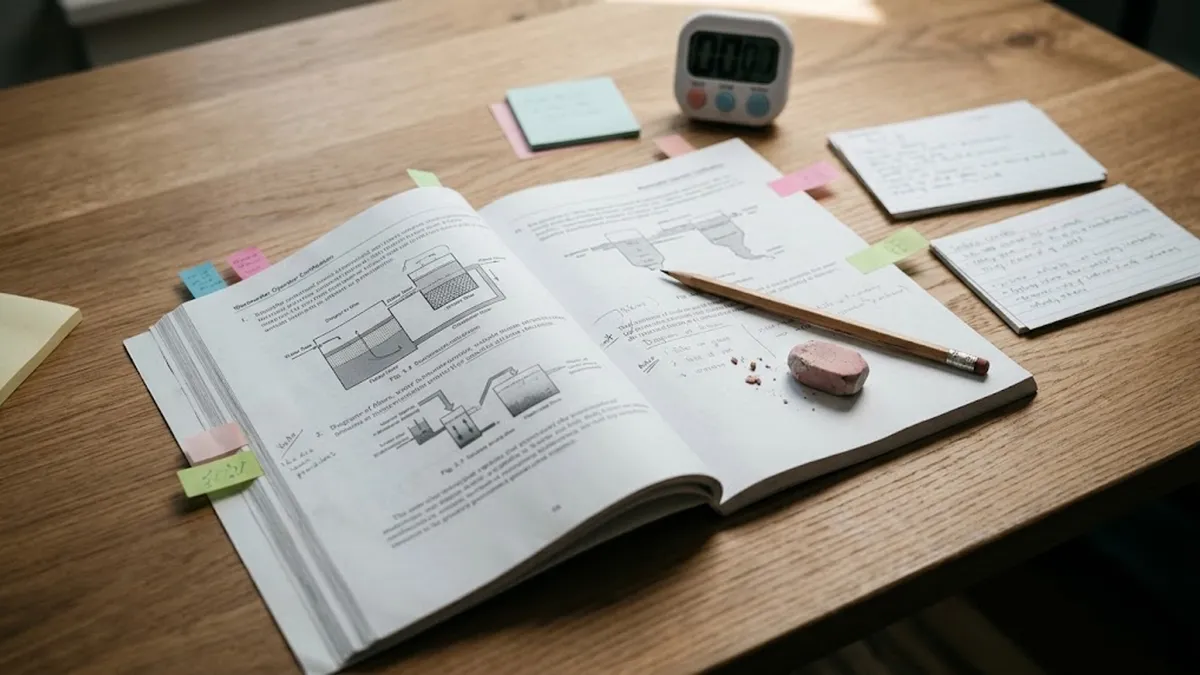
What Does a Municipal Wastewater Operator Do? Duties, Certification, Pay, and Exam Prep
How this page was made: written with AI tools and published by Nathan Beja, founder of Practice Test Geeks, who is responsible for its content. We have not yet matched this exam's facts to an official source, so confirm fees, dates and rules with the exam body. Not reviewed by a subject-matter expert. Editorial policy