
What Does a Municipal Wastewater Operator Do? Duties, Certification, Pay, and Exam Prep
🎯 What does a municipal wastewater operator do? Runs the plants that clean community sewage. See duties, levels, pay, and exam prep.
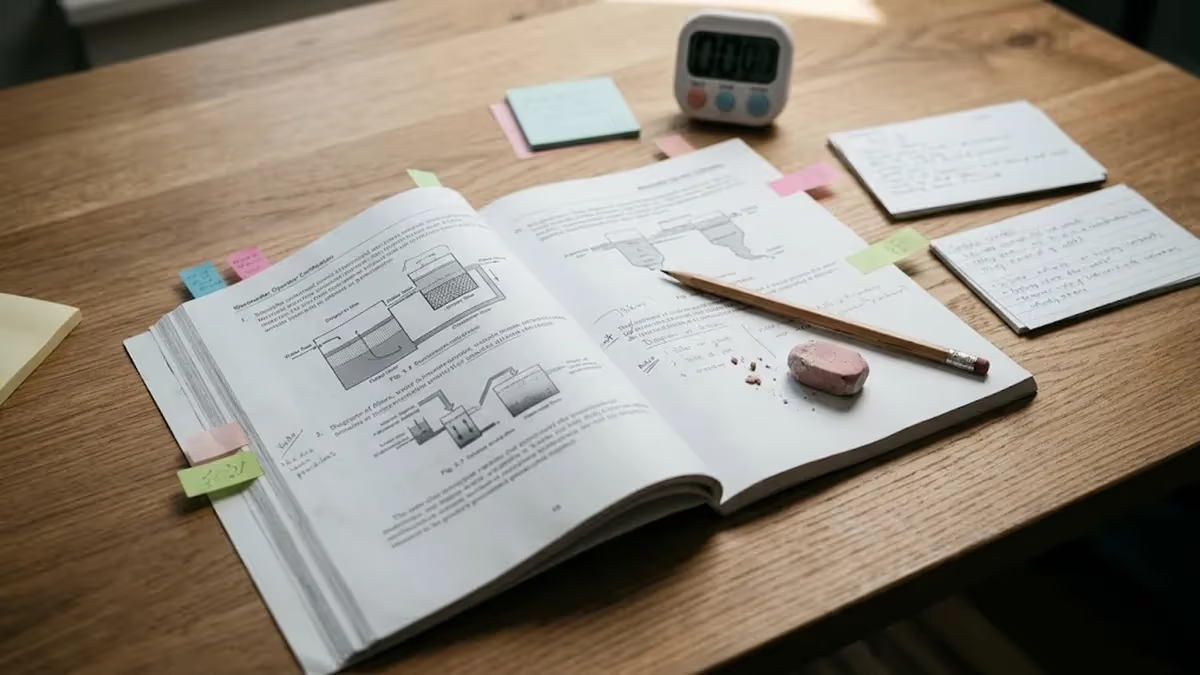
A municipal wastewater operator runs and maintains the treatment plants, pump stations, and sewer systems that clean a community's sewage before it returns to rivers, lakes, or the ocean. Daily work includes monitoring equipment, collecting samples, running lab tests, adjusting processes, keeping records for state permits, and responding to alarms around the clock.
What Does a Municipal Wastewater Operator Do: Key Facts (Updated November 2026)
| Fact | Details | Source |
|---|---|---|
| Core job | Operate and maintain municipal wastewater treatment plants, pump stations, and collection systems | U.S. Bureau of Labor Statistics |
| Governing law | Clean Water Act (1972); plants discharge under NPDES permits with numeric limits | U.S. Environmental Protection Agency |
| Who certifies operators | State environmental agencies, not the federal government | State environmental agencies |
| Certification levels | Usually several grades (often I to IV) tied to plant size and complexity; names vary by state | State environmental agencies |
| Common exam provider | Many states use exams developed by the Association of Boards of Certification (ABC) | Association of Boards of Certification |
| Typical entry education | High school diploma or equivalent plus long-term on-the-job training | U.S. Bureau of Labor Statistics |
| Work schedule | Plants run continuously, so shifts, weekends, holidays, and on-call duty are common | U.S. Bureau of Labor Statistics |
So what does a municipal wastewater operator do in practice? Think of the role as protecting public health and local waterways. Every flush, shower, and factory discharge in a town flows to a plant where the operator removes solids, organic matter, nutrients, and germs. Whether you are curious about the job or preparing for licensing, this guide explains duties, certification, pay, and where a good wastewater practice test with answers fits into your preparation.
Most people use the titles interchangeably, but a wastewater treatment plant operator is the most common version of the job. Municipal means the employer is a city, town, county, sanitary district, or authority that serves the public, as opposed to an industrial facility treating its own process water. Municipal operators answer to elected boards, state regulators, and ratepayers, so transparency, documentation, and steady compliance matter as much as technical skill. Smaller towns often ask one crew to cover plant and pipes.
A typical shift begins with a walk-through. The operator reads flow meters, checks dissolved oxygen in the aeration basins, inspects screens and grit removal equipment, and reviews overnight alarms from the control system. Next come samples: influent and effluent are tested for pH, suspended solids, biochemical oxygen demand, ammonia, and chlorine residual. Results guide adjustments to blower speed, sludge wasting, chemical feed, and recycle rates, so the plant keeps meeting its discharge limits.
Paperwork is a big part of the job. Under the Clean Water Act, plants discharge under National Pollutant Discharge Elimination System permits that set numeric limits and sampling schedules. Operators record readings, calculate averages, and submit discharge monitoring reports to the state agency, often monthly. A missed sample or an exceeded limit must be explained, and repeated violations can bring fines for the city, so careful, honest recordkeeping protects both the community and your own license.
Hands-on maintenance fills many hours. Operators lubricate pumps, replace belts and seals, clean clarifiers, calibrate meters, and help repair broken lift stations. They also handle biosolids, the treated sludge that gets dewatered and hauled for land application, landfilling, or composting. Safety is constant: confined spaces, hydrogen sulfide, chlorine and other chemicals, slippery walkways, and electrical equipment all demand lockout procedures, gas monitors, protective gear, and training that municipal employers renew every single year.
Entry is realistic for people without a degree. Federal labor data lists a high school diploma or equivalent as the typical requirement, followed by long-term on-the-job training. Many cities post wastewater operator in training jobs, sometimes titled trainee, operator-in-training, or Operator I, and they pay you while you learn. Within a year or two you can usually sit for your first state exam, and each higher grade unlocks more responsibility and higher wages.
Throughout this guide you will find plain-language explanations, realistic numbers, and free quizzes built around the domains operators actually face: chemistry and biology, regulations, sampling, treatment processes, collection systems, and equipment troubleshooting. Use them to test yourself as you read, and confirm any state-specific rule with your own certifying agency before you apply for a license.
Municipal Wastewater Operator Work by the Numbers
What Is a Municipal Wastewater Operator?
A municipal wastewater operator runs the unit processes that clean sewage: screening, grit removal, primary settling, biological treatment, clarification, disinfection, and solids handling. The operator watches gauges, adjusts pumps and blowers, and keeps every stage balanced so treated water meets permit limits before discharge.
Operators collect composite and grab samples, run tests for pH, solids, oxygen demand, ammonia, and bacteria, and compare results with permit limits. They log data, calculate averages, and file monitoring reports with the state, which proves the city is protecting local waterways and following the law.
Many operators maintain the pipes and pump stations that carry sewage to the plant. They jet-clean mains, inspect manholes, repair lift stations, and respond to backups or overflows. Preventing sanitary sewer overflows is a major regulatory priority, so this work is closely tracked and documented.
Operators lubricate and repair pumps, blowers, and valves, and manage chemicals, confined spaces, and electrical hazards with strict safety rules. They also respond to alarms, storms, and power failures at any hour, following written emergency plans to keep the plant compliant and the community protected.
What Does a Typical Day Look Like for a Municipal Wastewater Operator?
A typical day for a municipal wastewater operator mixes inspection, lab work, process adjustment, maintenance, and documentation, usually in rotating shifts. Large plants staff three shifts, while small-town facilities may have one operator on site and another on call. Whatever the size, the first task is the same: confirm that every process unit is working and that yesterday's effluent met permit limits before anything else changes.
Preliminary and primary treatment come first. Screens catch rags, plastics, and debris, and grit channels settle sand and gravel that would wear down pumps. Primary clarifiers then let heavy solids sink and grease float, removing roughly half of the suspended solids. Operators rake screens, pump sludge on schedule, and watch for odd smells or colors that signal an industrial dump, a storm surge, or a failing piece of equipment.
Secondary treatment is where biology does the heavy lifting. In an activated sludge plant, blowers push air into aeration basins so microorganisms consume dissolved organic matter. Operators track dissolved oxygen, mixed liquor suspended solids, sludge age, and settleability to keep that microbial population healthy. Too little air starves them, too much wastes energy, and a poorly settling sludge can wash out of the clarifier and violate permit limits within hours.
Disinfection and final polishing follow. Many plants use chlorine followed by dechlorination, while others use ultraviolet light, which avoids chemical storage but needs clean lamps and clear water. Operators verify contact time, measure chlorine residual or UV dose, and test effluent for fecal indicator bacteria. Some facilities also remove nitrogen and phosphorus to protect lakes and bays, which adds anoxic zones, chemical feed, or filters to the daily checklist.
Between rounds, operators take on projects. They calibrate probes, exercise valves, change oil in blowers, clean wet wells, and update standard operating procedures. A skilled wastewater operator also learns to read trends: a slow rise in effluent ammonia or a falling dissolved oxygen reading at 3 a.m. tells you what needs fixing before an alarm ever sounds, and that habit separates good operators from great ones.
Collection systems are part of the picture in many cities. One workforce often runs pump stations, cleans sewer mains with jetting trucks, inspects manholes, and responds to backups. Preventing overflows is a top regulatory priority, so crews map problem areas, clear grease and roots, and log every call. Any wastewater treatment operator who also holds a collections certificate is especially valuable to a small municipal utility.
Emergencies test everything. Heavy rain can double or triple flow, power outages shut down blowers, and a toxic slug from an industrial customer can kill the biology overnight. Operators follow written emergency plans, notify the state, divert flow only when the permit allows, and restart the plant methodically afterward. Calm judgment under pressure is among the most valuable skills in this field, and it grows through practice, mentoring, and honest after-action reviews.
How Does Wastewater Operator Certification Work at Each Level?
Entry-level operators usually start as trainees or Operator I employees. Many states issue a trainee or operator-in-training permit while you gain required experience, and a small plant may only require the lowest grade. The work focuses on rounds, sampling, cleaning, basic maintenance, and recordkeeping under supervision, which lets you learn the plant layout and safety rules before taking independent responsibility.
The first exam typically covers basic treatment processes, simple math, laboratory fundamentals, safety, and an introduction to permits. Most candidates need a high school diploma or equivalent and some months of experience, though exact rules vary. This stage is the best time to build study habits, because the formulas and vocabulary you learn now carry through every later class.
Is a Municipal Wastewater Operator Career Worth It?
- +Entry is possible with a high school diploma and paid on-the-job training
- +Steady demand because sewage treatment never stops and many operators are retiring
- +Municipal jobs often include pensions, health coverage, and paid holidays
- +Clear promotion ladder tied to certification grades and pay steps
- +Meaningful work that directly protects public health and local waterways
- +Varied days that mix lab work, mechanical repair, and problem solving
- −Shift work, weekends, holidays, and on-call duty are common
- −Exposure to odors, weather, confined spaces, and hazardous chemicals
- −Emergencies such as storms or power loss can mean long unplanned hours
- −Entry-level pay is modest until you earn higher certification grades
- −Heavy recordkeeping and legal responsibility for permit compliance
- −Certification rules differ by state, which complicates moving between jurisdictions
How Do You Prepare for a Wastewater Operator Practice Exam?
- ✓Request the exam content outline from your state agency or exam provider.
- ✓Rate your confidence in each exam domain from one to five.
- ✓Block six to eight weeks of consistent study time on your calendar.
- ✓Memorize the pounds formula (flow x concentration x 8.34) and practice it daily.
- ✓Take one untimed wastewater practice test to learn the question style.
- ✓Review the explanation for every missed question and write down the concept.
- ✓Shadow a senior operator to connect textbook ideas to real equipment.
- ✓Practice detention time, loading rate, and percent removal calculations by hand.
- ✓Take timed practice sets until you score above 80 percent on new questions.
- ✓Confirm ID, calculator rules, and test location before exam day.
Operators are public-health workers
The job is not just turning valves. Every adjustment affects the water that returns to a community's rivers and beaches, which is why states license operators and hold them accountable. Treat each exam topic as a real-world responsibility, and your preparation will feel purposeful rather than abstract.
What Skills and Certifications Does a Municipal Wastewater Operator Need?
A municipal wastewater operator needs a blend of technical knowledge, mechanical aptitude, and reliable habits. The core knowledge areas are chemistry, biology, basic math, hydraulics, and regulations, all applied to real equipment. You do not need a college degree to begin, but you do need to learn quickly, follow procedures exactly, and stay curious about why a process behaves the way it does when readings drift away from normal.
Math is more practical than scary. Operators calculate flow in million gallons per day, convert milligrams per liter to pounds using the 8.34 factor, figure detention times, and size chemical doses. A typical example: a flow of 2 MGD with 20 mg/L of suspended solids carries about 334 pounds of solids per day (2 x 20 x 8.34). Mastering these formulas early makes both daily work and licensing exams far easier.
Biology matters because the plant is really a managed ecosystem. Bacteria and protozoa in activated sludge consume waste, and their mix tells you how healthy the system is. Stalked ciliates suggest stable conditions, while heavy filament growth can signal bulking sludge. Learning to read a microscope slide, along with temperature, pH, and toxicity effects, helps operators diagnose trouble earlier than lab results alone, and it is a staple of exam questions.
Certification is how states confirm that knowledge. Authority sits with each state, so rules, class names, and experience requirements differ, but most programs have several grades tied to plant size and complexity. The structure is explained well in this wastewater operator certification program overview, which covers levels, exam content, and how experience credit is counted toward promotion from one grade to the next.
Many states use exams developed by the Association of Boards of Certification, or ABC, while others write their own. Exams are multiple choice and typically test treatment processes, laboratory procedures, collection systems, safety, math, and regulations. Passing scores are set by the state or exam provider, and retake rules vary, so always confirm details with your state environmental agency before you apply or schedule a test date or pay any fees.
Study materials make a big difference. Classic textbooks such as the California State University, Sacramento operator manuals are used widely across the country. If you want a deep dive, read about how a wastewater plant operator can use that text effectively, then pair your reading with practice questions so the concepts stick instead of fading after a single read-through.
Soft skills count too. Operators communicate with supervisors at shift change, explain problems to engineers, deal politely with residents who report odors, and keep honest logs. Physical readiness matters because the job involves stairs, ladders, heavy lids, and outdoor work in every season. A valid driver's license is commonly required, and some employers also ask for a commercial driver's license for hauling biosolids or operating larger vehicles.
Class names, experience requirements, exam providers, fees, and renewal hours differ from state to state. Always confirm current rules with your state environmental or operator certification agency before applying, and do not assume a license transfers automatically when you move.
How Much Is a Wastewater Operator Salary and What Is the Career Path?
Wondering what a wastewater operator salary looks like? Pay depends on state, class, plant size, and overtime, but federal data for water and wastewater treatment plant and system operators has recently shown median annual pay in the low-to-mid $50,000s. The lowest earners start below roughly $40,000, while experienced operators at large utilities often exceed $80,000 with premium pay. Always compare current Bureau of Labor Statistics figures with local job postings.
Trainees sit at the bottom of the scale, yet most employers raise pay quickly. A common pattern is a step increase when you pass your first state exam, another at the next grade, and a larger jump when you qualify as a lead operator or chief. Some cities tie pay directly to certification class, so every license earned can add several thousand dollars a year, which makes exam preparation a direct investment in income.
Benefits often matter as much as wages. Municipal employers frequently offer pension plans, health insurance, paid holidays, tuition help, and strong job security because sewage treatment cannot stop. Overtime for storm events, holiday shifts, and on-call stipends add to the paycheck. When comparing offers, include these extras: a job paying slightly less in wages but offering a defined-benefit pension can be worth far more over a full career.
Searches for wastewater treatment operator salary and water wastewater operator pay often mix two different jobs. Many small towns combine drinking water and wastewater duties under one dual-certified employee, which can raise earnings but also doubles the exam load. If you pursue both, plan separate study blocks, because water treatment emphasizes filtration, coagulation, and disinfection by-products, while wastewater emphasizes biological treatment, solids handling, and discharge permits.
The career ladder is clear. A typical path runs from operator in training to Operator I or II, then shift lead, lab or compliance specialist, plant superintendent, and eventually utility director. Others branch into pretreatment inspection, biosolids management, SCADA and instrumentation, or training roles. Each step rewards both certification and leadership, so keep a record of your projects, such as energy savings, permit compliance streaks, or process improvements you led.
Job demand is steady. Many experienced operators are nearing retirement, and utilities regularly struggle to fill positions, which creates openings for newcomers from retirements and turnover. Tightening rules on nutrients and emerging contaminants also create demand for people who understand advanced treatment. Automation helps, but plants still need licensed humans to make judgment calls, so the profession remains one of the more stable skilled-trades paths available without a four-year degree.
To raise your earning power, collect certifications deliberately. Add collections, laboratory, or industrial pretreatment credentials where your state offers them, take supervisor or safety courses, and volunteer for projects like SCADA upgrades. Many operators also earn the dual water and wastewater license. Treat each exam as a milestone with a target date, and use free practice questions to measure your readiness before you pay exam fees.
What EPA Wastewater Operator Training Free Resources Can You Use?
EPA publishes free NPDES permitting guidance, wastewater technology fact sheets, and small-system training and technical assistance information on its website. Many state environmental agencies and Rural Community Assistance Partnership offices also run low-cost or free operator workshops. Search epa.gov for current offerings, since titles and links change, and use them to learn how permits and regulations are written, which is useful background for every licensing exam.
Practical preparation starts with matching your study to the exam blueprint. Request the content outline from your state agency or exam provider, then list each domain: treatment processes, laboratory and sampling, collection systems, regulations, safety, and math. Rate your confidence in each from one to five and spend most of your time on the lowest scores. This simple audit prevents the common mistake of rereading topics you already know well.
Build a weekly rhythm. Six to eight weeks of consistent study usually beats a last-minute cram. For example, spend two evenings on one topic, one session on math problems, and one on practice questions, then review missed items on the weekend. A structured wastewater operator certification study guide can supply a week-by-week outline if you prefer a ready-made plan to follow.
Use a wastewater practice test the right way. Take one untimed first to learn the style, then take timed sets that mimic exam pressure. After each set, read every explanation, including those for questions you answered correctly, because lucky guesses hide gaps. Free wastewater collections practice test questions and a full wastewater operator practice exam are useful for checking readiness, and scores above roughly 80 percent on fresh questions signal you are close.
Do math by hand until it is automatic, because many exams limit calculator use or require specific types. Practice the core set: flow conversions, the pounds formula, detention time, surface overflow rate, food-to-microorganism ratio, sludge volume index, and percent removal. Write units on every line. Most calculation errors come from unit mistakes rather than arithmetic, so check whether your answer is reasonable before moving on to the next problem.
Learn from the plant itself. Ask senior operators to explain why they make certain adjustments, tour unfamiliar units, and read the discharge permit and standard operating procedures at your facility. Connecting textbook ideas to real equipment turns memorization into understanding. If you are not yet employed, ask about job shadowing, plant tours, or volunteer days at your local utility; many managers welcome serious candidates who show initiative.
Finally, prepare for exam day. Confirm the test location, identification, and approved calculator rules, sleep well, and arrive early. Read each question fully, eliminate clearly wrong options, and flag hard items to revisit. If you do not pass, review the score report, adjust your plan, and check your state's retake policy. Persistence is a defining operator trait, and many successful chiefs passed on a second attempt.
Wastewater Operator Questions and Answers
Wastewater Operator Certification Test: Complete 2026 Study Guide

Wastewater Treatment Plant Operator: Duties, Certification, Pay, and How to Start

Wastewater Operator Certification Program: Levels, Exams, Requirements, and How to Get Certified

How to Become a Wastewater Operator: Certification Levels, Exam Topics, and EPA Requirements

Illinois Wastewater Operator Certification: Classes, Requirements, Exam Topics, and Study Plan

Wastewater Operator Trainee: Jobs, Pay, Requirements, and How to Get Certified

Operation of Wastewater Treatment Plants Volume 2 PDF: What It Covers and How to Study It

Wastewater Operator Certification Practice Test PDF (Free Printable 2026)

Certified Industrial Wastewater Treatment Operator: Requirements, Classes, Exams, and Pay
How this page was made: written with AI tools and published by Nathan Beja, founder of Practice Test Geeks, who is responsible for its content. We have not yet matched this exam's facts to an official source, so confirm fees, dates and rules with the exam body. Not reviewed by a subject-matter expert. Editorial policy