
TCM 2.5 Ton Forklift Specifications and Parts: Complete Guide for TLILIC0003 Operators in Australia
Complete TCM 2.5 ton forklift specifications, parts and operator guide for TLILIC0003. Load charts, mast types, hydraulics and Australian compliance tips. ❓

The TCM 2.5 ton forklift remains one of the most widely operated counterbalance machines on Australian worksites, and understanding its specifications inside out is essential for anyone preparing for the TLILIC0003 high risk work licence. From timber yards in regional Victoria to busy distribution centres in Western Sydney, TCM machines such as the FD25T3, FG25T3 and the newer FHD25T3A series dominate the 2-3 tonne capacity bracket because they balance reliable hydraulics, simple service access and rated capacity stability across common load centres.
For TLILIC0003 candidates, the assessor expects you to identify key plate data, interpret the load capacity chart and demonstrate pre-start checks on the exact machine you will be tested on. The TCM 2.5 ton platform is frequently chosen as the test unit by registered training organisations because its compliance plate, mast assembly and operator controls follow standard Japanese-Australian conventions, making the learning transferable to Toyota, Mitsubishi and Komatsu equivalents you may operate later in your career.
This guide breaks down every specification you need to memorise for the assessment, including overall height, wheelbase, turning radius, fork dimensions, hydraulic pressures and battery or diesel powertrain options. We also cover the most common parts you will inspect during a daily pre-operational check, the wear items that fail safety audits and the manufacturer-recommended replacement intervals that keep your machine compliant under AS 2359.2 and the model Work Health and Safety Regulations 2011.
Beyond passing the verbal and practical assessment, knowing the TCM platform deeply helps you spot defects before they become incidents. A worn lift chain, a glazed clutch disc on the FG25T3 LPG variant or a leaking tilt cylinder seal can transform a routine pallet movement into a serious crush hazard. By the time you finish this guide, you will be able to talk through the TCM 2.5 ton forklift with the same confidence as a tradesperson talking through their own ute.
We will also touch on the regulatory expectations that sit alongside the equipment knowledge. Safe Work Australia, state-level regulators such as SafeWork NSW and WorkSafe Victoria, and the manufacturer's operator manual all overlap when it comes to defining who can drive a TCM 2.5 ton forklift, when it must be tagged out and what records of inspection must be kept. Treat this article as a study companion to your RTO's learner guide.
Finally, this resource is written for Australian conditions. We assume metric units, AS/NZS standards, 50 Hz electrical systems where battery chargers are involved, and on-road compliance only where the forklift is registered under a state vehicle scheme. If you operate overseas-spec machines, some load centre and tyre pressure figures will differ from what you see in this guide — always defer to the data plate on the actual machine you are operating.
Read the sections below in order, take the linked practice questions after each major block, and refer back to the forklift clearance height resource when you need to check overall dimensions against a specific door, container or racking system.
TCM 2.5 Ton Forklift by the Numbers
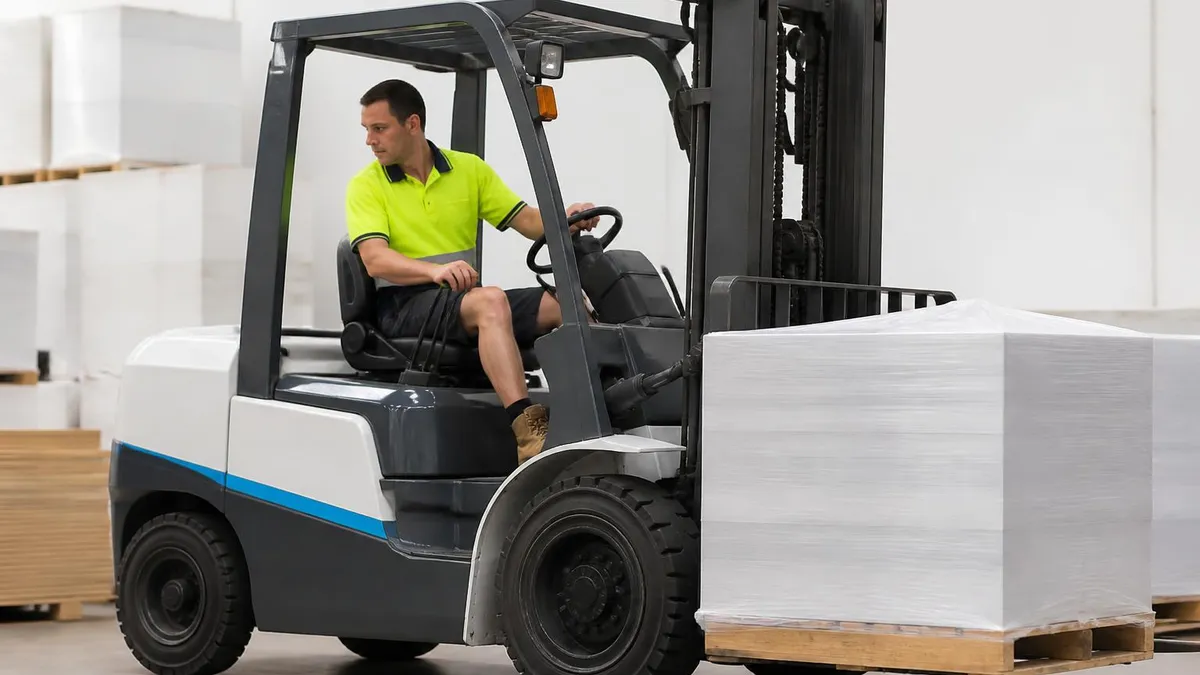
TCM 2.5 Ton Forklift Model Range Across Australia
The workhorse model running a Yanmar 4TNE92 indirect-injection diesel. Common in outdoor yards, freight depots and construction laydowns where torque under load and long fuel range matter more than emissions class.
A Nissan K21 or K25 four-cylinder dual-fuel engine. Preferred for indoor-outdoor cross-docking where exhaust scrubbers and ventilation systems can handle LPG combustion gases under AS 1596 storage rules.
A 48 V or 80 V three-phase AC traction motor with regenerative braking. The quietest of the range and the only TCM 2.5 ton model approved for cool rooms, food production lines and pharmaceutical warehousing.
TCM's newer Stage V compliant diesel with common-rail injection and DPF aftertreatment. Increasingly specified for government tenders and large logistics operators chasing reduced particulate emissions.
A low-mast variant capped at 2,180 mm overall height, allowing the unit to drive directly into a 20-foot shipping container. Often paired with side-shift and fork positioner attachments for unloading palletised freight.
The published specification sheet for a TCM 2.5 ton forklift is your single source of truth during the TLILIC0003 assessment. Assessors will routinely ask you to point to the data plate, read off the rated capacity and confirm the load centre, and then interpret what happens to that capacity if the load extends further forward. The standard TCM rating is 2,500 kg at a 500 mm load centre with the mast vertical and the carriage lowered, and you must be able to explain that figure in plain English.
Overall dimensions on the FD25T3 chassis are an overall length to fork face of approximately 2,490 mm, an overall width of 1,150 mm and a lowered mast height of 2,070 mm with the standard 3,000 mm two-stage simplex mast. The fork length is 1,070 mm with a section of 100 mm wide by 40 mm thick, and the carriage conforms to ISO Class 2. These figures matter when you are calculating clearance through doorways, between racking aisles or under low-bay lighting on a logistics floor.
The TCM load chart is laid out as a stepped graph. At 500 mm load centre the capacity is 2,500 kg, at 600 mm it drops to roughly 2,200 kg, and at 700 mm it falls further to about 1,950 kg. With a triplex full-free-lift mast extended above 4,500 mm, derating applies again because the centre of gravity shifts forward and upward. Memorise these stepdowns — examiners ask the question almost every assessment.
Tyre options also influence the published specification. Solid pneumatic tyres reduce overall height by about 30 mm compared with the cushion option but raise the working pressure on concrete floors. Air-filled pneumatics offer better outdoor traction but require regular pressure checks at 700 kPa front and 800 kPa rear. The data plate will note the tyre type the machine was rated against, and changing tyre style on your own without an engineer's sign-off voids the capacity rating.
The wheelbase of 1,700 mm and outside loaded turning radius of 2,300 mm give the TCM 2.5 ton a working aisle width of around 3,650 mm when handling a standard 1,165 mm Australian CHEP pallet. Many older Australian warehouses were designed for narrow Toyota 2 tonne machines with 3,300 mm aisles, so confirm the operational footprint before deploying a TCM into a site you have not measured.
Service brakes on the TCM 2.5 ton are wet disc, sealed against contamination and rated for around 8,000 hours before relining. The parking brake is a separate hand-applied drum unit on the transmission output shaft. Both must function correctly at the start of every shift, and the inability to hold the rated 2,500 kg load on an 8% grade is an immediate fail item in a TLILIC0003 practical assessment.
For an alternate view of how all these numbers tie together with mast configurations and clearance heights, see the related guide on mast of forklift components. The two articles overlap deliberately so that you can drill the same facts from two angles before exam day.
TLILIC0003 Practice Test Questions
Prepare for the Forklift Licence Australia - TLILIC0003 exam with our free practice test modules. Each quiz covers key topics to help you pass on your first try.
TLILIC0003 Forklift Licence Australia Atta...
TLILIC0003 Exam Questions covering Forklift Licence Australia Attachments and Modifications. Master TLILIC0003 Test concepts for certification prep.
TLILIC0003 Forklift Licence Australia Batt...
Free TLILIC0003 Practice Test featuring Forklift Licence Australia Battery and Fuel Safety. Improve your TLILIC0003 Exam score with mock test prep.
TLILIC0003 Forklift Licence Australia Emer...
TLILIC0003 Mock Exam on Forklift Licence Australia Emergency Procedures. TLILIC0003 Study Guide questions to pass on your first try.
TLILIC0003 Forklift Licence Australia Fork...
TLILIC0003 Test Prep for Forklift Licence Australia Forklift Pre-Operational Checks. Practice TLILIC0003 Quiz questions and boost your score.
TLILIC0003 Forklift Licence Australia Haza...
TLILIC0003 Questions and Answers on Forklift Licence Australia Hazard Identification. Free TLILIC0003 practice for exam readiness.
TLILIC0003 Forklift Licence Australia Load...
TLILIC0003 Mock Test covering Forklift Licence Australia Load Centre Calculations. Online TLILIC0003 Test practice with instant feedback.
TLILIC0003 Forklift Licence Australia Load...
Free TLILIC0003 Quiz on Forklift Licence Australia Load Handling and Capacity. TLILIC0003 Exam prep questions with detailed explanations.
TLILIC0003 Forklift Licence Australia Oper...
TLILIC0003 Practice Questions for Forklift Licence Australia Operating in Different Environments. Build confidence for your TLILIC0003 certification exam.
TLILIC0003 Forklift Licence Australia Oper...
TLILIC0003 Test Online for Forklift Licence Australia Operating Techniques. Free practice with instant results and feedback.
TLILIC0003 Forklift Licence Australia Pede...
TLILIC0003 Study Material on Forklift Licence Australia Pedestrian Safety. Prepare effectively with real exam-style questions.
TCM 2.5 Ton Forklift Engine, Hydraulics and Drivetrain
The FD25T3 runs a Yanmar 4TNE92 four-cylinder indirect-injection diesel producing approximately 33 kW at 2,450 rpm with peak torque of 145 Nm at 1,600 rpm. Service items include a spin-on oil filter, dual-stage dry air cleaner, paper fuel filter and water separator. Australian operators in dusty conditions should reduce the air filter service interval from 500 hours down to 250 hours to avoid premature turbocharger fouling on the later FHD25T3A common-rail variant.
Coolant capacity is around 7 litres of premixed long-life inhibitor. The radiator is mounted at the rear with the counterweight forming part of the airflow shroud. Overheating during TLILIC0003 assessments is almost always traced back to a leaf-clogged radiator or a slipping fan belt, so make these two checks part of every pre-start. A coolant temperature warning lamp on the dash should extinguish within 15 seconds of cold-start cranking.
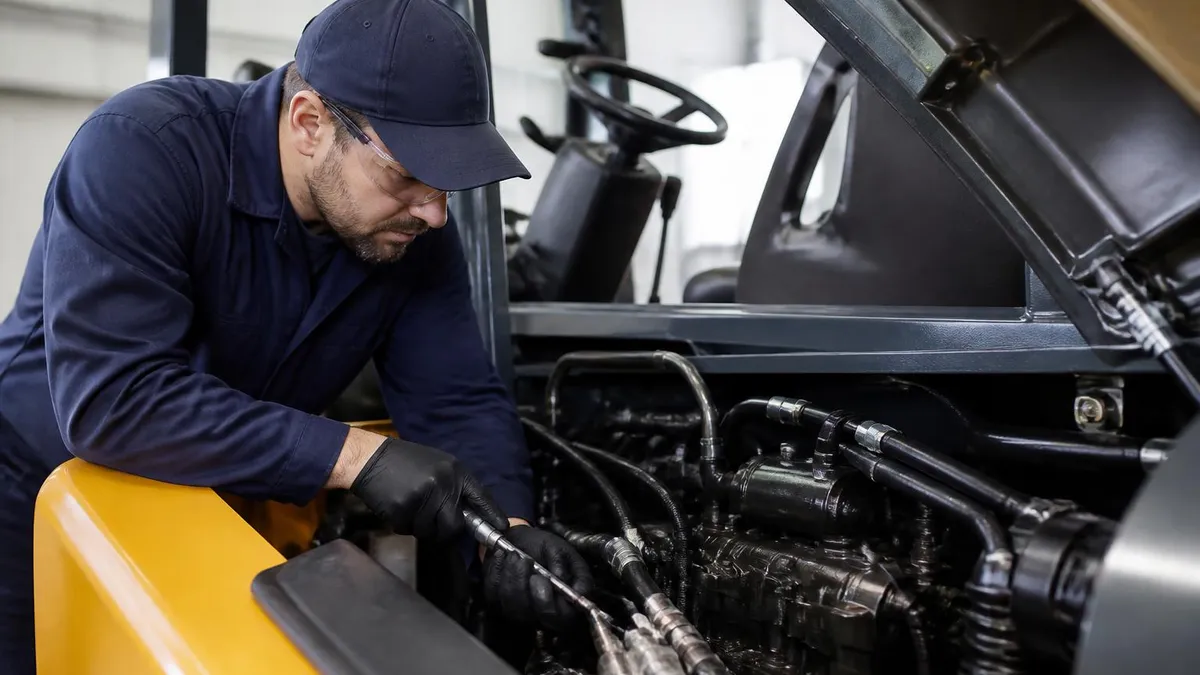
Is the TCM 2.5 Ton Forklift the Right Choice for Australian Sites?
- +Proven Yanmar and Nissan engines with parts available through every Australian capital city
- +Simple mechanical layout that suits owner-operators and small fleet workshops
- +Rated capacity holds well at standard 500 mm load centre across the model range
- +Lower purchase price than equivalent Toyota or Crown machines of the same era
- +Side-by-side spec compatibility with most ISO Class 2 attachments already on Australian sites
- +Operator cabin layout aligns with TLILIC0003 training conventions used by major RTOs
- −Older FD25T3 units lack DPF and may struggle to win government tender contracts
- −Replacement chassis panels increasingly hard to source for pre-2010 machines
- −Operator visibility through the mast is narrower than on modern Toyota 8FG/FD equivalents
- −Standard machine lacks a load-weight indicator unless retrofitted by a third party
- −LPG FG25T3 variant requires AS 1596 compliant cylinder change procedures and training
- −Resale values have softened compared with Toyota equivalents of the same hours
TCM 2.5 Ton Forklift Daily Pre-Start Checklist
- ✓Walk the perimeter and check for fluid leaks under the engine, hydraulics and drive axle
- ✓Inspect both forks for cracks at the heel, twist beyond 3% and visible wear notches
- ✓Confirm the lift chains have equal tension and no broken or stretched links beyond 2% wear
- ✓Check tyre pressure or solid tyre condition and look for chunking and embedded debris
- ✓Test the hydraulic lift, tilt and side-shift functions through their full range without load
- ✓Apply the service brake at walking pace and confirm the parking brake holds on a slope
- ✓Sound the horn, test the reversing beeper and confirm the flashing amber example operates
- ✓Verify the operator restraint seat belt latches cleanly and the seat presence switch works
- ✓Read the engine hour meter and log the figure on the daily pre-start record sheet
- ✓Confirm the data plate is legible and the rated capacity matches the work to be performed
Always Operate to the Plate, Never to Memory
Two TCM 2.5 ton forklifts that look identical can have very different rated capacities once a side-shift, fork positioner or extended fork is fitted. The data plate is the only legal source of capacity for that specific machine in its current configuration. If the plate is missing, illegible or contradicts your assessment paperwork, the machine must be tagged out under your site safety system until a competent engineer issues a replacement plate.
Common parts on the TCM 2.5 ton forklift fall into three buckets: consumables, wear items and structural components. Consumables include engine oil, hydraulic fluid, coolant, air and fuel filters, drive belts and grease points. These are replaced on a strict hour-based schedule, typically every 250, 500, 1,000 and 2,000 hours, and your service provider will keep records on a green-stickered card or in fleet management software like Crown Insite or Toyota I_Site equivalents.
Wear items are slightly more interesting from a TLILIC0003 perspective because operators must be able to spot defects without dismantling anything. Lift chains stretch over time; the test is a calibrated chain-wear gauge applied across 12 link pitches, and any reading over 2% requires immediate replacement of both chains as a matched pair. Forks wear at the heel, and a fork calliper measuring the heel section against the upright shank reveals more than 10% material loss, which is also an immediate tag-out condition.
Structural parts include the mast channels, carriage, counterweight and chassis. These should never crack under normal operation, and any visible crack in a weld is a serious notifiable defect that must be reported under the WHS incident reporting provisions in most Australian jurisdictions. Cracks tend to appear first at the bottom of the inner mast where it bolts to the carriage rollers, so this is a torch-and-mirror inspection point during quarterly compliance checks under AS 2359.2.
Tyres are technically a wear item but worth highlighting separately. Solid press-on tyres are common on indoor TCM 2.5 ton machines and have a 60J wear line moulded into the sidewall. Once worn past this line, the tyre must be replaced. Pneumatic tyres need pressure checks every shift, and any sidewall bulge indicates internal carcass damage requiring immediate removal from service even if the tyre still holds air.
Brakes, both service and park, are sealed wet-disc units on most TCM 2.5 ton variants. Operators cannot inspect the discs directly, but you can test for symptoms. A spongy brake pedal indicates air in the wet-disc circuit or low fluid level. A long-travel parking brake handle that ratchets through more than half its arc before holding indicates worn linings on the drum-style park brake. Both symptoms require a maintenance call before further use.
The electrical system is 12 V on diesel and LPG models, with starter, alternator, lights, horn and dash gauges all wired through a fuse board behind the right-hand side cover. The most common fault Australian operators report is corrosion of the battery terminals from coastal humidity, which manifests as slow cranking or intermittent dash warning lights. A monthly terminal clean and dielectric grease application solves this almost entirely.
Cross-check what you learn here against the broader multi directional forklift trucks guide. Many of the wear items on a multi-directional forklift overlap directly with the TCM platform, and understanding both gives you a stronger answer base for the TLILIC0003 verbal questions on equipment knowledge.
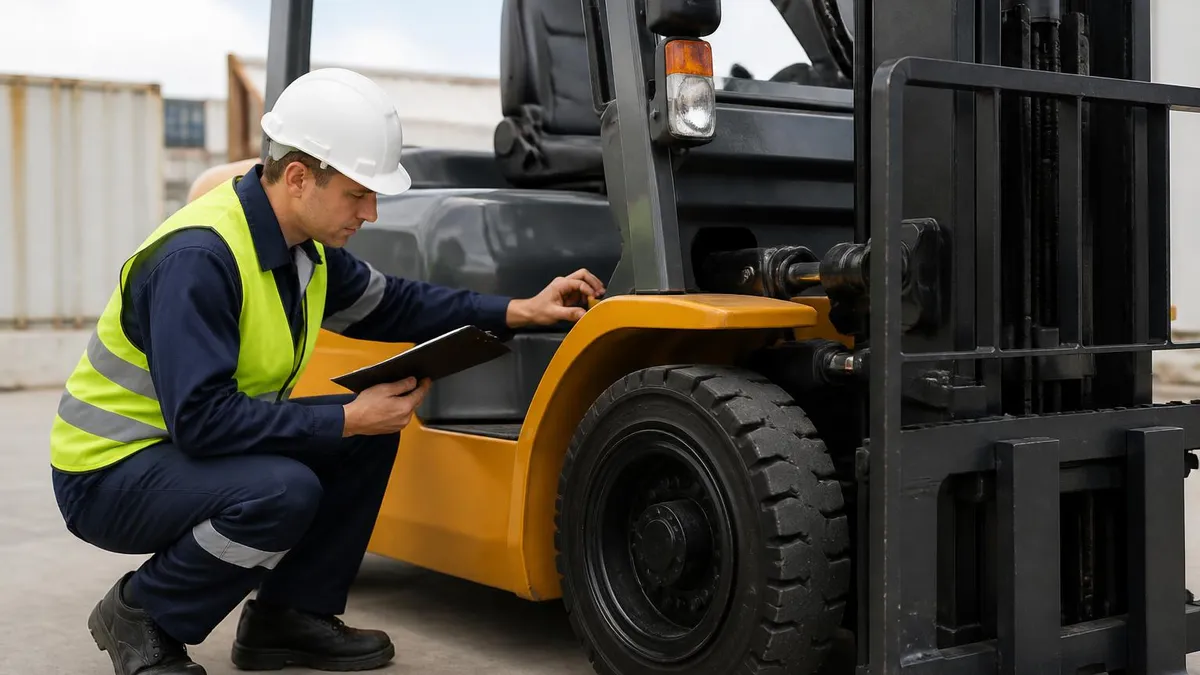
Any of the following on a TCM 2.5 ton forklift requires immediate tag-out and removal from service: cracked or twisted forks, lift chains stretched beyond 2%, hydraulic oil leaks visible as drips not stains, a missing or illegible data plate, brake or steering loss at any speed, or any structural crack in the mast, carriage or counterweight. Document the defect, attach a danger tag, and notify your supervisor before the next shift starts.
When you arrive at your TLILIC0003 assessment, the TCM 2.5 ton forklift in front of you may have been used by ten candidates that week, so do not assume the previous operator left it in textbook condition. The assessor is observing your process from the moment you walk up to the machine, and the first impression you make is during the pre-start walkaround. Move methodically, point at each item you inspect, and verbalise your findings even when everything is normal — silent inspections look like skipped inspections.
The verbal questioning portion will draw heavily on the data plate. Expect to be asked to identify the rated capacity, load centre, mast type, machine mass and serial number. Some assessors will ask you to calculate residual capacity with a 200 kg side-shift fitted at 200 mm forward of the standard load centre, and they will expect you to read both the original plate and the supplementary attachment plate if one is fitted. Practice this exact calculation a dozen times before assessment day.
The practical drive will include picking up a rated load, traversing a designated route, placing the load on racking, retrieving a second load and reversing into a tight bay. On a TCM 2.5 ton with its 2,300 mm turning radius and excellent rearward visibility through the counterweight cutout, this is achievable smoothly if you keep speeds low and use the tilt function correctly. Mast tilted back during travel, vertical during pickup and placement, and tilted forward only during fork insertion.
One common failure point during assessment is the racking placement. Operators tend to drive forward too far before lowering, which crushes the pallet against the back of the racking beam. The correct technique on a TCM 2.5 ton is to stop with the fork heel approximately 50 mm short of the back beam, lower until the load touches the bottom beam, then withdraw 50 mm before lowering the forks fully clear. Practice this in slow motion with an empty pallet before assessment day.
If the assessor asks you to demonstrate refuelling or LPG cylinder changeover on the FG25T3 variant, the procedure is strict. Park on level ground, apply the park brake, shut down the engine, isolate the battery if changing LPG, don gloves and safety glasses, close the cylinder valve, disconnect the supply hose, release residual pressure through the regulator vent, swap cylinders, reconnect and leak-test with soapy water. Skipping any step is an immediate fail.
For the final part of the assessment, the assessor will often present a hypothetical scenario, such as a hydraulic hose bursting mid-lift or a pedestrian walking into your work zone. Talk through the controlled-descent feature on the lift cylinders that limits lowering speed in a hose-failure event, and explain your three-zone response to pedestrians: stop, sound horn, wait for clear acknowledgement before resuming. Calm, structured answers consistently score higher than rushed technical jargon.
Finally, study the broader Australian regulatory context. Read the free forklift practice test 2026 resource, complete the linked attachment quizzes on this page, and review the Safe Work Australia Forklift Code of Practice. Knowing the law as well as the machine demonstrates the professional attitude assessors are looking for in a future high risk work licence holder.
Practical preparation in the final week before your TLILIC0003 assessment should focus less on cramming new facts and more on rehearsing what you already know until it becomes automatic. Spend at least three hours on a TCM 2.5 ton or equivalent machine performing the same pre-start, load pickup, travel, placement and shutdown sequence over and over. Australian assessors call this muscle memory the difference between a competent operator and a candidate who happens to know the right answers.
Build a personal cheat sheet of the TCM 2.5 ton specifications most commonly asked about: rated capacity 2,500 kg at 500 mm load centre, lift height 3,000 mm standard, wheelbase 1,700 mm, turning radius 2,300 mm, hydraulic pressure 18.6 MPa, engine 33 kW Yanmar diesel. Write these on the back of a business card and quiz yourself during commutes. The act of writing the figures down by hand cements them far more deeply than reading alone.
Run through the load chart in three scenarios: standard 500 mm load centre, extended 700 mm load centre and high-lift derating above 4,500 mm. For each, calculate the residual capacity and write down the figure. If you can recite these without hesitation, you will breeze through the calculation portion of the assessment. Many candidates lose marks here simply because they freeze when the assessor changes one variable in the question.
Pay special attention to attachment-related questions, since the linked practice quizzes on this page cover that exact territory. A side-shift adds approximately 130 kg of static weight forward of the carriage face and shifts the effective load centre forward by around 50 mm. A fork positioner adds slightly more. A drum clamp can derate the machine by 30% or more depending on the drum size. The TCM 2.5 ton must have a supplementary data plate for each attachment, and you should be able to read both plates together.
Sleep matters. The most consistently passed TLILIC0003 assessments are the ones where the candidate slept seven to eight hours the night before, ate a normal breakfast and arrived at the testing facility 20 minutes early. Adrenaline plus caffeine plus low blood sugar is a recipe for missed pre-start items and rushed mast movements. Treat assessment day like a normal workday, not a high-stakes exam.
Bring the right paperwork. You will need photo identification, your unique student identifier (USI), any prior verification of competency cards if applicable, and steel-capped boots, high-visibility clothing and any other PPE your RTO has specified. Forgetting safety glasses or a hi-vis vest can result in the assessment being rescheduled at your expense, which is an unforced error easy to avoid with a checklist the night before.
After you pass, your TLILIC0003 statement of attainment will be issued by the RTO, but the high risk work licence itself comes from your state regulator and may take two to six weeks to arrive. During this period you can legally operate a forklift under direct supervision while the application is processed. Confirm the supervision rules with your employer in writing so there is no doubt about your authorisation on day one of the new role.
Sample Forklift Licence Practice Questions
Try these questions from our free Forklift Licence practice tests. The correct answer and an explanation follow each question.
What emergency procedures should cover Forklift Pre-Operational Checks scenarios?
- A. No emergency procedures needed
- B. Response actions, evacuation, first aid, communication protocols, and specific hazard responses
- C. Only dialling 000
- D. A general evacuation plan only
Answer: B. Response actions, evacuation, first aid, communication protocols, and specific hazard responses
Emergency procedures must be comprehensive and specific to the hazards associated with the activity.
What penalties apply for non-compliance with Hazard Identification regulations in Australia?
- A. No penalties
- B. Significant fines (up to millions of AUD for corporations) and potential imprisonment for serious offences
- C. A verbal warning only
- D. A small administrative fee
Answer: B. Significant fines (up to millions of AUD for corporations) and potential imprisonment for serious offences
Australian WHS penalties are severe, with Category 1 offences carrying fines up to AUD 3 million and potential imprisonment.
On a counterbalanced forklift, where is the fulcrum point located?
- A. At the centre of the rear axle
- B. At the tips of the forks
- C. At the front axle between the two drive wheels
- D. At the base of the mast
Answer: C. At the front axle between the two drive wheels
The fulcrum point is at the front axle (between the two drive wheels), and it is the pivot point over which the forklift can tip forward if the combined centre of gravity moves in front of it.
Which condition MOST significantly reduces the stability of a forklift travelling with a raised load?
- A. Travelling slowly in a straight line on a flat, smooth floor
- B. Travelling over a small raised edge such as a door threshold
- C. Having the mast tilted fully back while the load is at travel height
- D. Operating in a well-lit, dry warehouse environment
Answer: B. Travelling over a small raised edge such as a door threshold
Travelling over a raised edge or bump with a load at height causes a sudden jolt that can dramatically shift the combined centre of gravity, greatly increasing the risk of tip-over when compared to smooth, flat surfaces.
TLILIC0003 Questions and Answers
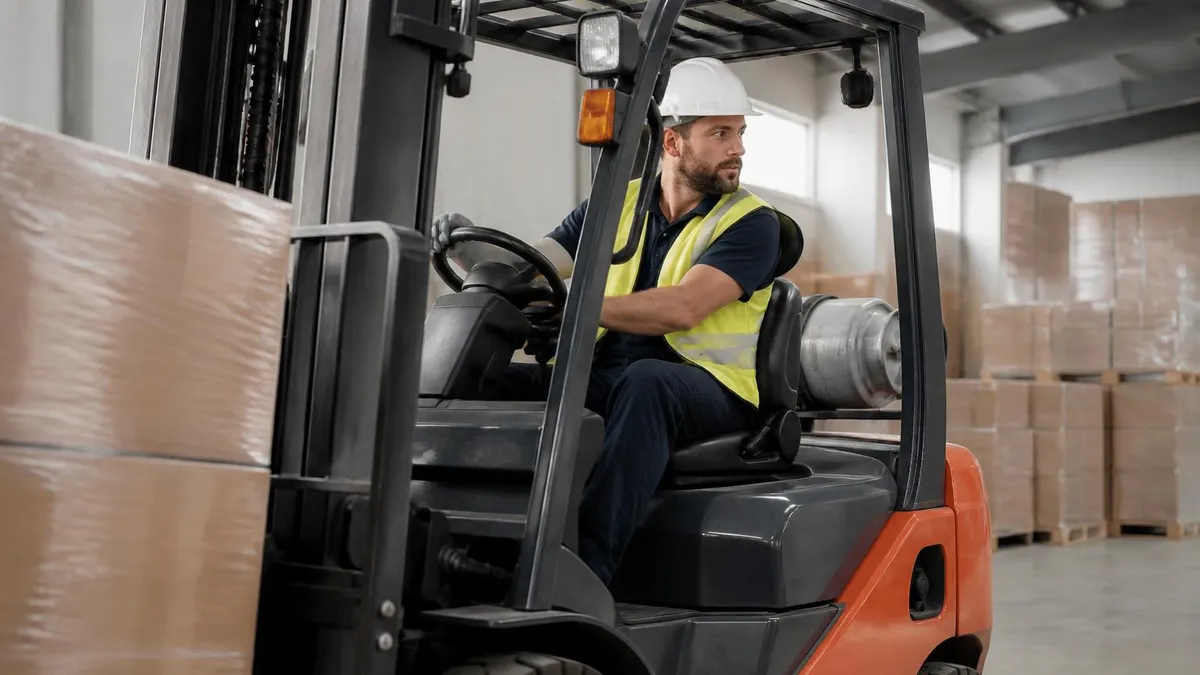
Mast of Forklift: Complete Guide to Forklift Parts for TLILIC0003 Operators in Australia

Multi Directional Forklift Trucks: Complete Guide to Forklift Types and Parts for TLILIC0003 Operators in Australia
Free Forklift Practice Test 2026 - Forklift Exam Questions
Forklift Clearance Height: Complete Guide to Forklift Specifications for TLILIC0003 Operators in Australia
Forklift Licence Near Me: How to Find Local TLILIC0003 Training Providers in Australia
About the Author

Certified Crane Operator & Skilled Trades Exam Specialist
Ferris State UniversityRobert Martinez is a Journeyman Ironworker, NCCCO-certified crane operator, and forklift trainer with a Bachelor of Science in Construction Technology from Ferris State University. He has 21 years of ironworking, rigging, and heavy equipment operation experience across high-rise and industrial construction sites. Robert prepares candidates for crane operator, rigger, forklift, and skilled trades certification examinations.