
Forklift Ticket Australia: Complete TLILIC0003 Study Guide & Certification Prep (2026 October)
Complete forklift ticket study guide for TLILIC0003 in Australia. 🔎 Learn requirements, exam topics, costs, and practice questions to pass first time.
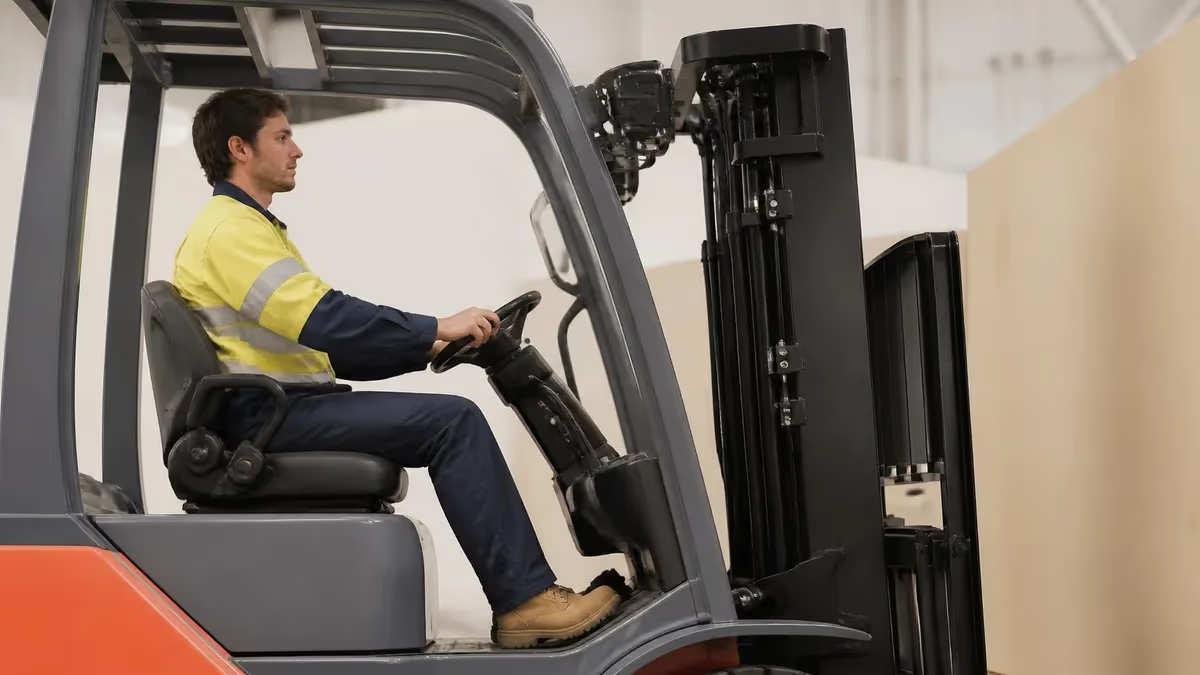
Earning your forklift ticket in Australia means completing the nationally recognised TLILIC0003 unit of competency, which authorises you to operate a forklift truck in any workplace across the country.
Whether you are entering the warehousing, logistics, construction, or manufacturing sector for the first time, or simply formalising skills you already have on the job, this qualification is the legal requirement that stands between you and the controls of a counterbalance forklift. Understanding exactly what the course covers, how the assessment works, and how best to prepare will save you time, money, and stress before you ever set foot in a training facility.
The TLILIC0003 unit is regulated by the Transport and Logistics Training Package and sits within the nationally consistent licensing framework administered by Safe Work Australia. Each state and territory applies this unit to its own high-risk work licensing scheme, which means your forklift ticket is valid everywhere from Western Australia to Queensland, from Victoria to the Northern Territory. That national portability is one of the biggest practical advantages of holding this credential rather than a company-specific induction certificate, which has no legal standing outside the issuing employer's gates.
Training for the forklift ticket is delivered by Registered Training Organisations (RTOs) that hold the relevant scope of registration with the Australian Skills Quality Authority (ASQA). RTOs must provide both theoretical instruction and a substantial block of supervised practical operation time.
The theoretical component covers pre-operational checks, load capacity principles, workplace hazard identification, Australian safety legislation, and the physics of forklift stability — all topics that appear directly in the written assessment. The practical component demonstrates your ability to perform pre-start inspections, travel loaded and unloaded across different surface conditions, stack and unstack loads at height, and shut down the machine safely.
Many candidates underestimate how demanding the theoretical side of the ticket can be. The written assessment is not simply a matter of answering a handful of obvious safety questions. Examiners test applied knowledge: you must be able to read a load capacity data plate and calculate whether a proposed lift is within rated limits, identify specific hazards in a photograph of a warehouse aisle, and explain the correct response to a hydraulic leak or a suspected LPG gas fault.
These are not questions you can answer reliably without structured preparation, which is why using quality practice tests and study resources before assessment day makes a measurable difference to pass rates.
The practical assessment is equally exacting. An independent assessor appointed by the state licensing authority — not your RTO trainer — will observe you complete a defined series of tasks. In most states, any dangerous act during the practical assessment results in immediate failure regardless of how well the rest of the tasks are completed. Dangerous acts include travelling with the forks raised to travel height incorrectly, overloading the machine, exceeding safe working speed in pedestrian areas, and failing to observe designated traffic routes. Practising these tasks repeatedly during training until they are automatic is the only reliable preparation strategy.
Cost is a common concern for candidates. Forklift ticket courses across Australia typically range from around $400 to $900, depending on the RTO, the state, the duration of the course, and whether you need additional practical hours because you are a complete beginner versus someone who already has some seat time.
Some RTOs offer Recognition of Prior Learning (RPL) pathways for experienced operators, which can reduce both the time and cost involved. However, RPL assessments are themselves rigorous, and candidates who attempt RPL without properly documenting their existing skills and knowledge often end up paying for a full course anyway after an unsuccessful RPL application.
This study guide is designed to be your central preparation hub for TLILIC0003. In the sections that follow, you will find a breakdown of everything the course covers, a realistic study schedule, an honest assessment of the advantages and challenges of holding a forklift ticket, a day-before-assessment checklist, and answers to the most frequently asked questions from candidates across Australia. Work through this material systematically alongside your practice tests, and you will arrive at assessment day with the knowledge and confidence to pass first time.
Free Forklift Licence Study Tools
Interactive Forklift Licence resources on PracticeTestGeeks, free to start:
- Forklift Licence practice test — 300+ questions with instant scoring and answer explanations
- Forklift Licence flashcards — review key terms and concepts card by card
- Forklift Licence study guide — topic-by-topic overview of what the exam covers
- Forklift Licence cheat sheet — one-page printable summary for last-minute review
TLILIC0003 Forklift Ticket by the Numbers
Key Facts at a Glance
| Item | Value | Details |
|---|---|---|
| Typical Course Duration | 2–4 days | Varies by RTO and prior experience |
| Course Cost Range | $400–$900 | Across Australian RTOs in 2026 |
| Licence Validity | 5 years | Before renewal required in most states |
| Minimum Theory Pass Mark | ~70% | Exact threshold set by state authority |
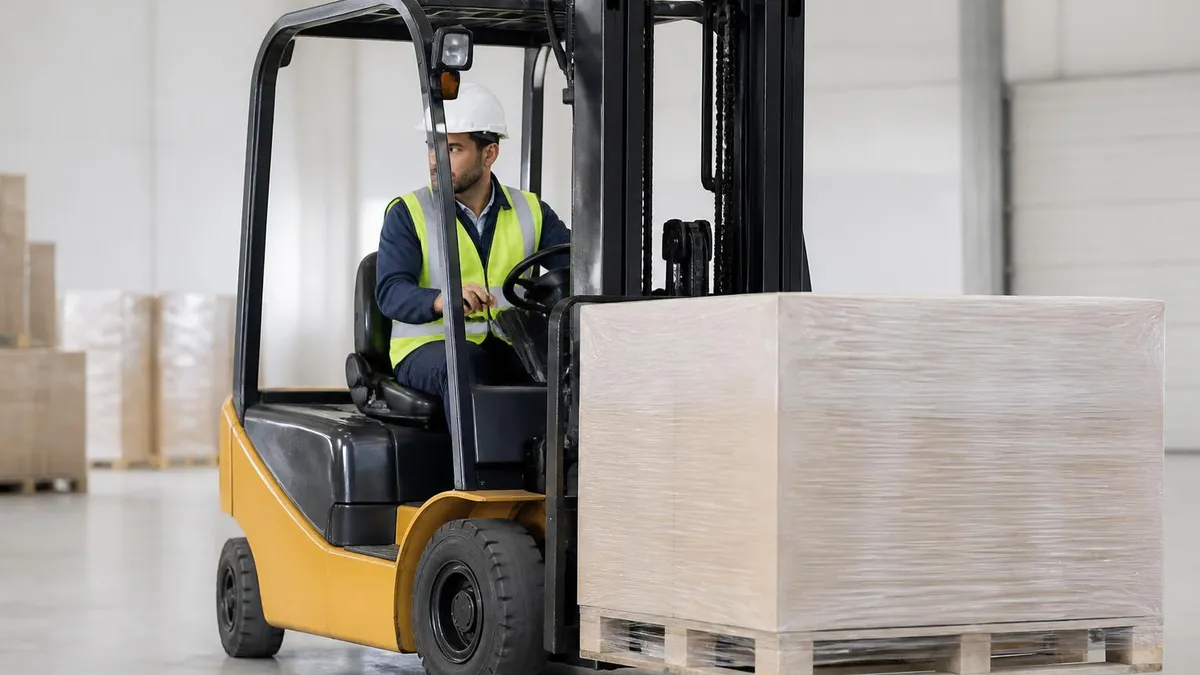
TLILIC0003 Study Schedule: Week-by-Week Prep Plan
- ▸Study counterbalance forklift components and their functions
- ▸Learn how to read a data plate and calculate safe working load
- ▸Memorise the stability triangle concept and tipping hazards
- ▸Complete one full set of practice theory questions and review all wrong answers
- ▸Memorise the complete daily pre-start inspection sequence
- ▸Understand hydraulic circuit components and common fault signs
- ▸Study LPG cylinder changing procedure and gas leak response
- ▸Complete two sets of practice questions focused on safety checks
- ▸Study the Work Health and Safety Act requirements for forklift operators
- ▸Learn speed limits, travel rules, and pedestrian separation principles
- ▸Review ramp and slope travel procedures and load positioning rules
- ▸Take a full timed practice test simulating assessment conditions
- ▸Practise pre-start walkaround until sequence is completely automatic
- ▸Focus on smooth load travel, stacking, and destacking at height
- ▸Revise all topics flagged as weak areas from practice tests
- ▸Complete a mock assessment with a study partner or trainer observation
The theory component of the TLILIC0003 assessment tests knowledge across six broad domains: forklift types and configurations, load capacity and stability, pre-operational inspection, operational safety, workplace and legislative requirements, and emergency procedures. Most RTOs deliver this content across one to two days of classroom or online instruction before the written assessment takes place. Understanding how examiners weight these domains will help you allocate your study time more effectively during your preparation period.
Load capacity and stability questions are among the most technically demanding items in the theory assessment. You must understand that a forklift's rated capacity is stated at a specific load centre distance — typically 500 millimetres from the front face of the forks — and that moving a load further forward from that centre reduces the actual safe working load significantly. Examiners will give you a data plate scenario and ask whether a proposed lift is within rated capacity. Getting these calculations right requires practice with real data plate examples, not just a conceptual understanding of the principle.
The stability triangle is another area that generates frequent incorrect answers. The triangle is formed by the front axle and the two rear steering wheels, and the combined centre of gravity of the forklift and load must remain within this triangle at all times during operation.
Candidates often understand the concept in the abstract but struggle to apply it when exam questions describe specific scenarios — a load that is unevenly distributed, a forklift travelling on a cross-slope, or a machine fitted with a side-shift attachment that has displaced the load laterally. Work through as many scenario-based questions on this topic as possible before your assessment.
Pre-operational inspection knowledge is tested in detail. You are expected to know the correct inspection sequence for every major system: tyres and wheels, forks and carriage, mast and chains, hydraulic system, LPG or battery systems depending on the machine type, brakes, steering, lights and horn, seatbelt and overhead guard.
You must also understand which defects require the machine to be taken out of service immediately versus which defects can be noted in the log and addressed at the next scheduled maintenance interval. Tagged-out machines must never be operated regardless of workplace pressure, and examiners will specifically test your knowledge of this rule.
Australian workplace health and safety legislation features heavily in the theory assessment. You must understand that forklift operators have personal duties under the Work Health and Safety Act 2011 (or the equivalent state legislation in Victoria, Western Australia, and Queensland, which maintain separate but substantially similar acts). These duties include taking reasonable care for your own safety and the safety of others affected by your work, complying with any reasonable instruction from the person conducting the business or undertaking (PCBU), and cooperating with any reasonable health and safety policy or procedure.
Knowing these obligations by name and understanding their practical application is essential.
Emergency procedures questions test your knowledge of the correct responses to specific hazard scenarios. These include: what to do if a forklift tips over (stay inside the cab, brace against the steering wheel and overhead guard, do not jump out), how to respond to an LPG leak (switch off the engine, move clear of the area, alert the emergency warden), how to handle a hydraulic system failure during a lift (lower the load if possible, isolate the machine, tag out and notify maintenance), and how to respond if a pedestrian walks into your operating zone without warning.
Practise these scenarios until your answers are automatic, as exam nerves can blank the memory at the critical moment.
Attachments and modifications are a final theory area worth dedicated study, particularly for candidates working in industries where specialised forklift configurations are common. Side-shift attachments, rotator attachments, clamp attachments, and jib attachments all affect the machine's rated capacity and handling characteristics differently. The general principle is that any attachment reduces the effective rated capacity, and operators must check the attachment-specific capacity plate rather than relying on the base machine data plate. This topic appears directly in several of the practice quiz sets available on this platform, making it one of the easiest areas to strengthen with focused preparation.
TLILIC0003 Practice Test Questions
Prepare for the Forklift Licence Australia - TLILIC0003 exam with our free practice test modules. Each quiz covers key topics to help you pass on your first try.
TLILIC0003 Forklift Licence Australia Atta...
TLILIC0003 Exam Questions covering Forklift Licence Australia Attachments and Modifications. Master TLILIC0003 Test concepts for certification prep.
TLILIC0003 Forklift Licence Australia Batt...
Free TLILIC0003 Practice Test featuring Forklift Licence Australia Battery and Fuel Safety. Improve your TLILIC0003 Exam score with mock test prep.
TLILIC0003 Forklift Licence Australia Emer...
TLILIC0003 Mock Exam on Forklift Licence Australia Emergency Procedures. TLILIC0003 Study Guide questions to pass on your first try.
TLILIC0003 Forklift Licence Australia Fork...
TLILIC0003 Test Prep for Forklift Licence Australia Forklift Pre-Operational Checks. Practice TLILIC0003 Quiz questions and boost your score.
TLILIC0003 Forklift Licence Australia Haza...
TLILIC0003 Questions and Answers on Forklift Licence Australia Hazard Identification. Free TLILIC0003 practice for exam readiness.
TLILIC0003 Forklift Licence Australia Load...
TLILIC0003 Mock Test covering Forklift Licence Australia Load Centre Calculations. Online TLILIC0003 Test practice with instant feedback.
TLILIC0003 Forklift Licence Australia Load...
Free TLILIC0003 Quiz on Forklift Licence Australia Load Handling and Capacity. TLILIC0003 Exam prep questions with detailed explanations.
TLILIC0003 Forklift Licence Australia Oper...
TLILIC0003 Practice Questions for Forklift Licence Australia Operating in Different Environments. Build confidence for your TLILIC0003 certification exam.
TLILIC0003 Forklift Licence Australia Oper...
TLILIC0003 Test Online for Forklift Licence Australia Operating Techniques. Free practice with instant results and feedback.
TLILIC0003 Forklift Licence Australia Pede...
TLILIC0003 Study Material on Forklift Licence Australia Pedestrian Safety. Prepare effectively with real exam-style questions.
TLILIC0003 Practical Assessment: What Assessors Look For
Assessors expect you to complete the pre-start inspection in a logical, systematic sequence without prompting. Begin at the forks and work around the machine methodically — checking fork heel wear and tip condition, carriage rollers, mast channels and chains, tyres, fluid levels, LPG or battery system, brakes, steering play, and safety devices including the seatbelt, overhead guard, and horn. Each item must be physically checked, not simply glanced at. Describe each check aloud as you perform it so the assessor can clearly see your methodology.
Common failures during the pre-start section include skipping checks in the wrong order, failing to physically test the horn and brake pedal, and overlooking the chain lubrication check on the mast. If you discover a defect during the inspection — a cracked fork heel, a low tyre, a hydraulic leak — you must demonstrate the correct response: stop the inspection, tag the machine out of service, and report it to your supervisor. Assessors sometimes deliberately introduce minor defects into the training machines to test exactly this knowledge.
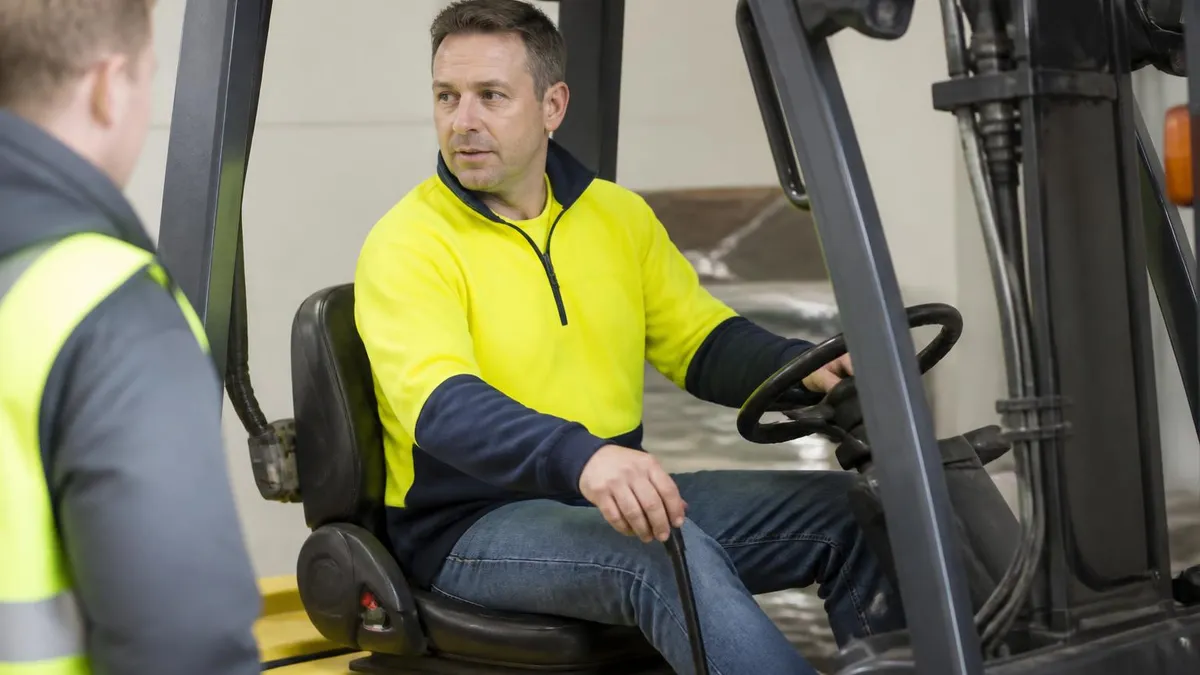
Forklift Ticket: Benefits and Challenges to Consider
- +Nationally portable — your TLILIC0003 licence is valid in every Australian state and territory without additional endorsements
- +Strong employment demand — warehousing, logistics, and construction sectors consistently list forklift operation as a high-demand skill
- +Relatively short time investment — most candidates complete the full course in two to four days compared to weeks for other trade qualifications
- +Clear regulatory framework — licence conditions and renewal requirements are well-defined, making compliance straightforward
- +Wage premium — licensed forklift operators typically earn $3–$8 per hour more than unlicensed general hands in similar roles
- +Entry point to further qualifications — TLILIC0003 can stack into Certificate III in Warehousing Operations and other logistics pathways
- −Physical assessment cannot be skipped or substituted — candidates with some physical limitations may need workplace adjustments or alternative assessment arrangements
- −Licence renewal is required every five years and involves a practical re-assessment in most states, not just an administrative fee
- −Course cost of $400–$900 is not subsidised by the federal government for most adult learners, though some state and employer schemes offer partial rebates
- −RTO quality varies significantly — choosing a poorly resourced RTO can mean inadequate practical time and higher first-attempt failure rates
- −Dangerous act during practical assessment causes immediate failure regardless of overall performance, creating high-stakes pressure on assessment day
- −Licence covers counterbalance forklifts only — order picking machines, reach trucks, and other specialised equipment require separate endorsements or unit completions
TLILIC0003 Pre-Assessment Day Checklist
- ✓Confirm your assessment date, time, and exact location with your RTO at least 48 hours before the scheduled date
- ✓Bring government-issued photo identification — a passport or driver licence is required for enrolment verification
- ✓Wear appropriate personal protective equipment: steel-capped boots, hi-vis vest, and long pants as a minimum
- ✓Review your pre-start inspection sequence until you can recite every check point from memory without referring to notes
- ✓Practise reading a load capacity data plate and calculating whether a specific load and load-centre combination is within rated limits
- ✓Revise the correct shutdown procedure for both LPG and battery-electric machines, paying attention to sequence differences
- ✓Complete at least one full timed practice theory test the evening before assessment and review any wrong answers immediately
- ✓Prepare your post-operational logbook entry template so you know exactly what fields to complete after the practical tasks
- ✓Plan your travel route to the assessment venue and confirm parking or public transport options to avoid arriving late
- ✓Get a full night's sleep — cognitive performance under assessment conditions drops measurably with less than seven hours of rest
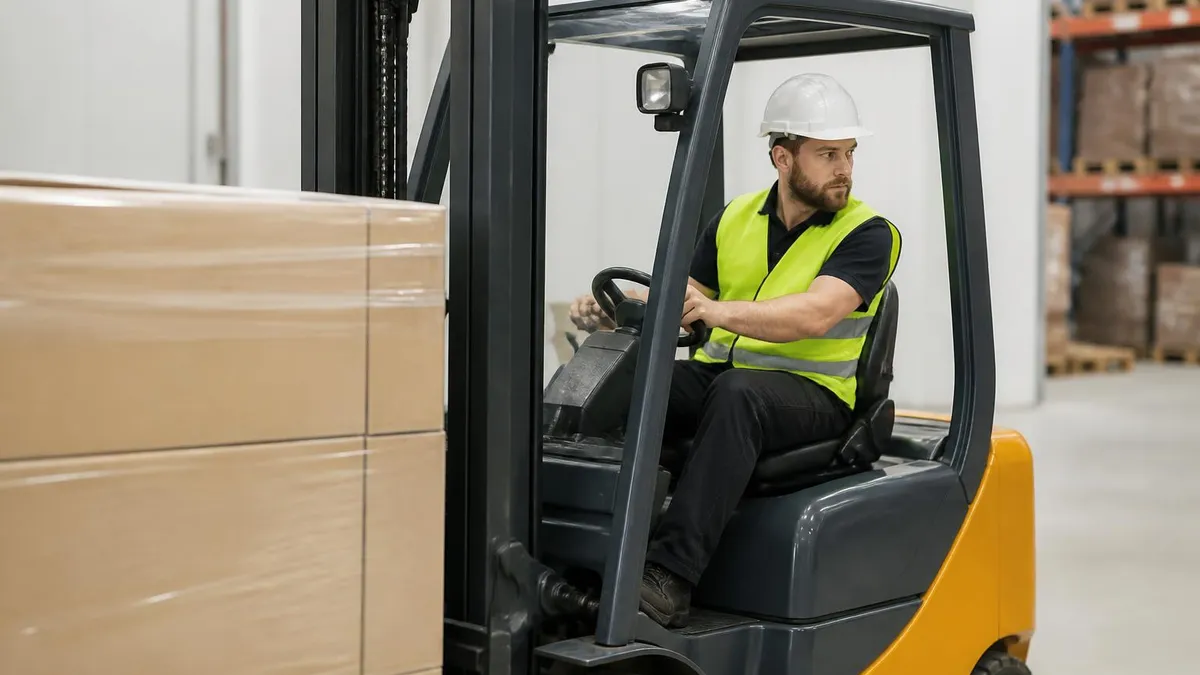
The Dangerous Act Rule Is Absolute — No Exceptions
In every Australian state and territory, committing a dangerous act during the TLILIC0003 practical assessment results in automatic failure of the entire assessment, regardless of how well you performed on all other tasks. Dangerous acts include travelling with the load improved above the safe travel height, failing to stop for a simulated pedestrian crossing, and operating a machine that has been tagged out of service. There is no partial credit and no second chance within the same assessment session. If you fail on this basis, you must rebook and complete the full practical assessment again.
Understanding the costs involved in obtaining your forklift ticket helps you budget realistically and avoid being caught out by hidden fees. The base course fee quoted by most RTOs covers tuition, supervised practical time, and the competency assessment itself. However, there are several additional costs that candidates frequently overlook when comparing providers.
The state high-risk work licence application fee — paid directly to the state licensing authority, not the RTO — is separate from the course fee and currently ranges from approximately $60 in Queensland to over $150 in some other jurisdictions. This fee is paid after you have been assessed as competent, when you apply to the state authority for your actual licence card.
Some RTOs charge separately for personal protective equipment hire if you do not have your own steel-capped boots and hi-vis vest. Others charge a re-assessment fee if you do not achieve competency on the first attempt, which can range from $100 to $250 depending on the provider and the extent of the re-assessment required.
A small number of RTOs also charge a separate fee for the Statement of Attainment document that is issued when you complete the unit, though this is increasingly uncommon as most providers include it in the base fee. Always request an itemised quote and ask specifically about re-assessment fees before enrolling.
Choosing the right RTO is arguably the most important decision you will make in your forklift ticket journey. The differences between RTOs in terms of equipment quality, trainer experience, student-to-trainer ratios, and assessment rigour are substantial. A well-resourced RTO will have multiple modern forklifts available, meaning each candidate gets adequate hands-on time rather than spending much of the practical day waiting for their turn. They will have trainers who are qualified assessors with real industry experience, not simply people who hold a training and assessment qualification without a background in forklift operation.
Checking an RTO's registration on the Australian Government's training.gov.au website verifies that they hold the scope of registration to deliver TLILIC0003 in your state or territory. Beyond that basic check, look at their Google reviews and ask former students about their experience. Specifically ask about the practical-to-theory ratio on the course: the nationally mandated minimum supervised practical time is defined in the training package, and any RTO that offers a one-day forklift course without a credible explanation of how they meet that requirement is likely cutting corners in ways that may affect your preparation quality.
Recognition of Prior Learning is available for candidates who have been operating forklifts in a workplace for a significant period without holding a formal licence — a situation that is unfortunately common in some industries where informal training and supervision has historically substituted for formal certification.
To pursue RPL, you must be able to demonstrate your skills and knowledge through a combination of a structured practical skills assessment, responses to theory questions, and supporting evidence such as employment records, logbooks, or third-party statements from supervisors. RPL assessments are not easier than standard assessments; they are simply structured to recognise what you already know rather than training you from scratch.
State-specific variations in forklift licensing requirements are another area where candidates sometimes receive incorrect information from well-meaning colleagues. While TLILIC0003 is the nationally consistent unit of competency, the practical requirements imposed by each state licensing authority can differ in details such as the minimum number of assessed tasks, the type of written assessment format, and the requirements for verifying identity before the assessment.
Victoria's WorkSafe authority, for example, has specific requirements about assessor accreditation that differ from New South Wales SafeWork requirements. Your RTO should be thoroughly familiar with the requirements of the state in which they operate, but it does not hurt to confirm key details directly with the state authority's website before assessment day.
Government funding and subsidies for forklift training are available in some circumstances. Under the Skills First program in Victoria, eligible individuals may access subsidised training at approved RTOs. Similar programs exist in Queensland, Western Australia, and South Australia under various names and with varying eligibility criteria that change from year to year.
Generally, subsidies are more accessible to people under 25, people who are unemployed or underemployed, and people who do not already hold a comparable qualification. Employers in some industries can also access training subsidies through industry partnerships with state government training authorities. Researching these options before committing to full-price course fees is always worthwhile.
Operating a forklift without a current high-risk work licence in Australia is a serious offence under state and territory Work Health and Safety legislation. Penalties for unlicensed operation can include substantial fines for both the operator and the person conducting the business or undertaking (PCBU) who allowed the unlicensed operation to occur. Employers who direct or permit unlicensed forklift operation face even higher penalties than operators themselves. Your employer's instruction to operate without a licence does not provide any legal defence — the obligation to hold a valid licence is personal and cannot be delegated or waived.
Once you hold your forklift ticket, the natural next question is: what comes next? Many newly licensed operators discover that their TLILIC0003 licence opens doors to a range of further qualifications and career pathways within the transport and logistics sector. The Certificate III in Warehousing Operations (TLI30319) is a popular pathway that stacks the forklift unit alongside additional competencies in receiving and dispatching goods, inventory management, and supply chain documentation. Completing this qualification while working in a warehouse role typically increases both employment security and earning potential within the logistics sector.
For operators who work in industries involving improved work platforms, cranes, or other plant, the high-risk work licensing framework provides additional licence classes that can be added to your portfolio. The Boom-type Improved Work Platform licence (TLILIC2005), the Scaffolding licence, and various Rigging licence classes are all part of the same nationally consistent framework that governs your forklift ticket. Each additional licence class increases your versatility as a site operator and makes you a more attractive candidate in competitive hiring situations, particularly in construction and mining where multi-skilled operators command significant wage premiums.
Licence renewal is a requirement that many forklift operators fail to plan for adequately. In most Australian states and territories, the high-risk work licence is valid for five years from the date of issue, after which it must be renewed. Renewal typically requires evidence of continued competency — either proof of recent workplace operation or a practical re-assessment — along with payment of the renewal fee to the state authority.
The renewal is not automatic, and an expired licence carries the same legal penalties as never having held one. Setting a calendar reminder twelve months before your licence expires gives you time to arrange any required re-assessment without the pressure of an imminent expiry date.
Workplace safety culture is an area where licensed forklift operators can have a significant positive impact beyond simply operating their own machine correctly. Experienced operators who model safe practices — consistently obeying speed limits, always sounding the horn at blind spots, refusing to carry unsafe loads regardless of schedule pressure — create reference points of professional behaviour that influence newer or less confident workers.
Many serious forklift incidents in Australian workplaces involve not a failure of technical skill but a failure of the broader safety culture in which operators feel implicitly pressured to take shortcuts. Your willingness to operate within the rules regardless of that pressure is itself a critical safety contribution.
Forklift incident statistics from Safe Work Australia consistently identify pedestrian contact, tip-overs, and load falls as the three most frequent categories of serious forklift-related injury and fatality. All three are preventable through the consistent application of the knowledge and skills tested in TLILIC0003.
Pedestrian contact is prevented by strict adherence to designated traffic routes, reduced speeds in pedestrian areas, and the use of mirrors, spotters, and audible warning systems at blind intersections. Tip-overs are prevented by never exceeding the rated capacity, travelling with loads at safe travel height, and slowing down on corners and ramps. Load falls are prevented by correct load engagement, full tine insertion, and mast tilt-back before travel.
Continuing professional development for forklift operators does not have a mandated formal structure in the way that some other licensed occupations require, but responsible operators seek out opportunities to update their knowledge.
Changes to Australian Standards affecting forklift operation — such as updates to AS 2359 (the Industrial Trucks standard series) or revisions to the Workplace Traffic Management Code of Practice — should be monitored and understood by anyone who operates forklifts professionally. Your RTO, industry associations, and the Safe Work Australia website are the most reliable sources for information about regulatory changes that affect your licence conditions and operational obligations.
Finally, it is worth recognising the genuine pride that comes with holding a nationally recognised, competency-based qualification in a safety-critical skill. The TLILIC0003 forklift ticket is not a participation certificate — it is evidence that you have been assessed by an independent, authorised assessor and found competent to operate potentially lethal plant equipment in Australian workplaces.
That assessment has real meaning, real consequences, and real value to every employer, colleague, and pedestrian who shares a working environment with you. Carry the licence with the seriousness it deserves, and continue to honour it through every operating decision you make on the job.
The final stage of your preparation — the week immediately before your assessment — should focus on consolidation rather than introducing new material. This is not the time to discover a topic you have never studied; it is the time to strengthen the foundations you have already built.
Run through your practice tests in timed conditions, aiming to complete the theory section well within the allocated time so that you have buffer to revisit flagged questions. Review every wrong answer not just to memorise the correct response but to understand why the correct answer is correct at a mechanical or regulatory level.
Physical preparation for the practical assessment is equally important and often overlooked. Wear your steel-capped boots for several hours in the days before the assessment if they are new — blisters caused by unfamiliar footwear create unnecessary discomfort and distraction on assessment day.
If your employer or RTO allows access to a forklift for additional practice hours in the days leading up to your assessment, take every opportunity available. The practical assessment tasks are not complex in themselves, but they must be executed under observation with an assessor recording every error, which creates psychological pressure that can degrade performance in less-practised candidates.
Hydration and nutrition on assessment day affect cognitive performance more than most candidates realise. The theory component of the TLILIC0003 assessment requires sustained concentration, careful reading of scenario questions, and mathematical calculation in load capacity items. All of these cognitive functions are impaired by dehydration, low blood sugar, or the effects of a poor night's sleep. Eat a proper breakfast, bring water and a snack for breaks, and avoid excessive caffeine if it tends to increase your anxiety rather than your focus. These are simple practical steps that experienced candidates consistently identify as underrated contributors to a successful outcome.
Manage your assessment day anxiety by reminding yourself what the assessment is actually testing. It is not designed to trip you up with obscure trivia or ambiguously worded trick questions. It is designed to verify that you know enough about safe forklift operation to be trusted with the controls of a machine that can injure or kill people.
The assessor is not an adversary — they are a professional verifying that you meet a standard that protects you and everyone around you. Approaching the assessment with that perspective rather than treating it as a hostile examination makes it significantly easier to perform to your actual level of knowledge and skill.
After completing your assessment, whether the outcome is competent or not-yet-competent, ask the assessor for specific feedback on your performance. RTOs are required to provide feedback to candidates, and this feedback is genuinely useful whether you passed or need to rebook. If you achieved competency, the feedback will confirm which areas you performed particularly well and flag any points of technique that, while not causing failure, would benefit from continued attention in your early days of workplace operation. If you did not achieve competency, the feedback will identify precisely which tasks or knowledge areas need further development before you reattempt.
Submitting your high-risk work licence application promptly after achieving competency is important because there is typically a processing period before your physical licence card is issued by the state authority. During this processing period, your Statement of Attainment from the RTO serves as evidence that you are in the process of obtaining the licence, and most employers will accept this as temporary authorisation to operate while your card is being processed. Keep this document accessible and do not misplace it, as replacing a Statement of Attainment requires contact with the original RTO and may involve a fee.
Building a network with other forklift operators and logistics professionals from your RTO course is a practical career benefit that many candidates underestimate. Your fellow course participants are often working in similar industries and similar geographic areas, and they represent a ready-made professional network of people who hold the same qualification and face similar workplace challenges. These connections can lead to job referrals, advice about specific employers and work sites, and ongoing peer support as you develop your operational experience in the months and years following your initial certification.
Sample Forklift Licence Practice Questions
Try these questions from our free Forklift Licence practice tests. The correct answer and an explanation follow each question.
Which hazard is MOST likely to cause a forklift to tip sideways?
- A. Travelling on a smooth, level concrete floor
- B. Turning at speed on a sloped or uneven surface with an elevated load
- C. Operating in a temperature-controlled warehouse
- D. Lowering an empty pallet to floor level
Answer: B. Turning at speed on a sloped or uneven surface with an elevated load
Turning at speed on a slope or uneven surface while carrying an elevated load shifts the centre of gravity outside the stability triangle, creating a high risk of lateral tip-over.
What penalties apply for non-compliance with Attachments and Modifications regulations in Australia?
- A. No penalties
- B. Significant fines (up to millions of AUD for corporations) and potential imprisonment for serious offences
- C. A verbal warning only
- D. A small administrative fee
Answer: B. Significant fines (up to millions of AUD for corporations) and potential imprisonment for serious offences
Australian WHS penalties are severe, with Category 1 offences carrying fines up to AUD 3 million and potential imprisonment.
How does raising a load to a greater height affect forklift stability?
- A. It improves stability by raising the centre of gravity above obstacles
- B. It has no effect on stability provided the load is within the rated capacity
- C. It reduces stability by raising the combined centre of gravity and increasing tip-over risk
- D. It only affects stability if the load exceeds 500 kg
Answer: C. It reduces stability by raising the combined centre of gravity and increasing tip-over risk
Raising a load elevates the combined centre of gravity, making the forklift more susceptible to tipping in all directions, which is why loads must be lowered to the travel position before moving.
How should Forklift Pre-Operational Checks hazards be communicated to workers?
- A. They should not be communicated
- B. Through inductions, toolbox talks, signage, labels, SDSs, and written procedures before exposure
- C. By word of mouth only
- D. Through an annual newsletter
Answer: B. Through inductions, toolbox talks, signage, labels, SDSs, and written procedures before exposure
Hazard communication must use multiple channels and occur before workers are exposed to the hazards.
TLILIC0003 Questions and Answers
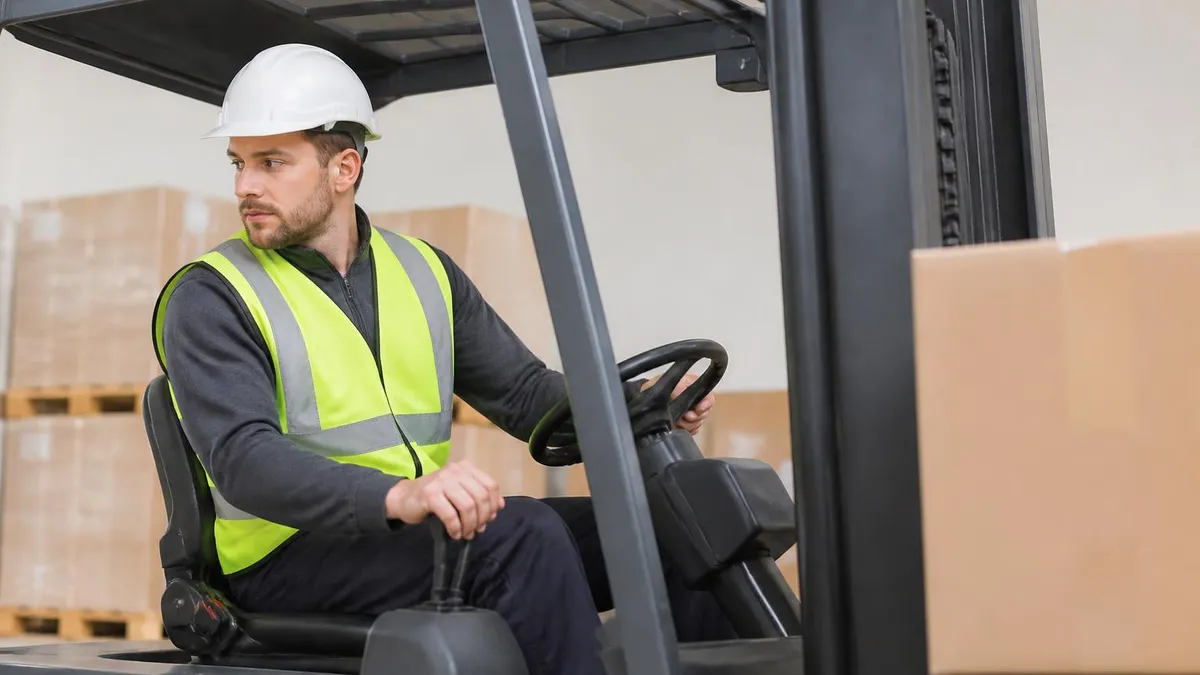
How To Get A Forklift License In Australia: Complete TLILIC0003 Step-by-Step Guide (2026)
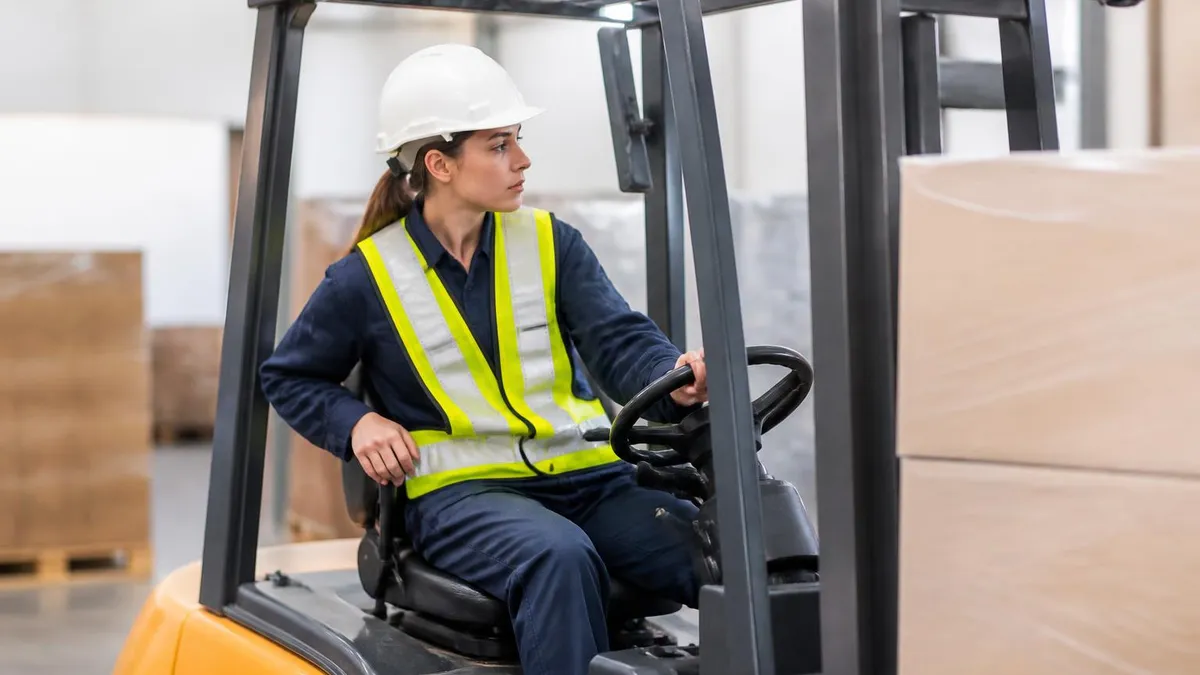
Multi Directional Forklift Trucks: Complete Guide to Forklift Types and Parts for TLILIC0003 Operators in Australia
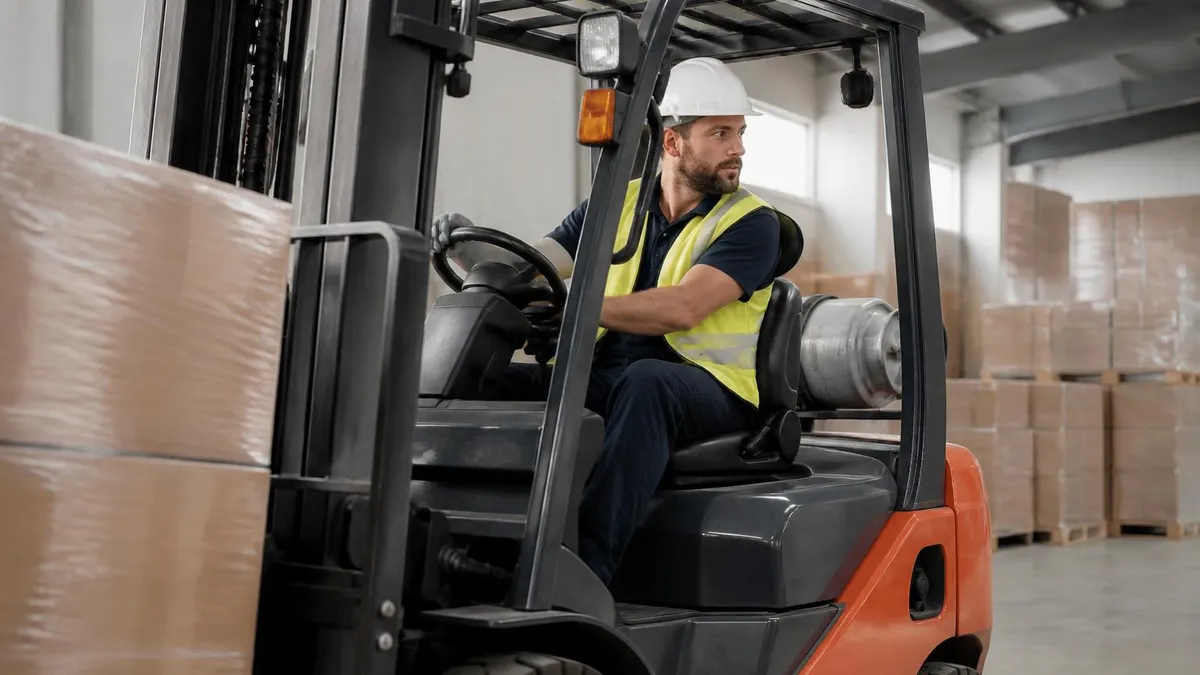
Mast of Forklift: Complete Guide to Forklift Parts for TLILIC0003 Operators in Australia
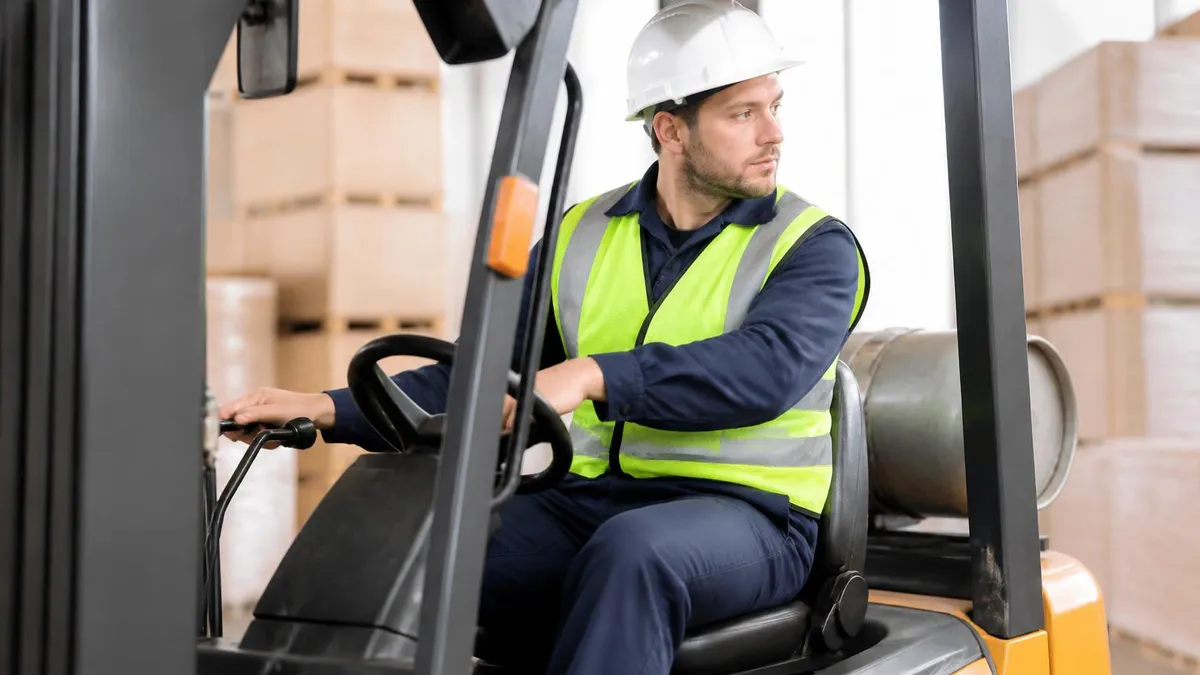
Forklift Hydraulic System: Complete Guide to Hydraulic Components, Operation, and Safety for TLILIC0003 Operators in Australia

Forklift Safety Knowledge (Australia) — Complete Guide (2026)
About the Author

Certified Crane Operator & Skilled Trades Exam Specialist
Ferris State UniversityRobert Martinez is a Journeyman Ironworker, NCCCO-certified crane operator, and forklift trainer with a Bachelor of Science in Construction Technology from Ferris State University. He has 21 years of ironworking, rigging, and heavy equipment operation experience across high-rise and industrial construction sites. Robert prepares candidates for crane operator, rigger, forklift, and skilled trades certification examinations.