
Forklift Hand Truck Guide: Understanding Forklift Equipment Types for TLILIC0003 in Australia
🎓 Forklift hand truck explained: how it differs from powered forklifts, the main forklift equipment types in Australia, and what TLILIC0003 covers.

A forklift hand truck is the first piece of equipment many Australian warehouse workers meet, and it is often confused with the powered machines that require a high risk work licence. Strictly speaking, a hand truck or manual pallet jack is not a forklift at all. It has no engine, no mast and no operator seat. Knowing where the line falls between manual handling aids and licensed forklift equipment types protects you, your colleagues and your employer from costly mistakes. Practice with the free Forklift Licence practice test on PracticeTestGeeks (300+ questions with answer explanations).
In everyday workplace language, the phrase forklift hand truck can mean three different things. It might refer to a two-wheeled sack trolley used to move cartons, a manual pallet jack with hydraulic forks, or a walkie stacker that lifts pallets electrically. Each has a different risk profile. The two-wheeled trolley is purely a manual handling aid, the pallet jack is a low-lift device, and the walkie stacker sits close to licensed territory because it raises loads on a mast.
Under the model Work Health and Safety laws used across most Australian jurisdictions, a high risk work licence is needed to operate a forklift truck. That generally means a powered industrial truck with a mast and an elevating load carriage fitted with forks or another load-engaging device. The licence class is LF, and the nationally recognised unit that trains and assesses it is TLILIC0003, Licence to operate a forklift truck. Rules differ slightly between states, so always confirm with your regulator.
Pallet trucks that only lift a load a few centimetres off the ground are usually treated differently from mast-type forklifts, because the main hazards of tip-over, falling loads and elevated work are much smaller. A lower risk does not mean no risk, though. Crushed feet, runaway loads on ramps and strain injuries from pulling heavy pallets remain common claims. Employers still owe a duty to provide training, supervision and well-maintained equipment even where no licence is legally required.
This article is awareness content for people who are new to materials handling. It explains how a forklift hand truck compares with counterbalance forklifts, reach trucks, order pickers, walkie stackers and telehandlers. You will see what each machine does, where it is typically used, and whether the TLILIC0003 licence applies. By the end you should be able to name the main equipment types, choose the right one for a job, and understand what the licence assessment expects.
Knowing the equipment types matters well beyond the licence test. Supervisors choose machines when planning a layout, safety officers write procedures around them, and operators must recognise limits such as rated capacity and load centre. A common mistake on busy docks is using whichever machine is nearby rather than the right one. A pallet jack pushed beyond its rated 2,500 kg, or a stacker used on a sloping yard, causes exactly the kind of incident that training is meant to prevent.
If you plan to sit the TLILIC0003 assessment, treat this guide as a foundation. You will still need practical instruction from a registered training organisation, a theory assessment, and supervised time on a real truck. Use the free practice questions linked below to test your recall of attachments, modifications and equipment identification before booking. Learning the vocabulary first makes practical training far easier to follow, and it builds confidence when an assessor asks you to name parts or explain a control.
Free Forklift Licence Study Tools
Interactive Forklift Licence resources on PracticeTestGeeks, free to start:
- Forklift Licence practice test — 300+ questions with instant scoring and answer explanations
- Forklift Licence flashcards — review key terms and concepts card by card
- Forklift Licence study guide — topic-by-topic overview of what the exam covers
- Forklift Licence cheat sheet — one-page printable summary for last-minute review
Forklift Equipment in Australia by the Numbers

Main Forklift Equipment Types in Australia
A hydraulic pump handle lifts the forks a few centimetres so a worker can pull or push a pallet over short distances. There is no motor and no mast, so a forklift licence is generally not required, but safe manual handling still applies.
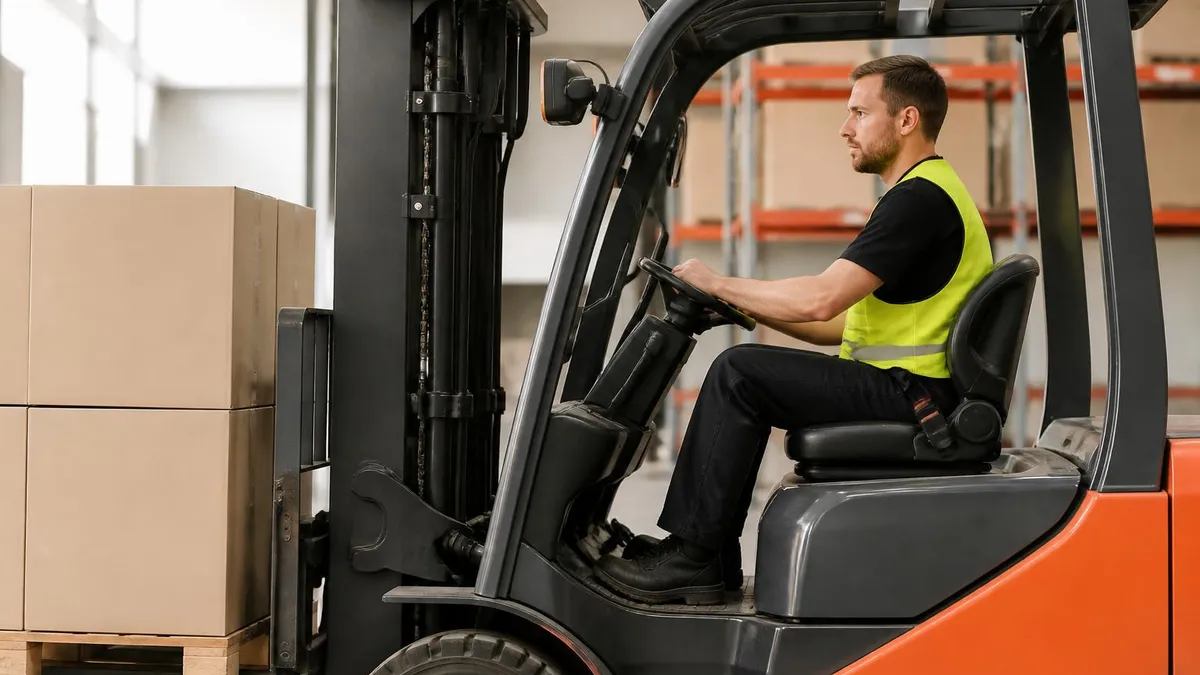
The classic forklift with forks at the front and a heavy rear counterweight. Powered by LPG, diesel or batteries, it suits loading docks, yards and warehouses, and it is the main machine covered by the LF licence class and TLILIC0003.
A narrow-aisle machine whose mast or forks extend forward to place pallets on high racking. Operators sit or stand sideways, and the compact chassis allows tight turns inside high-density warehouses with very little aisle clearance.
The operator platform rises with the forks so pickers can select individual items at height. It carries a separate order picking licence class, because falls from height and restricted visibility create hazards different from standard forklifts.
Telehandlers use a telescopic boom for outdoor and construction lifting, while side loaders carry long loads such as timber and pipe. Both are specialised machines, and some may need different licences or additional operator competencies.
A manual pallet jack, the most common forklift hand truck, works through simple hydraulics. When you pump the handle, fluid pushes a piston that raises the fork arms by roughly 100 to 200 millimetres. Most models carry between 2,000 and 2,500 kilograms on forks about 1,150 millimetres long and 540 millimetres wide. The forks slide into the pallet openings, the operator pumps the lever, and the load is lifted just enough to roll across the floor.
Australian warehouses rely heavily on the standard 1165 by 1165 millimetre pallet, which fits most racking and transport systems. A pallet jack suits it well because the forks enter the pallet through the open ends. Problems start with damaged boards, wrapped loads that overhang, and mixed pallet sizes. Before lifting, check the pallet is intact, the load is stable, and the forks are fully inserted so weight is carried along their length rather than only at the tips.
Technique matters on every shift. Pushing a loaded jack is generally safer than pulling it because you keep the load in front of you, can see ahead, and can step away if it runs. Keep your back straight, use your body weight rather than your arms, and walk at a normal pace. Never ride on the forks, never place a hand or foot underneath, and always lower the load fully before releasing the handle.
The biggest hazards are crushed feet, runaway loads and overloading. On a slight slope, a 1,500 kilogram pallet can build momentum quickly and trap an operator against a wall or racking leg. Uneven joins in a dock plate can stop the small wheels suddenly and tip the load. Rated capacity is printed on the data plate, and it is a hard limit, not a suggestion, particularly when loads are uneven or top-heavy.
Powered pallet trucks add an electric drive motor and a battery. The operator walks behind with a control tiller, or rides on a small platform on larger models, and travel speeds are typically around six kilometres an hour. Because these trucks lift loads only a short distance and have no mast, they are commonly treated as lower-risk than a licensed forklift. Even so, many employers insist on documented training, and some sites require formal competency checks before a worker is permitted to operate one.
Walkie stackers are a different story. They look like pallet trucks but have a mast that raises the forks to heights of around 1.6 to 3 metres or more. Once a machine can lift a load to height, the risk of falling goods and instability rises sharply. Depending on the design and your state or territory rules, such equipment may fall within the licensed forklift definition, so never assume. Ask your supervisor or regulator before operating one without a licence.
Daily checks keep a hand truck safe. Inspect the wheels and rollers for wear, look for oil leaks around the pump, and confirm the forks are not bent or cracked. Test the lift and lower mechanism with an empty pallet, and check the handle returns to neutral. Tag any faulty unit out of service immediately and report it. A jack that will not lower evenly or drops slowly under load can injure someone within seconds.
Forklift Hand Truck Options: Manual, Electric and Counterbalance
Manual hand trucks and pallet jacks are the cheapest and simplest option for moving pallets over short distances. They need no charging, almost no maintenance beyond occasional lubrication, and they fit into tight spaces such as retail stockrooms, delivery vehicles and small workshops. A worker supplies all the movement force, so they suit light, infrequent pallet moves rather than all-day heavy handling in a busy distribution centre.
The trade-off is physical effort and injury exposure. Starting a 2,000 kilogram pallet from rest takes real force, and repeated pulling causes shoulder and back strain. For that reason, many sites set a maximum travel distance, often under 30 metres, and switch to powered equipment beyond it. Good floors, correctly inflated or well-maintained wheels, and sensible load limits make the biggest difference to safety and comfort.
Hand Truck or Powered Forklift: Which Suits the Job?
- +Manual hand trucks cost far less to buy and maintain than powered forklifts
- +Pallet jacks fit into narrow spaces, vans and small stockrooms with ease
- +Hand trucks need no fuel, charging or specialist storage area
- +Powered forklifts lift loads to rack height in seconds, saving significant time
- +Counterbalance forklifts carry several tonnes that no hand truck could manage
- +Choosing the right machine reduces strain injuries and product damage
- −Manual hand trucks put heavy strain on shoulders, backs and wrists over a full shift
- −Pallet jacks cannot stack pallets or reach racking above ground level
- −Powered forklifts need a high risk work licence and regular licence renewal
- −Forklifts carry a higher risk of tip-over, collisions and serious injury
- −Batteries, gas and servicing add ongoing running costs for powered machines
- −Mixed fleets mean workers need training on several different machines
Pros and Cons at a Glance
| Pros | Cons |
|---|---|
| Manual hand trucks cost far less to buy and maintain than powered forklifts | Manual hand trucks put heavy strain on shoulders, backs and wrists over a full shift |
| Pallet jacks fit into narrow spaces, vans and small stockrooms with ease | Pallet jacks cannot stack pallets or reach racking above ground level |
| Hand trucks need no fuel, charging or specialist storage area | Powered forklifts need a high risk work licence and regular licence renewal |
| Powered forklifts lift loads to rack height in seconds, saving significant time | Forklifts carry a higher risk of tip-over, collisions and serious injury |
| Counterbalance forklifts carry several tonnes that no hand truck could manage | Batteries, gas and servicing add ongoing running costs for powered machines |
| Choosing the right machine reduces strain injuries and product damage | Mixed fleets mean workers need training on several different machines |
Forklift Hand Truck Selection and Safety Checklist
- ✓Confirm the weight of the load before choosing any equipment.
- ✓Check the rated capacity on the machine data plate.
- ✓Decide whether the load needs lifting to height or only moving.
- ✓Confirm whether a high risk work licence applies to the machine.
- ✓Inspect forks, wheels and hydraulics before every shift.
- ✓Check the pallet is undamaged and the load is stable.
- ✓Walk the route and look for slopes, joins and obstacles.
- ✓Keep pedestrians clear of the travel path.
- ✓Keep hands and feet away from the forks and load.
- ✓Tag out and report any faulty equipment immediately.
Licence Rules Follow the Machine, Not the Name
Calling something a hand truck does not decide whether you need a licence. What counts is how the machine is built and what it can do, especially whether it has a mast that lifts loads to height. If you are unsure, check with your state regulator before you operate it.
The counterbalance forklift remains the workhorse of Australian industry. Its heavy rear weight balances the load on the front forks, with the front axle acting as the pivot point. The combined centre of gravity of truck and load must stay within the stability triangle formed by the front wheels and the rear axle pivot. If the combined centre of gravity moves outside the triangle, the truck can tip, which is why speed, turning and mast height matter so much.
Rated capacity is tied to the load centre, which is commonly 500 millimetres from the face of the forks. A truck rated at 2,500 kilograms at that distance can lift less if the load is longer or sits further forward. Raising the forks to height also reduces what the truck can safely carry. Operators read the data plate, estimate where the load sits, and compare it against the plate before every lift rather than relying on guesswork.
Reach trucks serve high-density warehouses with narrow aisles, sometimes 2.5 to 3 metres wide. The mast or fork carriage moves forward to place the pallet in the rack, so the truck body stays in the aisle. Lift heights above ten metres are possible on some models. Because the operator works at such heights, awareness of rack condition, floor flatness and overhead clearance is critical, and incidents can involve both the load and the racking itself.
Order picking trucks raise the operator platform along with the forks, letting a worker pick individual cartons from racking without a ladder. Operators wear fall protection such as a harness anchored to the platform. Visibility and communication matter, since the operator may be several metres in the air. These machines have their own licence class, and an LF licence alone does not authorise you to operate one, so check the class on your card.
Telehandlers use a telescopic boom that extends forward and upward, which makes them valuable on construction sites and farms where loads must reach beyond a vehicle or wall. Side loaders carry long items such as timber, steel bars and pipes along the length of the truck. Both machines have unique stability and visibility challenges, and workers may need additional licences or competencies depending on the exact machine and how it is used.
Power sources matter too. Electric forklifts are quiet and produce no exhaust, so they suit indoor food and pharmaceutical settings. LPG machines are common in mixed indoor and outdoor operations, while diesel models suit heavy outdoor work. Each fuel brings its own hazards: battery acid and hydrogen gas for electric trucks, gas cylinders for LPG, and exhaust fumes for diesel. Safe refuelling and charging procedures are part of operator competence and site rules.
Choosing between these machines starts with the task. Ask how heavy the load is, how high it must go, how wide the aisle is, what surface the truck will travel on, and whether it works indoors or outdoors. A supervisor who answers these questions before ordering equipment avoids both underspecified machines that overload and oversized machines that cannot turn. Operators who understand the same questions are better able to spot when a job has been set up wrongly.
A forklift licence covers the classes shown on your card, and it does not cover every lifting machine on site. Operating a machine outside your licence class can breach WHS laws and void insurance. Always check your card and ask your supervisor before using unfamiliar equipment.
In Australia, a forklift licence is a high risk work licence issued by the state or territory work health and safety regulator. The LF class authorises you to operate a forklift truck, and the training and assessment unit is TLILIC0003. You must be at least 18 years old to hold the licence, and you normally need a Unique Student Identifier to enrol with a registered training organisation. Regulators check identity, so bring suitable photo identification to your assessment.
The assessment has two main parts: a knowledge component and a practical component. The knowledge component covers legislation, hazards, load calculations, equipment parts and safe procedures. The practical component usually involves pre-start checks, driving a course, stacking and destacking pallets, and shutting the truck down correctly. Assessors watch for consistent habits such as looking in the direction of travel, sounding the horn at intersections and keeping forks low while moving.
Once the assessor signs you off, you apply to the regulator for the licence itself. Licences are valid for five years, after which you must renew. Many people forget this date, and an expired card means you cannot legally operate a forklift. Note the expiry in your calendar, and keep your card with you at work, because inspectors and site managers may ask to see it at any time.
Attachments change how a forklift behaves, and this is a core topic in TLILIC0003 knowledge questions. A side shifter, fork positioner, clamp, drum handler or work platform changes the weight and the load centre of the truck. Each attachment reduces the rated capacity, so the truck needs an updated data plate showing the new limits. Operators must read that revised plate, not the original one, before lifting anything with the attachment fitted.
Modifications are a different matter and are tightly controlled. Welding, extending forks, removing guards or changing counterweights can affect structural strength and stability. Any change should be approved by the manufacturer or a qualified engineer, and the data plate must be updated to reflect it. Workers should never improvise changes to a machine to make a job easier. An unapproved modification can make a truck dangerous even if it appears to work on the day.
Platforms and cages on forklifts are a good example of why attachments are regulated. Lifting a person on forks without an approved, secured work platform is dangerous and prohibited in most workplaces. Where a cage or work box is approved, it must be secured to the carriage, used with fall protection, and operated under a documented procedure. The operator must stay at the controls and watch the platform at all times while it is raised.
Forklift hand truck users sometimes assume that attachment and modification rules apply only to big machines, yet pallet trucks have limits too. Fitting a longer pair of forks, adding extra weight or using a jack beyond its rating can cause fork bending and sudden hydraulic failure. Treat every piece of equipment as a system with a defined limit. The same discipline that earns a TLILIC0003 pass also keeps simpler equipment safe on the job.
Start your preparation by learning to name the parts of a counterbalance forklift. You should be able to point out the mast, tilt cylinders, carriage, forks, overhead guard, load backrest, counterweight, data plate and controls. Assessors often ask a worker to identify a component or explain its purpose. A short walk around a real truck with a trainer, naming each part aloud, builds recall far faster than reading a diagram alone.
Practise load calculations with real numbers. If a truck is rated at 3,000 kilograms at a 500 millimetre load centre, work out what happens when the load centre becomes 600 millimetres, or when an attachment is fitted. Understand that capacity drops as the load moves further from the fork face. Write a few worked examples on paper and check them against the data plate of a training truck so the idea becomes familiar.
Rehearse your pre-start check in a fixed order. Many operators walk around the truck clockwise, checking tyres, forks, chains, hydraulic hoses, guards, lights, horn, seatbelt, brakes and fluid levels. Then they start the engine and test the controls. Using the same sequence every time makes the check quick and reliable, and it shows an assessor that safe habits are already part of how you work.
Build safe driving habits early. Keep the forks low, around 150 millimetres off the ground, when travelling with a load. Tilt the mast back slightly for stability, travel with the load facing uphill on a slope, and slow down before turning. Look in the direction of travel, and use a spotter when your view is blocked. These habits are examined in the practical test and they prevent most real-world collisions and tip-overs.
Know the rules around pedestrians and workplace traffic management. Forklifts and people should be separated wherever possible, using barriers, marked walkways and one-way systems. Where separation is not possible, operators slow down, sound the horn and make eye contact before proceeding. Questions on traffic management plans and exclusion zones appear regularly in knowledge tests, so it helps to understand why each control exists, not only what it is called.
Use practice quizzes in short, regular sessions rather than one long cram. Ten to fifteen questions a day over a fortnight gives your memory time to hold the material. Review every wrong answer, find the reason, and note it down. Pay particular attention to questions on attachments, modifications and data plates, because small wording differences often change the correct answer. Repeating a quiz after a few days shows whether the learning has stuck.
On the day of your assessment, arrive early with photo identification, enclosed footwear, high-visibility clothing and any paperwork the provider requires. Listen carefully to instructions, ask questions if anything is unclear, and work at a steady pace. Speed is never the goal. Assessors look for control, awareness and safe decisions. If you make a mistake, correct it calmly and continue, since consistent safe practice matters more than a flawless performance.
Sample Forklift Licence Practice Questions
Try these questions from our free Forklift Licence practice tests. The correct answer and an explanation follow each question.
What penalties apply for non-compliance with Emergency Procedures regulations in Australia?
- A. No penalties
- B. Significant fines (up to millions of AUD for corporations) and potential imprisonment for serious offences
- C. A verbal warning only
- D. A small administrative fee
Answer: B. Significant fines (up to millions of AUD for corporations) and potential imprisonment for serious offences
Australian WHS penalties are severe, with Category 1 offences carrying fines up to AUD 3 million and potential imprisonment.
What penalties apply for non-compliance with Attachments and Modifications regulations in Australia?
- A. No penalties
- B. Significant fines (up to millions of AUD for corporations) and potential imprisonment for serious offences
- C. A verbal warning only
- D. A small administrative fee
Answer: B. Significant fines (up to millions of AUD for corporations) and potential imprisonment for serious offences
Australian WHS penalties are severe, with Category 1 offences carrying fines up to AUD 3 million and potential imprisonment.
What penalties apply for non-compliance with Pedestrian Safety regulations in Australia?
- A. No penalties
- B. Significant fines (up to millions of AUD for corporations) and potential imprisonment for serious offences
- C. A verbal warning only
- D. A small administrative fee
Answer: B. Significant fines (up to millions of AUD for corporations) and potential imprisonment for serious offences
Australian WHS penalties are severe, with Category 1 offences carrying fines up to AUD 3 million and potential imprisonment.
Under SafeWork Australia guidelines, what is the minimum requirement for a safe exclusion zone around a forklift operating area?
- A. There is no minimum — operators use their judgement
- B. Physical barriers or clearly marked exclusion zones that separate pedestrians from forklift travel paths
- C. A verbal warning to pedestrians at the start of each shift is sufficient
- D. Yellow floor tape only, with no physical barriers needed
Answer: B. Physical barriers or clearly marked exclusion zones that separate pedestrians from forklift travel paths
SafeWork Australia's hierarchy of controls requires physical separation (barriers, bollards, exclusion zones) between pedestrian and forklift areas as the preferred control measure.
Take the full Forklift Licence practice test
TLILIC0003 Questions and Answers
Traffic Management Plan Forklift: Complete Guide to Forklift Safety and Operations for TLILIC0003 Operators in Australia

Forklift Cage Attachment Safety: Complete Guide for TLILIC0003 Operators in Australia

Forklift License Queensland: Complete TLILIC0003 Training Guide (2026)

Cost of Forklift Licence in Australia: Complete TLILIC0003 Pricing Guide

4x4 Forklift Truck Guide: Forklift Types and Models for TLILIC0003 Operators in Australia
How this page was made: written with AI tools and published by Nathan Beja, founder of Practice Test Geeks, who is responsible for its content. Exam facts are checked against the official sources listed below. Not reviewed by a subject-matter expert. Editorial policy
Sources & references
Exam facts on this page (fees, format, dates, passing scores) are checked against these official sources; the date is our last check. Editorial policy
- training.gov.au — Test delivery, exam information · verified Oct 2026
- worksafe.vic.gov.au — Fees, renewal · verified Oct 2026
- wa.gov.au — Fees, renewal · verified Oct 2026
- safework.nsw.gov.au — Fees, renewal, eligibility · verified Oct 2026
- safeworkaustralia.gov.au — Registration deadline, score validity · verified Oct 2026
- app.safework.sa.gov.au — Renewal · verified Oct 2026